The history of Western classical music is populated by its fair share of eccentrics, but none quite match the radical, deadpan isolation of Erik Satie. He was a man who famously bought seven identical gray corduroy suits so he could wear the exact same outfit every day, earning him the nickname “The Velvet Gentleman.” He walked miles across Paris every night, carrying a hammer in his pocket for protection.
Yet nothing matches the surreal reality of his final years in the Parisian suburb of Arcueil. For twenty-seven years, absolutely no one, not even his closest friends, was permitted to enter his tiny, squalid apartment. It was only after his death in 1925 that the door was finally opened. Inside, amidst chaos, umbrellas, and unplayed letters, lay a bizarre sight: one upright piano stacked directly on top of another, the upper instrument serving as an ad-hoc storage chest for his unreleased musical sheets and personal effects.
Satie’s music, much like his life, is deeply quirky, weird, and subversively brilliant. Among his most famous compositions are the Gnossiennes—seven solo piano pieces written primarily in the 1890s. While they sound deceptive in their ambient simplicity, these pieces actually broke the very scaffolding of Western music.
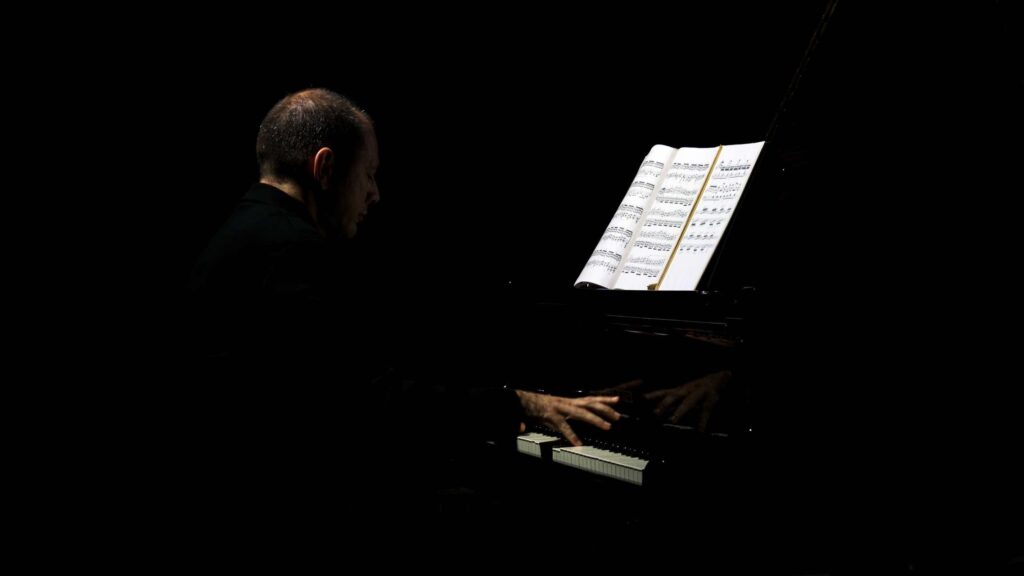
Breaking the Grid: The Illusion of Simplicity
By the late 19th century, classical music was bound to the strict tyranny of the grid. Standard musical notation relied heavily on bar lines (or measure separators) to dictate meter, emphasis, and time signature.
Satie looked at the grid and chose to erase it.
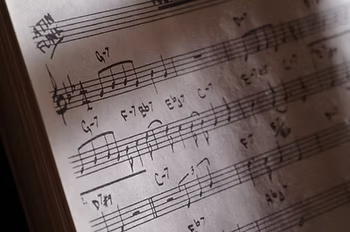
With the Gnossiennes, Satie completely omitted bar lines from the score. The music was given an unprecedented, completely free flow. The rhythm does not march to predictable, heavy beats; instead, it floats. It is an aesthetic framework that goes far beyond standard rubato (the temporary stretching or rushing of tempo). Because Satie provided no structural walls, he handed the performer an almost terrifying amount of temporal freedom.
“Satie’s scores don’t just ask you to play notes; they ask you to rethink how time itself passes.”
Because of this, performing the Gnossiennes is a notoriously deceptive challenge. They may look easy on paper, but keeping a cohesive rhythm across both hands while simultaneously maintaining that airy, boundary-less flow is an immense tightrope walk. Without bar lines to guide the eye and hand, different pianists render Satie’s compositions so wildly apart that they can sound like entirely different pieces of music.
Ancient Mysteries: Knossos, Gnosticism, and the Templars
Beyond his personal eccentricities, Satie was deeply fascinated by history, ancient philosophy, and alternative spiritualities. Though he left behind very little explanatory text regarding his intent, the clues left within his titles point to a mind obsessed with the ancient world.
The word Gnossienne itself was an entirely new word invented by Satie. Musicologists and historians have long debated its dual etymology, which splits into two fascinating historical pathways:
1. The Labyrinth of Knossos (Minoan Mythology)
Many scholars argue that Gnossienne is a direct nod to Knossos, the ancient capital of Minoan Crete. In Greek mythology, Knossos was home to King Minos and the legendary Labyrinth built by Daedalus to imprison the Minotaur.
When you listen to the music, this theory gains brilliant artistic weight. The repetitive, looping melodies of the Gnossiennes feel precisely like wandering through a maze. There is no traditional narrative arc, no grand climax, and no resolution, just a hypnotic, circling journey through stone corridors where time has lost its meaning.
2. Gnosticism and the Rose + Croix
The second, equally compelling origin stems from Gnosticism (from the Greek gnosis, meaning esoteric knowledge). During the period he composed the first Gnossiennes, Satie was intimately involved with the Ordre de la Rose-Croix Catholique du Temple et du Graal, a mystical, esoteric secret society founded by Joséphin Péladan.
Satie was deeply obsessed with the Knights Templar and medieval religious sects, even briefly breaking away to form his own mock-church (L’Église Métropolitaine d’Art de Jésus Conducteur), where he was the only member. The Gnossiennes can easily be read as sonic incantations—, everent, minimalist chants designed to induce a state of higher, mystical consciousness.
A Modern Master of the Unspoken Balance
Capturing this specific, boundary-less freedom without letting the music dissolve into total chaos requires an immense amount of structural discipline. It demands a performer who understands both the rigid rules of classical form and the lawless spirit of the avant-garde.
In his latest recording, Italian pianist Matteo Ramon Arevalos masterfully tackles Satie’s complete Gnossiennes. Arevalos solves the puzzle of the missing bar lines through a brilliant displays of dual-brained independence. On the track, he maintains a hypnotic, clock-like pulse in his left hand, acting as a steady, grounding architectural heartbeat. Meanwhile, he allows his right hand the total freedom to wander, executing a poetic, timeless rubato that floats weightlessly above the rhythm.
By honoring both Satie’s secret structures and his radical philosophy, Arevalos turns these 130-year-old pieces into something that feels urgently contemporary. It is a striking reminder that when bar lines are stripped away, the music stops marching, and finally begins to breathe.
Listen to the complete, definitive recording: Experience Erik Satie’s ancient, unbarred mysteries reimagined today on Matteo Ramon Arevalos’s Satie: Gnossiennes, released by Tunitemusic.
#ErikSatie #Gnossiennes #MatteoRamonArevalos #Tunitemusic #ModernClassical #AvantGarde #PianoMusic #ClassicalMusic #Minimalism #MusicHistory #MinoanMythology #Gnosticism #PreparedPiano #NewMusicRelease #AmbientPiano