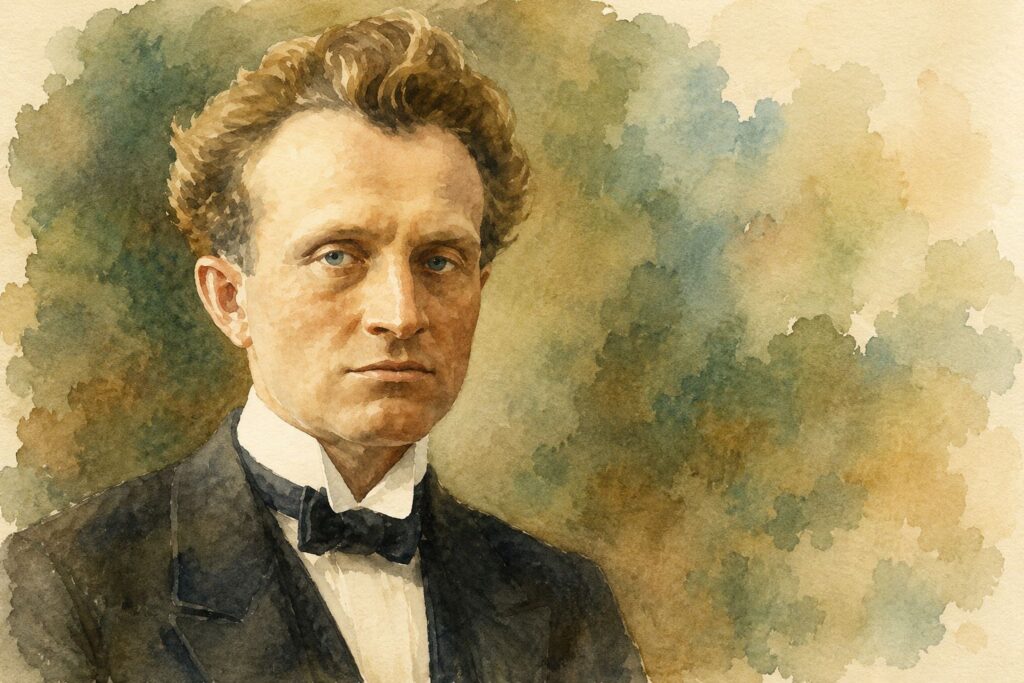
Few figures embody the spirit of the European Romantic movement as completely, or as tragically, as Robert Schumann (8 June 1810 – 29 July 1856). A man whose mind was an intersection of literature, music, and profound psychological turbulence, Schumann fundamentally altered the trajectory of Western classical music. He was not merely a composer; he was an intellectual tastemaker, an innovative critic, and a visionary who bridged the structural discipline of the Classical era with the deeply emotional, programmatic nature of the High Romantic period. His life was an intricate tapestry of artistic triumph, a legendary love affair, and a devastating descent into mental illness, leaving behind a legacy that still shapes the classical canon.
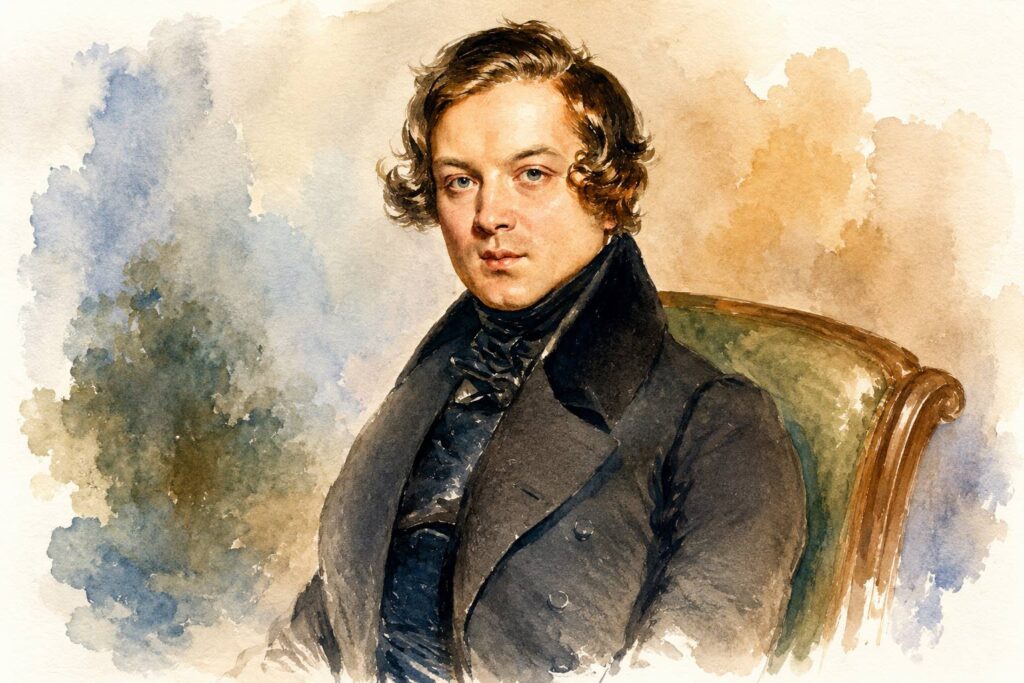
Early Life and a Shattered Dream
Born in Zwickau, Saxony, in 1810, Schumann grew up immersed in the worlds of both literature and music. His father, a bookseller and novelist, instilled in him a lifelong passion for prose, particularly the works of the German Romantic writer Jean Paul. This literary upbringing deeply influenced Schumann’s unique musical language, which often relied on narrative shapes, hidden poetic meanings, and split artistic personas.
Yielding to family pressure, Schumann initially moved to Leipzig to study law. However, the pull of the keyboard was too strong. He neglected his legal studies to take up intense piano lessons under the rigorous tutelage of Friedrich Wieck. Schumann was determined to become one of Europe’s premier virtuosos, practicing for hours on end to achieve flawless technical mastery.
This ambition came to a catastrophic halt in the early 1830s. In an attempt to accelerate his dexterity, Schumann used a mechanical finger-stretching device, which resulted in permanent nerve damage to the middle finger of his right hand. His dreams of a concert career were shattered. Forced to re-evaluate his path, Schumann channeled his relentless creative energy into two new avenues: music journalism and composition.
In 1834, he co-founded the Neue Zeitschrift für Musik (New Journal for Music). Through this influential publication, writing under distinct pseudonyms like the fiery Florestan and the introspective Eusebius to represent conflicting sides of his own personality, Schumann championed progressive new voices and fought against the superficial commercialism of the era.
Clara Wieck: The Anchor, Muse, and Virtuoso
Schumann’s artistic survival is inextricably linked to his relationship with Clara Wieck, Friedrich Wieck’s daughter. Clara was a child prodigy and one of the most brilliant pianists in Europe. As she matured, her artistic bond with Robert blossomed into deep love, igniting a bitter, multi-year conflict with her father. Friedrich Wieck vehemently opposed the match, viewing Robert as an unstable composer with poor financial prospects. The couple eventually fought for their right to marry in court, winning legal approval and marrying in 1840.
The marriage marked a period of immense creative output for Robert. The year 1840 became known as his Liederjahr (Year of Song), during which he composed over 130 extraordinary art songs, fueled by his love for Clara. Clara became Robert’s vital link to the musical world. Because his hand injury prevented him from performing, it was Clara who premiered his technically demanding piano works across Europe, interpreting them with unmatched insight.
Beyond acting as his primary interpreter, Clara was an accomplished composer herself, providing vital critique and intellectual companionship. Despite the domestic pressures of raising eight children and managing her own international touring career, she anchored their turbulent household, shielding Robert from the administrative and financial stresses that triggered his fragile mental state.
The Body of Work: From Piano to Symphony
Schumann’s compositional output is generally categorized by distinct creative phases, each focusing heavily on a specific medium. His early period was dedicated almost entirely to the piano, producing avant-garde masterpieces that defied traditional classical forms. Works such as Carnaval (Op. 9), Kreisleriana (Op. 16), and the Fantasy in C major (Op. 17) are revolutionary. Instead of adhering strictly to the classical sonata form perfected by Mozart and Beethoven, Schumann built these pieces out of fragmentary, episodic miniatures linked by recurring motifs and deep poetic subtexts.
Following his Year of Song, where he elevated the German Lied to new heights alongside master cycles like Dichterliebe (A Poet’s Love) and Frauenliebe und -leben (A Woman’s Life and Love), Clara urged him to expand his horizons beyond small-scale forms. Schumann stepped up to the challenge, turning his attention to symphonic and chamber works.
His four symphonies are highly innovative contributions to the orchestral repertoire. The Symphony No. 1 in B-flat major (“Spring”) bursts with optimistic energy, while the Symphony No. 3 in E-flat major (“Rhenish”) captures the sweeping grandeur of the German landscape. His Symphony No. 4 in D minor is particularly modern, structured so that its four movements flow together continuously without pause, bound by tightly woven thematic transformations. In his chamber music, notably the Piano Quintet in E-flat major (Op. 44), Schumann successfully integrated the expressive intimacy of the piano with the collaborative textures of string ensembles.
Dual Personalities and the Shadow of Illness
Schumann’s extraordinary creativity was always closely tied to his fragile mental health. Modern medical historians suspect he suffered from bipolar disorder or a similar severe affective condition, compounded in his later years by the tertiary stages of syphilis. His periods of manic hyper-activity, where he would compose complex masterpieces in a matter of weeks, were inevitably followed by crushing bouts of depressive catatonia.
By the early 1850s, his condition deteriorated dramatically. Serving as the music director in Düsseldorf, a position he struggled to maintain due to poor communication skills and erratic behavior, Schumann began suffering from terrifying auditory hallucinations. He reported hearing angelic melodies that quickly morphed into demonic, mocking voices.
In February 1854, during a profound psychotic episode, Schumann fled his home and threw himself into the freezing waters of the Rhine River. Rescued by fishermen, he requested to be placed in an asylum to prevent harming his family. He spent the final two years of his life confined to a private sanatorium in Endenich, near Bonn. Deprived of music and isolated from his beloved Clara for long stretches for medical reasons, he died in July 1856 at the age of 46.
Passing the Torch: The Brahms Connection
In the final months before his collapse, Schumann performed one last monumental service to the history of music: discovering a 20-year-old Johannes Brahms. In September 1853, an unknown Brahms arrived at the Schumann home in Düsseldorf, carrying a selection of his early piano compositions. Robert and Clara recognized his genius instantly.
“This is he who was bound to come,” Robert wrote in his journal after hearing Brahms play.
Schumann broke his long silence as a critic to write a historic, front-page article for the Neue Zeitschrift für Musik titled “Neue Bahnen” (New Paths). In it, he publicly declared the young Brahms to be the chosen heir to Beethoven, catapulting the unknown youth into the European spotlight overnight.
When Robert was institutionalized shortly thereafter, Brahms rushed to Düsseldorf to support Clara. He moved into the apartment above the Schumann home, helping care for the children and managing the family’s financial accounts while Clara traveled to earn income. This period gave rise to a complex, emotionally intense, and deeply debated relationship between Clara and Brahms. Bound by their shared grief and profound reverence for Robert, they maintained a lifelong, deeply affectionate correspondence, though they never married. Brahms remained fiercely devoted to Robert’s memory, helping Clara edit and publish Schumann’s complete works.
                  THE SCHUMANN-BRAHMS NEXUS (1853-1856)

    [Robert Schumann] --(Aesthetic Endorsement: "Neue Bahnen")--> [Johannes Brahms]
           |                                                               |
    (Spouse & Muse)                                                 (Devoted Ally)
           |                                                               |
           v                                                               v
    [Clara Schumann] <=========(Lifelong Emotional & Artistic Bond)=========>
Importance and Legacy in Western Music
Robert Schumann’s historical importance lies in his absolute rejection of predictable formula. Where the Classical era demanded symmetry, objective balance, and clear architectural design, Schumann championed subjectivity, literary metaphor, and the beauty of the unfinished fragment. He expanded the expressive boundaries of the piano, transformed the art song into a complex psychological dialogue between singer and accompanist, and injected a new poetic depth into symphonic form.
As a critic, his sharp intellect shaped public taste, steering European culture away from superficial display and toward intellectual depth. He helped revive interest in forgotten masters like J.S. Bach and Franz Schubert, while paving the way for the future of Romantic music. Through his music, his prose, and his mentorship of Brahms, Robert Schumann stands as the defining voice of an era—a composer who risked his mental stability to capture the unfiltered complexity of the human soul.
References
- Daube, B. (1997). Robert Schumann: Words and Music. Yale University Press.
- Ostwald, P. F. (1985). Schumann: The Inner Voices of a Musical Genius. Northeastern University Press.
- Reich, N. B. (2001). Clara Schumann: The Artist and the Woman. Cornell University Press.
- Swafford, J. (1997). Johannes Brahms: A Biography. Alfred A. Knopf.
- Worthen, J. (2007). Robert Schumann: Life and Work of a Romantic Rebel. Jonathan Cape.
#RobertSchumann #ClassicalMusic #RomanticEra #MusicHistory #ClaraSchumann #JohannesBrahms #PianoMusic #GermanLieder #Symphony #MusicCriticism #19thCentury #MusicalGenius #Romanticism #ComposerBiography #ClassicalComposer