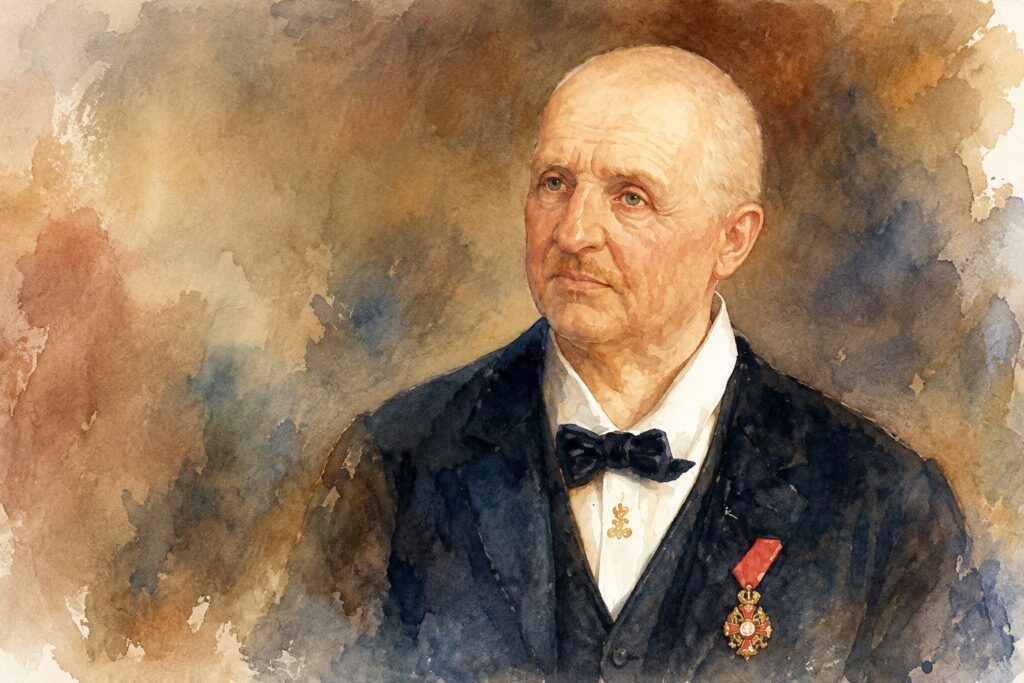
Anton Bruckner (4 September 1824 – 11 October 1896) was an Austrian composer, organist, and music educator whose monumental compositions stand among the most profound achievements of late nineteenth-century classical music. Often characterized during his lifetime as a humble, eccentric provincial musician misplaced in the glittering, hyper-critical cultural epicenter of imperial Vienna, Bruckner nonetheless forged a musical language of unparalleled grandeur, harmonic boldness, and spiritual intensity. As one of the pivotal music composers of the late Romantic period, he bridged the structural rigor of Viennese Classicism with the expansive, chromatic sonorities of Richard Wagner. Despite facing fierce hostility from contemporary critics, relentless self-doubt, and a complex history of editorial revisions that delayed full appreciation of his art, Bruckner’s legacy endures as a cornerstone of orchestral literature. His work altered the trajectory of music history, leaving an indelible mark on the symphonic form and serving as a vital bridge to the monumental symphonic landscapes of Gustav Mahler and the modernists of the early twentieth century.
Early Life and Education: From Village Schoolmaster to Organ Virtuoso
To understand the music of Anton Bruckner, one must first examine his origins in rural Upper Austria. Born in Ansfelden, a small village near Linz, Bruckner was the eldest of eleven children in a deeply devout Catholic family. His father, Anton Bruckner Sr., was a village schoolmaster and church organist who provided the young boy with his first lessons in violin, spinet, and organ. Bruckner’s childhood was steeped in the rhythms of church liturgical life and rural Austrian folk traditions—elements that would echo through his symphonic scherzos decades later.
Following the sudden death of his father in 1837, the thirteen-year-old Bruckner was sent to the Augustinian Monastery of Sankt Florian as a choirboy. Sankt Florian became his spiritual and intellectual sanctuary. It was here that he was exposed to the majestic sound of the monastery’s great organ—an instrument he would love above all others and beneath which he would eventually be buried. Though he initially trained as a schoolteacher, following his father’s profession, his musical gifts proved irresistible. He accepted teaching posts in small villages like Windhaag and Kronstorf, where he endured poverty and menial duties while diligently practicing the organ and studying the works of Johann Sebastian Bach, Wolfgang Amadeus Mozart, and Ludwig van Beethoven.
In 1845, Bruckner returned to Sankt Florian as an assistant teacher, eventually being appointed as the monastery’s principal organist in 1851. His extraordinary talent for organ improvisation began to gain regional renown. Yet, despite his formidable keyboard skills, Bruckner was plagued by a lifelong sense of inadequacy that drove him to seek formal, rigorous musical education long past the age when most composers consider their apprenticeships complete. In 1855, at age thirty-one, he embarked on six years of intensive counterpoint and music theory studies via correspondence with the famed Viennese pedagogue Simon Sechter. Sechter’s discipline was legendary; he forbade Bruckner from writing any free compositions until his studies in strict contrapuntal rules were finished. Bruckner submitted thousands of pages of exercises, earning Sechter’s astonishment and praise.
Upon completing his work with Sechter in 1861, Bruckner immediately sought further instruction from Otto Kitzler, the musical director of the Linz Theater. Kitzler introduced Bruckner to modern orchestration and the revolutionary music of Richard Wagner, particularly Tannhäuser and Tristan und Isolde. This encounter transformed Bruckner’s artistic worldview. The combination of Sechter’s uncompromising contrapuntal discipline and Wagner’s radical harmonic freedom provided the dual pillars upon which Bruckner would build his mature style.
The Vienna Years: Artistic Conflict and the “Bruckner Problem”
In 1868, following Sechter’s death, Bruckner moved to Vienna to take up the post of professor of harmony and counterpoint at the Vienna Conservatory, as well as an organist position at the Imperial Chapel. Vienna offered national prominence, but it also thrust Bruckner into the epicenter of the fiercest cultural feud in nineteenth-century music: the war between the “Conservatives” (led by critic Eduard Hanslick and composer Johannes Brahms) and the “Progressives” or New German School (championing Richard Wagner and Franz Liszt).
Bruckner, an unabashed worshiper of Wagner, dedicated his Third Symphony to the opera master in 1873. This allegiance made him an immediate target for Hanslick and the Viennese musical establishment. Hanslick’s scathing reviews subjected Bruckner to public humiliation, describing his music as chaotic, formless, and unmanageable. Bruckner’s personal demeanor exacerbated his vulnerability. He spoke with a broad Upper Austrian dialect, wore ill-fitting rustic clothes, was intensely insecure, and demonstrated a humble, almost servile deference to authority figures. The famed conductor Hans von Bülow famously dubbed him “half genius, half simpleton”, a cruel reduction that ignored the profound intellect reflected in his music.
This vulnerability gave rise to what musicologists refer to as the “Bruckner Problem”; the bewildering array of multiple versions and revisions of his symphonies. Susceptible to criticism from conductors, students, and well-meaning friends like Franz Schalk, Josef Schalk, and Ferdinand Löwe, Bruckner repeatedly revised his scores, cutting passages, altering orchestration, and reshaping structural proportions in the hope of securing performances. In some cases, his associates made unauthorized changes to make his works more palatable to Viennese audiences accustomed to traditional classical music. Consequently, modern conductors and music scholars face a complex editorial puzzle when selecting between original versions (which often possess raw, uncompromising power) and later revised editions.
Despite these hardships, Bruckner’s late years brought long-overdue recognition. The premiere of his Seventh Symphony in Leipzig in 1884 under Arthur Nikisch was a triumphant international breakthrough. Honor and accolades followed: Emperor Franz Joseph I awarded him the Order of Franz Joseph and granted him free quarters in the Belvedere Palace, where Bruckner spent his final years working feverishly on the incomplete finale of his Ninth Symphony before passing away in 1896.
Major Sacred Works and Chamber Masterpieces
While Bruckner is best known today for his grand orchestral canvases, his sacred vocal music represents some of the finest church compositions of the Romantic era. Deeply rooted in his unshakeable Roman Catholic faith, Bruckner viewed his creative gift as a divine trust dedicated to the glory of God.
His sacred output includes three grand Masses:
- Mass No. 1 in D minor (1864): A powerful, dramatic work for chorus, soloists, and full orchestra that announced his mature compositional style.
- Mass No. 2 in E minor (1866): Scored for eight-part choir and a wind band ensemble, this work merges the Renaissance polyphony of the Palestrina style with rich Romantic harmony, tailored for outdoor liturgical performance at Linz Cathedral.
- Mass No. 3 in F minor (1868): Often considered his sacred masterpiece, a colossal work of symphonic proportions and emotional breadth.
Equally renowned is his Te Deum (1884) for soloists, chorus, orchestra, and organ. Majestic and exultant, it was praised by Gustav Mahler, who scribbled on his own score that it was written “for the tongues of angels.” Bruckner’s shorter motets, such as Locus iste, Os iusti, Christus factus est, and Ave Maria, are supreme examples of acapella choral writing, blending modal archaisms with luminous Romantic expressiveness.
Outside of the church and concert hall, Bruckner produced remarkably few chamber works, but his String Quintet in F major (1879) stands as a chamber masterpiece. Incorporating an extra viola, the quintet features an Adagio movement of extraordinary lyrical beauty, proving that Bruckner’s symphonic breadth could be distilled into an intimate chamber setting.
The Symphonies: Cathedrals of Sound and Structural Innovations
At the heart of Bruckner’s legacy are his nine numbered symphonies (along with two early unnumbered works: the Study Symphony in F minor and Symphony No. 0 in D minor, known as “Die Nullte”). In these monumental works, Bruckner expanded the traditional architecture of the Classical Symphony into vast, transcendent sonic spaces frequently described as “cathedrals of sound”.
Where classical predecessors like Mozart and Haydn built symphonic movements through sleek, tightly woven thematic development, Bruckner approached symphonic architecture like a master builder erecting stone vaults and buttresses. His symphonic style is defined by several distinct structural innovations:
- Tremolo Openings and “Bruckner Rhythm”: Most of Bruckner’s symphonies begin with a quiet, shimmering string tremolo out of which a mysterious, elemental theme emerges from silence. Furthermore, he frequently utilized the “Bruckner rhythm”, a rhythmic motif combining a duplet and a triplet (2+3 or 3+2), which gives his music a unique, pulsating momentum.
- Three-Theme Expositions: Unlike the traditional two-theme exposition of the Classical Symphony, Bruckner expanded sonata form to include three distinct thematic groups: a dramatic first theme, a lyrical, song-like second theme (often termed the Gesangsperiode or “song period”), and a rhythmic, brass-heavy third theme.
- Block Orchestration and Terraced Dynamics: Drawing on his background as an organ virtuoso, Bruckner orchestrated in distinct acoustic “blocks”. Rather than blending orchestral colors seamlessly, he often contrasted brass, woodwind, and string sections against one another, as if switching manual keyboards or pulling organ stops. Sudden pauses (Bruckner pauses) frequently separate massive climaxes from serene reflective passages.
- Expansive Slow Movements and Scherzos: Bruckner’s Adagios are among the longest and most elevated in Western music, featuring soaring lyrical lines and solemn chorales that build through waves of sound (Steigerung) to overwhelmingly majestic climaxes. His Scherzos, by contrast, draw heavily on elemental Austrian folk dances (such as the Ländler), driven by powerful, rustic rhythmic force.
- Expanded Instrumentation: In his final three symphonies (Nos. 7, 8, and 9), Bruckner incorporated a quartet of Wagner tubas, specialized brass instruments bridging the horn and trombone, to lend a dark, noble solemnity to his music, particularly in the memorial Adagio of the Seventh Symphony written upon learning of Wagner’s death.
From the radiant lyricism of the Fourth Symphony (“Romantic”) to the staggering formal complexity of the Eighth Symphony in C minor, Bruckner redefined what the symphonic medium could express. His Ninth Symphony in D minor, dedicated “To the Beloved God” (Dem lieben Gott), remained unfinished at his death. Its three completed movements—ending with a heart-wrenching, tranquil Adagio—stand as an apotheosis of late Romantic symphonic art.
The Bruckner-Mahler Connection: Influence, Parallels, and Divergence
The relationship between Anton Bruckner and Gustav Mahler is one of the most intriguing chapters in late Romantic music history. Mahler was thirty-six years younger than Bruckner, yet their artistic lives crossed in Vienna, giving rise to an enduring bond of mutual respect and artistic influence.
When Mahler entered the Vienna Conservatory as a teenager in the late 1870s, he attended Bruckner’s lectures on harmony and counterpoint. Although Mahler was never formally Bruckner’s composition student, he became an ardent admirer and disciple of the older master. At the age of seventeen, Mahler attended the disastrous 1877 premiere of Bruckner’s Third Symphony, where much of the audience walked out and the orchestra abandoned the stage. Deeply moved, Mahler helped prepare a two-piano reduction of the score to assist in publishing the work. Throughout his later career as one of the world’s premier conductors, Mahler consistently programmed and championed Bruckner’s symphonies across Europe and North America.
| Structural & Conceptual Attribute | Anton Bruckner | Gustav Mahler |
| Architectural Quality | Static, cathedral-like blocks of sound | Dynamic, organic, continuous evolution |
| Philosophical Tone | Faith, spiritual repose, divine order | Existential quest, emotional unrest, irony |
| Vocal Integration in Symphonies | Purely instrumental symphonies | Frequently integrates vocal solos & chorus |
| Harmonic Basis | Organ-inspired polyphony & chorales | Linear counterpoint & complex modulations |
The musical influence of Bruckner on Mahler is evident in several key areas:
- Scale and Duration: Mahler inherited Bruckner’s monumental scale. Both composers rejected the compact dimensions of the mid-nineteenth-century symphony, creating expansive multi-movement works lasting over an hour.
- Orchestral Mass and Color: Mahler adopted Bruckner’s use of massive brass sections, off-stage instruments, chorales, and sweeping string figures to create cosmic orchestral soundscapes.
- Direct Quotations and Homages: Mahler paid explicit musical homage to Bruckner in his own compositions. The opening of the final Adagio of Mahler’s Ninth Symphony, for instance, directly echoes the serene, stepwise thematic motifs of the Adagio of Bruckner’s Ninth Symphony.
However, despite these structural parallels, the fundamental philosophies of the two masters diverged dramatically. As conductor Bruno Walter—who knew Mahler intimately and conducted both composers extensively, famously summarized: “At bottom Bruckner’s spirit was repose, Mahler’s unrest”.
Bruckner’s symphonies reflect an unshakable, objective faith; even his most dramatic, tragic movements resolve into cosmic certainty and divine affirmation. His music builds upwards toward eternity. Mahler, by contrast, was a modern, existential seeker whose music reflects personal neurosis, existential crisis, ironic juxtaposition of the sacred and the banal, and a relentless struggle with mortality. Where Bruckner’s world is one of divine order and spiritual peace, Mahler’s is a world of conflict, tragedy, and heroic struggle.
Importance and Legacy in Music History
Anton Bruckner occupies a towering position in music history. Standing at the threshold between late nineteenth-century Romanticism and twentieth-century modernism, he expanded the harmonic, formal, and expressive boundaries of symphonic composition.
Bruckner’s daring harmonic explorations, characterized by abrupt, distant modulations, unresolved dissonances, and roving tonal centers, helped liberate harmony from traditional tonal constraints. Composers of the Second Viennese School, including Arnold Schoenberg, Alban Berg, and Anton Webern, recognized Bruckner as an essential precursor whose harmonic adventurousness paved the way for early twentieth-century musical radicalism.
Furthermore, Bruckner proved that the symphonic form was far from exhausted after Beethoven and Brahms. By infusing the orchestral medium with the spiritual depth of sacred music and the architectural scale of Wagnerian opera, he demonstrated that the symphony could remain a viable vehicle for exploring the deepest existential and spiritual questions of humanity.
Today, after decades of debate surrounding his revisions and personality, Bruckner is universally recognized as one of history’s greatest music composers. His works are central pillars of the global orchestral repertoire, regularly performed by the world’s elite orchestras and recorded by visionary conductors such as Wilhelm Furtwängler, Herbert von Karajan, Sergiu Celibidache, Günter Wand, Bernard Haitink, and Riccardo Chailly. Bruckner’s “cathedrals of sound” continue to awe listeners worldwide, offering a rare experience of immense scale, meditative depth, and transcendent power within classical music.
Sources
- Doernberg, Erwin. The Life and Symphonies of Anton Bruckner. London: Arthur A. Kalmus Ltd., 1960.
- Hawkshaw, Paul, and Jackson, Timothy L. The Bruckner Companion. Westport, CT: Greenwood Press, 1997.
- Horton, Julian. Bruckner’s Symphonies: Analysis, Reception and Cultural Politics. Cambridge: Cambridge University Press, 2004.
- Korstvedt, Benjamin M. Bruckner: Symphony No. 8. Cambridge Music Handbooks. Cambridge: Cambridge University Press, 2000.
- Mahler Foundation. “Anton Bruckner (1824–1896).” Mahler Foundation Archive.
- Simpson, Robert. The Essence of Bruckner: An Essay Towards the Understanding of His Music. London: Victor Gollancz Ltd., 1992.
- Walter, Bruno. “Bruckner and Mahler.” Chord and Discord, Vol. 2, No. 2, 1940.
#AntonBruckner #ClassicalMusic #Symphony #MusicHistory #MusicComposers #ClassicalSymphony #GustavMahler #LateRomanticism #OrchestralMusic #CathedralsOfSound #ViennaClassical #BrucknerSymphonies #Wagnerian #SacredMusic #Organist