Niccolò Paganini (27 October 1782 – 27 May 1840) was an Italian violinist, violist, and composer whose staggering technical mastery and hypnotic stage presence redefined instrumental performance forever. Standing as a central giant in music history, he bridged the elegance of late Classical traditions with the intense emotional expression and dramatic individualism of the early Romantic era. Long before the advent of modern celebrity culture, mass media, or sound recordings, Paganini achieved an almost mythic international renown. Audiences across Europe flocked to his concerts in awe, rendered breathless by speed, precision, and tone that seemed to transcend human physical capability. To understand the evolution of virtuosity in Western classical music is to study Paganini, for he transformed the violin from a refined melodic voice into an instrument of unlimited orchestral power, athletic bravura, and theatrical magnetism.
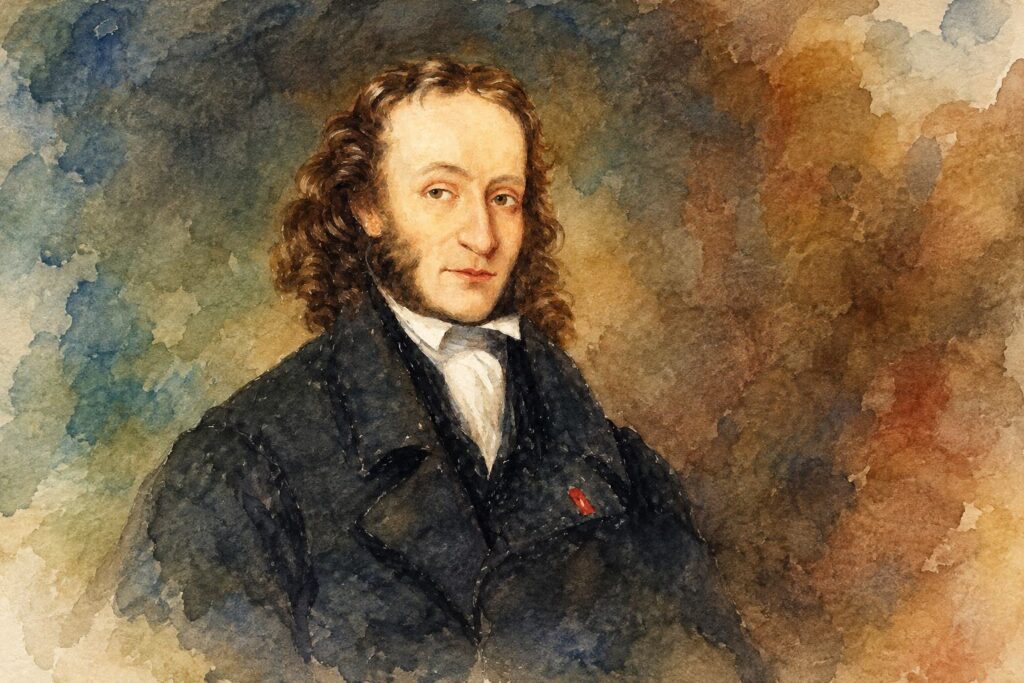
Introduction: The Dawn of the Modern Virtuoso
Before Niccolò Paganini took European concert halls by storm, instrumental performers generally operated within the bounds of classical restraint. While master violinists such as Arcangelo Corelli, Antonio Vivaldi, and Giuseppe Tartini had significantly expanded the instrument’s range and expressive depth in earlier generations, performance aesthetics remained tied to balance, elegance, and ensemble cohesion. Paganini shattered these conventions, establishing a completely new archetype: the solo virtuoso as a charismatic, larger-than-life figure capable of holding audiences spellbound entirely on his own.
Paganini was far more than an exceptionally fast player. He was an inventive sonic explorer who approached the four strings of the violin as an boundless landscape of timbre, resonance, and dramatic sound effects. He introduced and popularized unheard-of physical techniques, such as left-hand pizzicato while simultaneously bowing, double-stop harmonics, ricochet bowing, and custom instrument tunings (scordatura), that left rival musicians baffled and listeners astonished. In an age when European culture was falling in love with Romantic idealism, dramatic storytelling, and gothic mysteries, Paganini emerged as the musical incarnation of the Romantic ethos. His influence extended far beyond the violin fraternity, inspiring piano titan Franz Liszt, composer Frédéric Chopin, and orchestral master Hector Berlioz to push their own musical instruments to unprecedented technical boundaries.
Early Life and Prodigious Development
Niccolò Paganini was born in Genoa, Italy, then part of the Republic of Genoa, as the third of six children born to Antonio Paganini and Teresa Bocciardo. His father was a modest shipping trader who also earned extra income playing the mandolin. Recognizing young Niccolò’s extraordinary natural aptitude for music, Antonio subjected his son to a notoriously strict and punishing practice regimen from an early age. The child was forced to practice the violin for up to twelve hours a day; missing notes or displaying fatigue frequently resulted in harsh physical punishment or the withholding of food.
Despite these grueling conditions, Paganini’s genius blossomed rapidly. He received initial violin instruction from his father before studying under local Genoese musicians, including Giovanni Servetto and Giacomo Costa. By age seven, Niccolò was already performing publicly, and by age eight, he had composed his first violin sonata. Recognizing that local teachers had little left to offer the boy, his father took him to Parma in 1795 to seek advanced instruction from the famous master Alessandro Rolla. Upon hearing the young prodigy play a difficult piece at sight without preparation, Rolla famously remarked that he had nothing left to teach him and referred him to compositional master Ferdinando Paer and Paer’s own teacher, Gaspare Ghiretti.
Under Ghiretti and Paer, Paganini received rigorous training in counterpoint and composition, gaining a deep structural understanding of musical forms. However, the political turmoil sweeping across Italy due to the French Revolutionary Wars soon interrupted his formal schooling. Paganini returned to Genoa and began touring neighboring regions with his father, mesmerizing listeners in every town they visited. Freed from strict academic supervision, Paganini began experimenting relentlessly with unorthodox fingerings, extreme bowings, and novel acoustic effects, forging the foundational techniques that would soon make him famous worldwide.
Rise to Fame: The Court of Lucca and Tour of Europe
As Paganini entered young adulthood, he sought freedom from his overbearing father and the restrictive atmosphere of his home town. In 1801, at the age of nineteen, he was appointed first violin of the Republic of Lucca. When Napoleon Bonaparte annexed the region and established the Principality of Lucca and Piombino, placing his sister Elisa Baciocchi in charge as Grand Duchess, Paganini was hired as court violinist and conductor. During his years in Lucca, Paganini enjoyed financial independence, high social status, and the freedom to refine his personal style. He wrote numerous compositions for violin and guitar—an instrument he mastered with equal fluency—and composed dramatic concert solos designed specifically for imperial court celebrations.
It was also during his Lucca period that Paganini famously developed his mastery over performing entire compositions on a single string. According to legend, he composed a dramatic musical dialogue for the G and E strings representing two lovers, which delighted the court. When the Grand Duchess playfully asked if he could perform an entire piece on a single string, Paganini accepted the challenge, writing his celebrated Sonata Maria Luisa for the G-string alone. This technical feat became one of his most celebrated concert tricks throughout his career.
In 1809, Paganini resigned from the court of Lucca to pursue an independent career as a touring freelance soloist—a rare and risky endeavor for music composers and performers at the time, who typically relied on noble patronage or church posts. For the next two decades, he toured extensively throughout Italy, building an unprecedented reputation. His legendary status grew with every performance, but it was his grand international tour beginning in 1828 that elevated him into a true European phenomenon.
Starting with a triumphant series of concerts in Vienna, Paganini swept through Germany, Poland, France, Britain, and Scotland. Music critics praised his flawless execution, while audiences reacted with near-hysterical enthusiasm. Prominent cultural figures, including Johann Wolfgang von Goethe, Robert Schumann, and Franz Schubert, attended his concerts in amazement. Paganini managed every aspect of his tours meticulously, setting ticket prices at premium rates and accumulating immense wealth, becoming one of the first self-made superstar musicians in history.
The Diabolical Legend: Pact with the Devil and Church Conflict
No discussion of Niccolò Paganini is complete without addressing the dark, supernatural reputation that enveloped him throughout his life and persisted long after his death. Rumors frequently circulated that Paganini had entered into a Faustian pact, selling his soul to the devil in exchange for superhuman dexterity and speed on the violin.
Origins of the Myth
Several factors converged to fuel these demonic rumors:
- Uncanny Physical Appearance: Paganini suffered from severe, chronic health ailments throughout his adult life, including pulmonary tuberculosis, syphilis, and symptoms consistent with connective tissue disorders such as Marfan syndrome or Ehlers-Danlos syndrome. These conditions gifted him unusually long, flexible fingers and hypermobile joints, allowing him to execute impossible hand spans across the fingerboard. However, his illnesses also left him emaciated, pale, hollow-cheeked, and missing teeth. Dressed habitually in full black attire, his tall, gaunt figure appeared almost ghostly under stage lighting.
- Incomprehensible Musical Speed: To 19th-century audiences accustomed to classical violin playing, Paganini’s ability to execute lightning-fast arpeggios, double-stop harmonics, and rapid left-hand pizzicato was mathematically and physically incomprehensible. Lacking modern technical understanding, many listeners found it easier to attribute his talent to supernatural intervention.
- Showmanship and Rumor: Paganini understood the power of theatricality. Rather than dispelling the dark rumors, he often leaned into the mystique, arriving at venues in dark carriages, playing under dimmed lights, and maintaining an enigmatic persona. Whispers also persisted that he had spent years in prison for murdering a lover, during which time he allegedly perfected his technique on a single-stringed violin using string fashioned from his victim’s intestines. Though entirely untrue, these gothic tales captivated the public imagination.
The Denial of Burial and Ecclesiastical Controversy
While these diabolical stories were largely harmless romantic myths during his performing career, they had severe consequences upon Paganini’s death. In his final months, Paganini’s health deteriorated drastically due to larynx cancer and mercury poisoning (then used as a medical treatment for syphilis). By early 1840, he had lost his voice entirely and was severely weakened.
In May 1840, as Paganini lay dying in Nice, France, a local priest was dispatched to administer the Last Rites. Paganini, unable to speak and believing his death was not imminent, postponed receiving the sacrament. Before another priest could return, Paganini passed away on 27 May 1840.
Because Paganini had died without receiving final absolution and had long been dogged by accusations of heresy, impiety, and demonic ties, the Bishop of Nice strictly refused to grant his body a Christian burial in consecrated church ground.
His son, Achille Paganini, embarked on an arduous, decades-long legal battle to restore his father’s reputation and secure a proper burial. For over four years, Paganini’s embalmed body was kept in storage, moved between various locations including an abandoned oil factory, a basement, and a private villa in Genoa. It was not until 1844 that the body was transported to the family property in Villa Gaione near Parma. Finally, following official papal intervention and appeals to the Vatican, the ecclesiastical ban was formally lifted, and Paganini’s remains were officially interred in consecrated ground at the La Villetta cemetery in Parma in 1876—thirty-six years after his death.
Key Works and Musical Legacy
As a composer, Paganini created works designed primarily to showcase the expressive versatility and technical limits of the violin. While critics sometimes dismissed his orchestral accompaniments as straightforward background harmonic support, his solo writing transformed the language of stringed instruments forever.
Major Compositions
- 24 Caprices for Solo Violin, Op. 1 (1802–1817): Paganini’s crowning masterpiece and one of the most influential works in music history. Each caprice addresses specific technical challenges—such as rapid octave skips, trills, double-stops, and extended arpeggios—while maintaining striking musical creativity. The famous Caprice No. 24 in A minor, a theme with twelve demanding variations, became one of the most famous melodies in Western classical music, inspiring variation sets by Brahms, Rachmaninoff, Liszt, Lutosławski, and Szymanowski.
- Violin Concerto No. 1 in D major, Op. 6 (1816): A dramatic concerto blending Italian operatic lyricism (influenced by Gioachino Rossini) with explosive virtuosity. It features high harmonic runs, rapid ricochet bowing, and intense thematic beauty.
- Violin Concerto No. 2 in B minor, Op. 7 (1826): Famous for its exuberant third movement, nicknamed “La Campanella” (“The Little Bell”), due to the soloist’s imitation of a handbell using delicate high harmonics. Franz Liszt later adapted this movement into his celebrated piano étude of the same name.
- Moto Perpetuo, Op. 11 (1835): A breathtaking “perpetual motion” piece consisting of an uninterrupted stream of 1,600 sixteenth notes played at extreme velocity.
- Sonatas for Violin and Guitar: A rich collection of intimate chamber works reflecting Paganini’s lifelong affection for the classical guitar, blending warm Mediterranean melodies with graceful counterpoint.
Importance in Music History and Lasting Legacy
Paganini’s position in the grand narrative of music history is unique. He was not merely a master practitioner of an existing tradition; he was an innovator who redefined what was possible in performance art.
+-------------------------------------------------------------------+
|                   PAGANINI'S REVOLUTIONARY LEGACY                 |
+-------------------------------------------------------------------+
|  1. Instrumental Innovation                                      |
|     - Expanded violin fingerings, bowings, and harmonics          |
|     - Popularized left-hand pizzicato and scordatura              |
|                                                                   |
|  2. Birth of Romantic Virtuosity                                  |
|     - Shifted classical performance toward solo charisma          |
|     - Directly inspired Liszt, Chopin, Schumann, and Berlioz      |
|                                                                   |
|  3. The Modern Music Industry Model                               |
|     - Pioneered self-managed international concert touring        |
|     - Capitalized on public persona, branding, and showmanship    |
+-------------------------------------------------------------------+
- Revolution in Violin Technique: Paganini systematized and popularized techniques that had previously been considered impossible or mere novelties. Modern violin literature from the late 19th century through the present day relies heavily on the technical foundation Paganini laid down.
- Impact on Other Instruments: When young Franz Liszt heard Paganini perform in Paris in 1832, he was so profoundly transformed that he vowed to achieve on the piano what Paganini had accomplished on the violin. Liszt completely revamped piano technique, giving birth to modern solo piano recitals. Similarly, Frédéric Chopin and Robert Schumann drew direct inspiration from Paganini’s structural brevity and expressive intensity.
- Pioneering the Modern Soloist Career: Paganini broke the traditional mold of dependency on noble patrons or court appointments. By organizing his own international tours, managing marketing, and commanding large performance fees, he paved the way for the modern freelance concert artist.
Conclusion
Niccolò Paganini remains one of the most mesmerizing icons among historical music composers. Beneath the theatrical aura, diabolical legends, and romanticized gossip lay an extraordinarily dedicated artist who possessed an unparalleled mastery of his craft. By combining boundless physical skill with profound compositional ingenuity, Paganini expanded the boundaries of human artistic achievement, forever altering the landscape of performance and leaving behind a legacy that continues to inspire and challenge musicians around the globe.
Sources
- Cantù, Alberto. Nicolò Paganini: La vita e le opere. Genoa: San Marco dei Giustinian, 2003.
- Courcy, G. I. C. de. Paganini, the Genoese. Norman: University of Oklahoma Press, 1957.
- Kawabata, Maiko. Paganini: The Demonic Virtuoso. Woodbridge: Boydell Press, 2013.
- Sugden, John. Niccolò Paganini: His Life and Times. Midas Books, 1980.
- Tarisio Fine Instruments. “Niccolò Paganini and the Evolution of Violin Technique.” Tarisio Archives, 2018.
#Paganini #ViolinVirtuoso #MusicHistory #ClassicalMusic #MusicComposers #Violin #ClassicalViolin #RomanticEra #ViolinTechnique #Caprice24 #LaCampanella #ViolinMaster #ClassicalMusician #InstrumentalVirtuoso #ItalianComposers