Claude Debussy (22 August 1862 – 25 March 1918) was a French composer whose groundbreaking harmonic language and sensuous textural innovations redefined the trajectory of Western music history. Emerging during an era dominated by the heavy dramatic structures of late German Romanticism, Debussy discarded rigid symphonic forms and traditional functional harmony in favor of mood, evocative atmosphere, and pure sonic color. He stands among the most visionary music composers of the late nineteenth and early twentieth centuries, serving as the essential bridge connecting the 19th-century traditions of Richard Wagner and Franz Liszt to the radical modernism of Igor Stravinsky, Arnold Schoenberg, and Pierre Boulez. His compositions, marked by non-traditional scales, floating rhythms, and shimmering orchestral palettes, transformed how audiences listen to sound itself. Among all French composers, few have exerted such a profound, lasting imprint on the evolution of classical music.
Early Life and Education: Origins of an Iconoclast
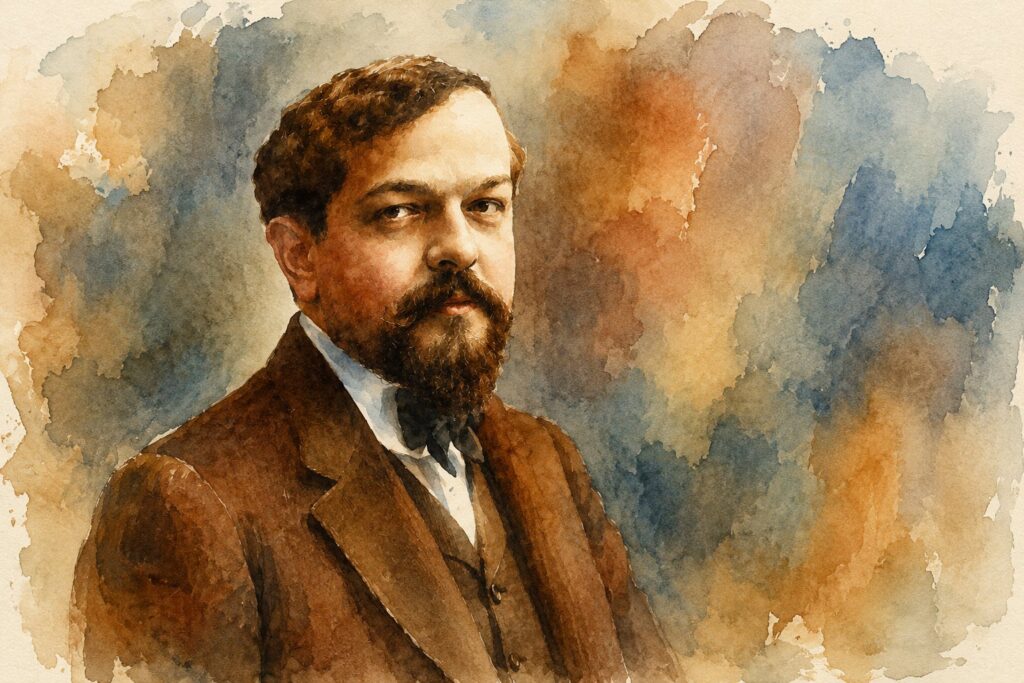
Achille-Claude Debussy was born in Saint-Germain-en-Laye, a small town northwest of Paris, into a modest family of shopkeepers. Neither of his parents possessed musical training, and there was little initial indication that young Claude would mature into a cultural giant. However, his extraordinary natural affinity for the keyboard became apparent during early childhood piano lessons. Encouraged by Marie Mauté de Fleurville, a pianist who claimed to have studied under Frédéric Chopin, Debussy auditioned for the prestigious Paris Conservatoire at the age of ten.
In 1872, Debussy entered the Conservatoire, beginning twelve years of intensive study in piano, solfège, and composition. From his earliest student years, he displayed a rebellious streak against academic orthodoxy. While his professors demanded strict adherence to classical counterpoint and voice leading, Debussy exasperated them by improvising lush, unresolved chord progressions at the piano. He frequently challenged traditional rules of harmony, famously proclaiming that his only master was “pleasure”—the pure sensory enjoyment of sound.
Debussy's Formative Years Timeline
├─ 1862: Born in Saint-Germain-en-Laye, France
├─ 1872: Enters the Paris Conservatoire at age 10
├─ 1880–1882: Travels as music tutor to Nadezhda von Meck; discovers Russian music
├─ 1884: Wins the prestigious Prix de Rome with "L'Enfant prodigue"
└─ 1889: Attends Paris Exposition Universelle; encounters Javanese Gamelan
During his student years, two external experiences fundamentally altered Debussy’s aesthetic development:
- The Russian Connection: Between 1880 and 1882, Debussy was hired as a domestic pianist and tutor by Nadezhda von Meck, the wealthy patroness of Pyotr Ilyich Tchaikovsky. Traveling with her family across Europe and Russia exposed Debussy to the works of Russian nationalist composers such as Aleksandr Borodin and Modest Mussorgsky. Mussorgsky’s unadorned, speech-like vocal lines and modal harmonies left a permanent mark on Debussy’s musical thinking.
- The Prix de Rome and Rome Residency: In 1884, Debussy won France’s highest musical honor, the Prix de Rome, with his cantata L’Enfant prodigue (The Prodigal Child). The prize funded a mandatory three-year residency at the Villa Medici in Rome. Debussy found the rigid artistic atmosphere of Rome suffocating, describing it as “a garrison town for artists.” Nevertheless, during this time he studied the vocal polyphony of Palestrina and began refining a highly personal voice.
Upon returning to Paris in 1887, Debussy attended the Paris Exposition Universelle of 1889, a watershed event in his artistic evolution. There, he heard traditional Javanese gamelan music for the first time. The shimmering gong textures, layered cyclic structures, and non-Western pentatonic tuning systems fascinated him, proving that complex, deeply expressive music could thrive outside the boundaries of Western major and minor scales.
Impressionism in Art and Music: Debussy’s Role and Aesthetic
The term Impressionism originated in the visual arts during the 1870s, initially coined by critics as a derisive label for a group of radical painters including Claude Monet, Auguste Renoir, Camille Pissarro, and Edgar Degas. These artists rejected the sharp outlines, formal studio lighting, and historical narratives of academic painting. Instead, they moved their canvases outdoors (en plein air), capturing transient light, shifting atmospheric conditions, and fleeting perceptual moments through loose, unblended brushstrokes.
Visual Impressionism (Monet, Renoir)        Musical "Impressionism" (Debussy)
───────────────────────────────────        ─────────────────────────────────
• Loose, unblended brushstrokes            • Parallel "planing" chords & open intervals
• Focus on light, water, and atmosphere    • Emphasis on timbre, resonance, & texture
• Rejection of sharp outlines/contours     • Blurring of metric pulses & cadence points
• Capturing fleeting, instantaneous states • Static modal, whole-tone, & pentatonic scales
Translating Canvas to Score
When applied to music history, Impressionism describes a style that prioritizes timbre, sonic texture, and atmosphere over linear thematic development and dramatic harmonic tension. Traditional Western music since the Renaissance relied on a system of tonal tension and resolution: major and minor keys established a “home base” (tonic), moved away to create conflict, and returned to resolve that conflict.
Debussy fundamentally dismantled this model. He treated individual chords not as functional stepping stones toward a resolution, but as self-contained sonorities valued purely for their sensory color. To achieve this atmospheric, painterly quality in sound, Debussy introduced several technical breakthroughs:
- Non-Traditional Scales: He popularized the whole-tone scale (a six-note scale composed entirely of whole steps, completely devoid of leading tones or tonal centers) and the pentatonic scale (five-note scale), alongside ancient church modes (Dorian, Phrygian, Mixolydian). These scales removed traditional tension, creating a sense of weightlessness and suspension.
- Chord Planing (Parallel Harmony): Instead of resolving chords according to classical harmony rules, Debussy moved entire chord structures in parallel motion up and down the scale, creating a rich stream of sound that echoed the unblended color strokes of an Impressionist painting.
- Fluidity of Pulse and Rhythm: Debussy frequently used irregular meters, tied notes across bar lines, and subtle rubato to obscure the underlying beat, giving the music an organic, drifting quality that mirrored movement in nature—such as wind, light, or flowing water.
- Orchestral and Pianistic Palette: He revolutionized orchestration by treating instruments like individual paint colors rather than massive structural blocks. On the piano, his extensive use of the damper pedal blended distant overtone registers, creating shimmering resonances that transformed the percussion instrument into an atmospheric soundboard.
Debussy’s Relationship with the Label
Despite being widely celebrated as the father of musical Impressionism, Debussy personally despised the term. In a 1908 letter to his publisher Jacques Durand, he wrote:
“I am trying to do ‘something different’—an effect of reality… what imbeciles call ‘impressionism,’ a term which is as poorly applied as possible, especially by the critics.”
Debussy felt closer to the Symbolist movement in French literature. He frequented the famous Tuesday evening literary salons (les mardis) hosted by poet Stéphane Mallarmé, associating with figures like Paul Verlaine, Charles Baudelaire, and Maurice Maeterlinck. Symbolist poets sought to evoke moods, emotions, and subtle psychological states through suggestion rather than direct description. Debussy shared this philosophy completely: his music rarely seeks to “tell a story” or paint a literal landscape, choosing instead to evoke the implicit emotional resonance of a scene.
Debussy and Maurice Ravel
No discussion of Impressionism in music is complete without examining the relationship between Debussy and his younger contemporary Maurice Ravel. Together, they represent the pinnacle of early 20th-century French composition. Critics constantly linked their names, sparking fierce rivalries among their followers. While both composers shared an interest in rich harmonies, exotic scales, and Spanish color, their stylistic philosophies differed significantly:
| Aesthetic Element | Claude Debussy | Maurice Ravel |
| Primary Artistic Alliance | Symbolist Poetry & Impressionist Painting | Classical Structure & Swiss-clock Precision |
| Harmonic Structure | Fluid, ambiguous, organic soundscapes | Complex, highly organized functional extended chords |
| Form | Instinctive, free-form, sensory-driven | Strict adherence to classical forms (Sonata, Pavane, Suite) |
| Key Piano Works | Préludes, Estampes, Images | Gaspard de la nuit, Miroirs, Jeux d’eau |
Debussy’s impressionistic style was organic, intuitive, and elusive, whereas Ravel brought an artisan’s precision, clarity, and structural rigor to similar sonic materials.
Catalog of Masterpieces: Major Works
Debussy’s catalog spans orchestral works, solo piano compositions, chamber music, songs, and an opera—each category featuring defining repertoire of classical music.
                     DEBUSSY'S KEY WORKS BY GENRE
                                  │
    ┌─────────────────┬───────────┴───────────┬─────────────────┐
    │                 │                       │                 │
Orchestral        Solo Piano               Opera             Chamber
    │                 │                       │                 │
    ├─ Prelude to the ├─ Suite bergamasque    └─ Pelléas et     ├─ String Quartet
    │  Afternoon of   │  (inc. Clair de lune)    Mélisande      │  in G minor
    │  a Faun         ├─ Estampes                (1902)         ├─ Sonata for Flute,
    ├─ Nocturnes      ├─ Préludes (Books I & II)                   Viola & Harp
    └─ La Mer         └─ Douze Études                           └─ Violin Sonata
1. Orchestral Works
- Prélude à l’après-midi d’un faune (Prelude to the Afternoon of a Faun, 1894): Inspired by Stéphane Mallarmé’s Symbolist poem, this 10-minute orchestral masterpiece is widely considered the dawn of modern music history. The piece opens with a famous, sensual solo flute melody that chromaticizes downward, lacking clear key signature or metric pulse. Conductor Pierre Boulez famously declared: “The flute of the faune brought new breath to the art of music.”
- Nocturnes (1899): A three-movement symphonic suite (Nuages, Fêtes, Sirènes) inspired by the atmospheric night paintings of James McNeill Whistler. In Nuages (“Clouds”), Debussy captures the slow, melancholy progression of gray skies over the Seine, while Sirènes incorporates a wordless female chorus to evoke the hypnotic call of the sea.
- La Mer (The Sea, 1905): Subtitled “Three Symphonic Sketches,” La Mer is Debussy’s grandest orchestral creation. Rather than composing a traditional four-movement symphony, Debussy creates an immense, fluid sonic portrait of the ocean. Through intricate layering, pentatonic motifs, and explosive brass climaxes, he captures the play of light on waves, the surge of the tide, and the dialogue between wind and water.
2. Works for Solo Piano
Debussy revolutionized piano writing as profoundly as Chopin or Liszt had two generations earlier, transforming the piano into an instrument of infinite color and resonance.
- Suite bergamasque (1890–1905): A four-movement suite containing “Clair de lune” (“Moonlight”), arguably the most famous piano piece in classical music history. With its delicate arpeggios, expressive rubato, and floating modal harmonies, “Clair de lune” captures the peaceful, melancholic beauty of night.
- Estampes (1903) & Images (Books I & II, 1905–1907): Collections of vivid tone-paintings for piano. Works like Pagodes incorporate gamelan-like pentatonic layers, while Reflets dans l’eau (Reflections in the Water) uses rapid cascades of notes to depict light dancing on water.
- Préludes (Books I & II, 1910–1913): Twenty-four preludes that represent the pinnacle of Debussy’s keyboard writing. Breaking with tradition, Debussy placed the descriptive titles at the end of each piece in parentheses—such as (…La cathédrale engloutie) or (…Voiles)—suggesting that the listener should experience the sound before attaching a visual image.
3. Opera and Vocal Music
- Pelléas et Mélisande (1902): Debussy’s only completed opera, based on Maurice Maeterlinck’s Symbolist play, stands as a landmark in lyric theater. Rejecting the grand aria structures and thunderous orchestral climaxes of Italian opera and Wagnerian drama, Debussy crafted a quiet, mysterious masterpiece. The vocal lines closely follow the subtle rhythms and inflections of spoken French prose, set against a shimmering, understated orchestral background.
Personal Life, Struggles, and Final Years
Debussy’s personal life was often as tempestuous as his music was refined. During the 1890s, he lived a bohemian existence in Paris, marked by financial instability and romantic entanglements. A ten-year relationship with Gaby Dupont ended painfully, followed by his marriage in 1899 to a fashion model, Rosalie “Lilly” Texier.
However, in 1904, Debussy abandoned Texier for Emma Bardac, a cultivated, musically talented woman from a wealthy bourgeois family. The public scandal caused by their affair—which drove Texier to a suicide attempt—scandalized Parisian society, alienating many of Debussy’s long-time friends. Debussy and Bardac fled briefly to England, where he completed La Mer. In 1905, the couple welcomed their cherished daughter, Claude-Emma (affectionately nicknamed “Chou-Chou”), to whom Debussy dedicated his delightful piano suite Children’s Corner (1908).
                  DEBUSSY'S LATE LIFE & CHALLENGES
                                 │
     ┌───────────────────────────┼───────────────────────────┐
     │                           │                           │
1905: Birth of Daughter     1909: Cancer Diagnosis      1914–1918: WWI Impact
Claude-Emma ("Chou-Chou")   Diagnosed with colorectal   Deep despair over wartime
Drives *Children's Corner*  cancer; health declines     destruction in France
The final decade of Debussy’s life was marred by severe health struggles. Diagnosed with colorectal cancer in 1909, his energy dwindled, though he continued to compose through sheer willpower. The outbreak of World War I in 1914 plunged him into deep emotional despair, heightening his sense of patriotism; he began signing late works with the poignant signature “Claude Debussy, musicien français” (“Claude Debussy, French musician”).
Despite failing health, he projected a late cycle of six sonatas for various instruments, completing three before his death: the Sonata for Cello and Piano (1915), the Sonata for Flute, Viola, and Harp (1915), and the Sonata for Violin and Piano (1917). Debussy died in Paris on March 25, 1918, at the age of 55, while the city was under bombardment by German artillery during the Spring Offensive.
Importance and Enduring Legacy
Claude Debussy’s impact on the evolution of Western music cannot be overstated. By liberating harmony from functional resolution and prioritizing timbre, texture, and silence, he dismantled three centuries of tonal hierarchy.
                       THE RIPPLE EFFECT OF DEBUSSY
                                     │
     ┌───────────────────────────────┼───────────────────────────────┐
     │                               │                               │
20th Century Classical            Jazz Innovation             Ambient & Film Scores
• Stravinsky (Rhythm/Bitonality) • Bill Evans (Modal Chords) • Toru Takemitsu
• Schoenberg / Webern            • Duke Ellington             • Ennio Morricone
• Pierre Boulez (Serialism)      • Miles Davis (*Kind of Blue*) • Brian Eno (Atmospheric texture)
- Impact on 20th-Century Classical Composers: Igor Stravinsky acknowledged that his own revolutionary ballets—including The Rite of Spring—were deeply indebted to Debussy’s explosive rhythmic and timbral freedom. Arnold Schoenberg and the Second Viennese School built upon Debussy’s emancipation of dissonance to create Atonality. Mid-century avant-garde composers like Olivier Messiaen and Pierre Boulez traced their entire harmonic systems back to Debussy’s modal exploration and instrumental color.
- Influence on Jazz and Modern Genres: Debussy’s extended harmonies, whole-tone scales, and parallel chords exerted a massive influence on 20th-century jazz. Icons such as Duke Ellington, Bill Evans, Miles Davis, and Herbie Hancock incorporated Debussyian impressionistic harmonies into modern jazz arrangements, giving birth to Modal Jazz.
- Legacy in Film Scoring and Ambient Music: The evocative, atmospheric nature of Debussy’s soundscapes laid the groundwork for modern film composition and ambient music. Film composers from Bernard Herrmann to Toru Takemitsu and Hans Zimmer have regularly employed Debussy’s timbral techniques to evoke mystery, nature, and deep psychological subtext.
Debussy taught the world that music does not always need to push aggressively toward a dramatic goal; it can simply exist as an ethereal, luminous moment in time. In doing so, he forever altered the landscape of global culture.
Professional Sources and Bibliography
- Lesure, François. Claude Debussy: Biography. Translated by Marie Rolf. Rochester, NY: University of Rochester Press, 2019.
- Lockspeiser, Edward. Debussy: His Life and Mind. 2 vols. Cambridge: Cambridge University Press, 1978.
- Parks, Richard S. The Music of Claude Debussy. New Haven: Yale University Press, 1989.
- Roberts, Paul. Images: The Music of Claude Debussy. Portland, OR: Amadeus Press, 1996.
- Ross, Alex. The Rest is Noise: Listening to the Twentieth Century. New York: Farrar, Straus and Giroux, 2007.
- Trezise, Simon (Ed.). The Cambridge Companion to Debussy. Cambridge: Cambridge University Press, 2003.
#ClaudeDebussy #ClassicalMusic #FrenchComposers #MusicHistory #Impressionism #MauriceRavel #MusicComposers #LaMer #ClairDeLune #ModernMusic #PianoMusic #Symbolism #OrchestralMusic #20thCenturyMusic #Musicology