Lili Boulanger remains one of the most luminary, tragic, and revolutionary figures in modern classical music. Born Marie-Juliette Olga Boulanger in Paris on August 21, 1893, she emerged from a distinguished artistic family to become a child prodigy and a trailblazing composition talent. Despite facing severe, debilitating ill health throughout her life, which ultimately cut her career short at the age of twenty-four, she produced a body of work characterized by astounding emotional depth, harmonic sophistication, and orchestral mastery. By becoming the first woman to win the coveted Premier Grand Prix de Rome in composition in 1913, she shattered centuries of institutional gender bias, carving out an enduring place among the most celebrated female classical composers of any era.
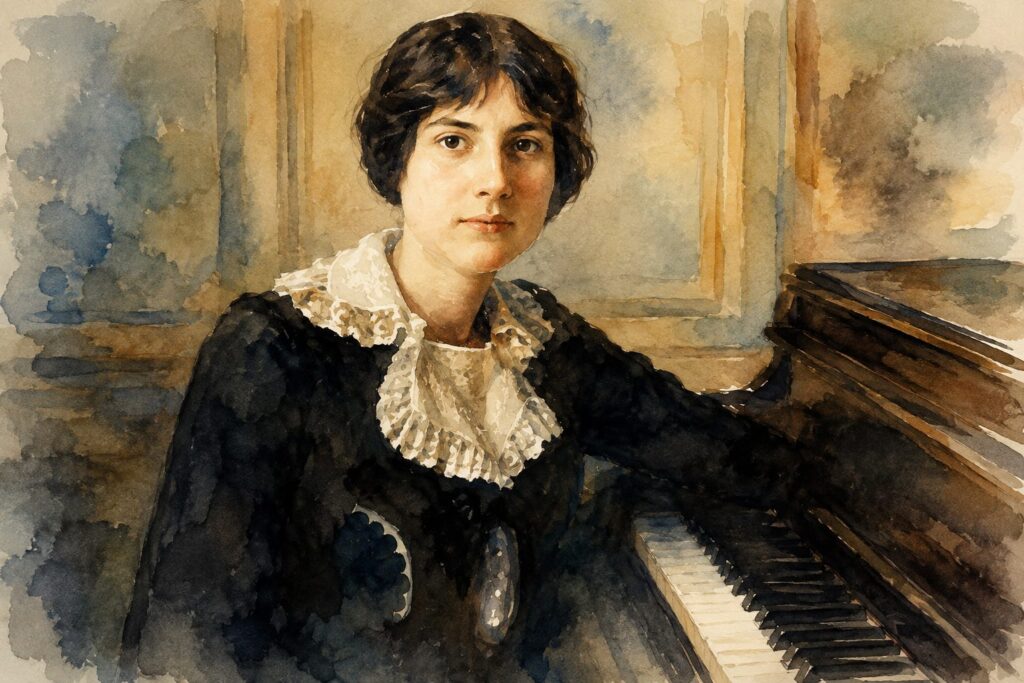
Early Life and Musical Pedigree
Boulanger was born into an environment thoroughly steeped in musical tradition. Her father, Ernest Boulanger, was a respected composer, voice teacher, and winner of the 1835 Prix de Rome who served as a professor at the Paris Conservatoire. Her mother, Raïssa Mischetzky, was a Russian princess with vocal training, and her older sister, Nadia Boulanger, would go on to become arguably the most influential composition pedagogue of the twentieth century. From infancy, Lili was surrounded by the intellectual and artistic elite of Paris; family friends and visitors included Gabriel Fauré, who early on recognized the young girl’s absolute pitch and extraordinary innate talent.
Tragedy struck early in Lili’s life. At two years old, she contracted severe bronchial pneumonia, an illness that severely damaged her immune system. She suffered from chronic, agonizing ailments for the remainder of her days, later diagnosed as intestinal tuberculosis (now understood by historians as likely Crohn’s disease). Due to her frail health, her formal childhood schooling was constantly interrupted. Nevertheless, her intellectual and musical development proceeded at a breathtaking pace. By age five, she was accompanying Nadia to classes at the Paris Conservatoire, sitting quietly in lectures on music theory and dictation.
She quickly mastered several instruments, receiving instruction in piano, violin, cello, organ, and harp from leading Paris professors, including Louis Vierne, Alphonse Hasselmans, and Marcel Tournier. Following the death of her beloved father in 1900, a loss that deeply traumatized the young girl and instilled a lifelong thematic obsession with mortality and grief, she resolved to dedicate her existence entirely to composition. In her mid-teens, she began formal private study in counterpoint and harmony with Georges Caussade and composition with Paul Vidal at the Paris Conservatoire.
The Historic Breakthrough: The 1913 Prix de Rome
Established in 1803 for musical composition, the Prix de Rome was the supreme official accolade for young French artists. For over a century, the prize was restricted exclusively to men. Even after female applicants were theoretically admitted to the competition in 1903, institutional resistance remained formidable. Nadia Boulanger had entered four times, achieving a Second Grand Prix in 1908, but never secured the top award.
Lili Boulanger made her first attempt at the competition in 1912 at age eighteen, but was forced to withdraw mid-competition after collapsing from physical exhaustion. Undeterred, she returned in May 1913. The final round required candidates to be sequestered at the Château de Fontainebleau for four weeks to compose a dynamic cantata based on a assigned dramatic text. Boulanger set Eugène Adenis’s text Faust et Hélène, based on Goethe’s Faust.
Her winning cantata stunned the judges with its theatrical power, vivid orchestration, and expressive chromaticism. On July 5, 1913, at age nineteen, Boulanger was awarded the Premier Grand Prix de Rome, becoming the first woman in history to win the prize. The historical moment reverberated far beyond France; international headlines celebrated her triumph as a watershed milestone in music history. The award brought widespread renown, a lucrative contract with the publisher Ricordi, guaranteeing her financial independence, and a residency at the Villa Medici in Rome.
Key Masterworks and Musical Style
Boulanger’s compositional catalog, though numbering fewer than fifty surviving pieces, demonstrates a rapid evolution from late-Romantic and Impressionist influences to a fiercely original, modern voice. Her harmonic vocabulary drew upon the modal nuances of Gabriel Fauré, the atmospheric color of Claude Debussy, and the expressive chromaticism of Richard Wagner, yet she integrated these into a language distinctly her own.
| Work Title | Composition Date | Instrumentation / Medium | Key Musical Features |
| Faust et Hélène | 1913 | Tenor, Baritone, Mezzo-Soprano, Full Orchestra | Dramatic cantata featuring Wagnerian leitmotifs, rich chromaticism, and soaring vocal lines. |
| Clairières dans le ciel | 1914 | High Voice and Piano | A 13-song cycle setting poems by Francis Jammes; delicate, introspective, and expressive. |
| Psalm 24 (La terre appartient à l’Éternel) | 1916 | Chorus, Organ, Brass, Harps, Timpani | Heroic fanfare textures, assertive homophonic choral writing, and martial rhythmic energy. |
| Psalm 129 (Ils m’ont assez opprimé) | 1916 | Baritone, Chorus, Full Orchestra | Dark, somber orchestral color, bitter harmonic tension, and reflective solemnity. |
| Psalm 130: Du fond de l’abîme | 1917 | Mezzo-Soprano, Tenor, Chorus, Orchestra, Organ | Monumental De Profundis; uses sarrusophone, massive orchestral climaxes, and profound grief. |
| Vieille prière bouddhique | 1914–1917 | Tenor, Chorus, Full Orchestra | Sets a Buddhist daily prayer (Metta Sutta); exotic modal harmonies and meditative ostinatos. |
| D’un soir triste & D’un matin de printemps | 1917–1918 | Orchestra / Chamber Ensemble | Companion works contrasting dark, tragic despair with vibrant, buoyant impressionistic life. |
| Pie Jesu | 1918 | Mezzo-Soprano, String Quartet, Harp, Organ | Sparse, hauntingly transcendent deathbed work; highly chromatic, modal, and visionary. |
Major Choral and Orchestral Works
Boulanger’s true mastery is revealed in her large-scale sacred and choral compositions. Psalm 130: Du fond de l’abîme (“Out of the Depths”), dedicated to the memory of her father, stands as her unquestioned masterpiece. Written during the height of World War I as her own physical health rapidly declined, the piece combines biblical lamentation with a terrifying awareness of mortality. Scored for chorus, soloists, organ, and a massive orchestra including rare low reeds like the sarrusophone, the work alternates between crushing darkness and ethereal beauty.
In contrast, Psalm 24 exhibits a fierce, brass-heavy splendor, while Vieille prière bouddhique (“Old Buddhist Prayer”) moves outside the Western Christian liturgy to set a prayer of universal compassion from the Metta Sutta. Her orchestration in these works displays a extraordinary ear for timbre, employing harps, celesta, and muted brass to build vast, shimmering soundscapes.
Instrumental and Chamber Music
Her companion orchestral pieces, D’un soir triste (“Of a Sad Evening”) and D’un matin de printemps (“Of a Spring Morning”), written during her final months, present a stark aesthetic contrast. The former is a mournful, heavy funeral march reflecting her looming death, while the latter is a light, rhythmic, and joyful celebration of nature. In her song cycle Clairières dans le ciel, she set the poetry of Francis Jammes, creating a subtle, psychological narrative of lost love through fluid piano textures and vocal lines.
During her final weeks, bedridden and in intense pain in Mézy-sur-Seine, she dictated her final composition—the Pie Jesu—note by note to her sister Nadia. Scored for soprano, string quartet, harp, and organ, the piece is a breathtaking testament to human resilience, blending chromatic dissonance with solemn, unearthly serenity.
Importance and Aesthetic Legacy
Lili Boulanger occupied a crucial position among early twentieth-century music composers. Rather than serving as a passive imitator of Impressionism, her work built a bridge toward the bolder, more starkly rhythmic avant-garde developments of the post-WWI era. Her innovative use of parallel harmonies, bitonal implications, unusual modal scales, and complex ostinatos directly influenced contemporaries like Arthur Honegger, Darius Milhaud, and Igor Stravinsky.
Her sudden death on March 15, 1918, at the age of twenty-four, deprived Western music of one of its most visionary talents. For decades following her passing, her legacy was zealously guarded and advocated by her sister Nadia. Nadia established the Lili Boulanger Memorial Fund to support promising young composers worldwide and frequently conducted Lili’s works on concert tours across Europe and America.
In contemporary musicology, Lili Boulanger is no longer viewed merely through the sentimental lens of a doomed young genius or solely as Nadia’s tragic sister. Instead, scholars recognize her as an uncompromising master of form, harmony, and orchestration. Her success proved that artistic brilliance transcends gender, forever changing how institutions evaluate creative achievement.
Conclusion
Lili Boulanger’s artistic journey was brief, yet her output remains immortal. In less than a decade of creative activity, she produced music of timeless authority, technical precision, and raw human emotion. Her compositions continue to inspire performers, scholars, and listeners globally, securing her place as an titan of modern music.
References
- Anstruther, F. (1939). Lili Boulanger. The Chesterian, 20(144), 81–85.
- Fauser, A. (1997). La Grande Vestale? Lili Boulanger et Prix de Rome. Journal of the Royal Musical Association, 122(1), 61–108.
- Potter, C. (2006). Nadia and Lili Boulanger. Ashgate Publishing.
- Rosenstiel, L. (1978). The Life and Works of Lili Boulanger. Fairleigh Dickinson University Press.
- Spycket, J. (1990). À la recherche de Lili Boulanger. Éditions Fayard.
#LiliBoulanger #ClassicalMusic #FemaleClassicalComposers #MusicHistory #MusicComposers #PrixDeRome #FrenchMusic #NadiaBoulanger #OrchestralMusic #ChoralMusic #20thCenturyMusic #FaustEtHelene #PieJesu #Impressionism #ChamberMusic