Igor Stravinsky (17 June 1882 – 6 April 1971) was a towering catalyst of twentieth-century modernism, widely regarded as one of the few artists who can claim to have single-handedly dismantled the aesthetic foundations of their medium only to rebuild them multiple times over. As a lightning rod for both fierce condemnation and religious adulation, the Russian-born composer stood at the epicenter of Western cultural modernization. His career was defined not by a linear evolution, but rather by a series of calculated stylistic mutations that routinely caught the public and his peers off guard. From the explosive, primordial rhythms of his early Russian ballets to the severe, calculated architecture of his neoclassical and serialist periods, Stravinsky permanently redefined what music could be, how it could be structured, and what it was permitted to express.
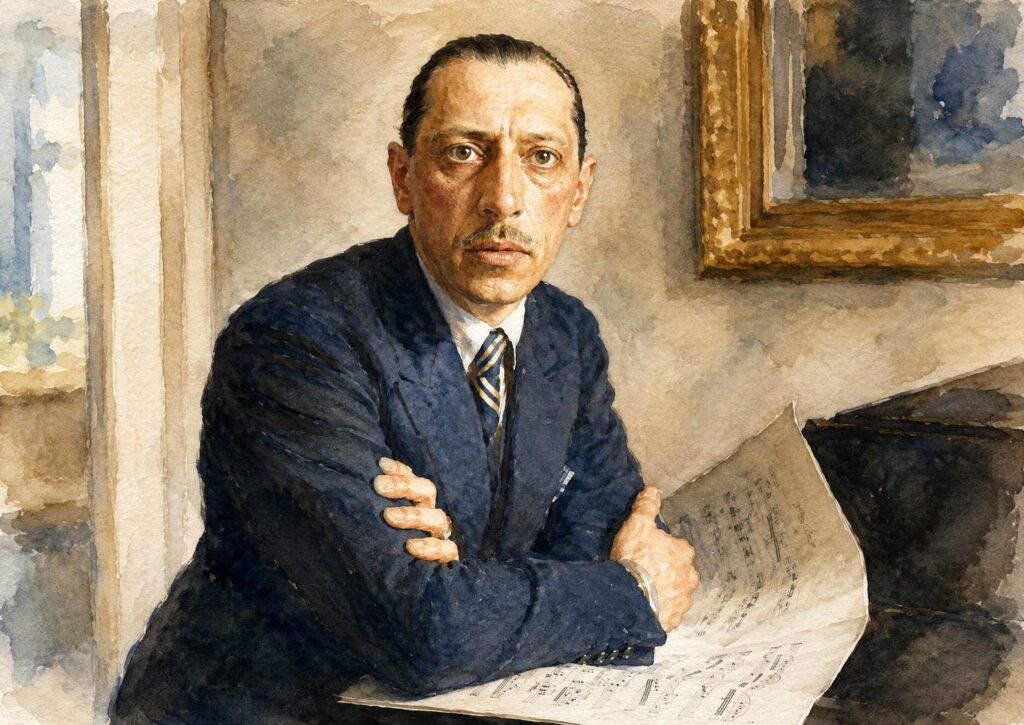
Early Life and the Crucible of St. Petersburg
Born on June 17, 1882, in Oranienbaum, Russia, near the imperial capital of St. Petersburg, Igor Fyodorovich Stravinsky was baptized into an elite musical ecosystem. His father, Fyodor Stravinsky, was a celebrated bass singer at the Mariinsky Theatre, exposing the young Igor to the grand tradition of Russian opera from infancy. Despite this immersive musical upbringing, his parents intended a different path for him, enrolling him in the law faculty at the University of St. Petersburg in 1901.
Stravinsky’s true education, however, took place outside the lecture hall. In 1902, he secured an introduction to Nikolai Rimsky-Korsakov, the undisputed titan of Russian orchestration and a leading member of the nationalist composer collective known as “The Five.” Recognizing the young man’s raw, unconventional talent, Rimsky-Korsakov took Stravinsky under his wing as a private pupil, bypassing the rigid curriculum of the St. Petersburg Conservatory.
Under Rimsky-Korsakov’s tutelage, Stravinsky mastered the dazzling, prismatic orchestral colorations that would define his early works. The sudden death of his mentor in 1908 marked the end of Stravinsky’s artistic adolescence. He was left with an impeccable command of the orchestra and a growing dissatisfaction with the late-nineteenth-century Romantic aesthetic that dominated Europe.
The Ballets Russes and Cosmic Success
The pivotal turning point in Stravinsky’s life occurred in 1909 when the visionary impresario Sergei Diaghilev heard his early orchestral work, Feu d’artifice (Fireworks). Diaghilev, who was assembling an avant-garde artistic troupe called the Ballets Russes to storm Paris, recognized in Stravinsky the bold musical voice he desperately needed.
What followed was one of the most brilliant creative partnerships in cultural history. Diaghilev commissioned Stravinsky to write a full-length ballet based on Russian folklore. The result was The Firebird (L’Oiseau de feu), premiered at the Opéra de Paris in 1910. The piece was an overnight sensation, blending the rich, magical chromaticism of Rimsky-Korsakov with a new, urgent rhythmic vitality.
Stravinsky quickly followed this success with Petrushka in 1911. Here, he introduced the famous “Petrushka chord”—a clashing combination of C major and F-sharp major triads played simultaneously—which perfectly captured the grotesque, tragic nature of the titular puppet. Petrushka demonstrated that Stravinsky was no longer just an apprentice of the Russian school; he was forging a completely new, biting harmonic language.
The Crucible of Modernism: The 1913 Riot
While The Firebird and Petrushka established Stravinsky as a formidable talent, his third major collaboration with the Ballets Russes secured his place in the annals of cultural myth. On the evening of May 29, 1913, at the newly inaugurated Théâtre des Champs-Élysées in Paris, the premiere of The Rite of Spring (Le Sacre du printemps) ignited what is widely considered the most famous riot in classical music history.
The Rite of Spring, subtitled “Pictures of Pagan Russia,” was conceived as a visceral, primeval depiction of a pagan ritual where a young maiden dances herself to death to propitiate the god of spring. The work was a radical assault on Western artistic sensibilities across three fronts:
- The Choreography: Vaslav Nijinsky abandoned the elegant, gravity-defying conventions of classical ballet in favor of heavy, earthbound movements, turned-in feet, and convulsive jerks.
- The Costumes: Designed by Nicholas Roerich, the performers wore bulky, long peasant tunics instead of traditional tutus, completely obscuring the idealized human form.
- The Score: Stravinsky unleashed an unprecedented sonic assault characterized by asymmetric time signatures, brutal polytonality, and a relentless, mechanical emphasis on rhythm.
The trouble began almost immediately with the opening bassoon solo, played in an unnaturally high, straining register that the audience failed to recognize as a traditional instrument. Within minutes, derisive laughter turned into open hostility. The theater split into two fiercely antagonistic camps: the avant-garde factions who championed the performance, and the wealthy, traditionalist patrons who viewed it as an insulting parody.
The auditory chaos inside the hall quickly eclipsed the music. Spectators shouted insults, spat at one another, and eventually engaged in physical altercations. The noise grew so deafening that Nijinsky had to stand on a chair in the wings, shouting out numbers to the dancers who could no longer hear the orchestra.
Stravinsky himself fled the auditorium in a fury, spending the remainder of the performance backstage holding Nijinsky’s jacket. Police were called to restore order, making several arrests during the intermission. Despite the pandemonium, the performance concluded, instantly transforming the work into a legendary symbol of modernist rebellion.
Dramatic Architecture: The Operas and Stage Works
Though popular history frequently emphasizes his ballets, Stravinsky’s relationship with vocal and dramatic theater was deep, extensive, and equally revolutionary. He approached the operatic medium not as a vehicle for emotional melodrama, but as a highly structured, objective platform for mythic storytelling.
His first opera, The Nightingale (Le Rossignol), begun in 1908 and completed in 1914, beautifully straddles his stylistic evolution. The first act reflects the lush, impressionistic influence of Claude Debussy, while the subsequent acts, written after The Rite, crackle with sharp, fractured modernism.
As his career shifted away from large-scale nationalistic spectacles, Stravinsky began experimenting with chamber theater. The Soldier’s Tale (L’Histoire du soldat, 1918), scored for just seven instruments and three actors, combined elements of spoken word, dance, and music theater, heavily incorporating the emerging syncopations of American jazz.
+--------------------------------------------------------------------------+
|                      STRAVINSKY'S OPERATIC EVOLUTION                      |
+--------------------------------------------------------------------------+
|  Le Rossignol (1914)     ->   Transition from Impressionism to Modernism|
|  Oedipus Rex (1927)      ->   Theatrical Monumentality & Rigid Latin Text|
|  The Rake's Progress (1951)-> Neoclassical Synthesis of Mozartian Forms   |
+--------------------------------------------------------------------------+
In 1927, Stravinsky completed Oedipus Rex, a towering “opera-oratorio” based on Sophocles’ tragedy. To achieve a sense of timeless, frozen monumentality, Stravinsky chose to have the text translated into classical Latin by Jean Cocteau. The characters were instructed to wear heavy masks and move with rigid, statue-like deliberation. By deliberately stripping away the emotional theatricality typical of nineteenth-century Italian opera, Stravinsky forced the audience to focus entirely on the austere, geometric perfection of the musical score.
His operatic crowning achievement arrived in 1951 with The Rake’s Progress, featuring a brilliant English libretto by W.H. Auden and Chester Kallman. Inspired by a series of eighteenth-century paintings by William Hogarth, the opera represents the absolute zenith of Stravinsky’s neoclassical period. It is a deliberate, highly stylized homage to the classical structures of Mozart and Handel, complete with formal recitatives, arias, and an explicit, ironic moral at the end. Yet, underneath its historical veneer, the work is unmistakably modern, punctuated by Stravinsky’s trademark rhythmic displacements, dry woodwind textures, and bittersweet harmonic undercurrents.
The Three Faces of an Icon: Stylistic Eras
Stravinsky’s career is conventionally divided into three distinct, highly influential periods, each representing a complete reimagining of his compositional philosophy.
1. The Russian Period (c. 1907–1920)
This era is characterized by an intense engagement with Russian folklore, primitive rituals, and the brilliant, colorful orchestrations of his youth. The defining characteristic of this period is the liberation of rhythm. Rather than treating rhythm as a steady framework for melody, Stravinsky elevated it into the primary driving force of the music. Works like The Rite of Spring and Les Noces (The Wedding) utilized additive rhythms, shifting accents, and block-like construction where musical ideas are abruptly juxtaposed rather than smoothly transitioned.
2. The Neoclassical Period (c. 1920–1954)
Following the social and political upheavals of World War I and the Russian Revolution, which permanently exiled him from his homeland, Stravinsky’s aesthetic shifted dramatically. He abandoned the massive orchestras and nationalist themes of his youth, declaring that “music is, by its very nature, essentially powerless to express anything at all.”
Turning back to the classical forms of the seventeenth and eighteenth centuries, he embraced emotional detachment, clarity, and balance. The ballet Pulcinella (1920), based on music attributed to Giovanni Battista Pergolesi, inaugurated this phase. Other masterpieces of this era include the sublime Symphony of Psalms (1930) and the Symphony in C (1940), which treated classical sonata forms with a lean, astringent twentieth-century sensibility.
3. The Serial Period (c. 1954–1968)
In one of the most stunning creative pivots of his life, Stravinsky completely reinvented himself once again in his seventies. For decades, he had stood as the conservative, tonal antithesis to Arnold Schoenberg’s radical twelve-tone (serial) system. However, following Schoenberg’s death in 1951, and guided by his young musical assistant Robert Craft, Stravinsky began meticulously studying the music of Anton Webern.
He gradually integrated serial techniques into his own writing, producing late-career masterpieces like the ballet Agon (1957) and the haunting Requiem Canticles (1966). Remarkably, even when using the highly abstract constraints of the twelve-tone system, the music remained unmistakably Stravinsky, distinguished by his signature crisp articulations, rhythmic vitality, and sparse, crystalline instrumentation.
Importance in Modern Music and Lasting Legacy
Stravinsky’s impact on the evolution of Western art music cannot be overstated. He shattered the tyranny of the bar line, demonstrating to future generations of composers that meter could be fluid, asymmetric, and unpredictable without losing its structural integrity. His concept of “rhythmic cells”, short fragments of sound that are repeated, inverted, and shifted across different beats, became a foundational building block for mid-century minimalism, directly influencing figures like Steve Reich and Philip Glass.
Furthermore, Stravinsky radically altered the global approach to instrumentation. He consistently rejected the lush, vibrato-heavy, romantic string textures of the nineteenth century, preferring instead the clean, dry, analytical precision of woodwinds, brass, and percussion. This shift in sonic palette laid the groundwork for modern wind ensembles and deeply informed the trajectory of early film scoring.
“Stravinsky’s music was the axis upon which the entire wheel of twentieth-century modernism turned. He proved that one could look forward to the future and backward into history simultaneously, without losing a shred of artistic authenticity.”
Beyond the academy, his influence bled into popular culture. Jazz musicians, including Charlie Parker and Ornette Coleman, routinely praised Stravinsky’s rhythmic audacity. His ability to move effortlessly across international borders—living in Russia, Switzerland, France, and eventually becoming a citizen of the United States in 1945—cemented his status as the definitive archetype of the global twentieth-century citizen.
Stravinsky passed away in New York City on April 6, 1971, at the age of 88. In accordance with his wishes, he was buried in the Orthodox corner of the cemetery island of San Michele in Venice, Italy, only a few yards from the grave of his old friend and catalyst, Sergei Diaghilev. It was a fitting resting place for a man who spent his life wandering the globe, leaving an indelible, revolutionary blueprint on the collective ear of humanity.
References
- Craft, Robert. Stravinsky: Chronicle of a Friendship. Vanderbilt University Press, 1994.
- Stravinsky, Igor. An Autobiography. Calder & Boyars, 1975.
- Stravinsky, Igor. Poetics of Music in the Form of Six Lessons. Harvard University Press, 1947.
- Taruskin, Richard. Stravinsky and the Russian Traditions: A Biography of the Works Through Mavra. University of California Press, 1996.
- Walsh, Stephen. Stravinsky: A Creative Spring: Russia and France, 1882–1934. Alfred A. Knopf, 1999.
- Walsh, Stephen. Stravinsky: The Second Exile: France and America, 1934–1971. Alfred A. Knopf, 2006.
#IgorStravinsky #ModernMusic #ClassicalMusic #TheRiteOfSpring #BalletsRusses #MusicHistory #ComposerLife #OperaHistory #AvantGarde #TwentiethCentury #MusicalRevolution #Neoclassicism #Orchestration #Diaghilev #Nijinsky