Last Exit from Utopia by Ratyński is a new release by the Polish composer and guitarist, continuing his highly personal exploration of the classical guitar as both a harmonic instrument and a narrative voice. His music is vast and deep despite the limited instrumentation, with a strong narrative force and emotional weight. More importantly, Ratyński’s control over the guitar, and over the sound he produces from it, is once again one of the most striking aspects of the recording.
At his core, Ratyński is a poet. He writes little poems using strings and notes instead of voice and words. Each track in his catalogue tends to feel like a short piece of sentimental poetry, built not around conventional song structures but around images, movement and atmosphere. Last Exit from Utopia is no exception. In fact, the two-piece EP may be one of the clearest examples yet of how closely his compositional language connects musical structure with a larger idea.
The poetic context supplied with the release makes that intention explicit:
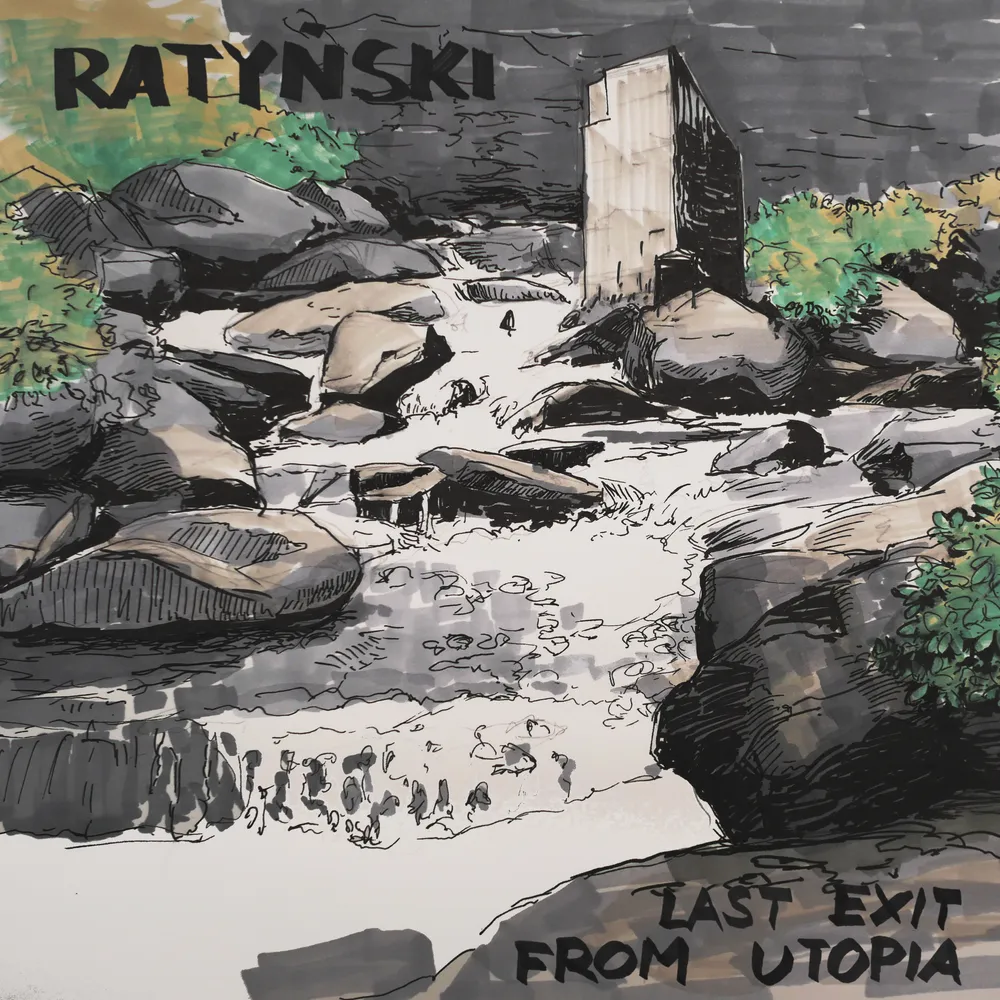
“the river sings songs / the stone dances to them / look at this and do not imagine / that you play any part”
Later comes another striking image:
“the melody / you hear is a surface wave / for you, so that watching you might think / you understand”
That idea, the visible or audible surface concealing something larger underneath; also describes the music surprisingly well.
Creek Dance: Motion Without Restlessness
The first track, “Creek Dance,” lives up to its name. There is something almost suite-like in its construction, with a bright, dance-oriented character supported by continuous arpeggiation and recurring rhythmic cells. The piece carries some of the lightness of folk dance, but it never settles comfortably into a single stylistic category.
What immediately stands out is the independence between the guitar’s registers. A persistent bass and thumb-driven pulse often behaves almost as its own voice, while the upper register develops a more lyrical melodic line. This gives the music a lightly polyphonic character: accompaniment and melody are not simply stacked on top of one another, but appear to converse.
Ratyński moves through changes of rhythmic emphasis, phrasing and meter without interrupting the forward motion. This is particularly important. On paper, some of these changes could easily make the composition sound fragmented, yet in performance they feel almost organic. The pulse stretches, contracts and shifts its weight, but the piece continues to flow.
There are also several moments where the harmonic centre seems to loosen. Bright major sonorities give way to more ambiguous passages before the music finds familiar ground again. Rather than presenting modulation as a dramatic event, Ratyński tends to slip from one harmonic environment into another. The listener often notices that the colour has changed before noticing precisely when the transition happened.
That fluidity has appeared before in his music. In my review of Surprise Stopover similarly I noted his tendency toward sudden changes in rhythm, key and mood while maintaining continuity through phrasing and modulation. Here, however, that technique feels particularly suited to the natural imagery of the piece. The composition behaves almost like water: changing constantly without ever truly stopping.
Last Exit from Utopia by Ratyński Turns Toward Weight
If “Creek Dance” is water, “Moving Monolith” is stone.
The second piece immediately introduces a heavier musical vocabulary. Syncopation plays a much stronger role, as do resonant lower strings and dense chordal sonorities. This is classic Ratyński territory: chord progressions, broken chords, arpeggios and melodic fragments become intertwined until the distinction between harmony, rhythm and melody is often difficult to separate.
The rhythmic language is especially interesting. Some passages establish a clear metrical pattern only to disturb it with displaced accents or uneven phrase lengths. Elsewhere the pulse becomes considerably freer, approaching rubato. Instead of using complexity as a technical spectacle, Ratyński allows rhythm to create physical tension. The music seems to lean forward, resist, pause and then move again.
This approach recalls aspects of Eyes Like Torches at the Gate, where I previously mentioned how Ratyński could build complex patterns such as 3-3-2, 3-2-3 and other asymmetric groupings while preserving a surprisingly natural melodic flow. “Moving Monolith” feels like a darker and more mature extension of that instinct. The complexity is present, but it rarely asks to be counted.
Harmonically, the piece is considerably less transparent than “Creek Dance.” The tonal centre remains perceptible, yet Ratyński repeatedly moves away from it through chromatic colour, altered chord tones and distant harmonic detours. Several passages deliberately avoid immediate resolution, allowing bass resonance and sustained upper notes to create tension between stability and uncertainty.
The recording itself deserves attention too. There is very little between the listener and the physical instrument. Finger articulation, changes in attack, sympathetic resonance and the wooden body of the guitar remain audible throughout. The bass strings have real physical weight, while harmonics and upper-register notes can become remarkably delicate. Instead of polishing these contrasts away, the recording allows them to form part of the composition.
A Continuing Musical Language
Listeners who have followed Ratyński through Tunitemusic will recognise many elements of this language. Surprise Stopover explored rhythmic unpredictability and shifting perspectives, while Eyes Like Torches at the Gate pushed further into asymmetric rhythm and expressive solo-guitar writing. More recently, My Head is the Mountain developed his fascination with landscape, motion and physical metaphor across three solo guitar pieces.
There is a clear evolution across these releases. In My Head is the Mountain, I described his writing as balancing intimacy and complexity, with technique consistently serving the larger narrative rather than becoming display for its own sake. That description remains true here, perhaps even more strongly.
The title Last Exit from Utopia could suggest something grand or philosophical, yet the music itself avoids making grand gestures. Instead, its argument emerges from two elemental images: flowing water and immovable stone. One moves constantly while remaining itself; the other appears permanent yet eventually moves under forces far greater than human intention.
That makes Last Exit from Utopia by Ratyński a compelling continuation of his work. It is technically sophisticated without presenting itself as a demonstration of technique, and philosophical without allowing the concept to overwhelm the music. Most importantly, the guitar remains unmistakably his voice: intimate, restless, poetic and capable of making a single instrument feel considerably larger than itself.
#Ratyński #LastExitFromUtopia #CreekDance #MovingMonolith #ClassicalGuitar #SoloGuitar #ContemporaryClassical #NeoclassicalMusic #InstrumentalMusic #GuitarComposition #PolishComposer #AcousticGuitar #ModernClassical #MusicReview #Tunitemusic