Pyotr Ilyich Tchaikovsky (7 May 1840 – 6 November 1893) stands as a monolithic figure in the history of classical music, a creator whose name is synonymous with the emotional peaks and valleys of the Romantic era. While many composers of his time sought to capture the grand narratives of history or the rugged beauty of nature, Tchaikovsky’s most profound compositions were often internal journeys. He was a music composer who translated the complexities of the human psyche, longing, fate, terror, and fleeting joy, into melodies that have remained unparalleled in their communal resonance.
To understand Pyotr Ilyich Tchaikovsky is to understand the tension between the disciplined structure of Western European traditions and the raw, untamed spirit of the Russian heart. His life was a constant navigation of these two worlds, both professionally and personally.
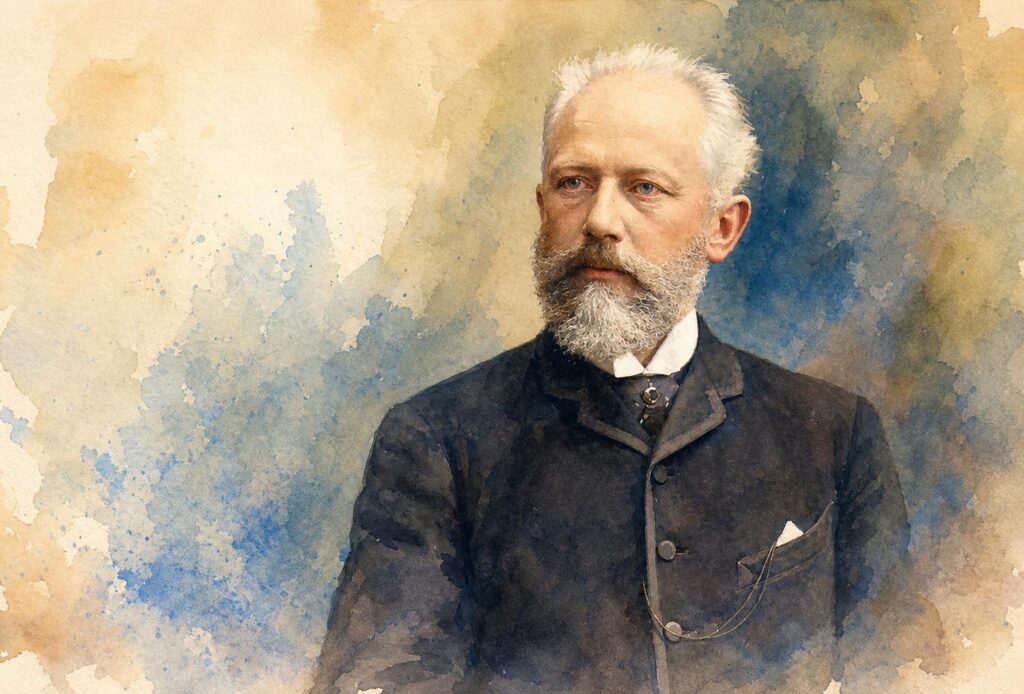
The Awakening of a Master
Born in May 1840 in Votkinsk, a small industrial town in the Ural Mountains, Tchaikovsky’s early life did not immediately signal the arrival of a world-altering classical composer. Although he showed an early sensitivity to sound, often described as a child who would weep at the beauty of a melody, his family steered him toward a stable career in the civil service. At the age of ten, he was sent to the Imperial School of Jurisprudence in St. Petersburg.
The death of his mother when he was only fourteen was a foundational trauma that colored his emotional landscape for the rest of his life. After graduating, he spent several years as a clerk in the Ministry of Justice, yet the pull of music was inexorable. The opening of the St. Petersburg Conservatory in 1862, under the direction of Anton Rubinstein, provided Tchaikovsky with the escape he desperately sought. He became one of its first students, a decision that would change the course of music history. Unlike many of his Russian contemporaries, Tchaikovsky received a rigorous, Western-style musical education.
This academic foundation allowed him to master the complex structures of the symphony and the concerto, providing a “vessel” for his intense emotional output. While the “Mighty Handful”, a group of nationalist composers including Mussorgsky and Rimsky-Korsakov, often viewed Tchaikovsky’s formal training with suspicion, he used these tools to craft works that were technically sophisticated yet undeniably Russian in their melodic DNA.
The Moscow Years and the Duel with Fate
In 1866, Tchaikovsky relocated to Moscow to teach harmony at the newly founded conservatory. This period was marked by the emergence of his first major masterpieces, including the First Symphony (Winter Daydreams) and the Romeo and Juliet Fantasy-Overture. These works showcased his unique ability to blend symphonic development with the sweeping, lyrical themes that would become his hallmark.
However, Tchaikovsky’s internal life was often in turmoil. As a gay man in the restrictive atmosphere of 19th-century Russia, he lived in a state of perpetual anxiety regarding his social standing and reputation. This inner conflict reached a breaking point in 1877, a year that would define his legacy. In an attempt to conform to societal expectations and perhaps “cure” his nature, he entered into a disastrous marriage with Antonina Milyukova, a former student. The marriage lasted only weeks, leading Tchaikovsky to a near-total mental collapse and a purported suicide attempt in the freezing waters of the Moscow River.
Ironically, this period of immense personal suffering coincided with a burst of creative genius. In the aftermath of the separation, he completed two of his most significant works: the Fourth Symphony and the opera Eugene Onegin. The Fourth Symphony, in particular, introduced the “Fate” motif: a terrifying, brass-heavy fanfare representing the inescapable force that prevents happiness from being realized.
The “Invisible” Patron: Nadezhda von Meck
Tchaikovsky’s survival and subsequent career were made possible by one of the most unusual arrangements in the history of classical music. Nadezhda von Meck, a wealthy and reclusive widow, became his financial patron for thirteen years. The two shared a profound emotional intimacy through a correspondence of over 1,200 letters, yet they lived under a strict agreement never to meet in person.
Von Meck’s patronage allowed Tchaikovsky to resign from his teaching duties and dedicate himself entirely to composition. Through their letters, we see a music composer who was deeply self-critical and often plagued by “compositional blocks,” yet fiercely disciplined. He once wrote that “Inspiration is a guest that does not willingly visit the lazy,” emphasizing his belief that music was as much about craftsmanship as it was about divine spark.
Revolutionizing the Ballet: From Decoration to Drama
Perhaps Tchaikovsky’s most enduring contribution to the global cultural canon is his transformation of the ballet. Before his arrival, ballet music was often treated as secondary, a collection of catchy but superficial tunes designed merely to keep time for the dancers. Tchaikovsky approached the ballet with the same gravity he applied to a symphony.
With Swan Lake (1876), The Sleeping Beauty (1889), and The Nutcracker (1892), he elevated the genre into a sophisticated dramatic form. He utilized “Leitmotifs”, recurring musical themes associated with specific characters or ideas, to give the stories a psychological depth they had previously lacked. The orchestration of these ballets was revolutionary; for instance, his use of the celesta in the “Dance of the Sugar Plum Fairy” introduced a “heavenly” sound that was entirely new to the audiences of the time.
The Years of Fame and the Pathétique Mystery
By the 1880s, Tchaikovsky had reached the zenith of his professional life. He was a celebrated classical composer not only in Russia but across Europe and the United States. In 1891, he traveled to New York to conduct at the opening of Carnegie Hall, where he was hailed as a living legend. Despite this external success, the melancholy that had haunted him since childhood remained a constant companion.
His final major work, the Symphony No. 6 in B Minor, known as the Pathétique, is widely considered his most introspective and autobiographical achievement. Breaking with the tradition of a triumphant symphonic finale, the Pathétique ends with a Finale: Adagio lamentoso, a slow, fading descent into silence that feels like a musical expiration. Tchaikovsky himself claimed there was a “secret program” to the symphony but refused to reveal it.
Only nine days after conducting the premiere of the Sixth Symphony in 1893, Tchaikovsky died at the age of 53. The official cause was cholera, allegedly contracted by drinking unboiled water during an epidemic. However, the timing and circumstances of his death have fueled over a century of speculation. Some historians suggest a “court of honor” ordered him to take his own life to avoid a scandal involving the Russian aristocracy, while others maintain the cholera diagnosis. Regardless of the cause, his death was felt as a national tragedy in Russia.
The Legacy of Pyotr Ilyich Tchaikovsky
Tchaikovsky’s music survived the transition into the modern era because it speaks to universal human emotions. He was a music composer who refused to hide behind academic abstraction. Instead, he placed his vulnerabilities on the page for all to hear. From the explosive joy of the 1812 Overture to the quiet desperation of his final symphony, Tchaikovsky’s work remains a testament to the power of classical music to articulate the unspoken.
Today, his ballets are performed more than those of any other composer, and his symphonies remain staples of every major orchestra’s repertoire. Pyotr Ilyich Tchaikovsky did not just write music; he wrote the soundtrack to the human condition, ensuring that as long as people feel love, loss, and the hand of fate, his voice will continue to be heard.
Sources
- Tchaikovsky: A Life – tchaikovsky-research
- Pyotr Ilyich Tchaikovsky – Britanica
- Tchaikovsky – Classicfm
- Homosexuality Myth – tchaikovsky-research
#Tchaikovsky #ClassicalMusic #RussianComposer #TheNutcracker #SwanLake #PathétiqueSymphony #MusicHistory #RomanticEra #Orchestra #ComposerLife #EugeneOnegin #1812Overture #Musicology #ClassicalComposer #StPetersburgConservatory