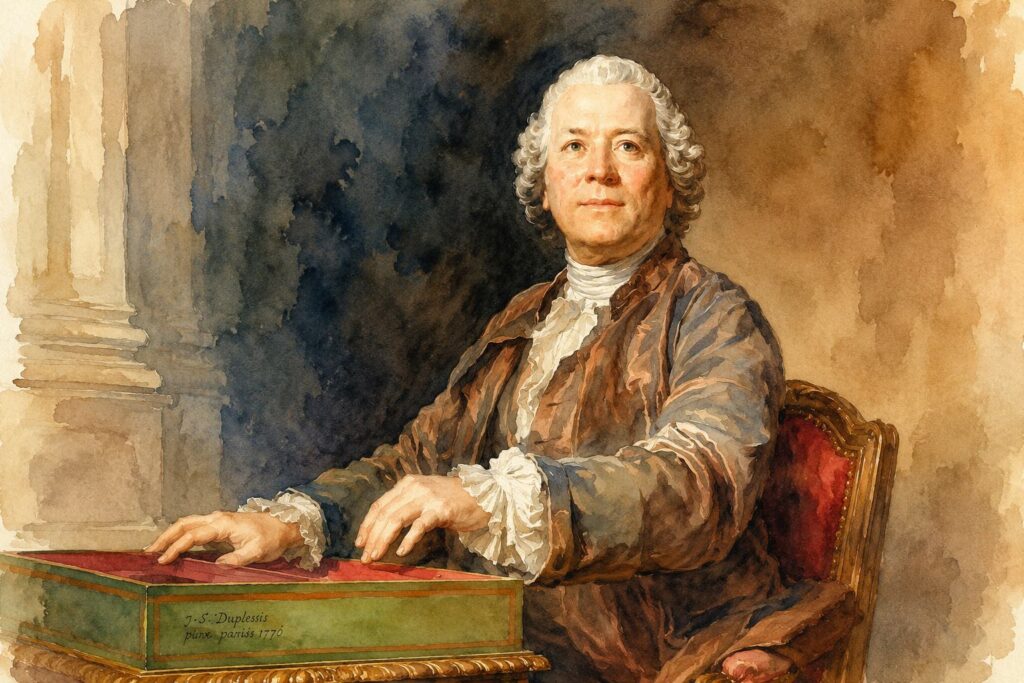
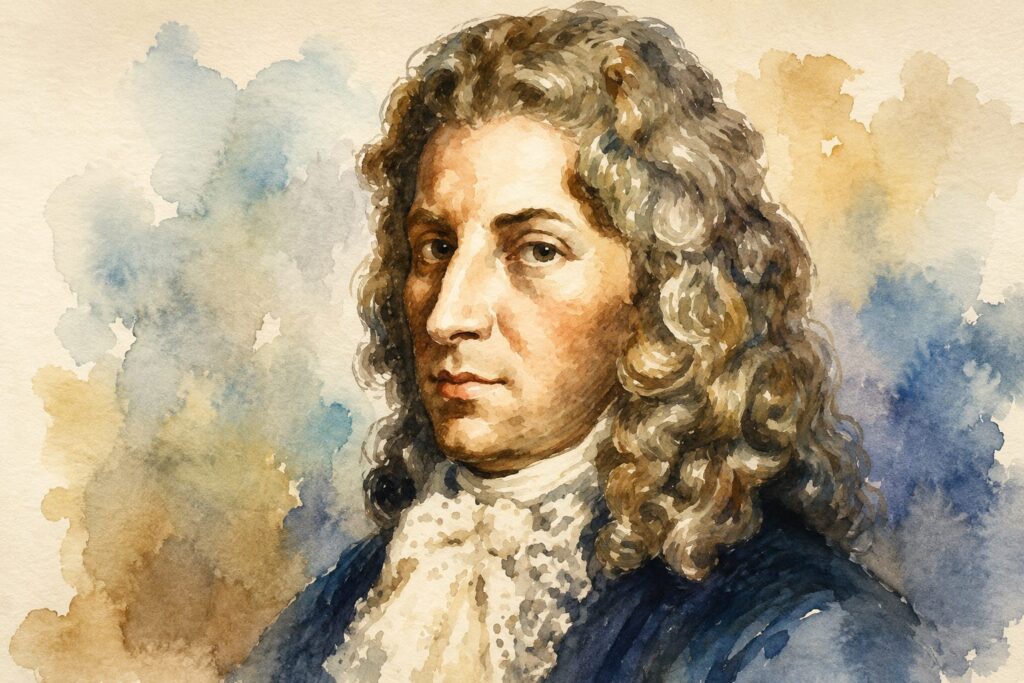
When the violin first emerged in the Italian courts of the seventeenth‑century, the instrument was still in its infancy. Its timbre was raw, its repertoire modest, and its technique largely uncharted. Into this embryonic world stepped a young violinist‑composer‑theorist from the Venetian Republic whose life would become a fusion of dramatic narrative, scientific inquiry and dazzling virtuosity: Giuseppe Tartini (1692–1770).
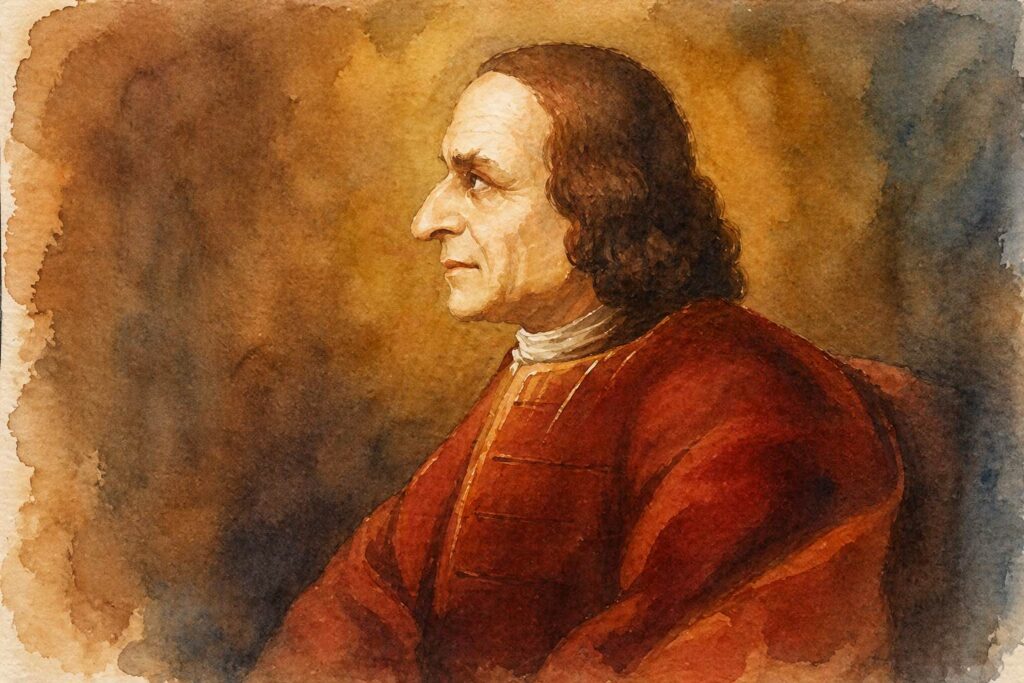
Early Life, Between Priests, Fencing and Forbidden Love
Giuseppe Tartini was born on 8 April 1692 in Pirano (today Piran, Slovenia), a town on the Istrian peninsula that then belonged to the Republic of Venice. His parents, Gianantonio, a Florentine of aristocratic lineage, and Caterina Zangrando, had hoped he would become a Franciscan friar, an expectation that placed him under the care of the local clergy and gave him a first, rudimentary musical education.
While his early schooling followed a path set by the Church, Tartini’s mind was drawn elsewhere. He studied law at the University of Padua (one of the oldest universities in the world) and became a respected fencer, a skill that would prove both a passion and a refuge later on. In 1710, following his father’s death, he married Elisabetta Premazore, a woman twenty years his senior, from a poorer background, and a favored confidante of the influential Cardinal Giorgio Cornaro. The cardinal, enraged by the union, charged Tartini with abduction, forcing the young composer‑lawyer to flee Padua. Disguised as a monk, he found sanctuary in the monastery of St. Francis in Assisi, where he could study the violin under the guidance of Bohuslav Matěj Černohorský without fear of arrest.
The Turning Point: Venice, Ancona, Prague and the Path to Mastery
Tartini’s time in Assisi was the crucible in which his violin technique crystallized. When he heard Francesco Maria Veracini perform in 1716, he was spurred to self‑imposed seclusion in a room in Ancona, where he could obsess over bowing in isolation. “He locked himself away in a room to practice,” notes the 18th‑century biographer Charles Burney, “to study the use of the bow in greater tranquility than the bustle of Venice would allow.”
By 1721, his reputation earned him the position of Maestro di Cappella at the Basilica di Sant’Antonio in Padua. His contract permitted him to play elsewhere, and so he accepted an appointment as master of the chapel of Count Kinsky in Prague (1723‑1726), exposing him to the Bohemian musical tradition. After returning to Padua, Tartini founded a violin school in 1728 that attracted pupils from across Europe and soon became a cornerstone of his legacy.
In 1740 he undertook a concert tour of Italy, cementing his standing as one of the most celebrated violinists of his time. By this point his oeuvre already included more than a hundred violin concertos and a staggering catalogue of sonatas, trios, quartets and sacred music such as a five‑part Miserere and a four‑part Salve Regina.
The Devil’s Trill Sonata; A Mythic Motif and a Technical Marvel
No other piece from Tartini’s output commands as much public fascination as the Violin Sonata in G‑minor, “The Devil’s Trill”. The sonata’s legend, popularized by Madame Blavatsky and later by modern writers, tells that Tartini dreamed of the Devil playing a violin at his bedside, and upon waking he was inspired to compose the work. Whether or not the dream actually existed, the music itself is an astonishing tour de force.
The sonata demands an extraordinary combination of double‑stop trills, rapid bow changes and sustained vibrato, pushing the limits of 18th‑century violin technique. For modern players, it remains a benchmark of virtuosity, requiring not only technical prowess but also an emotional depth that brings the mythic narrative to life.
Acoustic Pioneer, The Difference Tone
Tartini’s curiosity extended far beyond performance. In his laboratory‑like studies he discovered the difference tone (or Tartini tone), an acoustic phenomenon where a third, subtle pitch emerges when two tones are played simultaneously. This insight was of particular utility for string players, as the third can help in judging the intonation of double‑stop passages.
His discovery was published in Trattato di musica secondo la vera scienza dell’armonia (Padua, 1754), a treatise that set forth a mathematical theory of harmony, integrating algebraic and geometric principles. The work positioned Tartini as a pioneering figure in the nascent field of acoustics.
Theory and Ornamentation, A Legacy in Text
Tartini’s theoretical contributions are catalogued in three major treatises:
- Trattato di musica secondo la vera scienza dell’armonia (1754) – the foundational work on harmonic theory.
- Dissertazione dei principi dell’armonia musicale (1767) – an expansion that delved deeper into harmonic structure.
- Traité des agréments de la musique (1771) – a treatise on musical ornamentation, translated into French and later English. Though its influence waned during his lifetime, the work has become a valuable resource for historically informed performances, offering explicit guidance on bowing, ornamentation and cadenzas.
Modern editors, most notably Erwin Jacobi, have produced comprehensive editions of these treatises, enabling contemporary musicians to access Tartini’s practical advice with fidelity to his original manuscripts.
Musical Output, A Prolific and Versatile Catalog
Tartini’s compositional output defies the narrow categorization typical of many Baroque composers. His works include:
- Over 135 violin concertos and 100+ violin sonatas.
- A variety of chamber pieces: trios, quartets, and trio sonatas.
- Symphonic works such as a sinfonia in A.
- Sacred music: a Miserere, Stabat Mater, and several liturgical motets.
Cataloguing his compositions is notoriously difficult because Tartini did not date his manuscriptsand frequently revised them. Scholars Minos Dounias and Paul Brainard have attempted to divide his output into stylistic periods based solely on musical characteristics.
Today, 62 manuscripts reside at the Biblioteca Comunale Luciano Benincasa in Ancona, offering scholars a tangible link to Tartini’s creative process.
Influence of Giuseppe Tartini
Tartini’s influence is felt on multiple fronts:
- Performance Practice – His bowing technique and ornamentation guidelines are still taught to violinists seeking an authentic Baroque sound.
- Music Education – The school he founded in Padua attracted students from across Europe and laid groundwork for formalized violin pedagogy.
- Acoustics – The difference tone remains a cornerstone in studies of string resonance and tuning.
In his native town, Piran, a statue of Tartini stands in the central square (Tartini Square), a monument to his lasting impact. The local cathedral hosts an annual concert on his birthday, a testament to his enduring presence in Slovenian cultural memory.
Giuseppe Tartini in Popular Culture
The legend of the Devil’s Trill has seeped into the cultural imagination. It appears in:
- Literature – Madame Blavatsky’s Nightmare Tales, Daniel Silva’s The English Assassin, and Gerald Elias’s novel The Devil’s Trill.
- Anime – Descendants of Darkness (Yami no Matsuei) references his sonata.
- Music – Contemporary arrangements and performances continue to evoke the dramatic narrative of the Devil’s pact.
Fianl Thoughts
Giuseppe Tartini was more than a virtuoso; he was a scientist, a teacher, a composer, and a mythmaker. His life story, rooted in forbidden love, religious exile, and relentless pursuit of perfection, mirrors the very drama he created on the violin. Through his technical innovations, theoretical breakthroughs, and legendary compositions, Tartini left an indelible mark on the violin repertoire and the broader world of classical music.
For modern musicians and listeners alike, Tartini’s work remains a vibrant invitation to explore the intersection of artistic passion and intellectual curiosity. The Devil’s Trill continues to challenge and inspire, reminding us that the pursuit of mastery often dances on the edge of the mystical.
Sources
#GiuseppeTartini #BaroqueViolin #DevilsTrill #TartiniTone #MusicTheory #Acoustics #ItalianClassical #ViolinLegend #MusicHistory #HistoricalPerformance #VeniceMusic #PiranMusic #TartiniSchool #ViolinVirtuoso #AcousticScience