To listen to the music of Edvard Grieg (15 June 1843 – 4 September 1907) is to walk through the mist-shrouded valleys, rugged mountains, and fractured coastlines of nineteenth-century Norway. At a time when European classical music was heavily dominated by the structural and harmonic traditions of Germany, Grieg emerged as a revolutionary cultural force. He did not merely compose music; he translated the geography, folklore, and psychological identity of his homeland into a universal auditory language.
As a pivotal figure of the Romantic era, Grieg successfully bridged the gap between localized folk traditions and the grand, cosmopolitan concert halls of Europe. By embedding the idiosyncratic rhythms and modal inflections of traditional Norwegian music into classical frameworks, he became one of the foremost champions of musical nationalism. This article explores Grieg’s journey from a young student navigating the strict rigors of the Leipzig Conservatory to an internationally revered icon whose legacy fundamentally altered the trajectory of Western classical music.
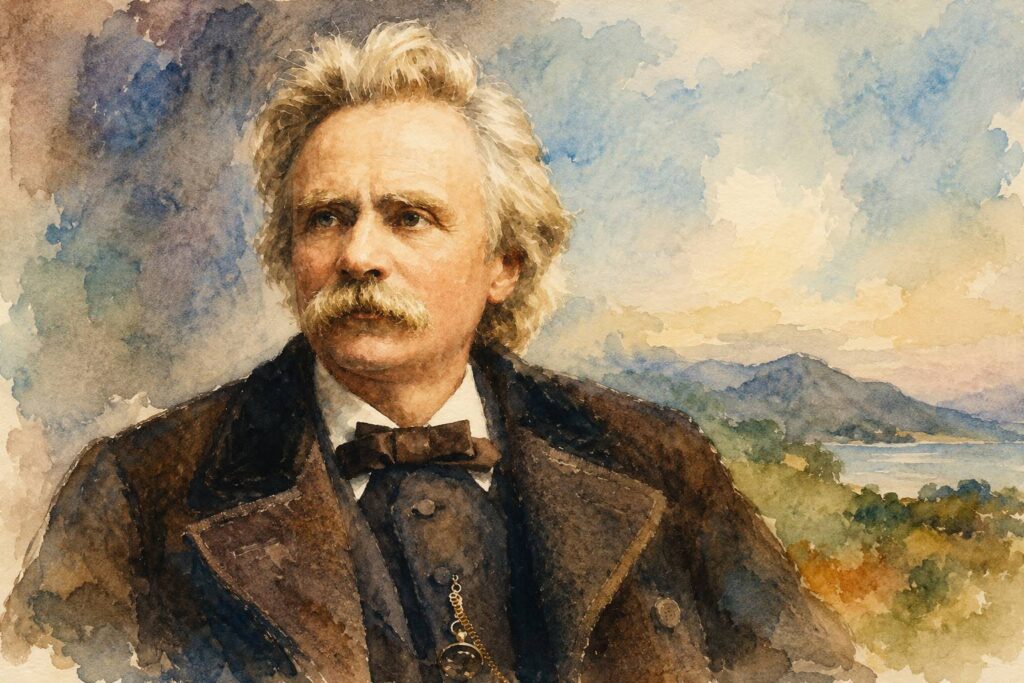
Formative Years and the German Instruction
Edvard Hagerup Grieg was born on June 15, 1843, in the coastal city of Bergen, Norway. He was raised in a culturally enriched, affluent household. His father, Alexander Grieg, was a merchant and British Vice-Consul in Bergen, while his mother, Gesine Judeithe Hagerup, was an accomplished pianist, teacher, and a central figure in Bergen’s musical circles. It was Gesine who introduced the young Edvard to the piano at the age of six, instilling in him a deep appreciation for the works of Wolfgang Amadeus Mozart, Frédéric Chopin, and Felix Mendelssohn.
Grieg’s prodigious talent quickly became apparent, though his early relationship with structured academics was fraught with resistance. He preferred improvising at the keyboard to performing rote technical exercises. The turning point of his youth occurred in the summer of 1858, when the legendary Norwegian violin virtuoso Ole Bull—often dubbed the “Nordic Paganini”—visited the Grieg family home. Recognizing the fifteen-year-old Edvard’s innate genius, Bull fiercely urged his parents to send him to Germany to pursue a formal musical education.
Later that autumn, Grieg enrolled at the Leipzig Conservatory, an institution founded by Felix Mendelssohn that stood as the epicenter of conservative European musical training. Grieg’s time in Leipzig was a complex period of intense discipline and personal trial. He despised the rigid, academic pedantry of many of his instructors, who favored strict adherence to traditional Germanic rules of harmony and counterpoint at the expense of creative originality. Furthermore, the grueling study regimen took a devastating toll on his health; in 1860, he contracted a severe case of pleurisy that resulted in the permanent collapse of his left lung—a respiratory infirmity that would plague him for the rest of his life.
Despite his dissatisfaction with the conservative curriculum, Leipzig exposed Grieg to world-class orchestral performances, allowing him to absorb the radical harmonic structures of Robert Schumann and Richard Wagner. He graduated in 1862 with excellent marks, fully equipped with the technical mastery required of a nineteenth-century composer, yet yearning for a voice that felt authentically his own.
The Awakening of Romantic Nationalism
Upon returning to Scandinavia, Grieg initially settled in Copenhagen, Denmark, which was then the undisputed cultural capital of the region. There, he fell under the tutelage of Niels Gade, the leading Danish composer of the era. While Gade encouraged the young composer, his style remained heavily indebted to German Romanticism, offering little room for the distinct Nordic identity Grieg wished to cultivate.
The catalyst for Grieg’s profound nationalist awakening arrived in the form of Rikard Nordraak, a charismatic young Norwegian composer whom Grieg met in 1864. Nordraak was fueled by an intense passion for Norwegian independence and folk culture. He openly rejected the cultural hegemony of Germany and Denmark, urging Grieg to look toward their native soil for artistic salvation. Together with other Scandinavian artists, they founded the Euterpe society, an organization dedicated to promoting the works of young northern composers.
Grieg later remarked on the profound impact of this friendship:
“The scales fell from my eyes; it was only through him that I learned to understand the Norwegian folk song and my own nature.”
Tragically, Nordraak died of tuberculosis in 1866 at the age of twenty-three, but the nationalist spark he ignited within Grieg would define the remainder of the composer’s career.
During this transformative Copenhagen period, Grieg also fell deeply in love with his first cousin, Nina Hagerup, a gifted soprano with an extraordinarily expressive voice. Despite fierce opposition from both families due to their close consanguinity, the couple married in June 1867. Nina became Grieg’s ultimate muse, serving as the definitive interpreter of his numerous lieder (songs). Her vocal style directly shaped his approach to vocal composition, ensuring that his melodies remained intimately tied to the nuances of human emotion and poetic text.
                          [The Artistic Journey of Edvard Grieg]
                                            │
               ┌────────────────────────────┴────────────────────────────┐
               ▼                                                         ▼
       [Leipzig Conservatory]                                  [Nordic Awakening]
  • Mastered Germanic counterpoint                         • Met Rikard Nordraak (1864)
  • Absorbed Schumann & Wagner                             • Embraced native folk traditions
  • Gained technical orchestral rigor                      • Found his muse in lyric soprano Nina Hagerup
The Masterworks: Forging a Distinctive Catalog
Grieg’s compositional output spans orchestral suites, chamber music, choral pieces, and an expansive library of miniatures for the piano. Unlike his contemporary Richard Wagner, who dealt in massive, operatic mythologies, Grieg excelled as a miniaturist—a master of capturing profound, fleeting atmospheric landscapes within concise musical structures.
The Piano Concerto in A minor, Op. 16 (1868)
Written during a summer retreat in Søllerød, Denmark, this monumental work catapulted Grieg onto the international stage. The concerto immediately signals its striking originality from its opening bars: a dramatic, cascading timpani roll followed by a plunging, virtuosic piano motif. While the work shares structural similarities with Robert Schumann’s piano concerto in the same key, it is infused with distinct Norwegian folk elements.
The main themes borrow heavily from the Halling—a traditional, athletic Norwegian folk dance—and make frequent use of the “Grieg motive,” a melodic progression consisting of a falling minor second followed by a falling major third. When Franz Liszt read through the manuscript in Rome in 1870, he famously shouted in admiration, “Keep on, I tell you! You have the right stuff in you, and don’t let them intimidate you!”
The Peer Gynt Suites, Op. 46 and Op. 55 (1875)
In 1874, the celebrated Norwegian dramatist Henrik Ibsen invited Grieg to compose incidental music for his satirical verse play, Peer Gynt. Though Grieg found the cynical, anti-heroic nature of the text challenging to set to music, the collaboration yielded what would become his most globally recognizable creations.
Grieg later extracted eight movements from the play to form two orchestral suites. Pieces such as “Morning Mood” (Morgenstemning) utilize a pentatonic scale to evoke a serene sunrise, while “In the Hall of the Mountain King” (I Dovregubbens hall) builds a relentless, claustrophobic crescendo through a simple, chromatic bass theme that accelerates into an orchestral frenzy. Through these works, Grieg permanently etched the imagery of Norwegian folklore into the collective global psyche.
┌───────────────────────────────────────────────────────────────────────────┐
│                     HIGHLIGHTS OF THE PEER GYNT SUITES                    │
├───────────────────────┬───────────────────────────────────────────────────┤
│ Movement              │ Core Musical Narrative                            │
├───────────────────────┼───────────────────────────────────────────────────┤
│ "Morning Mood"        │ A pastoral flutework evoking a serene, glowing     │
│                       │ dawn, shifting dynamically across strings.       │
├───────────────────────┼───────────────────────────────────────────────────┤
│ "Aase's Death"        │ A somber, deeply elegiac string movement utilizing │
│                       │ stepped chromatics to capture profound grief.     │
├───────────────────────┼───────────────────────────────────────────────────┤
│ "Anitra's Dance"      │ A seductive, rhythmic mazurka driven by pizzicato │
│                       │ strings and triangles, showcasing exoticism.     │
├───────────────────────┼───────────────────────────────────────────────────┤
│ "In the Hall of the   │ A grotesque march accelerating in tempo and pitch │
│  mountain king"       │ to simulate an escape from subterranean trolls.   │
└───────────────────────┴───────────────────────────────────────────────────┘
The Lyric Pieces (Lyriske stykker)
Spanning ten volumes and comprising sixty-six short works for solo piano published between 1867 and 1901, the Lyric Pieces serve as an intimate musical diary of Grieg’s artistic life. These character pieces range from impressionistic nature studies like “To Spring” (Til våren) and “March of the Trolls” (Troldtog) to direct distillations of traditional music like the Hardanger fiddle imitations in “Wedding Day at Troldhaugen” (Bryllupsdag på Troldhaugen). The collection was wildly popular among amateur and professional pianists alike, solidifying Grieg’s reputation as a domestic musical poet.
Sanctuary at Troldhaugen and Later Life
By the late 1870s, Grieg had grown weary of the constant travel, administrative duties, and social demands of urban life in Oslo (then called Christiania) and Bergen. He required isolation to commune directly with nature and focus entirely on composition. In 1885, he and Nina moved into Troldhaugen (“The Troll’s Hill”), a picturesque, Victorian-style villa built on the banks of Lake Nordås just south of Bergen.
Troldhaugen served as Grieg’s artistic sanctuary for the final twenty-two years of his life. To ensure absolute quiet while working, he constructed a small, single-room composition cabin nestled on the water’s edge, furnished only with a piano, a desk, and a view of the peaceful fjord.
                       [Lake Nordås Shoreline]
                                 │
                     [Grieg's Composition Cabin]
                     ├── Piano & Writing Desk
                     └── Panoramic Window Facing Fjord
                                 │
                     [Main Villa: Troldhaugen]
                     └── Residence & Performance Space
During this mature period, Grieg composed the Holberg Suite, Op. 40, a brilliant homage to the Enlightenment-era playwright Ludvig Holberg. The suite beautifully blends French Baroque dance forms—such as the Gavotte, Sarabande, and Rigaudon—with nineteenth-century Romantic string textures.
As his international fame swelled, Grieg embarked on numerous concert tours across Europe, performing as a conductor and pianist in London, Paris, Berlin, and Vienna. Despite his deteriorating health and the severe limitations of his respiratory system, he maintained a grueling schedule, driven by a deep desire to share the voice of Norway with the world.
Importance in Romantic Music and Global Legacy
Edvard Grieg’s historical significance within the Western classical canon cannot be overstated. He was not merely a regional figure; he was an innovator whose harmonic experiments laid the groundwork for the radical stylistic transitions of the early twentieth century.
Breaking the Austro-German Hegemony
For over a century, European classical music was governed by the structural paradigms established by Bach, Mozart, Beethoven, and Brahms. Grieg, along with contemporaries like Pyotr Ilyich Tchaikovsky in Russia and Antonín Dvořák in Bohemia, shattered this monopoly. He demonstrated that legitimate, high-art music could be derived from non-Germanic folklore, paving the way for future generations of composers to explore their own national heritages without feeling subverted by traditional academic expectations.
Harmonic Precursor to Impressionism
Grieg’s late works display an adventurous approach to harmony that directly influenced French Impressionism. His use of unresolved dominant sevenths, parallel fifths, and modal scales—common in Norwegian folk music but forbidden in strict classical counterpoint—deeply fascinated Maurice Ravel and Claude Debussy. Debussy, despite occasionally leveling witty, journalistic barbs at Grieg’s music, clearly absorbed the Norwegian’s atmospheric textures into his own keyboard works.
Furthermore, Grieg’s rhythmic vitality and stark, unvarnished treatments of folk themes directly anticipated the modernist ethnomusicological investigations of Béla Bartók and Igor Stravinsky.
Conclusion: The Immortal Voice of Norway
On September 4, 1907, Edvard Grieg succumbed to chronic heart and respiratory failure at a hospital in Bergen at the age of sixty-four. His death plunged Norway into deep national mourning. An estimated forty thousand people lined the streets of Bergen for his state funeral, weeping for the man who had given their burgeoning nation its definitive artistic identity. In accordance with his wishes, his ashes were interred alongside his beloved wife Nina within a grotto carved into a cliff face overlooking the waters at Troldhaugen.
Grieg succeeded because he understood that the most profound universal truths are often found in the deeply specific realities of one’s own home. He did not seek to rewrite the laws of symphonic architecture; instead, he sought to capture the pristine beauty of the North and present it to the world as an offering. Over a century after his death, his music remains an unassailable monument of the Romantic era—an eternal, resonant echo of the mountains and fjords he loved so dearly.
References
- Carley, Lionel. (2006). Grieg and Delius: A Musical Friendship. London: Marion Boyars Publishers.
- Foster, Beryl. (2007). The Songs of Edvard Grieg. Woodbridge: Boydell Press.
- Grimley, Daniel M. (2006). Grieg: Music, Landscape and Norwegian Identity. Woodbridge: Boydell Press.
- Schjelderup-Ebbe, Dag. (1964). Edvard Grieg 1858–1867: With Special Reference to the Evolution of his Harmonic Style. Oslo: Universitetsforlaget.
- Benestad, Finn, and Schjelderup-Ebbe, Dag. (1988). Edvard Grieg: The Man and the Artist. Translated by William H. Halverson and Leland B. Sateren. Lincoln: University of Nebraska Press.
#EdvardGrieg #ClassicalMusic #RomanticEra #MusicHistory #NorwegianComposer #PeerGynt #PianoConcerto #RomanticNationalism #Troldhaugen #NordicCulture #OrchestralMusic #Musicology #NineteenthCentury #PianoMusic #FolkTraditions