A three-movement piano journey through Hell, Purgatory and Paradise arrives at the Estonian Theatre and Music Museum on 11 September.
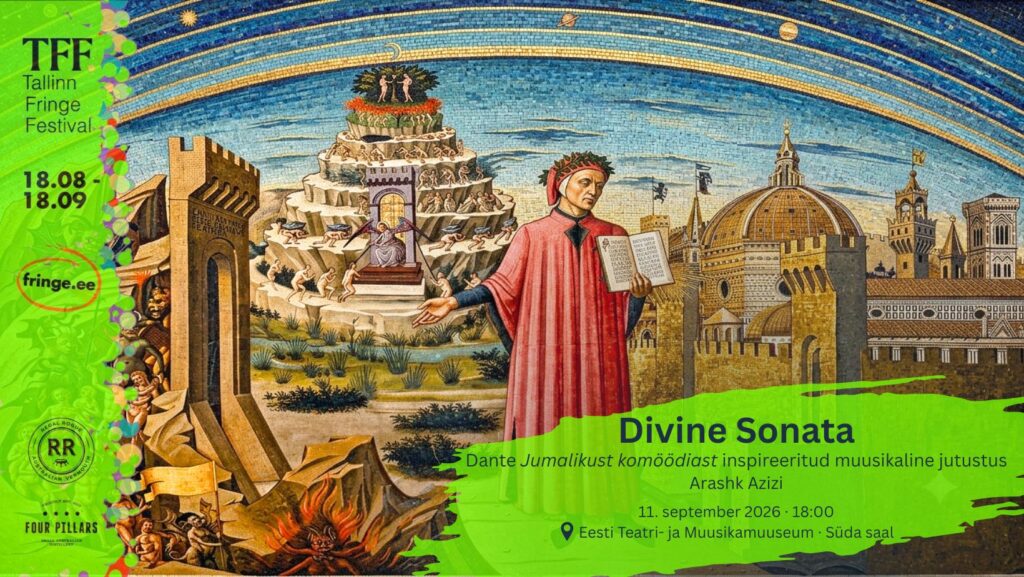
On 11 September, composer and pianist Arashk Azizi will bring his Divine Sonata to the Estonian Theatre and Music Museum in Tallinn, offering audiences a performance that places contemporary piano music in direct dialogue with one of literature’s most enduring works: Dante Alighieri’s Divine Comedy.
The concert, taking place in the museum’s historic Süda Hall, will combine live solo piano with recorded recitations of passages from Dante’s poem. Before each movement, the audience will hear selected sections of the text, providing a narrative doorway into the world that inspired the music. Rather than treating the literary source as background information, the performance uses Dante’s words to prepare listeners for each stage of the musical journey.
At the centre of the evening is Arashk Azizi’s three-movement Divine Sonata, originally commissioned for the Dante Festival in Ravenna, Italy. The work received its world premiere on 26 September 2024 at the Basilica di San Francesco, just steps from Dante’s tomb.
From Inferno to Paradiso
The structure of Divine Sonata follows Dante’s three realms: Inferno, Purgatorio and Paradiso. But Azizi’s interpretation is not an attempt to simply illustrate the medieval poem. Instead, the composer uses Dante’s journey as a framework for reflecting on the contemporary world.
The opening movement, Inferno, is rooted in C minor and descends into increasingly dense and dissonant musical territory. Its opening bitonal clash of A major and C minor establishes the central conflict between darkness and light, while successive variations become progressively more turbulent. In Azizi’s modern interpretation, Dante’s Hell becomes the human world of war, oppression and violence.
Purgatorio, in D minor, offers no easy resolution. Its unstable harmonies, irregular rhythms and sudden shifts reflect a state of uncertainty: the struggle to move beyond suffering without yet knowing whether redemption is possible. For Azizi, this is the space between devastation and peace; a restless human attempt to change, heal and begin again.
The final movement, Paradiso, moves into A major. The music gradually becomes more transparent and luminous, with ascending melodic lines and increasingly open textures. Rather than presenting Paradise as a distant theological ideal, Azizi imagines it as something more fragile and human: the possibility of peace after devastation, and the moment when the world finally becomes quiet.
Dante’s words return to the concert hall
The addition of recorded narration gives the Tallinn performance a distinctly theatrical dimension. Passages from Dante’s Divine Comedy, in Henry Wadsworth Longfellow’s English translation, will be heard before each movement, recalling the literary origins of the composition while allowing the audience to follow the dramatic progression of the work.
The spoken passages also serve as a reminder that Divine Sonata is ultimately a work about storytelling. The recurring musical theme travels through all three movements, changing character as the journey progresses; from the darkness of Inferno, through the instability of Purgatorio, toward the clarity of Paradiso.
More than seven centuries after Dante began writing his great poem, the basic question at the heart of the journey remains remarkably contemporary: how does humanity move from suffering toward peace?
Azizi’s answer is not presented as a historical reconstruction of Dante. Instead, Divine Sonata treats the Divine Comedy as a living framework through which the anxieties and hopes of the present can be heard. Hell becomes the violence humans create, Purgatory becomes the difficult process of transformation, and Paradise becomes the fragile possibility of peace.
The Tallinn concert therefore promises an evening somewhere between a piano recital, a literary encounter and a contemporary meditation; with Dante’s words opening the doors and the piano carrying the audience through.
Divine Sonata will be performed by Arashk Azizi on Friday, 11 September 2026, at 18:00 at the Estonian Theatre and Music Museum, Süda Hall, Müürivahe 12, Tallinn, as part of Tallinn Fringe Festival 2026. The performance lasts approximately one hour. Tickets are available from €15, with group tickets and a ticket option including the Divine Sonata CD also available.
#DivineSonata #ArashkAzizi #Dante #DivineComedy #ContemporaryClassical #PianoMusic #ClassicalMusic #PianoRecital #MusicAndLiterature #DanteAlighieri #Inferno #Purgatorio #Paradiso #TallinnConcert #TallinnFringeFestival