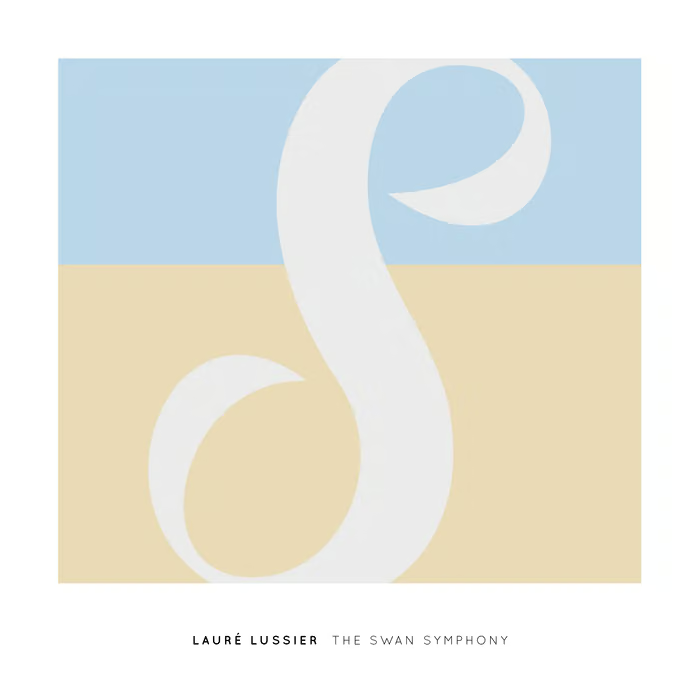
The Swan Symphony by Lauré Lussier is the third and final work of the composer’s Symphonic Triptych, a sprawling electro-orchestral narrative that has gradually unfolded since Strange Symphony in July 2024 and The Orphana Symphony in March 2026. Across these works, Lussier has been building something that is part symphonic cycle, part psychological drama, and part imagined mythology: a story about a Composer who creates two works, abandons them, and must eventually confront what he has left behind. In its booklet, the composer describes the triptych as an “electro orchestral work in three acts,” in which electroacoustic forces, orchestra and chamber writing converge into a single expansive form.
I have followed Lussier’s work for some time now, from Strange Symphony to Driftsways and The Orchestral Alchemy of Lauré Lussier, and there is a particular quality in his music that keeps drawing me back: he does not seem interested in choosing between composition and sound design. He treats the orchestra almost as a living sound environment. In Driftsways, I wrote about his tendency to treat classical forms as conceptual frameworks rather than rigid structures, allowing themes to return transformed rather than simply repeated. In my earlier portrait of his work, I described his compositions as “living architectures,” where acoustic and electronic sounds are sculpted together rather than functioning as separate worlds.
The Swan Symphony takes that idea further, but this time the architecture has a voice.
The Symphonic Triptych: Three Works, One Story
The first two works of the cycle can be understood as two abandoned creations belonging to the same Composer. Strange Symphony is the first to face the world: a work born out of an almost grotesque mixture of desire, creation and abandonment. Lussier describes it as the “Bastard Song,” a creation left behind and eventually exposed to an audience waiting to judge and condemn it.
The Orphana Symphony takes the opposite path. Concealed from the world after what happened to its sibling, it remains in exile, wandering through the remnants of the concert hall and slowly revealing itself. It is described as a work emerging from “quiet candor and fragile innocence,” carrying its own identity rather than simply existing as the rejected counterpart to Strange Symphony.
The third work changes the perspective completely. This time, the Composer speaks, and that distinction is crucial.
The first two symphonies are, in a sense, the creations speaking through music. The Swan Symphony is the creator finally forced to confront them. Its four movements, The Hallowed Silence Abideth, A Witnessless Burden Borne, The Hidden Vow Enshrouded, and Return Transfigured, form the final act of the triptych. It is therefore not simply a third symphony. It is a reckoning.
The Swan Symphony by Lauré Lussier: Music Emerging from Silence
The composition, spanning almost forty minutes, begins with atmosphere rather than melody. There is a sense of space before there is a sense of music. Then comes the timpani: sudden, almost violent roars emerging from that atmospheric field.
The timpani gradually become more insistent. Their trills draw closer together, increasing the pressure almost imperceptibly until percussion begins to accumulate around them. Eventually the full orchestra enters, and what initially sounded like an isolated disturbance develops into a complicated sonic mayhem.
Then, almost as quickly as it appeared, it collapses. A snare drum remains. A moment of quiet follows.
This opening is a good example of what I find most interesting in Lussier’s approach to orchestration. He does not necessarily build intensity by presenting a conventional theme and developing it. Instead, he builds it through density, timbre, frequency and spatial perception. The orchestra becomes a physical environment. Sound accumulates until the listener feels the pressure of it, and then that pressure suddenly disappears. It is not quite chaos. It is a controlled instability.
The orchestra returns gradually, with woodwinds, electronics and eventually strings creating a soft bed of sound. But it is not an entirely calming one. Something remains unsettled underneath the surface. The harmonies do not comfortably belong to traditional diatonic tonality, yet neither do they simply declare themselves atonal. They exist somewhere between these systems, or perhaps outside the need to define the distinction at all.
This is one of Lussier’s strengths. He does not seem particularly interested in asking whether a passage is tonal or atonal. He is interested in what the harmony does to the atmosphere. That difference matters.
When Speech Becomes Music
Eventually, after another brief pause, we hear a human voice. It is not singing. It is not an operatic recitative. It is reading. And yet it does not feel like someone simply talking over a musical background.
This is where the electroacoustic side of Lussier’s writing becomes particularly effective. The music follows the voice, filling the gaps and completing what feels like a hidden melody within the spoken words. Electronic sounds begin to imitate the contours and nuances of the voice itself, eventually developing into their own melodic fragments and sustained musical pads.
The voice becomes another instrument. This is particularly important because the Composer’s text is not decorative narration. It is the dramatic substance of the work. In the second movement, he recalls that “not one, but two rose from within me,” describing the two symphonies as “twin brethren bound by all, save fate itself.”
The music and the text therefore describe the same psychological state from two different directions.
The voice tells us what happened and the orchestra tells us what it feels like.
That distinction is what prevents the spoken passages from becoming a conventional narrated soundtrack. The recitation is scattered through the musical texture, while electronics and orchestral colors react to it. The words are absorbed into the soundscape.
Lussier has explored this relationship between narration and music before. In Darkness, for example, narration becomes almost another instrumental layer rather than the centerpiece, and in Strange Symphony he pushed the symphonic form toward something closer to a multilingual storyteller. Here, however, the technique becomes dramatically necessary. The Composer is finally speaking, but even his speech cannot exist independently from the music. He is trapped inside his own creation.
A Symphony Without Hard Borders
Another striking feature of The Swan Symphony is its treatment of form. The movements do not feel as though they end and restart. They merge into one another. They are detachable in the sense that each has its own dramatic identity, but the boundaries remain porous.
This is consistent with Lussier’s broader approach to musical architecture. In Driftsways, I noted how he uses traditional concepts such as variation and rondo more as conceptual frameworks than strict formal blueprints. The same principle is present here, but the effect is even more organic.
The symphony flows rather than locks itself into place. There are no obvious formal doors saying: this movement ends here, the next one begins now. Instead, one psychological state mutates into another.
And this is perhaps the best way to understand Lussier’s symphonic writing. His forms are not always built from blocks. They are built from transformations.
That is why the electronic component feels so natural. Electronics allow sounds to blur, stretch, decay, mutate and reappear without the physical limitations of an acoustic instrument. But Lussier does not use technology simply to make the orchestra sound futuristic. He uses it to extend the orchestra’s ability to transform.
From Bartók to Stockhausen and Beyond
Listening to The Swan Symphony, I hear something of the late Romantic tradition beneath the experimental surface. There is still the dramatic instinct of the symphonic poem, the psychological weight of the late nineteenth-century orchestra and the expressive density of early modernism.
But Lussier refuses to remain there.
The musical lineage that comes to my mind stretches from Bartók to Stockhausen; not because Lussier sounds exactly like either composer, but because he occupies that fascinating territory where orchestral thinking begins to dissolve into a broader conception of sound.
There is also something distinctly contemporary about his refusal to make the electronic and acoustic components compete for attention. They belong to the same organism.
The orchestra is not accompanied by electronics. The orchestra and electronics are the same world.
This is also where my earlier description of Lussier as an “orchestral alchemist” still feels appropriate. His work is less concerned with presenting a beautiful orchestral object than with transforming raw sonic material into narrative.
The Burden of Creation
The strongest aspect of The Swan Symphony, however, is not its orchestration or its harmonic language. It is the psychological idea behind it.
The Composer’s confession gradually becomes darker. He remembers the moment when he decided that only one symphony should be heard. He remembers the judgment approaching, the laughter, the mockery, and then his decision to conceal one of the works.
This is where the symphony becomes more than a story about two compositions. It becomes a story about artistic responsibility.
What happens when a creator abandons something he has brought into existence? What happens when artistic judgment becomes fear? And what happens when the thing we hide refuses to remain hidden?
The final movement, Return Transfigured, gives the story its most beautiful turn. Years have passed. The Composer has aged. Then the hidden work returns, and he recognizes it “at the very first note.” But it is no longer what it was. Silence has changed it. Exile has marked it. Its sound has been transformed by the years in which it was not allowed to exist.
This is perhaps the most powerful metaphor in the entire triptych. Music changes when it is suppressed. Ideas change when they are denied. And perhaps people do too.
A Swan, Finally Free
The ending of The Swan Symphony by Lauré Lussier is not an epic resolution. There is no grand orchestral gesture, no final burst of triumph. Instead, Lussier arrives at something much more intimate: a long, sustained chord held almost motionlessly in time.
An organ-like sound accompanies the strings, while the harmony itself barely moves. The chord remains, but the sound around it does not. Layers slowly appear, disappear and shift in prominence, subtly changing the timbre of the orchestra without changing the underlying harmonic ground. What we hear is not harmonic progression, but timbral transformation.
It is as though the music has stopped moving forward and has instead begun to breathe.
The longer the chord remains, the less important its individual components become. Strings, organ and the surrounding layers gradually merge into one sustained field of sound. There is something deeply cathartic in this suspension. After all the tension, remembrance, regret and remorse of the preceding movements, the music no longer needs to struggle toward a conclusion.
It simply lets go. And then, it fades.
For me, this is where the title The Swan Symphony finally makes complete sense. The swan does not need to rise triumphantly above the orchestra. Its freedom is quieter than that. The final chord feels like a soul finally released from the weight it has carried; not through victory, but through acceptance. After so much silence, exile and remorse, the music reaches its final state not by resolving everything, but by allowing everything to disappear. It is a moment of freeing the soul.
#TheSwanSymphony #LaureLussier #LauréLussier #ContemporaryClassical #ElectroOrchestral #ElectroacousticMusic #ModernSymphony #ContemporaryMusic #ExperimentalMusic #SoundArt #OrchestralMusic #ModernComposition #SymphonicMusic #MusicReview #NewMusic
This post was written as part of a music promotion service provided by Tunitemusic, based on information submitted by the artist.