The harpsichord is an instrument in the family of stringed keyboard instruments. It was developed in the 1400s during the late Middle Ages and has been used as a popular instrument ever since, experiencing a massive modern renaissance in concerts, recordings, and digital media today.
Introduction to the Harpsichord
The harpsichord has one or two sets of strings that are plucked by a small quill or plectrum. Unlike a modern piano where a hammer strikes the string, the harpsichord mechanism uses a vertical wooden strip called a “jack.” When you press down on one of the keys, the jack rises, causing the plectrum to pluck the string to make a crisp, bright sound.
The strings themselves are stretched across a rigid wooden frame called the “harpsichord’s case.” The instrument was invented in the 15th century and reached its peak popularity throughout the 17th and 18th centuries. Culturally, the word “harpsichord” is often tied to the Italian phrase “cimbalo di cipresso”, which historically translates to “cypress wood clavier,” referencing the lightweight wood favored by early Mediterranean builders. Ultimately, the harpsichord remains defined as a keyboard instrument that produces its distinct, shimmering sound specifically by plucking strings with plectra rather than striking them.
The history of the harpsichord
Most likely developed in the late Middle Ages, the earliest written records of the harpsichord date back to the late 14th century. By the 16th century, Italian harpsichord builders began producing incredibly light instruments with low-tension brass stringing, known for their clean, articulate sound perfect for rapid ornamentations.
Beginning in the late 16th century, the Southern Netherlands adopted a new strategy, particularly under the leadership of the famous Ruckers family of Antwerp. With sturdier case construction and greater tension steel treble stringing, Flemish harpsichords had a much more potent, resonant, and distinct tone. The Ruckers family was also responsible for introducing the first harpsichords with two keyboards (manuals), which were originally used for easy pitch transposition.
By the 18th century, harpsichord builders in other regions across Europe modeled their craft after these Flemish instruments. In France, double keyboards were modified to operate various string choirs independently or coupled together via a mechanical shove, resulting in a much more musically adaptable instrument (known as “expressive doubles”). Among all harpsichords, those from the height of the French tradition—created by master artisans like the Blanchet family and Pascal Taskin—are among the most admired in history and are frequently utilized as models for newer instruments today. Meanwhile, the Kirkman and Shudi companies in England created large, complex harpsichords with a deeply rich, powerful sound and sophisticated pedal controls. In Germany, creators like Hieronymus Albrecht Hass expanded the instrument’s sonic range even further by adding rare sixteen-foot (an octave lower) and two-foot (two octaves higher) string choirs. In the modern era, these massive German creations have served as structural models for contemporary custom builders.
However, a massive shift occurred when Bartolomeo Cristofori created the first fortepiano in Florence around 1700. The early fortepiano uses percussion; the strings are not plucked but rather pounded with leather-covered paper hammers. The fortepiano gets its name from its revolutionary ability to vary the dynamic volume based purely on the player’s touch. Contrary to the harpsichord, which maintains a uniform volume regardless of how hard a key is struck, the fortepiano offered unprecedented emotional expression. Because of this, the harpsichord was almost entirely replaced by the piano by the late 18th century. It virtually vanished from popular culture for most of the 19th century, with the rare exception being its ongoing usage in opera houses to accompany simple dialogue (secco recitative), though the piano sometimes replaced it even there.
In the early twentieth century, attempts to restore the harpsichord relied heavily on modern piano technology. Builders constructed heavy instruments with massive iron frames and thick strings, championed by legendary revivalists like the virtuoso Wanda Landowska. However, ideas regarding harpsichord construction experienced a significant shift beginning in the middle of the 20th century. Visionary builders like Frank Hubbard, William Dowd, and Martin Skowroneck worked rigorously to revive the original, lightweight woodworking and acoustics of the Baroque era. The current global scene is entirely dominated by harpsichords constructed using this kind of historically informed building technique, yielding instruments that sound exactly as Bach or Couperin would have expected.
Why do some harpsichords have two rows of keys?
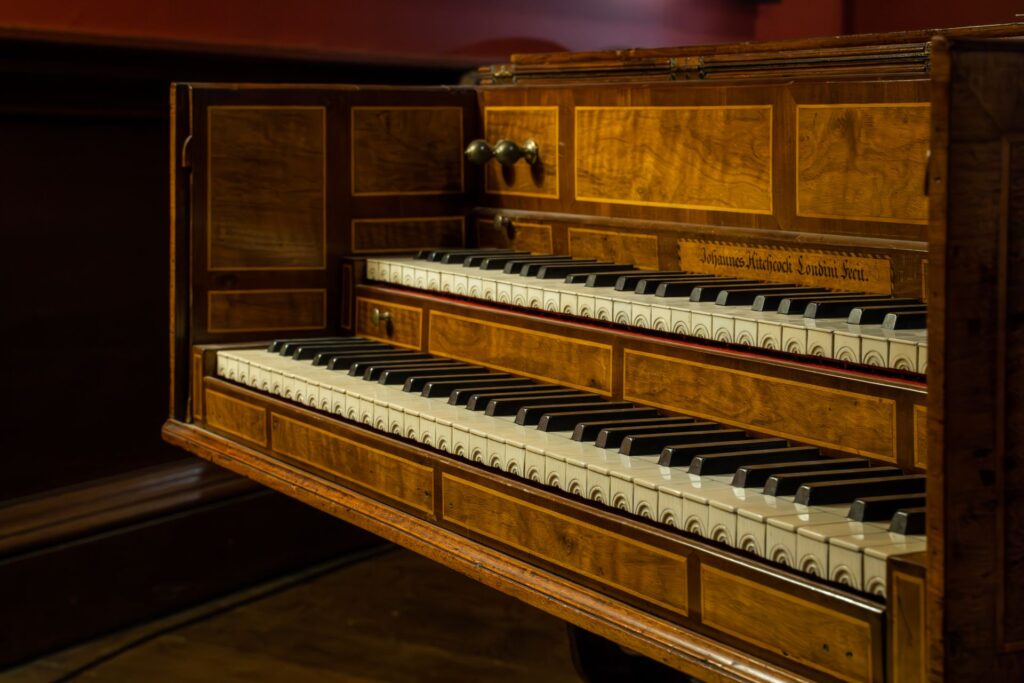
When looking at a large harpsichord, the most striking feature you might notice is that it has two rows of keys stacked on top of each other, looking much like a small pipe organ. In the musical world, these rows are called “manuals,” and an instrument featuring them is known as a double-manual harpsichord.
Because pressing a harpsichord key always results in the same volume, players cannot just press harder to play louder. Instead, builders invented the double-manual system to solve this limitation in two major ways:
- Contrasting Volumes (Terraced Dynamics): The two rows are usually hooked up to different sets of strings inside the case. Typically, the lower manual plays a “loud” set of strings, while the upper manual plays a “soft” set. This allows the player to instantly switch between a bold, robust volume and a quiet, intimate whisper simply by moving their hands between the two rows, a technique essential for Baroque echo effects.
- Playing Complex Interlocking Melodies: In certain pieces, such as J.S. Bach’s famous Goldberg Variations, the music requires the left and right hands to play in the exact same pitch range at the same time. On a single keyboard, the player’s fingers would constantly collide and trip over each other. Having two rows allows the hands to cross past each other smoothly on separate levels without any physical interference.
Additionally, many double-manual harpsichords feature a “manual coupler.” By gently shifting the upper keyboard forward or backward, the two rows lock together. When the coupler is engaged, pressing a single key on the lower row automatically pulls down the corresponding key on the top row, plucking multiple sets of strings simultaneously to create a massive, symphonic wall of sound.
Famous pieces composed for the harpsichord
The harpsichord is an eye-catching instrument that was popular during the Renaissance, Baroque, and Classical periods, until it was supplanted by a new creation, the fortepiano. Its popularity and use had expanded throughout Europe by the 1600s, and all great composers created masterworks for it. Here is an expanded compilation for you to appreciate, ranging from early solitary keyboard Italian compositions to complex contrapuntal works and diverse tuning temperaments:
- J. S. Bach: Goldberg Variations, BWV 988 (A monumental double-manual workout)
- Giovanni Picchi: Danze et Toccata (Early 17th-century Italian rhythmic brilliance)
- Louis and François Couperin: Pièces de Clavecin (The pinnacle of French elegance and ornamentation)
- Domenico Scarlatti: Keyboard Sonatas (Including K.2, K.208, and K.213, featuring Spanish folk influences)
- J. S. Bach: Concerto for Harpsichord No. 1 in D minor, BWV 1052 (One of the earliest true keyboard concertos)
- Joseph-Nicolas-Pancrace Royer: La Marche des Scythes (Famous for its wild, aggressive, and orchestral fury)
- G. F. Handel: Brockes Passion, HWV 48 & Aminta e Fillide, HWV 83 (Featuring the aria “E un foco quel d’amore,” highlighting the harpsichord’s crucial role in vocal accompaniment)
- Jean-Philippe Rameau: Nouvelles Suites de Pièces de Clavecin (Including the famous birdsong imitation, Le Rappel des Oiseaux)
- L. V. Beethoven: Sonatas per il clavicembalo o piano-forte, Nos. 1, 8 (Pathétique) & 14 (Moonlight) (Early editions explicitly stated they could be played on either instrument during the transition era)
- J. S. Bach: Concerto for two harpsichords (in modern day interpreted as concerto for violin and oboe)
Harpsichord in the classical era
The majority of the traditional harpsichord repertoire was composed during the instrument’s first historical blooming, the Renaissance and Baroque eras. However, it did not disappear overnight when the classical era arrived.
Harpsichord music was written and regularly performed by two of the Classical era’s most important composers, Joseph Haydn (1732-1809) and Wolfgang Amadeus Mozart (1756-1791). For both prodigies, the harpsichord and its quiet cousin, the clavichord, played an important role in their early careers. Despite their later encounters with the evolving fortepiano, they continued to use and respect them for the rest of their lives. In fact, historical accounts suggest that Mozart may have performed his final keyboard concerto (the “Coronation” Concerto No. 26 in D major) on the harpsichord during his travels.
However, with the rapid introduction and mass production of the piano, harpsichords faced a formidable opponent by the middle of the 18th century and ultimately lost widespread appeal to the piano’s mellower, sustaining, and dynamic tone.
The revival of the harpsichord
The piano nearly entirely replaced the harpsichord throughout the 19th century. Yet, composers drew back to the instrument in the 20th and 21st centuries as they looked for unique textures and variety in the sounds at their disposal. Pioneering harpsichordists Violet Gordon-Woodhouse (1872–1951) and Wanda Landowska (1879–1959) were at the forefront of the instrument’s rebirth under the initial influence of early music pioneer Arnold Dolmetsch.
This sparked a wave of new classical repertoire. Francis Poulenc composed his famous Concert champêtre (written in 1927–1928) specifically for Landowska’s powerful neo-traditional instrument, and Manuel de Falla composed a celebrated chamber concerto for the harpsichord. Later in the century, the Double Concerto by Elliott Carter was written to intentionally contrast the starkly different sounds of the harpsichord, the piano, and two chamber orchestras. György Ligeti also pushed the instrument to its mechanical limits with his frantic, rhythmic 1968 piece Continuum.
Today, the harpsichord’s revival has reached far beyond the classical concert hall. In modern pop culture and media, the instrument’s distinct timbre is widely used in film scores, video game soundtracks, and indie music to evoke mystery, horror, or vintage baroque pop aesthetics. With a booming global early music scene, high-quality digital sampling, and affordable kit-building options, the harpsichord is more accessible and widely heard today than it has been in centuries.
#music #instrument #Musicalinstrument #harpsichord #baroquemusic #keyboard