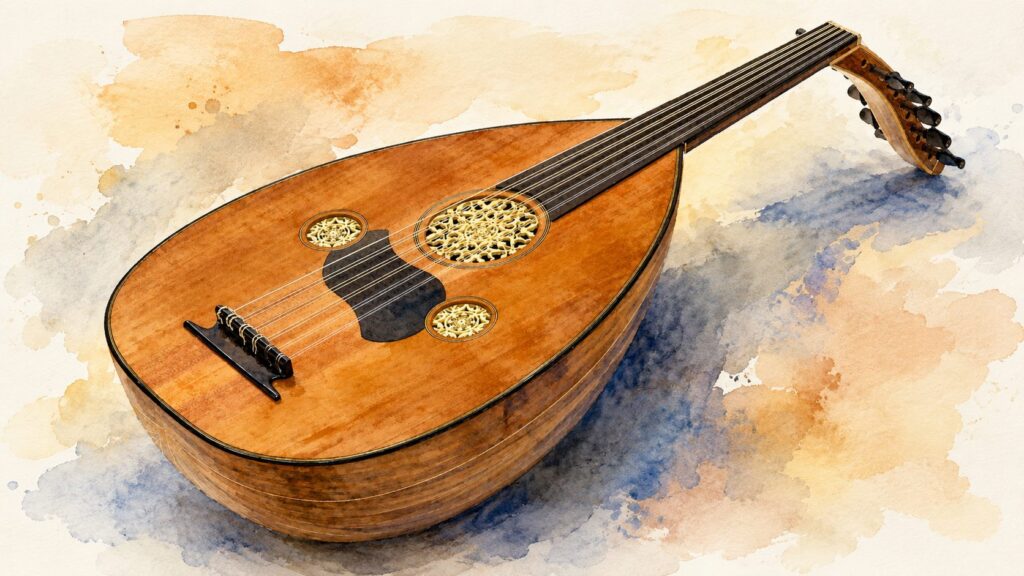
Often hailed as the “King of Instruments” (Sultan al-Awtar) across the Middle East and North Africa, the oud (Arabic: العود) occupies a unique apex in global history of music. With its pear-shaped wooden body, fretless neck, deeply vaulted bowl, and resonant warmth, this ancient chordophone has served as the foundational pillar of Eastern classical music systems for over two millennia. More than merely a musical tool, the oud has functioned as a philosophical laboratory, a vehicle for theoretical innovation, and the direct ancestor of European string traditions that shaped Western art music.
Ancient Roots and Organology
The word oud translates literally to “wood” or “thin strip of wood” in Arabic, a name historically adopted to distinguish an instrument crafted with a soundboard of flexible wooden staves from earlier skin-topped chordophones such as the ancient barbat.
Mesopotamian and Persian Ancestry
Organologists trace the lineage of short-necked lutes to the ancient civilizations of the Fertile Crescent. Cylindrical seals from Mesopotamia dating to the Akkadian period (c. 2350–2150 BCE) depict early chordophones with small soundboxes and long necks. Over centuries, these primitive forms evolved into the Persian barbat and Central Asian lute variants.
By the 7th century CE, during the rise of the Islamic Golden Age, the instrument underwent a profound structural transformation in cities like Mecca, Medina, and Baghdad. Craftsmen replaced skin tops with thin, lightweight wooden soundboards, introduced sophisticated bracing inside the bowl, and refined the characteristic backward-angled pegbox (mutaqaddim).
Physical Construction
The modern classical oud is comprised of four primary anatomical components:
- The Bowl (Al-Qasa): Constructed from 15 to 25 curved wooden ribs (staves) glued edge-to-edge, typically made from walnut, maple, mahogany, or rosewood.
- The Soundboard (Al-Wajh): Made from lightweight spruce or cedar, pierced by one main circular soundhole (shamsiyya) and often two smaller soundholes (qamariyyat), intricately carved with filigree rosettes.
- The Fretless Neck (Al-Ebra): A short, smooth neck allowing microtonal dexterity, microtonal slides (zand), and complex pitch bending impossible on fretted instruments.
- Strings and Tuning: Typically strung with 10 to 12 strings arranged in 5 or 6 courses (pairs), tuned in fourths. Historically plucked with an eagle feather quill, contemporary performers use a thin flexible plectrum called a reesha.
   [ Pegbox ] ──> Angles backward at ~90 degrees
       │
   [ Neck ] ────> Short, fretless fingerboard
       │
   [ Soundboard ] ─> Spruce top with carved rosettes (Shamsiyya)
       │
   [ Bowl ] ────> Vaulted body made of curved wooden staves
Offspring and Regional Variants
As the oud traveled along trade networks and imperial expansion routes, it diversified into distinct regional configurations while simultaneously spawning new families of stringed instruments across continents.
European Lute (Lauto / Laúd)
During the Moorish presence in Al-Andalus (modern-day Spain) between the 8th and 15th centuries, the oud crossed into Western Europe. Medieval European musicians adopted the instrument verbatim, preserving its Arabic name through translation (al-ʿūd became laute in German, luth in French, lute in English, and laúd in Spanish). Over time, European luthiers added fixed gut frets to accommodate polyphonic harmony and Western equal temperament, turning the fretless monophonic oud into the polyphonic Renaissance lute.
Regional Families
Within its traditional geography, the instrument evolved into several specialized styles:
| Regional Style | Physical Characteristics | Sound Profile & Playability |
| Arabic Oud (Syrian, Egyptian, Iraqi) | Larger bowl, deeper resonance, spruce tops, traditional microtonal bridge setups. | Dark, warm, full-bodied low-end; suited for deep maqam exploration. |
| Turkish / Armenian Ud | Slightly smaller body, shorter scale length, tuned higher (usually a whole step higher). | Bright, crisp, highly articulate; built for rapid ornamentation and fast tempos. |
| Maghrebi Oud (Kwitra / Flissa) | Narrower body, traditionally four courses, preserved in North Africa. | Sharp, percussive timbre, optimized for Andalusian classical traditions. |
| Persian Barbat (Resurrected) | Re-engineered in the 20th century with a smaller body and longer neck. | Focused mid-range, distinct attack, favored in contemporary Iranian art music. |
Influence on Music Theory and Philosophy
The history of Middle Eastern music theory (Ilm al-Musiqa) is inseparable from the geometry of the oud. Medieval Islamic polymaths utilized the instrument’s fingerboard as a physical, quantifiable model to explain acoustics, intervals, and cosmic harmony.
“The string of the oud is a ladder between the physical world of acoustics and the spiritual world of the soul.”
— Al-Farabi (Kitab al-Musiqi al-Kabir, c. 935 CE)
Theoretical Foundation
- Al-Kindi (c. 801–873 CE): The “Philosopher of the Arabs” was among the first to transcribe music using string notation on the oud. He added a fifth string to the traditional four-string instrument, associating each string with a element, season, cardinal direction, and bodily humor.
- Al-Farabi (c. 872–950 CE): In his monumental treatise Kitab al-Musiqi al-Kabir (“The Great Book of Music”), Al-Farabi used the positions on the fingerboard of the oud to define mathematical ratios for microtonal intervals, laying the foundation for the Maqam system, the modal framework governing music across the Persian, Arab, and Turkish worlds.
- Safi al-Din al-Urmawi (c. 1216–1294 CE): Formulated the 17-tone systemic scale based on oud fret positions, establishing a rigorous acoustic model that bridged Eastern theoretical traditions for centuries.
By serving as the baseline for microtonal division (including quarter tones and microtonal inflections), the oud allowed theorists to systematically categorize over 100 modes (maqamat), cementing its position as the ultimate musical tool of the Islamic world.
Masters of the Instrument: Historical to Contemporary
The trajectory of oud performance is marked by towering virtuosos who transformed the instrument’s technique, repertoire, and socio-cultural standing across centuries.
Historical Luminaries
     8th–9th Century                20th Century                     21st Century
 [ Ziryab (Al-Andalus) ] ──> [ Munir Bashir (Iraq) ] ──> [ Anouar Brahem / Naseer Shamma ]
   Added 5th string &          Pioneered modern solo       Innovated modern technique &
   feather quill technique       concert improvisation      cross-genre jazz synthesis
- Ziryab (Abu al-Hasan ‘Ali ibn Nafi’, 789–857 CE): A legendary polymath and musician from Baghdad who migrated to the Umayyad Court of Córdoba. Ziryab revolutionized performance by introducing a fifth string (representing the soul), substituting wood plectrums with eagle quills, establishing the first music conservatory in Europe, and codifying the Andalusian Nuba suite structure.
- Ibrahim and Ishaq al-Mawsili (8th–9th Century): Father and son court musicians in Abbasid Baghdad who codified classical vocal accompaniment techniques on the oud, setting royal standards for performance excellence.
20th-Century Pioneers
- Munir Bashir (1930–1997): The Iraqi master who single-handedly elevated the oud from an ensemble accompaniment instrument to a solo concert-hall soloist across the globe. Bashir developed a meditative, contemplative style of solo improvisation (taqsim), incorporating silence, subtle dynamics, and microtonal nuance influenced by Western classical minimalism and Indian classical ragas.
- Jamil Bashir (1920–1977): Brother of Munir Bashir, renowned for his blinding speed, pristine technical facility, and authoritative pedagogical books that remain standard conservatory texts across the Arab world today.
- Farid al-Atrash (1910–1974): The Syrian-Egyptian virtuoso and film icon known as “King of the Oud,” who introduced explosive, percussive showmanship and popularized the instrument across mainstream Arab cinema and popular culture.
- Sharif Muhiddin Targan (1892–1967): A Turkish-Ottoman virtuoso who combined Western classical cello techniques with traditional Ottoman ud playing, introducing left-hand thumb position techniques and hyper-virtuosic polyphonic compositions.
Contemporary Innovators
- Naseer Shamma (b. 1963): Iraqi virtuoso, educator, and founder of the prestigious Bait al-Oud (House of the Oud) conservatories across Cairo, Abu Dhabi, Baghdad, and Alexandria. Shamma is famous for inventing a single-handed technique for disabled musicians and expanding the instrument’s physical range with customized 8-string ouds.
- Anouar Brahem (b. 1957): Tunisian performer and composer who brought the instrument into the global contemporary jazz sphere via the ECM record label. Brahem’s sparse, cinematic compositions bridge Middle Eastern modal traditions with chamber jazz and European improvisation.
- Dhafer Youssef (b. 1967): Tunisian vocalist and master player who fuses vocal vocalizations with electric jazz, electronic music, and avant-garde jazz textures.
- Le Trio Joubran: Three Palestinian brothers (Samir, Wissam, and Adnan Joubran) from a multi-generational family of luthiers who created the world’s premier oud trio ensemble, orchestrating intricate polyphonic arrangements for three ouds.
Global Impact and Modern Renaissance
In the 21st century, the oud is experiencing a dynamic global renaissance. While historically restricted to regional folk and classical ensembles, the instrument has broken through genre boundaries into modern orchestral compositions, jazz fusion, world ambient music, and cinematic film scoring.
Contemporary composers frequently employ the instrument to evoke complex emotional landscapes, leveraging its unique voice—capable of both deep melancholic resonance (tarab) and rhythmic drive. Through digital archives, international luthiery competitions, and specialized academies like Bait al-Oud, the instrument continues to inspire new generations of performers from Western Europe to East Asia, proving that the ancient “King of Instruments” remains a living, evolving pillar of human musical expression.
Sources:
- Al-Farabi, A. N. (c. 935). Kitab al-Musiqi al-Kabir [The Great Book of Music]. Cairo: Dar al-Kutub al-Arabiya.
- Farmer, H. G. (1937). The Organon of the Arabs: A History of Arabian Music and Instruments. London: Luzac & Co.
- Touma, H. H. (1996). The Music of the Arabs. Translated by Laurie Schwartz. Portland, OR: Amadeus Press.
- Marcus, S. L. (2007). Music in Egypt: Experiencing Music, Expressing Culture. New York: Oxford University Press.
- Wright, O. (1978). The Modal System of Arab and Persian Music A.D. 1250–1300. London: Oxford University Press.
- Shamma, N. (2000). The Evolution of the Oud and Its Musical Theoretical Foundations. Cairo: Higher Institute of Arab Music.
#Oud #MusicalInstruments #MiddleEasternMusic #WorldMusic #Lute #MusicHistory #Ethnomusicology #ArabicMusic #TurkishMusic #Maqam #AcousticMusic #NaseerShamma #AnouarBrahem #Ziryab #BaitAlOud