Georges Bizet (25 October 1838 – 3 June 1875) was a French Romantic composer whose tragic, early death cut short one of the most promising careers in music history. Known throughout the world as the creator of Carmen, one of the most widely performed and recognized works in all of opera, Bizet was a master of lyricism, vivid orchestration, and dramatic storytelling. Though his genius was largely unrecognized during his short lifetime, today he stands among the most celebrated French Composers of the nineteenth century.
Bizet possessed a remarkable gift for combining local color, melodic charm, and deep emotional psychological realism. His innovative theatrical sensibilities bridged the romanticism of the mid-1800s with the emerging realism (verismo) that would dominate Italian and European opera at the turn of the century.
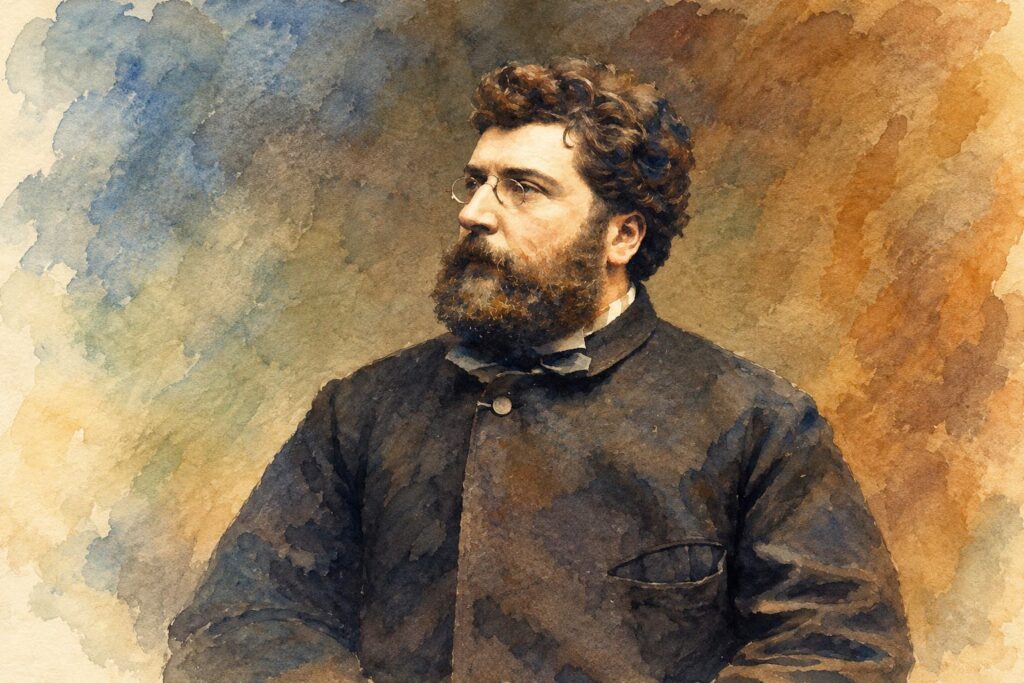
Early Life and Prodigious Talent
Born Alexandre-César-Léopold Bizet in Paris, he was known simply as Georges from childhood onward. Raised in an extraordinarily musical household, his father, Adolphe Bizet, was a singing teacher, and his mother, Aimée Delsarte, was an accomplished pianist, young Georges demonstrated an exceptional ear and memory for music almost immediately.
In 1848, just before his tenth birthday, Bizet was admitted to the prestigious Paris Conservatoire, which waived its strict age restrictions to enroll the prodigy. There, he studied under leading figures such as Antoine François Marmontel, Pierre Zimmermann, François Benoist, and Charles Gounod, the latter becoming a central mentor and stylistic influence on the young composer.
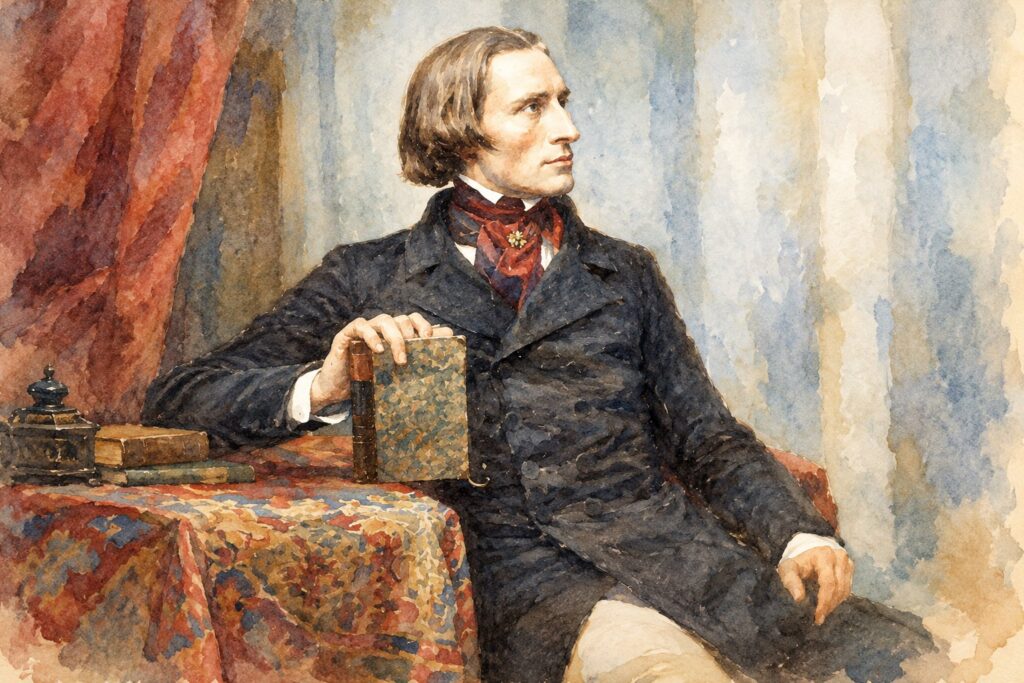
Bizet excelled rapidly at the Conservatoire, capturing top prizes for organ, fugue, and piano sight-reading. His talent as a pianist was so formidable that Franz Liszt, after watching the young Bizet sight-read one of his most intricate keyboard compositions flawlessly, declared Bizet to be one of the finest pianists in Europe.
At just seventeen years old, Bizet composed his Symphony in C Major (1855). Though heavily influenced by Gounod’s own symphony, Bizet’s work radiated fresh youthful energy, classical balance, and vibrant melodic inventiveness. Astonishingly, the piece was set aside, undiscovered, and unperformed until 1935, when it rapidly entered the standard orchestral repertoire as a youthful masterpiece.
In 1857, Bizet earned France’s highest musical honor for young students: the coveted Prix de Rome for his cantata Clovis et Clotilde. The award provided a government pension and allowed him to spend nearly three years living and studying at the Villa Medici in Rome. These Italian years were among the happiest and most creatively peaceful of his life, away from the intense commercial pressures of the Parisian musical establishment.
The Parisian Struggle: Hardships and Mid-Career Works
Upon returning to Paris in 1860, Bizet faced the harsh economic reality confronting most young music composers of the era. The Parisian musical scene was fiercely conservative, dominated by grand opera, light operettas, and established names. Theater directors were hesitant to risk production costs on new works by young local creators.
To earn a living, Bizet spent countless hours doing tedious musical hackwork, arranging piano scores, transcribing orchestral music, and writing commercial piano arrangements for popular sheet music publishers. These grueling demands left him exhausted and severely limited the time he could devote to original compositions.
Despite these struggles, Bizet produced several notable works during the 1860s and early 1870s:
- Les Pêcheurs de perles (The Pearl Fishers, 1863): Set in ancient Ceylon (Sri Lanka), this opera highlighted Bizet’s passion for exotic settings and rich orchestral colors. Though its initial run received a cool response from critics, Hector Berlioz famously praised its score. The opera features the beloved tenor-baritone duet “Au fond du temple saint,” which remains one of the most famous operatic duets in music history.
- La Jolie Fille de Perth (The Fair Maid of Perth, 1867): Based loosely on Sir Walter Scott’s novel, this opera displayed Bizet’s evolving talent for musical characterization, though it achieved only moderate success.
- Jeux d’enfants (Children’s Games, 1871): A charming, twelve-movement suite written for piano four-hands, reflecting Bizet’s delicate touch and mastery of miniature musical forms.
- L’Arlésienne (1872): Commissioned to write incidental music for Alphonse Daudet’s play, Bizet produced a score of rare brilliance. Although the play itself failed at the box office, Bizet arranged his music into an orchestral suite that achieved instant acclaim, featuring famously dramatic movements like the “Farandole” and the “Prélude”.
In his personal life, Bizet married Geneviève Halévy in 1869, the daughter of his former Conservatoire teacher Fromental Halévy. The couple had a son, Jacques, in 1872. However, Bizet’s domestic life was frequently strained by financial anxieties, self-doubt, and recurring bouts of severe throat ailments. His service in the French National Guard during the Franco-Prussian War (1870–1871) further disrupted his creative work.
Georges Bizet’s Masterpiece: Carmen
In 1872, the directors of the Opéra-Comique in Paris commissioned Bizet to write a full-length opera. Working with librettists Henri Meilhac and Ludovic Halévy, Bizet chose an adaptation of Prosper Mérimée’s gritty novella Carmen.
Set in Seville, Spain, the opera broke radically with established traditions. Instead of nobility, mythology, or historic heroes, Carmen focused on working-class figures: cigarette factory workers, soldiers, smugglers, and bullfighters. The central character, Carmen—a free-spirited, fiercely independent Romani woman—refuses to surrender her liberty to any man, eventually driving her jealous ex-lover, Don José, to murder her outside a bullfighting arena.
Bizet threw himself into the score with unprecedented intensity. He infused the music with vivid Iberian rhythms, sultry melodies, and striking orchestral textures. Numbers such as the seductive “Habanera” (“L’amour est un oiseau rebelle”) and the rousing “Toreador Song” (“Votre toast, je peux vous le rendre”) showcased his genius for memorable, character-driven songwriting.
The Scandalous Premiere and Tragedy
Carmen premiered at the Opéra-Comique on March 3, 1875. From the start, the work shocked bourgeois audiences and critics alike. The depiction of raw passion, female sexual agency, criminal behavior, and a violent murder on stage was deemed morally offensive and unsuited for a family-oriented theater. Critics denounced the music as overly complex, lacking tune, and devoid of traditional morality.
Heartbroken and convinced that his greatest creation was a total failure, Bizet fell into severe depression. Already suffering from chronic heart and throat conditions, his health rapidly declined. On June 3, 1875, exactly three months after the opera’s premiere and on his sixth wedding anniversary, Georges Bizet died of a fatal heart attack at the age of 36.
He passed away without ever knowing that Carmen would become one of the most successful, acclaimed, and iconic operas ever composed.
Key Musical Characteristics and Innovations
Bizet’s output reflects a unique position among nineteenth-century French Composers. His writing is characterized by several distinct qualities:
- Dramatic Realism (Verismo): Bizet brought unfiltered human emotions, psychological complexity, and socio-economic realities to the operatic stage. He rejected artificial sentimentality in favor of high dramatic tension and stark realism.
- Exoticism and Local Color: Bizet had a rare ability to evoke distant lands and cultures through sound. Though he rarely traveled outside France, his use of Spanish dance rhythms (habanera, seguidilla) in Carmen and orientalist melodies in Les Pêcheurs de perles set new standards for musical color.
- Mastery of Orchestration: Influenced by Hector Berlioz and Charles Gounod, Bizet utilized the orchestra not merely as an accompaniment, but as an active narrator. His instrumental combinations are noted for their clarity, transparency, warmth, and dramatic punch.
- Melodic Inventiveness: Bizet’s melodies are celebrated for their immediate lyricism, rhythmic vigor, and emotional honesty.
Importance and Enduring Legacy
Georges Bizet’s influence on music history is profound. Shortly after his death, major musical figures recognized the revolutionary nature of Carmen. Pyotr Ilyich Tchaikovsky predicted that Carmen would become the most popular opera in the world, while philosopher Friedrich Nietzsche praised its clarity and warmth as a vital antidote to the heavy, dense music dramas of Richard Wagner. Johannes Brahms reportedly attended twenty performances of Carmen, admiring its craftsmanship and emotional power.
Bizet’s realistic representation of working-class struggles directly inspired the Italian verismo movement, paving the way for composers like Giacomo Puccini (La Bohème, Tosca), Pietro Mascagni (Cavalleria Rusticana), and Ruggero Leoncavallo (Pagliacci).
Today, Carmen remains a cornerstone of the global operatic canon, continuously performed across opera houses worldwide and adapted into film, ballet, and modern theatrical productions. Coupled with his Symphony in C, L’Arlésienne Suites, and Les Pêcheurs de perles, Bizet’s small but extraordinary body of work guarantees his place among the immortal giants of Western classical music.
Major Works Overview
| Title | Year | Genre | Key Highlights |
| Symphony in C Major | 1855 | Orchestral | Youthful masterpiece composed at age 17; discovered in 1935. |
| Le Docteur Miracle | 1857 | Operetta | Winner of the Offenbach operetta competition. |
| Les Pêcheurs de perles | 1863 | Opera | Features the famed duet “Au fond du temple saint”. |
| La Jolie Fille de Perth | 1867 | Opera | Romantic opera based on Walter Scott’s novel. |
| Jeux d’enfants | 1871 | Piano Duet / Suite | Twelve charmful pieces describing children’s games. |
| L’Arlésienne Suites | 1872 | Incidental / Orchestral | Contains famous movements such as “Prélude” and “Farandole”. |
| Carmen | 1875 | Opera | Masterpiece of operatic realism; includes “Habanera” & “Toreador Song”. |
Sources
- Curtiss, Mina. Bizet and His World. Vienna House, 1974.
- Dean, Winton. Georges Bizet: His Life and Work. J.M. Dent & Sons, 1975.
- Macdonald, Hugh. Bizet. Oxford University Press, 2014.
- Encyclopædia Britannica. Georges Bizet | French Composer & Opera Innovator. Britannica Publications, 2026.
- Lacombe, Hervé. The Keys to French Opera in the Nineteenth Century. University of California Press, 2001.
#GeorgesBizet #Carmen #ClassicalMusic #Opera #FrenchComposers #MusicHistory #RomanticEra #PrixDeRome #PearlFishers #LArlesienne #OperaLovers #ClassicalComposers #MusicComposers #Verismo #ParisConservatoire