Alessandro Marcello (1 February 1673 – 19 June 1747) was a distinguished Venetian nobleman, polymath, and composer whose multifaceted genius left an indelible mark on European music history. The older brother of the famous legal magistrate and composer Benedetto Marcello, Alessandro moved with equal grace through the worlds of music, literature, mathematics, philosophy, and fine arts. Operating within the glittering cultural milieu of the Republic of Venice during the late Baroque period, he created works of enduring emotional power while maintaining a life dedicated to aristocratic civic duty and scholarly inquiry. Though his musical output was relatively compact compared to full-time professional music composers of his era, its extraordinary quality—most notably exemplified by his immortal Oboe Concerto in D minor—ensured his place among the most respected figures in classical music.
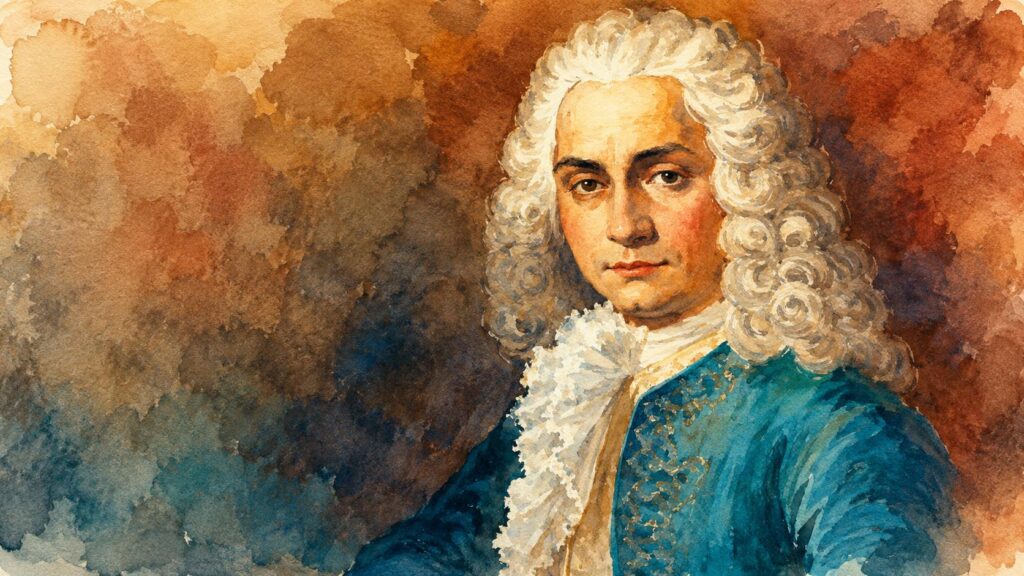
Biography: The Polymath Patrician of Venice
Born into one of Venice’s most exalted patrician families, Alessandro Marcello enjoyed all the privileges and expectations of the Venetian nobility. His father, Agostino Marcello, was a respected senator and avid violinist who fostered an environment of rigorous intellectual and artistic curiosity at home. His mother, Paolina Capello, nurtured the family’s literary and musical pursuits, ensuring that both Alessandro and his younger brother Benedetto received top-tier instruction from a young age.
Unlike professional musicians who depended on church posts or noble courts for employment, Alessandro Marcello was financially independent. As a Venetian nobleman, he was expected to participate in the governance of the Republic, serving in various administrative bodies, including the prestigious Great Council. This social standing meant he did not publish or perform for commercial gain; instead, he embraced the identity of a cultured, high-born dilettante—a term that, in the 18th century, carried prestige and signified a scholar who pursued art purely for love of beauty and intellectual devotion.
Alessandro Marcello Timeline (1673–1747)
├── 1673: Born in Venice into patrician nobility
├── 1698: Active in Venetian literary and musical academies
├── 1708: Publishes "12 Cantatas" under pseudonym Eterio Stinfalico
├── ~1717: Oboe Concerto in D minor published in Amsterdam
├── 1715–1717: J.S. Bach transcribes the Oboe Concerto for keyboard (BWV 974)
├── 1738: Publishes "La Cetra" (6 concertos for winds and strings) in Augsburg
└── 1747: Dies in Venice at the age of 73
Marcello’s intellectual curiosity extended far beyond composition. He was a genuine Renaissance man:
- Academies and Pseudonyms: He was an active member of the Accademia degli Animosi and later the Accademia dell’Arcadia in Rome. In accordance with Arcadian tradition, he adopted the pastoral pseudonym Eterio Stinfalico, under which many of his musical scores and literary treatises were published.
- Scientific Inquiry: Marcello engaged in deep studies of mathematics, geometry, optics, and philosophy, corresponding with scholars across Europe.
- Visual Arts: He was an accomplished painter and draftsman, occasionally decorating his own manuscripts and creating portraits of his contemporaries.
Despite his administrative duties and varied intellectual pursuits, music remained Marcello’s primary artistic outlet. He held regular musical academies (accademie) at his Venetian palace, where his chamber works, cantatas, and concertos were performed for elite international audiences. He spent his final years quietly in Venice, passing away on June 19, 1747, at the age of 73.
Musical Oeuvre and Creative Style
Alessandro Marcello’s musical catalog is characterized by refined lyricism, spatial clarity, and a subtle bridge between late Baroque contrapuntal rigor and early Galant expressiveness. Because he was not driven by commercial deadlines, every surviving work demonstrates meticulous craft.
                  [Alessandro Marcello's Core Corpus]
                                   │
      ┌────────────────────────────┼────────────────────────────┐
      ▼                            ▼                            ▼
[Chamber Vocal]            [Solo Sonatas]            [Concerti & Orchestral]
• 12 Cantatas (1708)       • 12 Violin Sonatas, Op. 1  • Oboe Concerto in D minor
  (Self-authored lyrics)     (Expressive cantabile)    • "La Cetra" Concertos (1738)
1. The Cantatas (12 Cantate a voce sola, 1708)
Published in Venice under his pastoral pseudonym Eterio Stinfalico, this collection of 12 solo cantatas for voice and basso continuo highlights Marcello’s dual talents as poet and musician. Marcello wrote both the poetic texts and the musical settings. The cantatas explore themes of pastoral love, longing, and philosophical reflection, featuring delicate recitatives and fluid, song-like arias that prefigure the cantabile style of the mid-18th century.
2. Chamber Instrumental Works
Marcello composed a set of 12 Violin Sonatas (Op. 1), which display a profound understanding of string technique and expressive ornamentation. His sonatas avoid empty bravura in favor of clean phrase structures, rhythmic grace, and noble melodies.
3. La Cetra (The Lyre, c. 1738)
Published in Augsburg around 1738, La Cetra is a collection of six concertos written for unusual combinations of wind instruments (oboes and flutes) alongside string orchestra and basso continuo. The set is notable for its innovative use of woodwind sonorities:
- Marcello treats woodwinds not merely as doubling instruments for the violins, but as independent soloist voices with distinct tonal colors.
- The collection showcases rich contrapuntal dialogues, unexpected harmonic modulations, and a graceful Venetian charm that rivals the orchestral works of Antonio Vivaldi and Tomaso Albinoni.
The Immortal Oboe Concerto in D Minor
Among all of Alessandro Marcello’s compositions, one work stands as a monument in woodwind literature: the Oboe Concerto in D minor (also preserved in C minor). Composed around 1708–1716 and published in Amsterdam by Jeanne Roger in 1717, it is widely considered one of the finest concertos ever written for a solo wind instrument.
            [Concerto in D minor Structure]

  I. Allegro moderato ──► Crisp, rhythmic ritornello; driving energy
  II. Adagio           ──► Soaring cantabile aria; emotional core
  III. Presto          ──► Light, fugal 3/8 meter; playful conclusion
Movement Structure
- I. Allegro moderato: The opening movement establishes a firm, rhythmic ritornello in the string orchestra. The oboe enters with clean, aristocratic lines, engaging in a transparent dialogue with the ensemble.
- II. Adagio: The heart of the concerto. Set in 3/4 meter, the movement features a long, unbroken, highly expressive melody sung by the oboe over a steady, pulsing bass line in the accompaniment. It radiates a quiet melancholia and spiritual stillness that has captivated listeners for centuries.
- III. Presto: A lively, lighthearted finale in 3/8 meter that uses contrapuntal imitation and rapid scalar passages, bringing the concerto to a brilliant, buoyant conclusion.
J.S. Bach‘s Transcendent Keyboard Rendition (BWV 974)
The immense quality of Alessandro Marcello’s Oboe Concerto captured the attention of Johann Sebastian Bach. During his years as court organist and concertmaster at Weimar (1708–1717), Bach devoted substantial time to studying and transcribing Italian concertos. Prince Johann Ernst of Saxe-Weimar had returned from travel in the Netherlands carrying published scores from Amsterdam print houses, introducing Bach to the latest Venetian instrumental style.
Recognizing the architectural purity of Marcello’s concerto, Bach made a complete transcription for solo harpsichord, cataloged today as BWV 974.
    [Original Oboe Line]                 [Bach's BWV 974 Keyboard Adaptation]
 Long, sustained blown notes   ──►   Written-out trills, turns, & appoggiaturas
 Simple basso continuo bass    ──►   Richly voiced left-hand counterpoint & pulse
Analysis of Bach’s Keyboard Transformation
Bach did not merely copy Marcello’s score note-for-note; he translated a wind instrument’s vocal expression into the idiomatic language of the harpsichord:
- Sustained Sound vs. Decay: An oboe can sustain a single long note with continuous breath, whereas a harpsichord note begins decaying immediately after a string is plucked. To solve this, Bach filled Marcello’s long melodic holds with breathtaking ornamentation—trills, mordents, turns, and delicate chromatic passing tones.
- Harmonic Realization: Bach fully realized the implicit harmonies of Marcello’s basso continuo, adding inner counterpoint voices that gave the keyboard version richer harmonic density while preserving Marcello’s original melodic contour.
- The Adagio Transformed: In Bach’s hands, the second movement Adagio became a masterpiece of keyboard expressiveness. The contrast between the left hand’s steady pulse and the right hand’s intricate, floating ornamentations creates an atmosphere of profound emotional intimacy.
Historical Impact: Bach’s keyboard transcription preserved Marcello’s music in German organ and harpsichord circles, ensuring that even when original orchestral parts went out of print, the composition survived in the repertoire of 18th-century keyboard masters.
The Misattribution Saga: Alessandro vs. Benedetto
For over two centuries, the Oboe Concerto in D minor suffered one of the most famous cases of identity confusion in classical music.
                          Attribution History

  1717 Publication ──► Printed in Amsterdam under surname "Marcello"
                             │
                             ▼
  19th/20th Century ──► Misattributed to the more famous BENEDETTO MARCELLO
                             │
                             ▼
  Modern Scholarship ──► Confirmed as ALESSANDRO MARCELLO (Eterio Stinfalico)
Because the 1717 Amsterdam edition published the work under simply the last name “Marcello,” and because younger brother Benedetto Marcello was widely known across Europe due to his popular psalm settings (Estro poetico-armonico), 19th-century editors assumed Benedetto was the author. Countless sheet music editions, recordings, and concert programs miscredited the concerto to Benedetto Marcello.
It was not until mid-20th-century musicological research—spearheaded by scholars like Eleanor Selfridge-Field—re-examined 18th-century library catalogs and manuscript copies carrying Alessandro’s Arcadian pseudonym (Eterio Stinfalico) that Alessandro Marcello was definitively restored as the concerto’s true composer.
| Feature / Attribute | Alessandro Marcello (1673–1747) | Benedetto Marcello (1686–1739) |
| Primary Social Role | Aristocratic Polymath, Arcadian Scholar | Legal Magistrate, Senator, Composer |
| Arcadian Pseudonym | Eterio Stinfalico | Driante Sacreo |
| Musical Focus | Instrumental Concertos, Woodwinds, Cantatas | Sacred Psalms (Estro poetico-armonico), Opera Satire |
| Famous Work | Oboe Concerto in D minor / La Cetra | Estro poetico-armonico / Il teatro alla moda |
| Bach Connection | Transcribed Oboe Concerto (BWV 974) | Studied in Northern Europe as a choral master |
Historical Importance and Legacy
Alessandro Marcello occupies a crucial position in the development of Baroque instrumental music. Along with Antonio Vivaldi, Tomaso Albinoni, and Giuseppe Torelli, he established the three-movement Venetian concerto form (Fast–Slow–Fast) as the gold standard across Europe.
His contributions can be summarized across three main pillars:
- Pioneer of Woodwind Literature: Marcello was among the first Italian music composers to treat the solo oboe with the same lyricism and dramatic weight previously reserved for the human voice or violin.
- Master of Italian Melodic Elegance: His ability to construct long, singing melodic lines without overwhelming them with unnecessary bravura influenced both German Baroque masters (such as Bach and Telemann) and early Classical composers.
- Model of the Noble Dilettante: Alessandro demonstrated that creative independence from court patronage allowed for exceptional artistic purity, creating works unburdened by commercial trends.
Today, the Oboe Concerto in D minor is an indispensable staple of the woodwind repertoire, performed by oboists worldwide, while Bach’s keyboard transcription remains a favorite of pianists and harpsichordists. Through these works, Alessandro Marcello’s legacy endures as a shining example of Venetian artistic grace.
Sources
- Eleanor Selfridge-Field, The Music of Benedetto and Alessandro Marcello: A Thematic Catalogue with Commentary on the Works, Oxford University Press, 1990.
- Eleanor Selfridge-Field, Venetian Instrumental Music from Gabrieli to Vivaldi, 3rd rev. ed., Dover Publications, 1994.
- Michael Talbot, The Venetian Concerto, Cambridge University Press, 1978.
- Christoph Wolff, Johann Sebastian Bach: The Learned Musician, W. W. Norton & Company, 2000.
- Bach-Digital Catalog: Concerto in D minor, BWV 974, German National Library & Bach Archive Leipzig.
#AlessandroMarcello #OboeConcerto #BaroqueMusic #ClassicalMusic #MusicHistory #VenetianBaroque #MusicComposers #JSBach #BWV974 #EterioStinfalico #LaCetra #Harpsichord #EarlyMusic #OboeRepertoire #ItalianBaroque