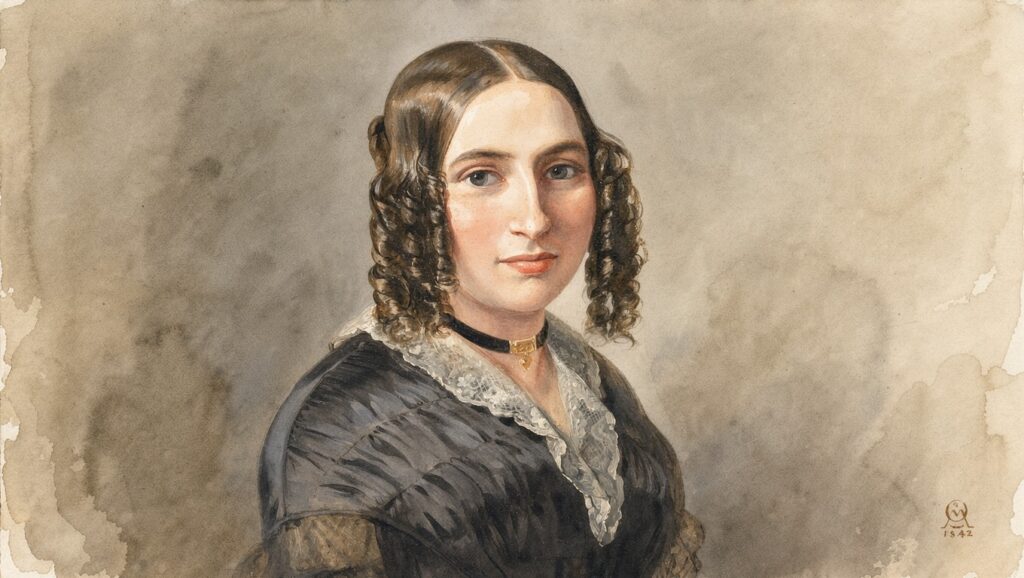
Fanny Mendelssohn (14 November 1805 – 14 May 1847) was a German composer and pianist whose extraordinary talent was frequently overshadowed by the societal expectations of the nineteenth century. Born into one of the most intellectually and artistically prominent families in Berlin, she was the niece of the philosopher Moses Mendelssohn and the sister of the celebrated composer Felix Mendelssohn. Despite her immense musical abilities, Fanny’s career was constrained by the prevailing attitudes toward women in the arts, which dictated that a lady’s place was in the home rather than on the public stage. Yet, through her private salon, her extensive compositions, and her pioneering spirit, she carved out a significant niche in music history. Today, she is recognized as one of the most important female Composers of the Romantic era, and her legacy continues to inspire musicians and scholars alike.
Early Life and Musical Education of Fanny Mendelssohn
Fanny Cäcilia Hensel was born in Berlin, Germany, into a family that deeply valued education and the arts. Her parents, Abraham and Lea Mendelssohn, recognized the musical genius of both Fanny and her younger brother Felix early on. They provided both children with rigorous training in piano, composition, and the humanities. Fanny’s musical education was comparable to that of her brother, and by the age of twelve, she was already composing intricate and sophisticated pieces.
The Mendelssohn household became a hub for Berlin’s intellectual and artistic elite. Musicians, writers, and philosophers frequently gathered there, creating an environment that nurtured Fanny’s creativity. It was in this setting that she developed her skills as a pianist and composer, often performing her own works for the distinguished guests who visited her family.
However, despite the progressive nature of her upbringing, the limitations placed on women in the nineteenth century soon became apparent. Fanny’s father, while supportive of her musical development, also emphasized the traditional role of women. He famously wrote to Fanny in 1820, acknowledging her talent but cautioning that composition should remain a hobby rather than a profession, as it could jeopardize her “domestic happiness.” This sentiment was echoed by Felix, who, while loving his sister, also believed that her public career as a composer was not feasible.
The Salon and Private Performances
Unable to pursue a public career, Fanny turned to the private sphere, where she could exercise her artistic freedom. In 1829, she established a weekly music salon in her Berlin home, which quickly became one of the most important cultural gatherings in the city. Her salon attracted prominent musicians, composers, and intellectuals, including Felix, the painter Julius Hübner, and the composer and pianist Ignaz Moscheles. Fanny herself performed her own compositions and those of other contemporary composers, showcasing her exceptional pianistic abilities.
The salon was not merely a social event but a serious musical forum. Fanny carefully curated the programs, selecting works that challenged and inspired her guests. Her gatherings provided a platform for new music and fostered creative exchange among the attendees. Many of Felix’s works were first performed at her salon, and she played a crucial role in shaping the musical taste of Berlin’s artistic community.
Through her salon, Fanny also cultivated relationships with other musicians and composers who respected her talent. She corresponded with Robert Schumann, who would later become one of her greatest champions, and she maintained a close friendship with Moscheles, who recognized her compositional gifts and encouraged her work.
Fanny Mendelssohn Compositional Output and Style
Fanny Mendelssohn was a prolific composer, producing over 460 works during her lifetime, including piano pieces, lieder (art songs), chamber music, and a symphony. Her music reflects the influence of her brother and the broader Romantic movement, yet it possesses a distinct voice characterized by emotional depth, structural ingenuity, and lyrical beauty.
Her most famous work is Das Jahr (The Year), a large-scale piano cycle inspired by the landscapes and traditions of the Italian countryside, where she spent time with her husband, the painter Wilhelm Hensel. The work is structured around the twelve months of the year, each movement depicting a different season or event. Das Jahr is considered one of the most ambitious and innovative piano works of the nineteenth century.
Another significant contribution to her repertoire is her Lieder, of which she composed more than one hundred. These songs, set to poetry by contemporary German poets, display a remarkable sensitivity to text and melody. Her lieder often explore themes of nature, love, and loss, and they demonstrate her mastery of harmonic language and expressive phrasing.
Fanny’s piano music, particularly her Clavierstückchen (Little Piano Pieces), is also highly regarded. These short character pieces offer intimate glimpses into her emotional world and showcase her technical virtuosity. Her chamber music, including string quartets and a piano trio, reveals her ability to craft complex, multi-layered textures that rival those of her male contemporaries.
Despite her productivity, Fanny published very few of her works under her own name during her lifetime. Most of her compositions were published anonymously or under Felix’s name, a common practice that reflected the gender biases of the time. Felix himself often encouraged Fanny to publish her music, but she was reluctant, fearing public criticism and the potential damage to her reputation.
Relationship with Felix Mendelssohn
The relationship between Fanny and Felix Mendelssohn was complex, marked by both deep affection and professional rivalry. They were close in age and shared a profound musical bond. Felix admired his sister’s talent and frequently sought her opinion on his compositions, while Fanny relied on Felix’s encouragement and support.
However, their relationship was also shaped by the differing expectations placed upon them. Felix was encouraged to pursue a public career, while Fanny was expected to remain within the domestic sphere. This disparity caused tension, particularly when Felix published some of Fanny’s works without her explicit permission or when he received public acclaim for pieces that had been influenced by her.
Despite these challenges, the siblings remained deeply connected throughout their lives. Felix dedicated several works to Fanny, and she, in turn, arranged and performed his music. Their correspondence reveals a mutual respect and love that transcended the limitations imposed by their society.
Reception and Recognition During Her Lifetime
During her lifetime, Fanny Mendelssohn received limited public recognition for her compositional achievements. While she was respected within her circle of musicians and friends, her work was largely confined to private performances and the salon circuit. The few works she published were often met with praise, but they did not bring her widespread fame.
One of the earliest signs of public recognition came in 1831, when Fanny published her Opus 1, a collection of piano pieces. The work was well-received, and it demonstrated her compositional maturity. However, she continued to face barriers in her efforts to establish a public career.
Robert Schumann, the influential music critic and composer, was one of the few public figures who championed Fanny’s music. In 1832, he wrote a glowing review of her piano trio, praising its originality and emotional power. Schumann’s endorsement helped to elevate her status within certain circles, but it did not lead to the widespread recognition she deserved.
Death and Posthumous Recognition
Fanny Mendelssohn died on 14 May 1847, just a few months after the death of her brother Felix. The loss of Felix had devastated her, and she struggled with her health in the years following his passing. Her death marked the end of a remarkable life, but it also coincided with a period of neglect for her music.
For many decades after her death, Fanny’s contributions to music were largely overlooked. Her works were overshadowed by Felix’s, and she was often remembered merely as his sister rather than as a composer in her own right. The gender biases of the nineteenth century continued to influence the reception of her music, and many of her compositions remained unpublished or unavailable.
However, the latter half of the twentieth century saw a significant revival of interest in Fanny Mendelssohn’s music. Feminist musicologists and scholars began to re-examine the role of women in music history, and Fanny emerged as a central figure in this reevaluation. Her diaries, letters, and compositions were studied in depth, revealing the breadth and depth of her artistic achievements.
Today, Fanny Mendelssohn is recognized as one of the most important composers of the Romantic era. Her music is performed and recorded with increasing frequency, and her influence on subsequent generations of female Composers is widely acknowledged. Scholars continue to uncover new aspects of her life and work, ensuring that her legacy will endure for future generations.
Legacy and Influence of Fanny Mendelssohn
Fanny Mendelssohn’s legacy extends beyond her compositions. She paved the way for future generations of women in music, demonstrating that women could achieve artistic excellence even in the face of significant obstacles. Her salon provided a model for female-led cultural institutions, and her dedication to music education and mentorship inspired many young musicians.
Her influence can be seen in the work of later female composers who sought to break down the barriers that had constrained her. Figures such as Clara Schumann, Amy Beach, and Florence Price have all acknowledged the importance of Fanny’s contributions to music history. Her story serves as a reminder of the systemic inequalities that have shaped the canon of classical music and the ongoing effort to correct these imbalances.
In recent years, Fanny Mendelssohn has experienced a renaissance. Her complete works are being cataloged and published, and her music is being performed in concert halls around the world. Recordings of her compositions have received critical acclaim, and scholars continue to explore the nuances of her style and the context of her life.
Final Thought
Fanny Mendelssohn’s life and work offer a compelling narrative of talent, resilience, and artistic integrity. Despite the constraints imposed by her gender and her era, she produced a body of work that rivals that of her male contemporaries. Her music, characterized by its emotional depth, technical sophistication, and lyrical beauty, deserves a permanent place in the repertoire of music composers.
As we continue to reassess the contributions of female Composers to the canon of classical music, Fanny Mendelssohn stands as a testament to the power of artistic expression and the enduring value of perseverance. Her story reminds us that music history is richer and more diverse than the traditional narratives suggest, and that the voices of women have always been an integral part of the symphony.
Today, Fanny Mendelssohn is celebrated not merely as the sister of Felix but as a formidable German composer and pianist in her own right. Her legacy is one of artistic excellence, intellectual curiosity, and quiet defiance, and it continues to resonate with audiences and musicians around the world.
#FannyMendelssohn #ClassicalMusic #RomanticEra #FemaleComposers #WomenInMusic #MusicHistory #Composer #Pianist #GermanMusic #19thCenturyMusic #ClassicalComposer #MusicEducation #SalonCulture #Lieder #DasJahr