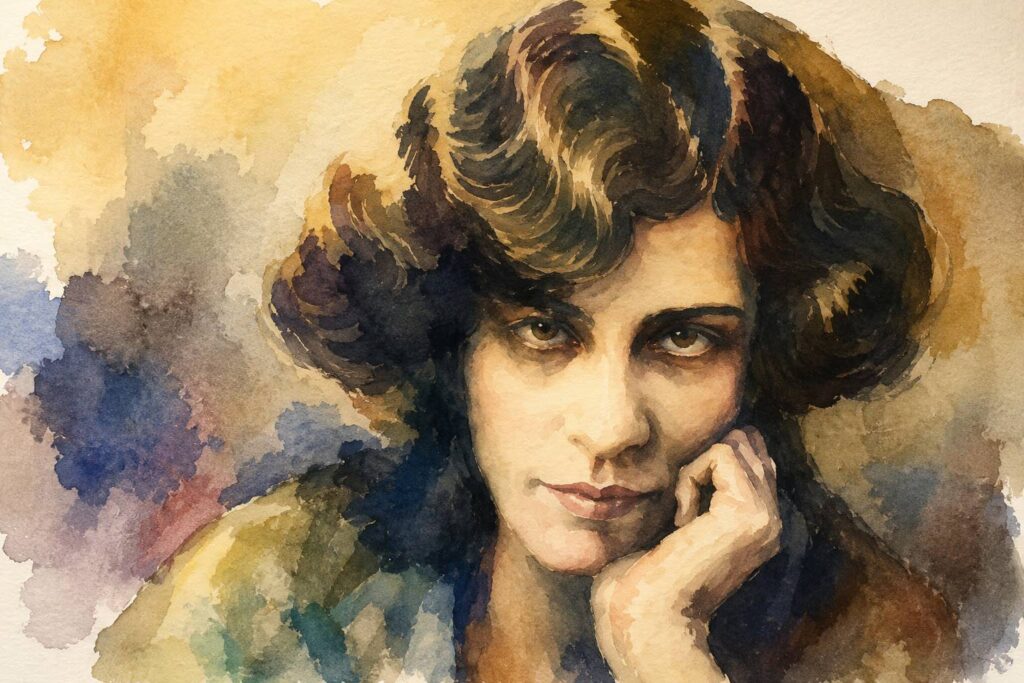
The history of twentieth-century classical music in Latin America is fundamentally incomplete without an examination of the cultural landscape of Brazil. While figures like Heitor Villa-Lobos and Camargo Guarnieri frequently dominate international concert programs, a deeper musicological inquiry reveals a parallel narrative of brilliant creators who fundamentally altered the country’s aesthetic trajectory while dismantling deeply entrenched institutional barriers. Foremost among these trailblazers was Dinorá de Carvalho (1 June 1895 – 28 February 1980).
As a virtuoso pianist, visionary conductor, insightful critic, and extraordinarily prolific composer, Carvalho occupied a singular position in the Brazilian musical vanguard. She was an artist who continuously evolved, transitioning seamlessly from the rich tapestry of musical nationalism to the complex abstractions of the mid-century avant-garde. Beyond her sonic output, her status as the first female member of the prestigious Academia Brasileira de Música (Brazilian Academy of Music) solidifies her role as a transformative force who reshaped the architectural possibilities for women in South American art culture.
Early Virtuosity and the Parisian Horizon
Dinorá Gontijo de Carvalho was born in Uberaba, located in the state of Minas Gerais, Brazil. While mid-century biographical lexicons occasionally cited her birth year as 1904 or 1905, a common discrepancy in historical documentation of the era, recent academic research and archival data from the Academia Brasileira de Música have firmly established 1895 as her true birth year. Raised in a household that valued artistic expression, her exceptional musical gifts manifested early under the encouragement of her father, an amateur musician.
Recognizing her extraordinary potential, her family relocated to São Paulo, where the young prodigy entered the Conservatório Dramático e Musical de São Paulo at the age of six. Under the rigorous tutelage of celebrated pedagogues Maria Lacaz Machado and Carlino Crescenzo, Carvalho developed a formidable keyboard technique. She made her formal concert debut at the age of seven, delivering commanding performances of works by Wolfgang Amadeus Mozart and Felix Mendelssohn that stunned local critics.
Carvalho’s trajectory shifted from local sensation to international artist when she earned a prestigious scholarship from the Brazilian Ministry of Culture to pursue advanced piano studies in Europe. Arriving in Paris during the twilight of the Belle Époque, she became a student of Isidor Philipp, the legendary French pianist and pedagogue whose pedagogical lineage influenced generations of keyboard virtuosos. Her time in Europe not only polished her pianistic command but also exposed her to the simmering modernism of the early twentieth century, an experience that would fundamentally inform her subsequent compositional philosophies.
Modernism, Nationalism, and Compositional Synthesis
Upon returning to Brazil in the late 1920s and early 1930s, Carvalho found herself thrust into a society experiencing a profound cultural awakening. The historic Semana de Arte Moderna (Modern Art Week) of 1922 had shattered traditionalist expectations, leaving Brazilian intellectuals eager to forge an authentic, nationally distinct artistic identity. Carvalho embedded herself within this creative epicenter, establishing close professional relationships with iconic modernists such as the writer and musicologist Mário de Andrade, as well as fellow composers Francisco Mignone and Camargo Guarnieri.
Intrigued by the intersection of intellectual modernism and traditional folk idioms, Carvalho recognized that her true calling extended beyond concert performance. She committed herself to rigorous studies in harmony, counterpoint, and composition under the guidance of Lamberto Baldi and Martin Braunwieser. Later, she studied conducting with the respected maestro Ernst Mehlich.
Carvalho’s early compositions directly reflected the tenets of the nationalist movement (Nacionalismo). Rather than merely quoting folk tunes verbatim, she absorbed the rhythmic vitality, modal inflections, and melancholic syntax of Brazilian urban and rural folk traditions, transforming them into sophisticated art music. Her initial catalog featured brilliant solo piano miniatures, chamber works, and art songs that set the poetry of her contemporary literary icons, including Carlos Drummond de Andrade, Cecília Meireles, and Menotti del Picchia.
Institutional Pioneer: The All-Women Orchestra and the Academy
As a woman navigating a profoundly patriarchal classical music establishment, Carvalho encountered systemic skepticism at every stage of her career. Rather than succumbing to these limitations, she engaged in radical institutional builderism. In the 1930s, recognizing the severe lack of professional opportunities available to female instrumentalists, she founded the Orquestra Feminina de São Paulo (Women’s Orchestra of São Paulo).
Serving as its founding director and artistic conductor, Carvalho made history by establishing the first all-women symphony orchestra in South America. Through this ensemble, she proved to be a champion of both historical repertoire and contemporary Latin American composition, challenging the pervasive societal bias that viewed conducting and orchestral leadership as exclusively masculine domains.
Institutional Milestones of Dinorá de Carvalho:
├── 1930s: Founded the Orquestra Feminina de São Paulo
│          └── First all-women symphonic ensemble in South America
└── 1945: Elected to the Academia Brasileira de Música
           └── First female composer to break the gender barrier in the Academy
Her growing prestige as a composer and cultural advocate reached an undeniable peak in 1945. When the Academia Brasileira de Música was established under the leadership of Heitor Villa-Lobos to safeguard and advance the nation’s musical heritage, Dinorá de Carvalho was elected as a founding member, occupying Chair Number 14. This milestone marked the first time a female composer was granted entry into the highest echelon of Brazil’s musical intelligentsia, effectively paving the way for future generations of women music makers.
A Catalog of Metamorphosis: From Folk Roots to Avant-Garde
Dinorá de Carvalho’s total compositional output spans approximately 400 works across nearly every classical genre, including symphonic poems, concertos, ballets, chamber works, and choral liturgies. Her artistic lifespan can be understood as an evolution from evocative national romanticism to an aggressive, experimental cosmopolitanism.
In her early and middle periods, works like the Fantasia para Piano e Orquestra (1934) and the Suite Brasileira for cello and piano (1948–1949) demonstrated an intuitive mastery of structural balance and a brilliant integration of Afro-Brazilian and indigenous rhythmic textures. Her piano music from this era captures the idiosyncratic syncopations of the choro and the batuque, elevated by a refined impressionistic harmonic palette reminiscent of her Parisian training.
However, by the late 1950s and 1960s, Carvalho refused to remain static within the nationalist idiom that had brought her fame. Embracing a cultural mission to Europe sponsored by the Brazilian government in 1960, she observed the latest shifts in Western art music and subsequently integrated atonality, dodecaphony (twelve-tone serialism), and highly abstract structural concepts into her writing.
Her late-period masterpieces showcase a composer operating at the peak of her experimental powers. The striking Salmo XXII – O Bom Pastor (1971) employs a highly unusual chamber orchestration, consisting of clarinet, horn, harp, cello, piano, and percussive elements, to construct an eerie, intensely moving sacred soundscape. Similarly, her monumental choral work Missa Profundis won the coveted First Prize for Best Vocal Work of 1977 from the Associação Paulista de Críticos de Arte (APCA), proving that her late avant-garde style was both intellectually rigorous and profoundly expressive.
| Composition | Year | Ensemble Type | Aesthetic Phase / Character |
| Fantasia para Piano e Orquestra | 1934 | Piano and Orchestra | Early Nationalist; Virtuosic and rhythmic |
| Suite Brasileira | 1948 | Cello and Piano | Mid-Period Nationalist; Modal folk inflections |
| Devaneio | 1969 | Cello and Piano | Transitional; Harmonically dense, lyrical |
| Salmo XXII – O Bom Pastor | 1971 | Mixed Chamber Sextet | Late Avant-Garde; Serialist textures, unique timbre |
| Missa Profundis | 1977 | Chorus and Orchestra | Late Masterpiece; Atonal liturgical expressionism |
Importance, Legacy, and Posthumous Rediscovery
Dinorá de Carvalho passed away in São Paulo on February 28, 1980, leaving behind a massive archival footprint that reflects a lifetime entirely dedicated to the sonic arts. In addition to her output as a composer and conductor, she served for decades as a prominent music critic for major newspapers, including Folha de S.Paulo, where her sharp analytical essays helped shape public taste and champion contemporary composers.
For several decades following her death, much of Carvalho’s music remained in manuscript form, performed only occasionally by dedicated specialists. However, the twenty-first century has witnessed a significant renaissance of scholarly interest in her work. Her extensive manuscripts and personal archives are currently preserved across vital institutions, most notably the Mário de Andrade Collection at the Institute of Brazilian Studies (IEB-USP) and the Dinorá de Carvalho Collection at the Center for Integration, Documentation, and Diffusion of Culture (CIDDIC) at the State University of Campinas (Unicamp).
Ongoing critical editions and musicological performance projects are steadily bringing her vocal, chamber, and symphonic works into print and onto modern streaming platforms. Interpreted today through the lenses of both feminist musicology and Latin American modernism, Dinorá de Carvalho is increasingly recognized not merely as a historic “first,” but as a towering, highly original creative force whose music captures the complex, fractured, and beautiful soul of twentieth-century Brazil.
References
- Antonio, Irati, and John Schechter. “Carvalho (Muricy), Dinorá (Gontijo) de.” Grove Music Online. Oxford University Press.
- Academia Brasileira de Música. “130 anos do nascimento de Dinorá de Carvalho.” Official Archives, ABM.
- Furman Schleifer, Martha, and Gary Galván. Latin American Classical Composers: A Biographical Dictionary. London: Rowman & Littlefield, 2016.
- Carvalho, Flávio. Salmo XXII – O Bom Pastor: Uma Revisão Crítica e Estudo Analítico da Obra de Dinorá de Carvalho. Campinas: CIDDIC/Unicamp, 2019.
- Sadie, Julie Anne, and Rhian Samuel. The Norton/Grove Dictionary of Women Composers. New York: W. W. Norton & Company, 1994.
#DinoradeCarvalho #BrazilianComposers #WomenInMusic #ClassicalMusic #LatinAmericanMusic #MusicHistory #OrchestralConducting #PianoVirtuoso #Modernism #AcademiaBrasileiradeMusica #VanguardMusic #AtonalMusic #Musicology #WomenMaestros #BrazilianCulture