From its very first moments, The Sounds of Eternity makes it clear that it is not simply presenting three orchestral works, it is tracing a musical dialogue between worlds.
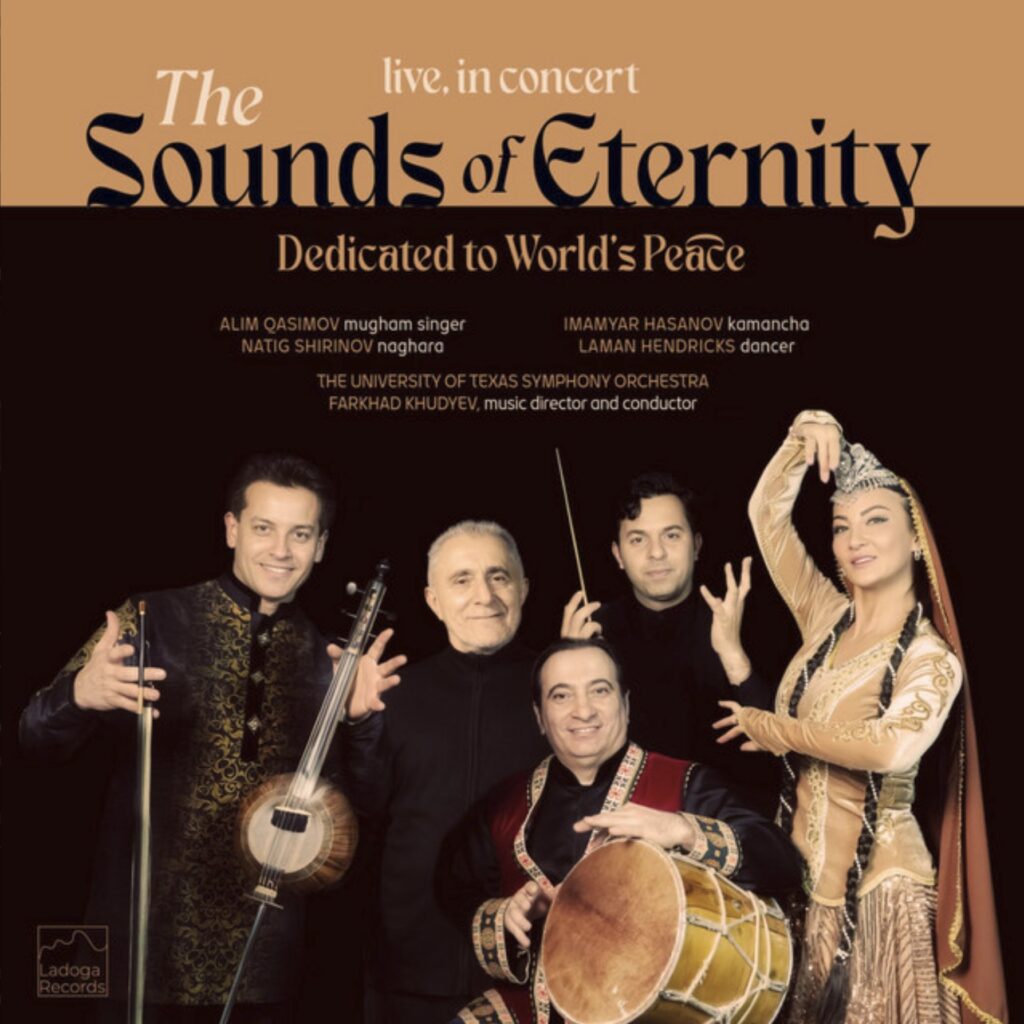
Performed by the University of Texas Symphony Orchestra under the direction of Farkhad Khudyev, this newly released live recording (2026) unfolds as a compact but striking triptych exploring the meeting point between Western symphonic language and the maqami and modal, improvisational, and emotional vocabulary of the Caucasus and Middle Eastern traditions. Across just three works and roughly forty minutes of music, the album sketches a surprisingly complete artistic landscape, one built on contrast, coexistence, and ultimately reconciliation.
What makes the album compelling is not only its repertoire, but its conviction. These are not decorative gestures toward “world music.” They are structural conversations.
A theatrical opening: Eldar Hudiyev’s Circus
The album opens with Eldar Hudiyev’s Circus for clarinet and orchestra, a compact but vividly theatrical work that immediately establishes the album’s central tension between playfulness and unease.
From the very first gestures, the orchestral language evokes a modernist stage world. I was instantly reminded of Stravinsky, not in imitation, but in attitude: sharply profiled rhythms, alert orchestral responses, and a sense that the music is always slightly off balance in the most intentional way. The clarinet enters not simply as a soloist but as a character moving through scenes.
Jonathan Gunn’s playing makes this dramaturgical role unmistakable. His phrasing moves freely between irony and lyricism, often within the span of a few measures. High-register clarinet lines sparkle with a Klezmer-like flexibility, while muted brass punctuate the texture with a dry, almost theatrical wit. The orchestration supports this atmosphere beautifully: short gestures from winds and brass feel like stage lights switching direction, constantly reshaping perspective.
What impressed me most while listening is how quickly the piece shifts emotional terrain. Moments of comic agility suddenly give way to passages of genuine introspection. The clarinet descends into warmer, more vocal registers where the line briefly becomes intimate and reflective, before being drawn back into motion again. These transitions never feel arbitrary, they create the sensation of watching a performer balancing vulnerability and spectacle in real time.
Rhythm plays an especially important role here. The orchestra often seems to circle the clarinet rather than accompany it, creating a sense of pursuit, interruption, or playful resistance. At several points the texture almost suggests chase music, reinforcing the circus metaphor not as literal imagery but as psychological space.
Equally striking is the control of orchestral balance. Even in the more animated passages, the ensemble never overwhelms the soloist. Instead, the clarinet remains the narrative center throughout, guiding the listener through shifting musical environments rather than competing against them.
By the end of the piece, what initially appeared as light theatrical color reveals itself as something more layered: a portrait of performance itself, its agility, its risk, and its fragile moments of stillness behind the mask.
Reclaiming an ancient voice: Khanmammadov’s Kamancha Concerto
If the first piece plays with theatrical imagery, the second piece changes the emotional axis entirely.
Haji Khanmammadov’s Concerto for Kamancha and Orchestra (1987), performed here by Imamyar Hasanov, remains historically significant as the first concerto written for the kamancha within a symphonic framework. But beyond its historical importance, the work reveals something deeper: how a modal improvisational tradition can breathe inside orchestral architecture without losing its identity.
The opening unfolds in free rhythm, immediately recalling vocal maqam practice. The augmented seconds of the melodic line create an unmistakably Eastern atmosphere, not as ornament, but as grammar. The kamancha does not adapt itself to the orchestra; instead, the orchestra adapts to the kamancha.
Imamyar Hasanov’s performance is a clinic in melismatic phrasing. The kamancha, acts as a surrogate human voice. You can hear the high-level control in his microtonal ornaments, those subtle “between-the-notes” inflections that are central to the Maqam tradition.
Notice the use of glissandi and varying vibrato speeds on the kamancha. Unlike a Western violin, the kamancha’s rotating neck allows for a fluid, almost liquid-like pitch shifting that Hasanov uses to maximize the “Largo” (slow/solemn) emotional weight.
The structure of the movement as a whole feels almost like an inner multi-movement arc compressed into a single span. After the improvisatory opening comes an adagio-like section in which the instrument sings over restrained orchestral textures. Gradually the music gathers energy until the orchestra joins fully in a shared climax, transforming the solo line into collective expression. Then, unexpectedly, the work returns to stillness, closing again in introspection rather than triumph.
One of the most impressive compositional decisions lies in the treatment of balance. The kamancha is not naturally designed to compete with a modern symphony orchestra. Instead of forcing projection, the orchestration yields space. Much of the accompaniment remains in piano dynamics, allowing the solo instrument to remain emotionally central rather than acoustically overwhelmed.
The centrepiece: Khudyev’s The Sounds of Eternity
The final and longest work on the album, Farkhad Khudyev’s The Sounds of Eternity, expands the project from dialogue into vision.
The piece begins almost like a storm, an orchestral collision between harmonic worlds already introduced earlier in the album. Western symphonic weight meets modal melodic gravity. Instead of resolving the tension immediately, the work lets it accumulate.
Gradually the texture opens.
The return of the kamancha, now joined by maqam singing from Alim Qasimov and percussion by Natig Shirinov, transforms the musical space completely. The free rhythmic language of maqam re-enters like memory rather than quotation. It does not interrupt the orchestra, it redefines its horizon.
This is the moment where the album’s concept becomes clear.
Khudyev is not presenting East and West as opposites. He is presenting them as temporal layers of the same musical consciousness.
The inclusion of vocal changes everything. The human presence shifts the symphonic narrative from abstraction to testimony. The text in Azeri speaks about memory, separation, love, and return, ideas that resonate strongly with the musical structure of the piece. The orchestra becomes less a frame and more a landscape through which these voices move.
By the time the closing message emerges, “the secret to happiness is love,” the gesture feels earned rather than symbolic.
A convincing cultural architecture
What makes The Sounds of Eternity particularly persuasive is its structural coherence across the three works. The album quietly traces a trajectory:
theatrical narrative → modal introspection → spiritual synthesis.
The Western orchestra never disappears. Nor does the maqam-based tradition dissolve into orchestral color. Instead, both remain intact, and their coexistence becomes the subject of the recording itself.
This is difficult to achieve convincingly. Too often intercultural projects remain surface-level collaborations. Here the interaction feels compositional rather than decorative.
The result is an album that functions not only as a concert document but as a statement: that symphonic language is still expanding, still absorbing voices older than itself, and still capable of carrying them forward without erasing their origins.
The Sounds of Eternity is not simply a recording of three works. It is a proposal about what orchestral music can become when it listens carefully to memory.
#ClassicalMusic #ContemporaryClassical #SymphonicMusic #Kamancha #Mugham #AlimQasimov #FarkhadKhudyev #UniversityOfTexasSymphonyOrchestra #OrchestralMusic #CrossCulturalMusic #ModernComposition #ClarinetConcerto #WorldPremiereRecording #MusicAndCulture #SoundsOfEternity
This post was written as part of a promotional service provided by Tunitemusic, based on information submitted by the artist.