Johann Strauss II (25 October 1825 – 3 June 1899) was an Austrian composer, conductor, and violinist whose artistic vision permanently altered the trajectory of European light classical compositions. Widely revered across the globe as the “Waltz King,” he elevated ballroom dance music from modest, functional entertainment into an enduring art form celebrated in international concert halls. Over a brilliant career spanning more than five decades, Strauss composed over 500 individual works, encompassing sweeping waltzes, energetic polkas, majestic marches, structured quadrilles, and captivating operettas. His remarkable capacity for rich melody, colorful orchestration, and rhythmic innovation allowed him to define the golden era of 19th-century Viennese culture. Today, his musical catalog remains a foundational cornerstone within western music history, representing the absolute pinnacle of Romantic-era light music and orchestral charm.
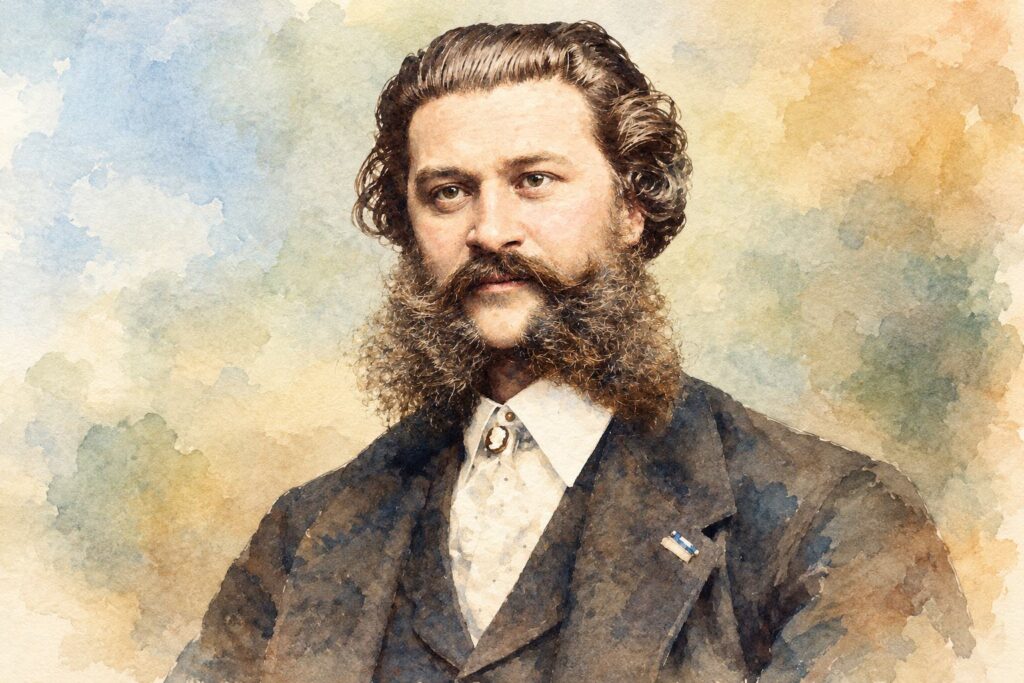
Early Life and Family Rivalry
Johann Baptist Strauss II was born in St. Ulrich, a village near Vienna, into one of the most famous musical families in Western culture. His father, Johann Strauss I, was already an established master of light music, credited with popularizing the Viennese waltz across Europe. Despite his own success, the elder Strauss was fiercely opposed to his children pursuing careers as professional music composers. Understanding the grueling physical demands, economic uncertainty, and social instability that often plagued working artists, Johann Sr. intended for his eldest son to enter the banking sector.
Driven by a passion for melody, young Johann secretly studied the violin and music theory. His early training was facilitated in private by Franz Amon, the concertmaster of his father’s own orchestra, as well as by Anton Kollmann, a ballet répétiteur at the Vienna Court Opera. When Johann Sr. discovered his son practicing the violin, he punished the young boy severely in an effort to beat the music out of him.
It was only after the elder Strauss abandoned his household in 1842 to live with his mistress, Emilie Trampusch, that Johann II received full support from his mother, Maria Anna Streim. With her encouragement, he undertook formal instruction in counterpoint, harmony, and composition under Professor Joachim Hoffmann and Kapellmeister Joseph Drechsler. Armed with glowing testimonials from his instructors, Strauss applied to the Viennese municipal authorities for a license to perform publicly with his newly assembled ensemble.
In October 1844, at the age of nineteen, Strauss II made his official conducting debut at Dommayer’s Casino in Hietzing. He performed his own original compositions, including the waltz Sinngedichte (Op. 1) and the Herzenslust Polka (Op. 3), alongside famous pieces by his father. The performance was a sensational triumph. Critics immediately recognized the young musician’s undeniable genius, declaring that three-quarter time had found a powerful new champion. This debut sparked a dramatic artistic rivalry between father and son, splitting Viennese audiences into passionate factions until the elder Strauss died in 1849. Following his father’s passing, Johann II merged both orchestras into a single powerhouse ensemble, securing his position as the undisputed maestro of Vienna.
Rise to Fame and International Success
Throughout the 1850s and 1860s, Strauss expanded his influence across Europe and beyond. His annual summer engagements conducting concerts at Pavlovsk near St. Petersburg, Russia, brought him massive acclaim and cemented his reputation beyond Austrian borders. Strauss transformed the structural mechanics of dance music. Rather than writing simple, repetitive background music for dancers, he crafted intricate orchestral compositions complete with dramatic introductions, rich thematic development, and expressive codas.
His personal life was equally dynamic and often interwoven with his professional trajectory. In 1862, Strauss married Henrietta “Jetty” Treffz, a talented opera singer who became his devoted business manager. Jetty recognized her husband’s creative potential, taking over administrative burden, managing correspondence, and encouraging him to expand into large-scale theatrical compositions. Following Jetty’s death in 1878, Strauss married actress Angelika Dittrich, though the marriage dissolved shortly after. In 1887, he married Adele Deutsch, who managed his legacy with devotion and later helped extend copyright protection laws for music composers.
Strauss’s popularity crossed the Atlantic Ocean in 1872 when he was invited to the United States to conduct at the World’s Peace Jubilee and International Musical Festival in Boston. Conducting an orchestra of over 1,000 musicians before tens of thousands of audience members, Strauss proved his extraordinary skill as both a maestro and a showman. His international concert tours established him as one of the world’s first true musical superstars, capable of drawing record-breaking crowds in every major cultural center he visited.
                     +---------------------------------------+
                     |         JOHANN STRAUSS II             |
                     |              (1825–1899)              |
                     +-------------------+-------------------+
                                         |
            +----------------------------+----------------------------+
            |                                                         |
  +---------v----------+                                    +---------v----------+
  |   ORCHESTRAL &     |                                    |    STAGE WORKS &   |
  |    DANCE MUSIC     |                                    |      OPERETTA      |
  +---------+----------+                                    +---------+----------+
            |                                                         |
            |-- By the Beautiful Blue Danube (1867)                   |-- Die Fledermaus (1874)
            |-- Tales from the Vienna Woods (1868)                    |-- Der Zigeunerbaron (1885)
            |-- Emperor Waltz (1889)                                  |-- Eine Nacht in Venedig (1883)
            |-- Tritsch-Tratsch-Polka (1858)                          |-- Ritter Pásmán (1892)
Major Works and Masterpieces
The catalog of Johann Strauss II contains some of the most recognizable melodies ever written. His masterworks span dance music and theatrical operetta.
The Blue Danube (An der schönen blauen Donau, Op. 314)
Composed in 1867, The Blue Danube stands as Strauss’s defining masterpiece. Originally commissioned as a choral piece for the Vienna Men’s Choral Association, its orchestral arrangement created a sensation at the Paris World’s Fair later that year. The work features a shimmering tremolo introduction followed by a succession of five captivating waltz themes. Today, it is widely considered the unofficial national anthem of Austria.
Tales from the Vienna Woods (Geschichten aus dem Wienerwald, Op. 325)
Premiered in 1868, this masterpiece highlights Strauss’s skill in blending Viennese folk elements with sophisticated symphonic textures. Notable for its evocative introduction featuring a solo zither, the piece captures the rustic, romantic spirit of the countryside surrounding Vienna.
Emperor Waltz (Kaiser-Walzer, Op. 437)
Written in 1889 to commemorate a historic summit between Emperor Franz Joseph of Austria and Kaiser Wilhelm II of Germany, the Emperor Waltz begins with a quiet march before blossoming into a grand, majestic waltz. Its balanced form and rich instrumentation showcase Strauss at the summit of his symphonic powers.
Die Fledermaus (The Bat, 1874)
Encouraged by his wife Jetty and fellow creators to write for the stage, Strauss produced Die Fledermaus, the ultimate Viennese operetta. Filled with wit, social satire, memorable champagne choruses, and gorgeous vocal duets, it remains a permanent fixture in the repertories of the world’s leading opera houses.
Der Zigeunerbaron (The Gypsy Baron, 1885)
Achieving over 7,000 performances within four decades of its premiere, Der Zigeunerbaron blended Hungarian folk dance rhythms with classic Viennese lyricism. Its rich musical score proved that light stage works could feature genuine dramatic depth and sophisticated counterpoint.
| Title | Year | Genre | Key Feature / Significance |
| Sinngedichte | 1844 | Waltz | Debut composition played at Dommayer’s Casino |
| Tritsch-Tratsch-Polka | 1858 | Polka | High-energy piece reflecting Viennese gossip and local humor |
| The Blue Danube | 1867 | Concert Waltz | World-famous orchestral masterpiece and Austrian cultural icon |
| Tales from the Vienna Woods | 1868 | Concert Waltz | Features rustic folk influences and a solo zither introduction |
| Die Fledermaus | 1874 | Operetta | The quintessential Viennese comic opera |
| Voices of Spring | 1882 | Concert Waltz | Features brilliant coloratura vocal lines and celebratory orchestration |
| Der Zigeunerbaron | 1885 | Operetta | Blends Viennese lyricism with Hungarian folk idioms |
| Emperor Waltz | 1889 | Concert Waltz | Grand symphonic piece written for imperial dignitaries |
Technical Innovation and Artistic Style
Strauss revolutionized light music by bringing high symphonic craft to popular dance formats. Prior to his compositions, dance tunes were short, repetitive, and meant primarily for social movement. Strauss transformed the waltz into a complex musical form with dramatic tension and refined orchestration.
- Thematic Architecture: Strauss expanded the standard waltz structure into a multi-movement suite. A typical Strauss waltz features an atmospheric prelude, a series of distinct waltz sections, and an elaborate coda that synthesizes the preceding musical themes into a dramatic climax.
- Rhythmic Lift: He perfected the distinct “Viennese waltz beat,” characterized by a subtle, anticipation-filled anticipation of the second beat. This rhythmic flexibility gave his melodies an organic warmth and momentum.
- Masterful Orchestration: Influenced by classical masters, Strauss utilized woodwinds, brass, and percussion with remarkable subtlety. His scores feature delicate instrumental solos, lush string writing, and dynamic contrasts that appealed to classical connoisseurs and casual listeners alike.
Importance, Legacy, and Global Impact
The influence of Johann Strauss II on music history is both profound and widespread. Although he specialized in light music, he earned the deep admiration of the nineteenth century’s most serious classical figures.
Johannes Brahms, a close personal friend of Strauss, held his compositions in exceptionally high regard. When asked to sign an autograph fan for Strauss’s wife, Brahms inscribed the opening bars of The Blue Danube and famously wrote beneath them: “Unfortunately NOT by Johannes Brahms”. Richard Wagner praised Strauss as “the most musical brain in Europe,” while Richard Strauss (no relation) acknowledged his melodic genius and referenced Viennese waltz themes throughout his grand opera Der Rosenkavalier.
   [ Romantic Orchestral Tradition ]
                  |
                  v
       +--------------------+
       | Johann Strauss II  | <=== Admired by Brahms, Wagner, & Liszt
       +---------+----------+
                 |
        +--------+--------+
        |                 |
        v                 v
[ Modern Concert ]   [ Golden Age of ]
[ Classical Stage ]  [ Viennese Culture]
Strauss died of pleuropneumonia in Vienna on 3 June 1899 at the age of seventy-three. He was buried in the Zentralfriedhof (Central Cemetery) of Vienna, placed alongside fellow monumental music composers such as Ludwig van Beethoven, Franz Schubert, and Johannes Brahms.
Today, Strauss’s artistic legacy is celebrated annually across the globe. The Vienna Philharmonic’s world-famous New Year’s Concert, broadcast to millions of viewers across more than ninety nations every January 1st, remains heavily centered around the works of Strauss and his family. His music stands as an immortal symbol of elegance, joy, and artistic brilliance that continues to enrich human culture.
Sources
- Britannica Editors. “Johann Strauss II: Austrian Composer.” Encyclopedia Britannica.
- World History Encyclopedia. “Johann Strauss II Biography.” World History Encyclopedia.
- Museum of Music History. “Johann Strauss II (1825–1899) Exhibition.” Museum of Music History.
- Vienna Concert Society. “Johann Strauss: The History of the Waltz King.” Concert Vienna.
#JohannStraussII #WaltzKing #ClassicalMusic #MusicHistory #MusicComposers #Vienna #ClassicalComposers #TheBlueDanube #DieFledermaus #VienneseWaltz #OrchestralMusic #ClassicalConcerts #AustrianCulture #RomanticEra #ClassicalMusicCommunity