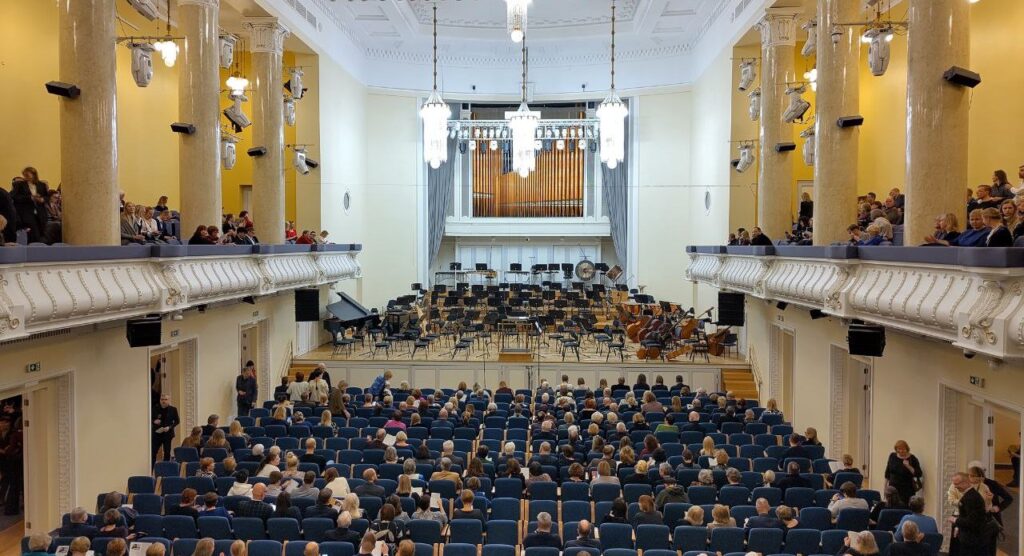
When I first set foot inside Peeter Süda Hall for MANUS: The Hands, I wasn’t quite sure what to expect. A concert? Musical theatre? Philosophy? Perhaps some kind of performance art? When I walked out after the performance, however, I realised that the answer was all of these things; and something more difficult to define.
MANUS, presented as part of Tallinn Fringe Festival 2026, is a participatory interdisciplinary performance built around something deceptively ordinary: the human hand. Across five movements, the performance examines the hand not simply as a physical tool, but as a symbol of creation, communication, labour, writing, exhaustion, wisdom and human connection.
The concept draws on the philosophical ideas of Julia Kristeva, Walter Benjamin, Jacques Derrida, Byung-Chul Han and Alain de Botton. Each thinker provides a different lens through which the hand is examined, while the music moves between lied, chanson, jazz, musical theatre and rock, performed across Italian, German, Turkish, English and French.
It sounds intellectually ambitious on paper. On stage, surprisingly, it never felt like a lecture.
Five Hands, Five Ways of Seeing
The first movement, inspired by Julia Kristeva, approaches the hand through birth, touch and the first rhythms of human existence. The hand is initially something intimate and instinctive: the hand that touches, holds and creates the first connection with the world.
From there, MANUS moves toward Walter Benjamin and the searching hand; the hand that tries to understand and construct the world around it. Here the hand becomes an instrument of discovery, a means through which we interact with reality and give form to our surroundings.
The third movement turns to Jacques Derrida and perhaps the most intellectually intriguing idea of the evening: the writing hand. Writing leaves a trace. A hand puts something onto paper, but once that mark exists, it can continue to speak beyond its creator. The performance connects this idea to Derrida’s concept of différance, the instability of meaning and the endless distance between what we intend to communicate and what is ultimately understood.
This was particularly interesting to me as someone who is drawn to both writing and music. A musical performance is also a trace. Once a sound has been made, it disappears, yet something remains in the listener. MANUS seemed to understand that paradox very well.
The fourth movement, centred on Byung-Chul Han, takes a darker turn. The hand becomes tired. Han’s ideas about the contemporary burnout society are translated into the physical language of the performance. The hand that once created, searched and wrote is now overworked. Productivity becomes exhaustion. The ability to do more and more becomes almost a form of imprisonment.
And then comes Alain de Botton’s wise hand, the final movement. After birth, discovery, writing and exhaustion, the hand reaches maturity. It is no longer simply an instrument for doing things; it becomes a symbol of presence, experience and understanding.
The progression gives the performance a surprisingly coherent philosophical arc. The hand creates and destroys, connects and separates, expresses and oppresses. It can offer comfort or exert power. It can build something beautiful or become exhausted by the endless demand to produce.
In other words, the hand becomes a miniature history of being human.
Music Without Borders
And then there was the music.
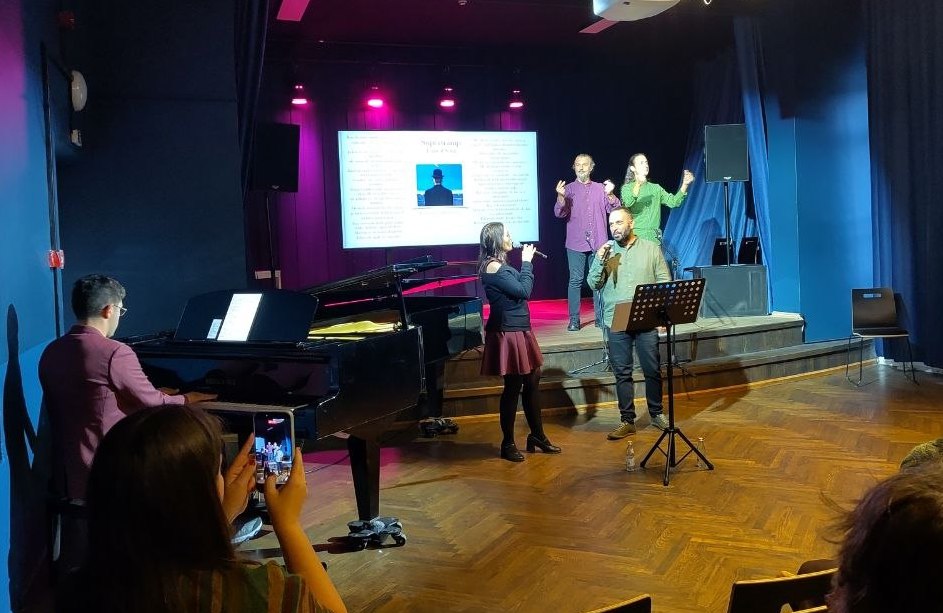
Rûbar Dindar at the piano was one of the things that immediately caught my attention. His playing had an unusual ability to move between musical languages without treating them as isolated genres. Even when a passage leaned toward rock, I could hear traces of blues; classical passages carried touches of jazz, while jazz moments could suddenly acquire a distinctly rock-like accentuation.
Rather than changing styles mechanically from one piece to another, he seemed to allow the styles to bleed into each other. That made the piano feel almost like another character in the performance.
Beside him, soprano and concept developer Seren Akyoldaş and tenor Emre Oktayoğlu carried the vocal side of the performance with remarkable ease. One of the most impressive aspects was the multilingual repertoire. Moving between five languages can easily become a technical exercise, but here the languages felt like part of the musical identity of each movement rather than an obstacle.
Oktayoğlu has a powerful and versatile voice. He can move into deep, resonant territory and then suddenly become light and delicate. Akyoldaş, meanwhile, uses her voice almost as an additional instrument. Her control of dynamics, nuance, timing and counter-melodic possibilities made some passages feel as though she was accompanying the music rather than simply singing over it. There were moments when her voice seemed to become part of the arrangement itself.
The repertoire also created an interesting dialogue between very different musical worlds. References to artists and traditions ranging from classical repertoire to Supertramp, Sting, Cem Karaca, Cole Porter and Joni Mitchell might sound unrelated, but within MANUS they became different musical manifestations of the same central idea: the hand as a vehicle for human expression.
And Then the Audience Became the Instrument
But the performance wasn’t limited to the stage.
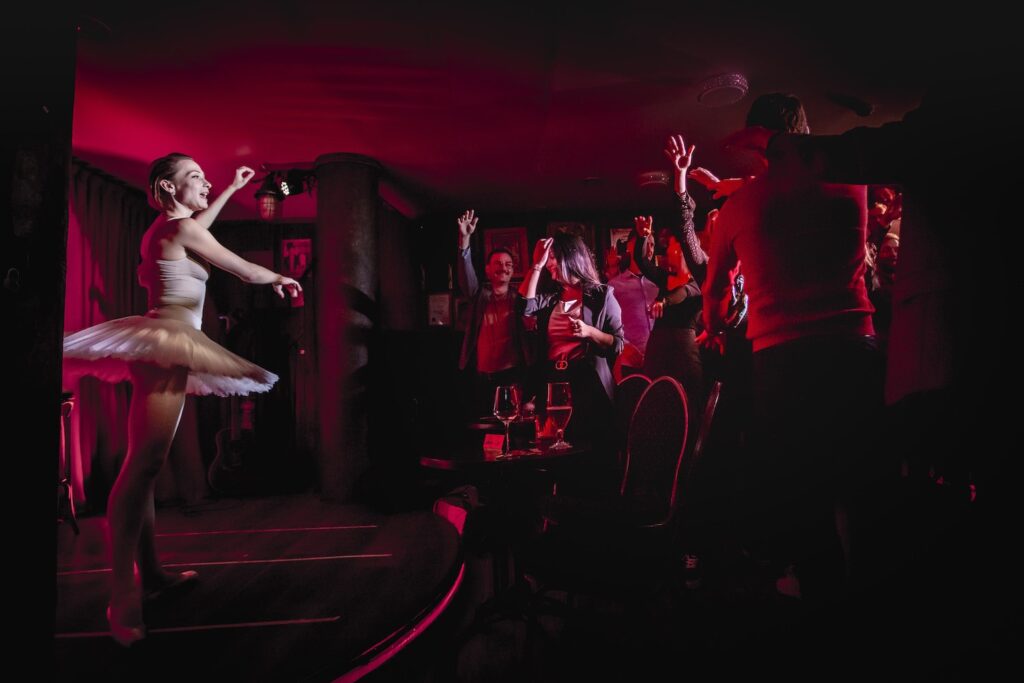
Gökçe Gürçay and Özgü Bulut of the KeKeÇa Body Percussion Ensemble gradually brought the audience into the musical structure. Through clapping, snapping, tapping feet and hands against our laps, the audience became another percussion section.
At first, I was slightly sceptical. I have to confess that I’m not particularly fond of audience participation. I generally prefer to sit quietly, watch the performers and let the work unfold in front of me.
But MANUS handled participation differently. It didn’t feel forced or gimmicky. The gestures were simple, and they emerged naturally from the performance. Gökçe Gürçay guided the audience almost like a conductor leading an orchestra, gradually building a collective rhythmic language.
Suddenly, the sound was no longer coming only from the piano and the singers. It was coming from the room. Dozens of individual hands became one rhythmic body. That may have been the most literal realisation of the concept, but also one of the most effective. The performance was talking about hands as a means of connection, and then it actually used our hands to connect us.
A Personal Connection
I found MANUS particularly enjoyable because several of its references happen to intersect with things I personally care about. I’m a fan of Derrida’s work, I have a long-standing affection for Supertramp and Sting, and I have always been interested in Alain de Botton’s philosophical approach to everyday human experience.
But even without those personal connections, the performance has enough layers to work on several levels. You can simply enjoy it as a concert. You can approach it as musical theatre. You can follow the philosophical ideas and contemplate what each movement is trying to say. Or you can forget the philosophy entirely and simply start thinking about the physical role of the hand in music; from the pianist’s fingers moving across the keyboard to the percussionists creating rhythm with their palms, feet and bodies, and finally the audience doing the same.
That is perhaps the greatest strength of MANUS: it doesn’t demand a single way of experiencing it.
More Than a Concert
The second European performance of MANUS took place here in Tallinn as part of Tallinn Fringe Festival 2026, following its premiere at Institut français Firenze in Italy. Created by Seren Akyoldaş, the project brings together an unusually international group of performers and ideas, while keeping its central subject remarkably simple. But this was only the second stop of the project’s ongoing tour, meaning that for those who missed it in Tallinn, there is still a chance to experience it elsewhere.
And I would definitely recommend doing so.
Follow MANUS on social media and keep an eye on their upcoming performances. They are continuing their journey to different cities, and there is a good chance that MANUS: The Hands may eventually appear somewhere near you. If it does, don’t miss it.
For me, MANUS was one of those performances where I walked in wondering what exactly I was about to see and walked out still thinking about it. It wasn’t simply a concert I attended. It was an experience that followed me out of the hall.
#MANUSTheHands #ManusProject #MANUS #TallinnFringe #TallinnFringeFestival #ContemporaryPerformance #MusicalTheatre #InterdisciplinaryArt #BodyPercussion #ContemporaryMusic #MusicAndPhilosophy #LivePerformance #ClassicalMusic #TallinnCulture #EstonianCulture