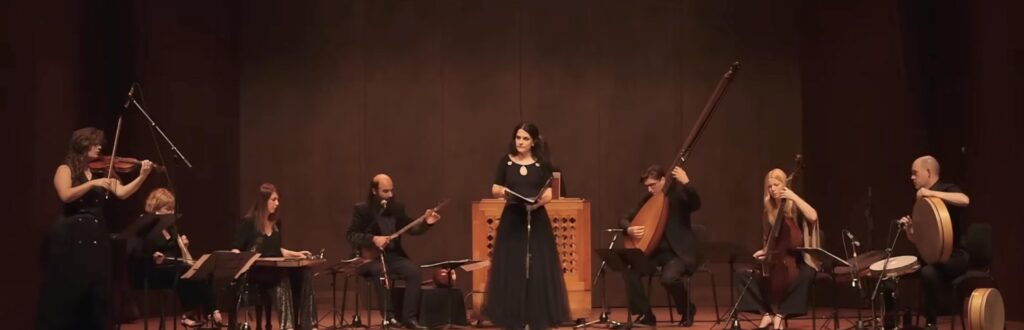
Cross-cultural collaborations have become increasingly common in the world of early and contemporary music, yet very few achieve the level of artistic integrity found in Bach & Khayyam. Created by the Montreal-based ensemble Constantinople under the artistic direction of Kiya Tabassian, this remarkable production brings together the music of Johann Sebastian Bach with the poetry of the Persian polymath Omar Khayyam. Joined by the extraordinary Czech soprano Hana Blažíková and an ensemble combining Baroque and Persian instruments, the project creates a musical language that feels both ancient and entirely new. Premiered at the Internationales Bachfest Schaffhausen in 2022 and later performed at Salle Bourgie in Montreal, the concert stands as one of the most imaginative dialogues between European and Persian musical traditions in recent years.
Bach & Khayyam: A Dialogue Across Civilizations
Combining Bach and Khayyam, two towering figures of music and poetry from two profound civilizations, is an inspired artistic concept. The use of the Iranian setar alongside instruments contemporary to Bach creates a rich tapestry of sound that honors both traditions without allowing either to dominate the other. Rather than presenting a simple East-meets-West fusion, Kiya Tabassian builds a genuine conversation between cultures.
The familiar melodies of Bach acquire completely new colors through Tabassian’s exceptional instrumentation. The warm resonance of the setar, the expressive kemençe, the shimmering kanun, together with the viola da gamba, theorbo, Baroque violin, and positive organ, surround Bach’s music with unexpected timbres. Hana Blažíková’s luminous interpretation of Bach’s sacred repertoire blends naturally with Persian verses sung by Tabassian, creating a musical landscape unlike anything else in today’s classical world.
Why This Musical Pairing Works
What makes the project especially compelling is that it does not simply alternate between German and Persian texts. Each newly composed Persian setting responds directly to Bach’s musical ideas. Tabassian uses Bach’s harmonic language and melodic gestures as inspiration while composing entirely original music for the quatrains of Omar Khayyam. The result is neither arrangement nor quotation, but a true dialogue across centuries.
Bach’s Faith Meets Khayyam’s Philosophy
One particularly interesting artistic choice is Tabassian’s decision to pair Bach with Omar Khayyam. Among Persian poets, Khayyam would not be the most obvious counterpart to Bach. Bach devoted his life to Lutheran sacred music, famously writing “Soli Deo Gloria” (“Glory to God alone”) on many of his manuscripts and considering his music an offering to God. His often-quoted statement, “The aim and final reason of all music should be none other than the glory of God and the refreshment of the soul,” perfectly summarizes his artistic philosophy.
Khayyam, on the other hand, represents a strikingly different philosophical voice. While his poetry certainly reflects on God and the mysteries beyond human understanding, his Rubaiyat is filled with existential questions about mortality, uncertainty, and the fleeting nature of life. Again and again he reminds us that death awaits every human being, encouraging the reader to embrace the present moment, enjoy wine, friendship, and beauty while they still exist. His verses rarely offer certainty; instead, they invite contemplation of life’s impermanence.
These worldviews are not identical. One could even argue that Persian poets such as Attar of Nishapur or Rumi might seem closer companions to Bach’s spiritual universe. Yet this apparent contrast may be precisely what gives Bach & Khayyam its remarkable depth.
Instead of attempting to prove that Bach and Khayyam thought alike, Tabassian allows their differences to coexist. Bach’s certainty encounters Khayyam’s questioning. Christian devotion meets Persian philosophical reflection. Neither voice attempts to overcome the other. Together they reveal that the search for meaning, beauty, and transcendence is shared across cultures, even when the answers differ.
The success of the concert therefore lies far beyond its beautiful performances or sophisticated instrumentation. It reaches beyond combining Western and Persian instruments, beyond alternating German and Persian poetry, and even beyond blending Baroque and Persian musical languages. At its heart, Bach & Khayyam creates an entirely new artistic space where two civilizations speak to one another with mutual respect.
What Makes Bach & Khayyam Unique?
- Brings together Baroque and Persian musical traditions.
- Combines German sacred texts with Persian poetry.
- Features both historical European and traditional Iranian instruments.
- Creates original musical settings rather than simple arrangements.
- Explores the philosophical dialogue between faith and existentialism.
- Demonstrates how two seemingly distant cultural worlds can coexist within a single artistic vision.
| Aspect | Bach | Khayyam |
|---|---|---|
| Era | Baroque Germany (1685–1750) | Medieval Persia (1048–1131) |
| Legacy | Composer of sacred and instrumental masterpieces | Poet, mathematician, astronomer, philosopher |
| Artistic Focus | Christian faith and devotion | Existential reflection and the human condition |
| Central Theme | The glory of God and spiritual order | Mortality, uncertainty, and living in the present |
| Representation in the Concert | Original compositions by J.S. Bach | Newly composed settings of Khayyam’s Rubaiyat by Kiya Tabassian |
Kiya Tabassian’s Vision on Bach & Khayyam
This concert is an exploration of humanity’s shared artistic heritage. More than six centuries separate Bach and Khayyam, yet through Kiya Tabassian’s thoughtful vision they appear less as distant historical figures than as contemporaries engaged in an intimate conversation about faith, doubt, beauty, mathematics, mortality, and the sublime.
It is a rare achievement, and one that deserves to be regarded as a landmark in intercultural history of classical music.
#Bach #OmarKhayyam #KiyaTabassian #ConstantinopleEnsemble #HanaBlazikova #EarlyMusic #PersianMusic #BaroqueMusic #ClassicalMusic #CrossCultural #Setar #WorldMusic #MusicReview #ConcertReview #SacredMusic