Joseph Haydn is rightfully remembered as a titan of Western classical music. The “Father of the Symphony” and the “Father of the String Quartet” spent his long life building the structural foundations of the Classical era, mentoring a young Wolfgang Amadeus Mozart, and teaching a tempestuous Ludwig van Beethoven. When he passed away in Vienna in 1809 at the age of 77, the musical world wept. Yet, while his musical legacy remained perfectly intact, his physical body was about to endure one of the most grotesque and surreal misadventures in music history.
Haydn’s death coincided with the Napoleonic occupation of Vienna. Because of the wartime chaos, the celebrated composer was hastily buried in a simple, unglamorous grave at the Hundsturm cemetery. A proper, grand burial would have to wait. But just days after his funeral, under the cover of darkness, two men bribed the local gravedigger, exhumed the composer’s fresh corpse, and cleanly severed his head. They stuffed the skull into a sack and vanished into the night, leaving a headless icon behind.
The Pseudoscience of a Theft
The grave robbers were not ordinary ghouls seeking gold fillings. They were Joseph Carl Rosenbaum, a former secretary to Haydn’s aristocratic patrons, the Esterházy family, and Johann Nepomuk Peter, a prison governor. Both men were devoted disciples of phrenology, a highly popular nineteenth-century pseudoscience pioneered by Franz Joseph Gall. Phrenologists believed that an individual’s moral character, intellect, and specific talents were directly mapped to the shape and contours of their skull. To Rosenbaum and Peter, Haydn’s brain was an absolute goldmine. They desperately needed to examine his skull to locate the physical bumps responsible for his unparalleled musical genius.
Upon bleaching and inspecting the skull, Peter and Rosenbaum triumphantly declared that the “bump of music” on Haydn’s skull was, predictably, extraordinarily well-developed.
For over a decade, the stolen skull lived an active social life. Rosenbaum, an avid collector, kept it in an elaborate, silk-lined custom box, occasionally displaying it to shocked and fascinated guests at his garden parties. Meanwhile, Haydn’s headless torso remained completely undisturbed in its modest Viennese grave.
The Grand Exhumation and the First Switch
The plot thickened in 1820. Prince Nikolaus Esterházy II, remembering the immense cultural debt his family owed their longtime court composer, decided it was time to move Haydn’s remains to the family seat at the Bergkirche in Eisenstadt. When the coffin was unsealed for relocation, the assembled dignitaries recoiled in horror. Inside lay a decayed uniform and a white wig, but absolutely no skull.
An enraged Prince Esterházy immediately ordered a state investigation. The police quickly connected the dots back to the phrenology-obsessed Rosenbaum and Peter. However, the thieves were clever. Warned of the impending police raid, Rosenbaum gave the skull to his wife, Therese, who hid it beneath her heavy skirts and sat on it, pretending to be sick in bed while officers searched the house.
Realizing the authorities wouldn’t leave empty-handed, Rosenbaum engineered a brilliant deception. He procured the skull of an anonymous, recently deceased young woman and handed it over, claiming it was the composer’s. The police, unable to tell the difference, accepted the trick and took the decoy skull to Eisenstadt. It was promptly placed into the coffin with Haydn’s body, and the tomb was sealed shut.
A Century-Long Game of Hot Potato
Before his death, a remorseful Rosenbaum bequeathed the real skull to Johann Peter, who later left it to the Vienna School of Medicine. By 1895, the genuine skull had found its way into the custody of the prestigious Society of the Friends of Music (Gesellschaft der Musikfreunde) in Vienna, where it was put on public exhibition. Musicologists, tourists, and composers alike could look directly into the eye sockets of the man who wrote the London Symphonies.
For decades, the Society stubbornly refused to return the relic to the Esterházy estate, arguing that it was a vital scientific and historical artifact. It wasn’t until the mid-20th century, following the geopolitical shifts of World War II, that an agreement was finally reached to reunite Haydn with his true head.
Two Heads Are Better Than One
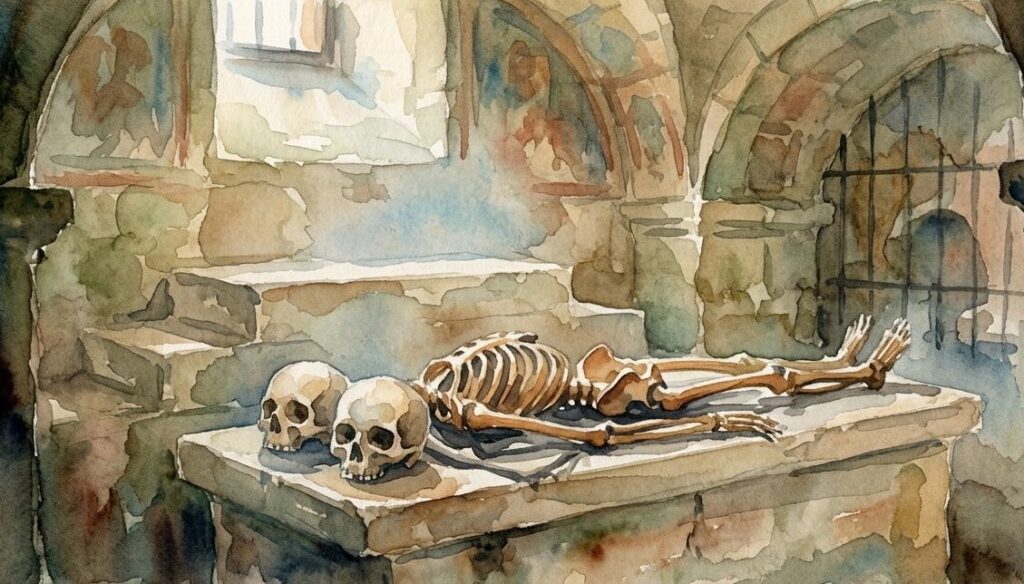
On June 14, 1954, a staggering 145 years after his initial burial, a solemn, elaborate procession carried Joseph Haydn’s authentic skull from Vienna to the mausoleum in Eisenstadt. The real skull was finally laid to rest alongside the skeletal remains.
However, a final, surreal decision had to be made: what should be done with the anonymous substitute skull that had occupied the coffin for over 130 years? Rather than discarding it or desecrating another unknown soul’s resting place, church and estate officials made the ultimate executive decision to leave it exactly where it was.
Today, visitors to the beautifully ornate Haydn Mausoleum in Eisenstadt are paying respects to an undisputed musical genius who enjoys a distinction shared by no other composer in history. Joseph Haydn rests in eternal peace, forever keeping watch over classical music history with one body, and two heads.