Richard Strauss (11 June 1864 – 8 September 1949) was one of the few figures in Western classical music to triumphantly, and contentiously, straddle the boundary between two eras. Emerging at the tail end of the nineteenth century as the undisputed heir to the German Romantic tradition, he went on to dismantle the walls of harmonic convention, helping to launch the twentieth-century modernist revolution. As a master of the orchestra and a pioneering dramatic realist in opera, he became a target of both conservative ire and avant-garde skepticism. His life and art ultimately mirrored a fast-changing world, capturing the opulence of the late German Empire, the anxieties of the Weimar Republic, and the complex moral compromises of the Second World War.
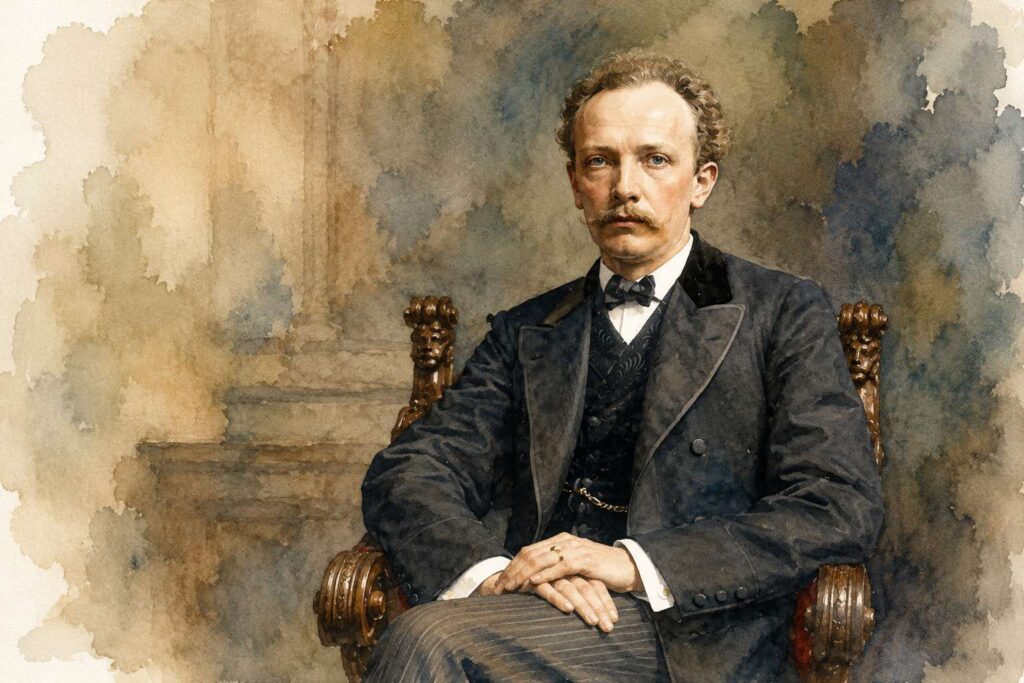
The Shadow of the Father: Paternal Conservatism vs. Radical Awakening
To understand the artistic development of Richard Strauss, one must first understand his father, Franz Strauss. Franz was the principal horn player of the Munich Court Orchestra and arguably the most celebrated horn virtuoso of his day. He was also a fierce musical conservative who despised the progressive “Music of the Future” championed by Franz Liszt and Richard Wagner. Franz believed that the peak of musical achievement had been reached by Mozart, Beethoven, and Haydn, and he raised his son under a strict regime of classical orthodoxy.
As a prodigy, the young Richard composed works that mirrored his father’s tastes—polished, well-behaved pieces heavily indebted to Felix Mendelssohn and Robert Schumann. Franz Strauss shielded his son from the radical developments occurring in nearby Bayreuth, where Wagner was redefining the operatic art form. Ironically, Franz’s own orchestral duties forced him to perform Wagner’s complex scores under the composer’s supervision, even as he openly grumbled from the orchestra pit.
The turning point for Richard Strauss came in his early twenties, when he left the immediate orbit of his father and fell under the influence of Alexander Ritter, a violinist and ardent Wagnerian who had married Wagner’s niece. Ritter introduced Strauss to the philosophical writings of Arthur Schopenhauer and the aesthetics of programmatic music.
This exposure shattered the young composer’s classical constraints. Strauss realized that music could do more than express abstract structural beauty; it could depict narrative, philosophy, psychology, and physical reality. This intellectual awakening marked the beginning of his maturity as a composer, signaling a lifelong tension between the classical discipline instilled by his father and his own innate drive toward radical expression.
Reinventing the Tone Poem
Having abandoned the traditional symphony, Strauss turned his attention to the symphonic poem, a genre initiated by Liszt but brought to its absolute zenith by Strauss, who preferred the term tone poem (Tondichtung). Between 1888 and 1898, Strauss unleashed a series of orchestral works that stunned Europe with their technical virtuosity, vivid storytelling, and daring orchestration.
His first major success, Don Juan (1888), made him an overnight celebrity. The piece bursts with a restless, erotic energy, pushing the boundaries of orchestral technique and showcasing an unprecedented mastery of brass writing—perhaps a nod to his father’s instrument, despite the radical departure in style. Strauss followed this with Till Eulenspiegel’s Merry Pranks (1895), a witty, rhythmically complex portrait of a folkloric rogue, and Also sprach Zarathustra (1896), an ambitious attempt to translate Friedrich Nietzsche’s philosophical concepts into pure sound. The opening of Zarathustra, depicting a cosmic sunrise, remains one of the most famous musical gestures in human history immortalized by Satanley Kubrik in the opening of his movie, 2001: A Space Odeyssey.
Key Tone Poems by Richard Strauss (1888–1898):
├── Don Juan (1888) — Erotic vitality and programmatic narrative
├── Till Eulenspiegel (1895) — Rhythmic wit and orchestral virtuosity
├── Also sprach Zarathustra (1896) — Philosophical inquiry in sound
└── Ein Heldenleben (1898) — Autobiographical heroism and sonic complexity
In Don Quixote (1897) and Ein Heldenleben (A Hero’s Life, 1898), Strauss pushed programmatic music to its absolute limit. He used the orchestra to mimic the bleating of sheep, the chattering of critics, and the clash of battles. While traditionalists accused him of vulgarity and sacrificing musical form for literal illustration, Strauss proved that his tone poems were held together by rigorous structural logic, often utilizing highly sophisticated variations and rondo forms beneath their descriptive surfaces.
The Operatic Revolution: Scandal and Neoclassicism
By the turn of the twentieth century, Strauss felt he had exhausted the possibilities of the tone poem. He turned his creative energy toward the stage, a move that would cement his status as the world’s leading opera composer following the deaths of Giuseppe Verdi and Richard Wagner.
His initial attempts, Guntram (1894) and Feuersnot (1901), met with limited success. However, in 1905, Strauss shocked the cultural world with Salome, an adaptation of Oscar Wilde’s scandalous play. Salome was a masterclass in psychological realism and musical expressionism. Strauss matched Wilde’s decadent, sensuous text with an orchestral score of unprecedented violence, dissonance, and lushness. The opera’s climax—featuring the infamous “Dance of the Seven Veils” and Salome’s necrophilic monologue to the severed head of John the Baptist—caused censorship battles across Europe and New York. Mechanically and harmonically, Salome pushed tonal music to the very brink of collapse.
“I do not approve of this, but I must say that the man has immense talent, and it will be difficult for him to get down from the height he has reached.” — Gustav Mahler, writing to his wife Alma regarding the premiere of Salome.
Strauss pushed even further into early expressionism with Elektra (1909), a brutal, dissonant, and psychologically claustrophobic psychological drama based on Sophocles’ tragedy. Elektra marked the first collaboration between Strauss and the Austrian poet and playwright Hugo von Hofmannsthal. Their partnership would become one of the most successful and enduring collaborations in operatic history.
| Opera | Premiere Year | Librettist / Source | Musical Style |
| Salome | 1905 | Oscar Wilde | Expressionist, highly dissonant, decadent |
| Elektra | 1909 | Hugo von Hofmannsthal | Polytonal, avant-garde, psychologically violent |
| Der Rosenkavalier | 1911 | Hugo von Hofmannsthal | Neoclassical, lushly tonal, Viennese waltz-infused |
| Ariadne auf Naxos | 1912 | Hugo von Hofmannsthal | Chamber opera, meta-theatrical, Mozartian |
Just when the avant-garde expected Strauss to take the final step into total atonality, he executed a stunning aesthetic pivot. In 1911, Strauss and Hofmannsthal unveiled Der Rosenkavalier (The Knight of the Rose). Set in an idealized eighteenth-century Vienna, the opera was a bittersweet, aristocratic comedy filled with lush, anachronistic Viennese waltzes and sparkling, Mozartian clarity. It was a massive commercial triumph, but it permanently alienated the radical avant-garde, who viewed Strauss’s sudden return to diatonic lyricism as a betrayal of modernism.
Strauss and Hofmannsthal continued their fruitful partnership with complex, symbolist masterpieces such as Die Frau ohne Schatten (The Woman Without a Shadow, 1919) and Arabella (1933), proving that Strauss had chosen to refine and expand the boundaries of tonality rather than abandon it entirely.
The Darkest Movement: Navigating the Third Reich
The most controversial and heavily scrutinized chapter of Strauss’s biography is his relationship with the Nazi regime in the 1933s. When Adolf Hitler rose to power in 1933, Strauss was nearly seventy years old, globally famous, financially secure, and deeply apolitical. He viewed politicians with aloof contempt, caring almost exclusively about the preservation of German musical culture and his own financial interests.
In 1933, the Nazi regime appointed Strauss as the president of the Reichsmusikkammer (State Music Bureau) without his prior consultation. Strauss accepted the position, believing he could use his influence to protect German music, elevate copyright laws for composers, and insulate classical art from political interference. It was a naive miscalculation. The regime used Strauss’s international prestige to legitimize their cultural apparatus, while systematically banning Jewish musicians and composers.
Strauss’s motivations were also intensely personal and protective. His daughter-in-law, Alice, was Jewish, meaning his beloved grandchildren were classified as Jewish under Nazi law. Strauss cooperated with the regime to secure their safety.
However, his relationship with the authorities soured dramatically in 1935 over his opera Die schweigsame Frau (The Silent Woman). The libretto had been written by Stefan Zweig. Strauss insisted that Zweig’s name appear on the program playbills in Dresden, defying Nazi directives. The Gestapo intercepted a letter from Strauss to Zweig in which the composer wrote: “For me, there are only two kinds of people: those who have talent and those who have none.” Strauss was promptly forced to resign from his position as head of the Reichsmusikkammer, spending the remainder of the Nazi era under surveillance, politically isolated and terrified for his family’s survival.
The Metamorphosis and Twilight
Following the devastation of World War II, Strauss entered an extraordinary creative Indian summer. Displaced from his home and horrified by the destruction of Germany’s historic opera houses—which he viewed as the true temples of European civilization—he channeled his grief into absolute music.
In 1945, he composed Metamorphosen, an elegiac study for twenty-three solo string instruments. The piece is a profound, mourning meditation on the collapse of German culture, culminating in a quotation of the funeral march from Beethoven’s Eroica Symphony.
His artistic valedictory came in 1948 with the Four Last Songs (Vier letzte Lieder) for soprano and orchestra. Setting poems by Hermann Hesse and Joseph von Eichendorff, these songs are an exquisite, serene farewell to life, art, and the entire nineteenth-century Romantic tradition. In the final song, Im Abendrot (At Sunset), as the soprano asks, “Is this perhaps death?”, the orchestra gently quotes the transfiguration theme from his own tone poem Death and Transfiguration, composed sixty years earlier. Strauss died peacefully in Garmisch-Partenkirchen on September 8, 1949.
Significance and Legacy
Richard Strauss remains a colossal figure in the transition from Late Romanticism to Modernism. His importance lies in his revolutionary expanding of the orchestra’s expressive vocabulary. He wrote for instruments with an unprecedented understanding of their technical limits, treating the massive late-Romantic orchestra as a fluid, giant chamber ensemble capable of the most delicate intimacy or the most thunderous, complex polyphony.
Historically, he demonstrated that modernism did not have to mean a complete break with the past. While contemporary figures like Arnold Schoenberg chose the path of total atonality and serialism, Strauss showed that the traditional tonal framework still possessed immense psychological depth and expressive power. His legacy echoes clearly through the twentieth century, directly influencing the lush, programmatic styles of mid-century film scoring, particularly the works of Max Steiner, Erich Wolfgang Korngold, and later, John Williams. Strauss closed the book on the long nineteenth century, leaving behind a sonic architecture that remains as dazzling and emotionally resonant today as it was a century ago.
References
- Boyden, Matthew. Richard Strauss. Northeastern University Press, 1999.
- Gilliam, Bryan. The Life of Richard Strauss. Cambridge University Press, 1999.
- Kennedy, Michael. Richard Strauss: Man, Musician, Enigma. Cambridge University Press, 2006.
- Ross, Alex. The Rest Is Noise: Listening to the Twentieth Century. Farrar, Straus and Giroux, 2007.
- Youmans, Charles. The Cambridge Companion to Richard Strauss. Cambridge University Press, 2010.
#ClassicalMusic #RichardStrauss #OperaHistory #Musicology #TonePoem #Salome #DerRosenkavalier #FourLastSongs #LateRomanticism #ModernMusicians #Orchestration #GermanComposers #MusicHistory #Zarathustra #Hofmannsthal