Mikhail Glinka: The Architect of Russian Musical Nationalism
Before the nineteenth century, the art music landscape of Western Europe was dominated primarily by Germanic, Italian, and French traditions. Russia, despite its vast territory and rich tapestry of indigenous folk song, possessed no native classical tradition that could rival the symphonic and operatic achievements of Western Europe. The Russian court and aristocracy favored imported art, routinely hiring Italian and French composers to write operas and direct court chapels.
This cultural dependency shifted dramatically with the emergence of Mikhail Ivanovich Glinka (1 June 1804 – 15 February 1857). Widely recognized by musicologists and historians as the “father of Russian classical music,” Glinka single-handedly laid the foundations for a distinctive, nationally conscious musical idiom. By synthesizing the rigorous contrapuntal and formal methodologies of Western Europe with the modal harmonies, rhythmic irregularities, and melodic contours of Russian folk song, Glinka emancipated Russian music from foreign hegemony (Abraham, 1976). His breakthrough operas, A Life for the Tsar and Ruslan and Lyudmila, alongside his innovative orchestral works like Kamarinskaya, provided the genetic material from which subsequent generations of Russian composers, most notably the nationalist circle known as “The Five” and Pyotr Ilyich Tchaikovsky, would draw their inspiration. This article provides a comprehensive analysis of Glinka’s biography, his seminal masterpieces, his stylistic innovations, and his enduring legacy within global musicology.
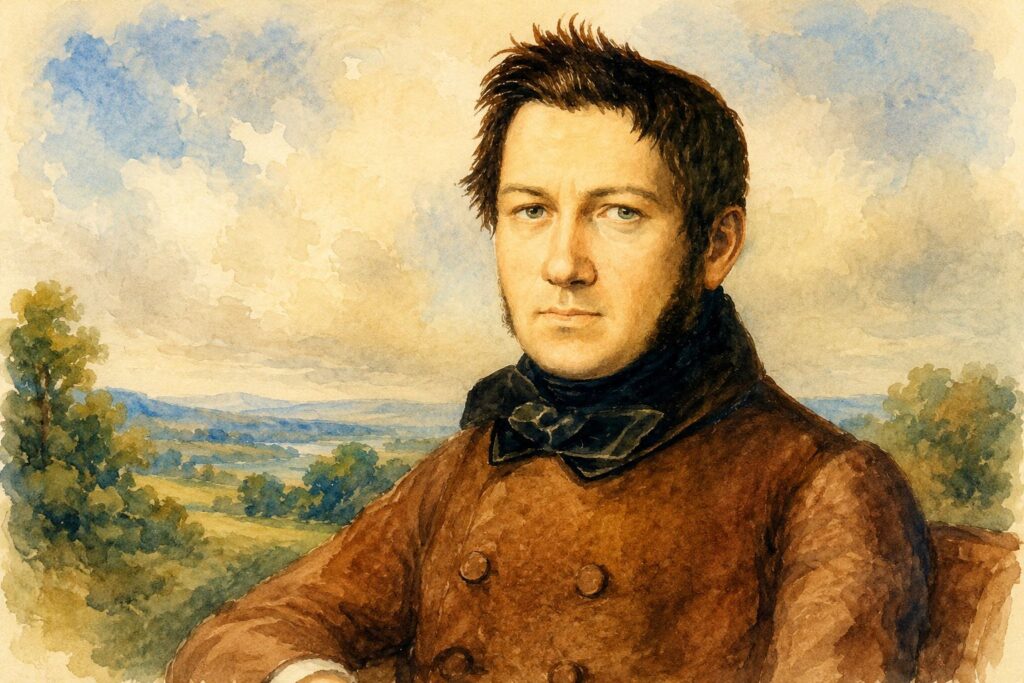
Early Life and Formative Influences
Mikhail Ivanovich Glinka was born in the village of Novospasskoye, situated in the Smolensk Governorate of the Russian Empire. Born into a wealthy family of the landed gentry, Glinka’s early childhood was marked by physical fragility and overprotective care, a circumstance that fostered a lifelong hypochondria and a hyper-sensitive disposition (Brown, 1974). His early isolation, however, was mitigated by a rich auditory environment. He was deeply captivated by the vibrant peal of church bells in his village, a sonic texture that would later reverberate through his operatic choruses, and by the traditional folk songs sung by the local peasantry.
Glinka’s formal exposure to classical music began through his maternal uncle’s private orchestra, which comprised serf musicians who performed works by European masters such as Haydn, Mozart, and Beethoven (Campbell, 2003). Glinka frequently participated in these private concerts, learning to play the flute and the violin. This hands-on experience provided him with an early, intuitive understanding of orchestration and ensemble balance.
In 1817, Glinka was sent to the Chief Pedagogical Institute in St. Petersburg, an elite school for the nobility. In the imperial capital, he took sporadic piano lessons from prominent visiting musicians, including the celebrated Irish composer and pioneer of the nocturne, John Field (Maes, 2002). Despite these lessons, Glinka did not receive a rigorous, systematic education in music theory or composition during his adolescence. Following his graduation in 1822, he complied with family expectations by entering the civil service, working as an assistant secretary in the Department of Public Highways. This bureaucratic tenure was short-lived; Glinka’s fragile health and swelling passion for music led him to resign his post in 1828 to pursue composition more seriously, though he still operated within the social framework of an aristocratic amateur, composing elegant salon romances and chamber pieces for the St. Petersburg intelligentsia (Brown, 1974).
The European Wanderjahre and Artistic Awakening
Recognizing the limitations of his self-taught status and seeking a more favorable climate for his chronic ailments, Glinka embarked on an extended tour of Western Europe in 1830. He spent three years in Italy, residing primarily in Milan, Naples, and Rome. During this period, Glinka immersed himself in the Italian operatic tradition, frequenting performances at Teatro alla Scala and forging personal acquaintances with leading operatic figures of the day, including Vincenzo Bellini and Gaetano Donizetti (Glinka, 1980). He absorbed the nuances of Italian bel canto, the art of beautiful, expressive, and fluid vocal writing, which would permanently shape his approach to vocal melody.
Despite his admiration for Italian lyricism, Glinka experienced a profound crisis of artistic identity while in Italy. He grew increasingly disillusioned with the superficiality and predictability of contemporary Italian opera, realizing that copying foreign models would never satisfy his artistic ambitions. In his autobiographical memoirs, Glinka recalled a profound wave of homesickness that triggered his nationalist awakening: “We children of the North are different… Nostalgia led me gradually to the idea of writing in a Russian style”.
To acquire the technical tools necessary to realize this vision, Glinka left Italy in 1833 and traveled to Berlin. There, he underwent five months of intensive, rigorous study in harmony and counterpoint under the tutelage of the distinguished German music theorist Siegfried Dehn. Dehn was a crucial catalyst for Glinka’s development; he did not impose rigid academic formulas but instead helped Glinka systematically organize his intuitive musical thoughts. Dehn analyzed Glinka’s sketches, refined his part-writing, and encouraged him to utilize his native Russian folk material within robust structural frameworks. Armed with this newfound compositional authority, Glinka returned to St. Petersburg in 1834, resolved to create a grand Russian opera that would be “national not only in subject matter but in its music”.
The Operatic Masterpieces
A Life for the Tsar (1836)
Upon his return to Russia, Glinka aligned himself with the prominent literary circles of St. Petersburg, interacting with figures such as Vasily Zhukovsky, Nikolai Gogol, and Alexander Pushkin. It was Zhukovsky who suggested the historical subject for Glinka’s first major opera: the self-sacrifice of Ivan Susanin, a seventeenth-century peasant hero who saved the life of the newly elected Tsar, Mikhail Romanov, by deliberately leading an invading force of Polish soldiers astray into an impassable forest.
Originally titled Ivan Susanin, the opera was renamed A Life for the Tsar (Zhizn’ za tsarya) out of deference to Emperor Nicholas I, who took a personal interest in its production. The premiere took place on November 27, 1836, at the Bolshoi Kamenny Theatre in St. Petersburg, conducted by Catterino Cavos. It was an unprecedented, monumental triumph.
[Western Structural Model] ───┐
                              ├───► [A Life for the Tsar (1836)]
[Russian Folk/Modal Idiom] ───┘
Musically, A Life for the Tsar was revolutionary. While it retained the conventional formal architecture of French grand opera and Italian bel canto, such as distinct recitatives, dynamic arias, and grand choral finales, it infused these structures with an authentically Russian musical lexicon. Glinka achieved this through several innovative techniques:
- Modal Harmonies and Rhythmic Asymmetry: Rather than relying exclusively on the Western major-minor tonal system, Glinka incorporated natural minor, Aeolian, and Phrygian modes characteristic of Russian peasant polyphony. He also employed unusual meters, such as the 5/4 time signature in the Act III bridal chorus, mimicking the asymmetric rhythms of traditional folk dances.
- Thematic Contrast as Dramatic Conflict: Glinka structuralized the geopolitical conflict between Russia and Poland by assigning distinct musical styles to each camp. The Russian characters, particularly Susanin and his daughter Antonida, express themselves through expansive, melancholic, folk-like melodies. Conversely, the Polish invaders are characterized exclusively by Western European dance forms, specifically the polonaise, the mazurka, and the krakowiak.
- Proto-Leitmotivic Design: Long before Richard Wagner popularized the leitmotif system in his music dramas, Glinka utilized recurring melodic motifs to unify the opera’s narrative architecture. The opening folk theme returns transformed throughout the work, culminating in the transcendent, brass-heavy “Slavsya” (“Glory”) chorus of the epilogue, which effectively established the archetypal vocabulary of Russian ceremonial music (Maes, 2002).
Ruslan and Lyudmila (1842)
Emboldened by the success of his first opera, Glinka embarked on a second operatic project based on Alexander Pushkin’s narrative fantasy poem, Ruslan and Lyudmila. Glinka had hoped that Pushkin would write the libretto himself; however, the poet’s tragic death in a duel in 1837 forced Glinka to piece together a fragmented libretto with the assistance of several minor literary figures. This chaotic collaborative process resulted in a dramatic structure that was episodic and dramaturgically flawed, a vulnerability that severely impacted its reception.
The premiere of Ruslan and Lyudmila occurred exactly six years after his first opera, on November 27, 1842. The reception was distinctly cool. The aristocratic audience, accustomed to the straightforward narrative and patriotic fervor of A Life for the Tsar, was baffled by the non-linear plot, the whimsical fairy-tale elements, and the highly eccentric, avant-garde musical language.
Despite its initial public failure, Ruslan and Lyudmila is now widely regarded by musicologists as Glinka’s most influential work, serving as the blueprint for the entire tradition of Russian fantasy and epic opera. In this score, Glinka introduced several radical compositional techniques that expanded the harmonic boundaries of European classical music:
- The Whole-Tone Scale: To depict the malevolent, disembodied magic of the evil wizard Chernomor, Glinka constructed a recurring harmonic motif utilizing a strict whole-tone scale (a scale consisting entirely of whole-step intervals). This was the first systematic use of the whole-tone scale in Western art music, predating its widespread adoption by French Impressionist composers like Claude Debussy by several decades (Taruskin, 1996).
- Musical Orientalism: Glinka established the stylistic paradigms of Russian musical exoticism, or “orientalism.” To depict the magical realms of the East within the opera, he utilized authentic Middle Eastern melodies, chromatic modulations, syncopated rhythms, and sensual, translucent orchestration (such as the prominent use of the English horn and solo cello in Ratmir’s aria). This specific soundscape would directly inspire later works such as Balakirev’s Islamey, Rimsky-Korsakov’s Scheherazade, and Borodin’s Polovtsian Dances (Maes, 2002).
- Dissonance and Changing-Background Variations: In the depiction of Naina’s magic castle, Glinka utilized daring contrapuntal dissonances. Furthermore, he developed the “Glinka variation” technique (often termed changing-background variations), wherein a folk-like melody is repeated verbatim while the orchestral accompaniment, texture, counter-melody, and harmony change dynamically beneath it around each repetition.
Instrumental Masterpieces and the Spanish Voyages
Disheartened by the critical failure of Ruslan and Lyudmila and plagued by deteriorating health and marital discord, Glinka once again sought refuge in foreign travel. In 1844, he visited Paris, where he befriended the French Hector Berlioz, one of the most innovative orchestrators of the nineteenth century. Berlioz deeply admired Glinka’s music, conducting extracts from A Life for the Tsar and Ruslan and Lyudmila at his concerts and publishing an enthusiastic analytical essay praising Glinka’s compositional genius. Glinka, in turn, studied Berlioz’s complex scores, refining his own understanding of instrumental color and transparency.
From 1845 to 1847, Glinka lived in Spain, spending extensive time in Madrid and Granada. Fascinated by the rhythmic vitality and passionate expression of Spanish folklore, he learned local dance steps and collected folk melodies directly from street musicians and guitarists. This immersive ethnomusicological journey resulted in two brilliant symphonic works, known collectively as the Spanish Overtures: Capriccio brillante on the Jota Aragonesa (1845) and Souvenir d’une nuit d’été à Madrid (Night in Madrid, 1848). These pieces are celebrated for their sparkling orchestration, rhythmic drive, and sophisticated handling of authentic Iberian thematic material, setting a precedent for subsequent Western composers, such as Bizet, Rimsky-Korsakov, and Ravel, who would later explore Spanish exoticism.
Upon his return to Russia, Glinka composed his orchestral masterpiece, Kamarinskaya (1848). This brief but immensely consequential symphonic fantasia is built entirely upon two Russian folk tunes: a slow, melancholic wedding song (Iz-za lesa) and a rapid, highly syncopated bridal dance song (Kamarinskaya). Utilizing his signature changing-background variation technique, Glinka seamlessly juxtaposed these disparate melodies, constructing an orchestral texture that mirrored the improvisatory nature of traditional Russian balalaika and accordion playing.
“The entire Russian symphonic school is contained in Kamarinskaya, just as the whole oak is in the acorn.”
— Pyotr Ilyich Tchaikovsky, in his personal diary entries.
Technical Innovation and Musicological Importance
Glinka’s significance in music history rests primarily on his ability to resolve a fundamental aesthetic dilemma: how to integrate the localized, horizontal, and modal properties of Russian folksong into the vertical, teleological, and functional harmonic structures developed over centuries in Western Europe. Prior attempts by lesser-known composers had resulted in clumsy pastiches, where folk melodies were forced into inappropriate Western classical contexts.
Glinka overcame this through several specific technical innovations that permanently altered the trajectory of Russian music theory:
| Aesthetic Dimension | Western European Tradition | Glinka’s Nationalist Synthesis |
| Harmonic Basis | Major-minor functional tonal system; standard cadential progressions. | Integration of church modes (Aeolian, Dorian) and artificial whole-tone configurations to denote supernatural elements. |
| Variational Form | Theme and variations involving melodic decoration and structural transformation. | “Changing-background” variations; the melody remains intact while orchestrations, counterpoints, and harmonies mutate. |
| Orchestral Color | Homogeneous blending of brass, woodwinds, and strings; functional doublings. | Heterogeneous, transparent orchestration; prioritizing highly individualized instrumental colors and solo groupings. |
| Vocal Prosody | Rigid structures adapted to Italian or German syntax. | Flexibility in recitative to mirror the natural cadence, stress, and inflections of the Russian language. |
Final Years and Legacy
The final decade of Glinka’s life was marked by restlessness, intermittent compositional inactivity, and nomadic wandering between St. Petersburg, Paris, and Berlin. He dedicated considerable energy to writing his Memoirs (Zapiski), an invaluable historical document that offers deep insights into his creative psychology and the cultural life of nineteenth-century Russia. In his final years, Glinka grew increasingly fascinated by ancient church polyphony. In 1856, he returned to Berlin to re-examine the historical roots of Western counterpoint and vocal polyphony with his old mentor, Siegfried Dehn, seeking a way to synthesize the ancient liturgical chants of the Russian Orthodox Church with strict Western fugal structures.
This final creative avenue was cut short. Glinka caught a severe chill following a concert in Berlin where excerpts of his music were performed under the direction of King Frederick William IV. He died in Berlin on February 15, 1857. His remains were initially buried there, but a few months later, they were exhumed and transferred to the cemetery of the Alexander Nevsky Monastery in St. Petersburg, where they rest today among Russia’s greatest cultural icons.
                       [ Mikhail Glinka ]
                        (The Foundation)
                               │
            ┌──────────────────┴──────────────────┐
            ▼                                     ▼
     [ "The Five" ]                           [ Tchaikovsky ]
(Balakirev, Mussorgsky, etc.)               (Symphonic Path)
            │                                     │
            └──────────────────┬──────────────────┘
                               ▼
                    [ 20th-Century Giants ]
                  (Stravinsky, Shostakovich)
Glinka’s legacy can be traced cleanly through the subsequent history of Russian classical music. His direct spiritual heir was Mily Balakirev, who positioned himself as the guardian of Glinka’s nationalist principles. Balakirev, along with the critic Vladimir Stasov, formed “The Five” (Moguchaya kuchka), a circle of composers including Modest Mussorgsky, Nikolai Rimsky-Korsakov, Alexander Borodin, and César Cui. This group took Glinka’s innovations, such as the changing-background variation, the whole-tone scale, musical orientalism, and modal folk harmonies, and amplified them into monuments of late-nineteenth-century musical nationalism, yielding masterpieces like Mussorgsky’s Boris Godunov and Rimsky-Korsakov’s The Golden Cockerel (Maes, 2002).
Concurrently, Pyotr Ilyich Tchaikovsky, though more aligned with Western institutional conservatism, drew deeply from Glinka’s symphonic well. Glinka’s influence extended well into the twentieth century; the vibrant orchestral colors, rhythmic ostinatos, and neoclassical transparency found in the early ballets of Igor Stravinsky (such as The Firebird and Petrushka) and the symphonies of Sergei Prokofiev and Dmitry Shostakovich are deeply indebted to the formal and instrumental parameters established by Glinka.
Conclusion
Mikhail Glinka was much more than a talented nineteenth-century composer; he was a cultural revolutionary who fundamentally reshaped the global musical map. Operating at a time when Russian high culture was deeply insecure and heavily dependent on foreign imports, Glinka possessed the vision, historical intuition, and technical mastery required to forge an authentic, sophisticated, and globally viable national style. By marrying the structural rigor of the West with the soul and modality of the East, Glinka did not merely introduce Russia to the classical world, he permanently enriched the expressive, harmonic, and orchestral vocabulary of Western classical music as a whole.
References
- Abraham, G. (1976). The Tradition of Russian Music. Westport, CT: Greenwood Press.
- Brown, D. (1974). Mikhail Glinka: A Biographical and Critical Study. London, UK: Oxford University Press.
- Campbell, S. (2003). Russians on Russian Music, 1830–1880: An Anthology of Critical Essays. Cambridge, UK: Cambridge University Press.
- Frolova-Walker, M. (2007). Russian Music and Nationalism: From Glinka to Stalin. New Haven, CT: Yale University Press.
- Glinka, M. I. (1980). Memoirs. (R. B. Mudge, Trans.). Westport, CT: Greenwood Press. (Original work published 1870).
- Maes, F. (2002). A History of Russian Music: From Kamarinskaya to Babi Yar. (A. J. Pomerans & E. Pomerans, Trans.). Berkeley, CA: University of California Press.
- Taruskin, R. (1996). Defining Russia Musically: Historical and Hermeneutical Essays. Princeton, NJ: Princeton University Press.
- Tchaikovsky, P. I. (1945). The Diaries of Tchaikovsky. (W. Lakond, Trans.). New York, NY: W. W. Norton & Company.
#MikhailGlinka #RussianMusic #ClassicalMusic #MusicHistory #OperaHistory #Musicology #ALifeForTheTsar #RuslanAndLyudmila #Kamarinskaya #MusicalNationalism #TheFive #19thCenturyMusic #Orchestration #BelCanto #FolkMusic