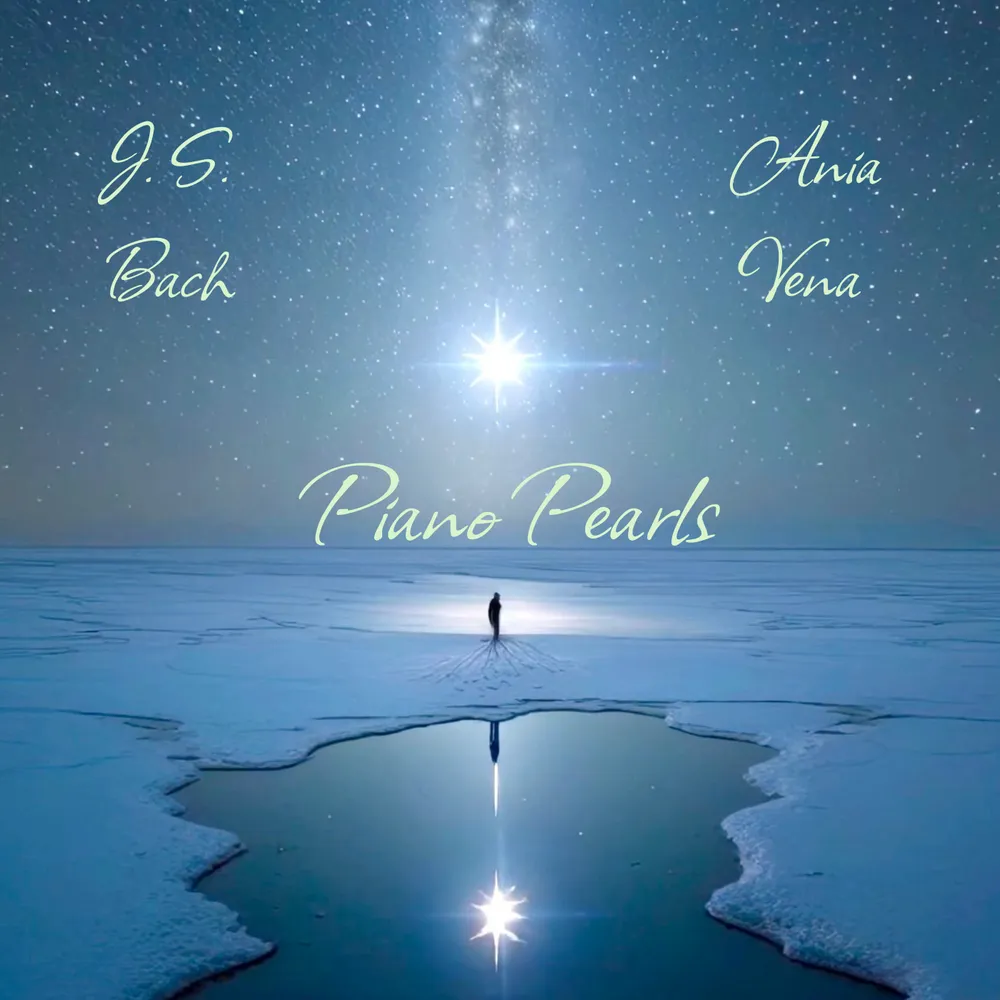
In a contemporary classical landscape often dominated by rigid academic precision or overly flashy pyrotechnics, Ania Vena’s latest release arrives as a sanctuary of profound intimacy. Piano Pearls by Ania Vena is not merely an interpretation of Baroque masterpieces; it is a deeply spiritual translation. Vena approaches the architecture of Johann Sebastian Bach not as a cold blueprint to be executed, but as a living, breathing canvas. By intentionally softening the percussive boundaries of the modern instrument, she captures what she describes as “the echo of something eternal.” The album bridges centuries of musical evolution, offering listeners a space where mathematical genius dissolves into pure, weightless emotion.
Interpreting the works of J.S. Bach on a modern grand piano presents a fascinating dialectical challenge. Bach’s keyboard music was conceived for the harpsichord and the clavichord, and the well-tempered tuning system, which is quite distinct from our standardized, equal-tempered modern pianos. Translating these intricate works to the modern concert grand requires a delicate balance.
Historically, performance practice has split into distinct camps: the strict, metronomic, and crystalline clarity of Glenn Gould versus the romanticized, expansive, and deeply poetic approach of virtuosos like Lang Lang. What Ania Vena achieves in this collection is a breathtaking third path. She envelops Bach’s counterpoint in a delicate layer of sentimentalism, utilizing a muted, velvety timbre that evokes the intimate warmth of a felt piano rather than the bright brilliance of a traditional grand. Whichever school of interpretation you lean toward, Vena’s approach is undeniably moving.
A Journey Through Piano Pearls by Ania Vena
A Weighted Silence: The Prelude in B Minor
The journey begins with the Prelude in B minor, and it immediately establishes the album’s ethereal thesis. The opening arpeggios possess an incredible human expression, revealing a performer who has poured her absolute soul into the keys. As Ania Vena puts it herself:
The melody feels almost weightless—as if it is not being actively played, but rather gently appearing out of the silence, floating somewhere in the liminal space between memory, prayer, and dream.
Through a remarkably soft piano timbre and an exquisitely subtle use of rubato, pushing the boundaries of Baroque elasticity just enough without breaking the structural rhythm, Vena breathes vibrant life into the emotional chord progressions Bach left behind. It stands as one of the most emotionally rich interpretations of this prelude captured on record.
From Dance to Counterpoint
This emotional momentum carries gracefully into the subsequent tracks, including the courtly Menuet and a deeply expressive Sarabande in G major (BWV 816). However, it is her treatment of the Invention No. 2 in C minor (BWV 773) that truly highlights her artistic daring. Typically approached as a brisk Allegro Moderato exercise in precise two-part counterpoint, Vena deliberately slows the tempo. In doing so, she transforms a rigorous technical masterpiece into a serene dialogue. The two independent, interlocking voices are woven together with an emotional texture that values lyricism over sheer velocity.
Heartfelt Renditions and Transcriptions
No collection of Bach is complete without the iconic Aria from the Goldberg Variations. Vena’s rendition is a deeply felt, emotionally deployed performance that mirrors the poetic expansive qualities of Lang Lang’s interpretation. Her gentle touch on the clavier is further emphasized in the Concerto No. 5 in F minor, where the inherent crispness of the notes yields to a tender, rounded depth.
The album culminates in what is arguably one of the most beautiful melodies in music history: the Adagio from the Oboe Concerto in D minor by Alessandro Marcello, famously transcribed for keyboard by Bach himself (BWV 974). Vena treats this concluding piece with the utmost reverence. Her touch is heartwarming yet melancholic, drawing out a tear-shedding beauty from the descending lines that lingers long after the final note decays back into the silence from which it emerged.
Final Thoughts
Ultimately, Piano Pearls by Ania Vena serves as a poignant reminder of Bach’s timeless universality. Regardless of your typical generic preferences or the century we inhabit, Bach’s architecture remains infinitely adaptable, and Vena has done an extraordinary job of breathing a soft, contemporary life into these centuries-old bones. It is an essential, highly recommended listen for anyone seeking a moment of profound peace and emotional resonance.
#AniaVena #PianoPearls #JSBach #ClassicalMusicReview #BaroqueMusic #PianoAlbum #ModernClassical #FeltPiano #BachPrelude #GoldbergVariations #Counterpoint #ClassicalPiano #MusicJournalism #NewClassicalRelease #MarcelloAdagio