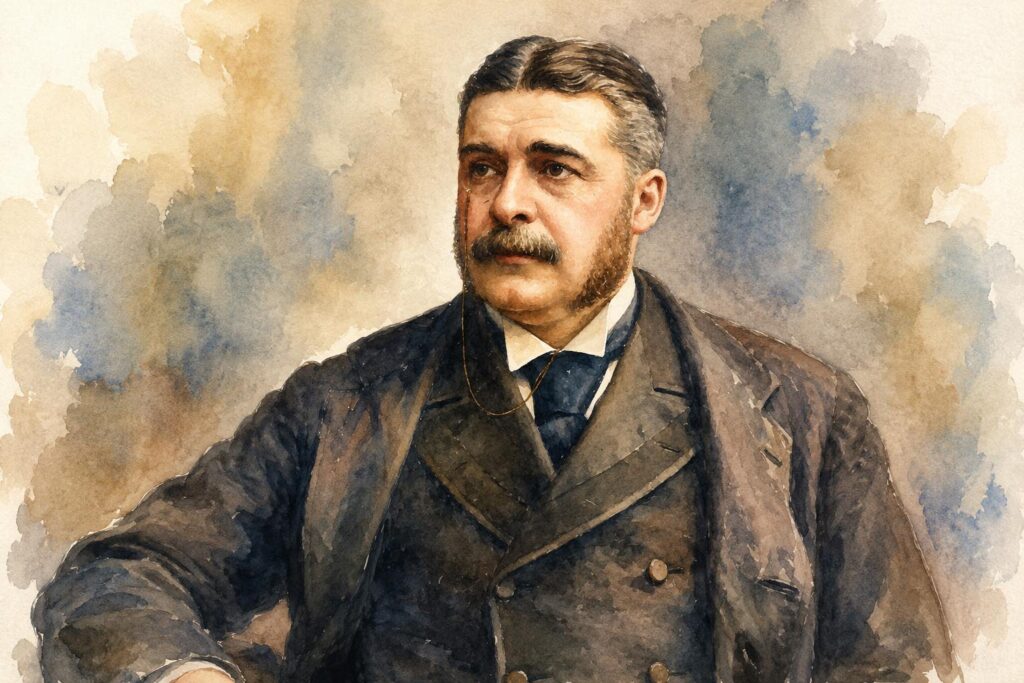
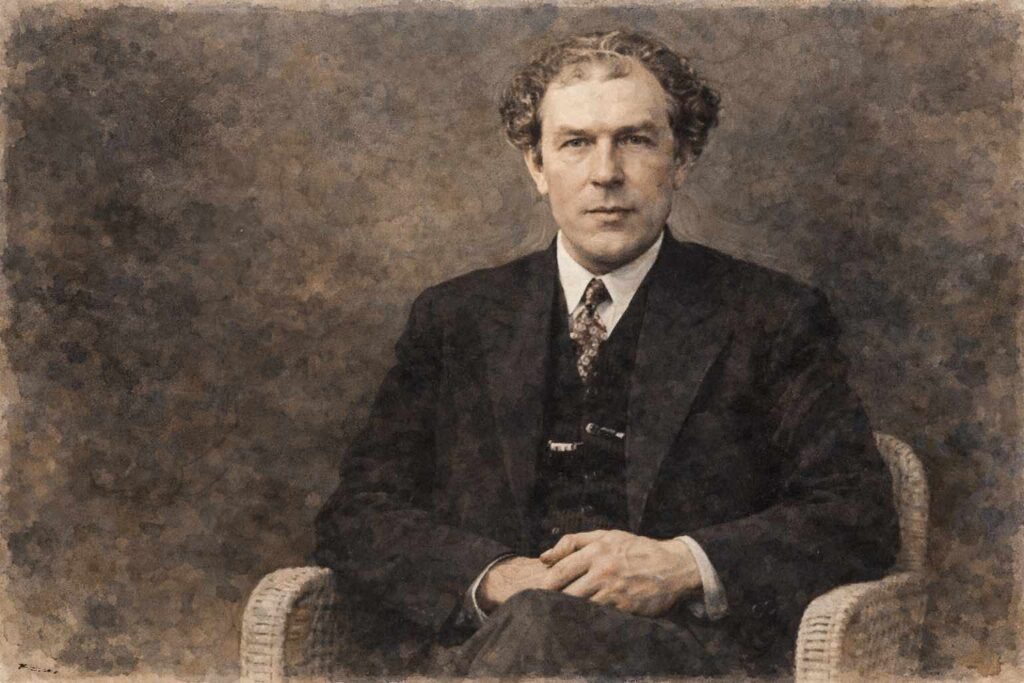
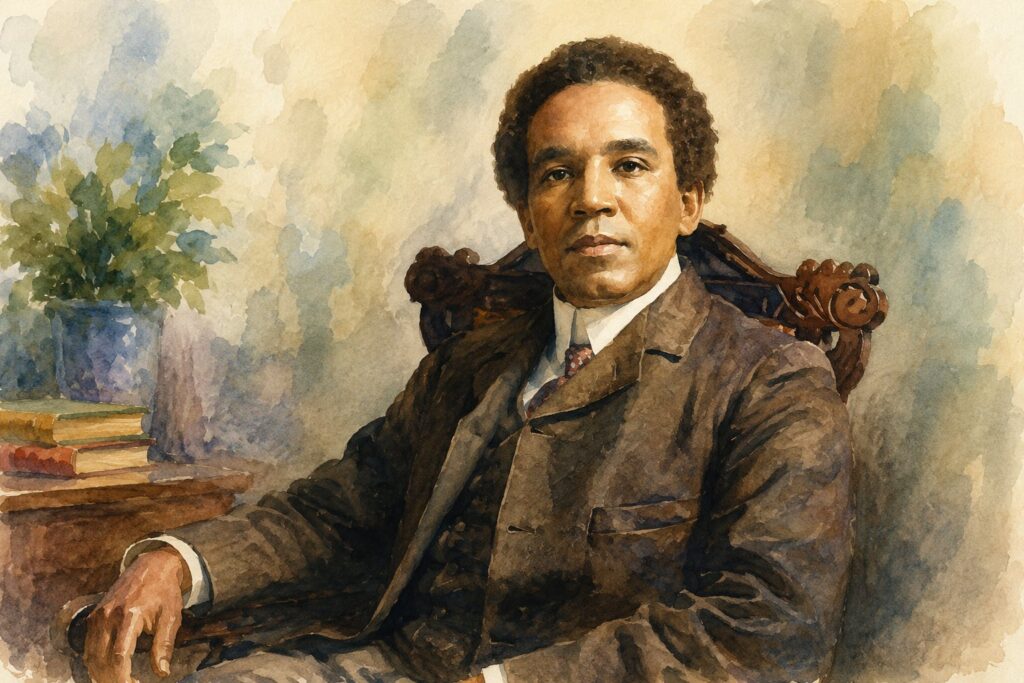
Samuel Coleridge-Taylor (15 August 1875 – 1 September 1912) was a musical luminary whose meteoric rise at the turn of the twentieth century permanently altered the landscape of British classical music. Operating in an era dominated by the late-Romantic heavyweights of Europe, this Anglo-African composer from Croydon captured the ears of the global public with an idiosyncratic blend of rich orchestral color, melodic accessibility, and profound cultural synthesis. At the height of his transatlantic fame, his music was performed with a frequency that rivaled his most celebrated white contemporaries, earning him historic invitations to the White House and securing his status as an international cultural icon. Yet, behind the public adoration lay a complex narrative of racial prejudice, systemic financial exploitation, and an untimely death that cut short one of the era’s most brilliant creative minds (Self, 1995).
Origins and the Royal College of Music
Born in Holborn, London, Samuel Coleridge-Taylor was the son of Alice Hare Martin, an Englishwoman, and Dr. Daniel Peter Hughes Taylor, a Sierra Leonean physician who had studied medicine in the capital. Dr. Taylor returned to West Africa without knowing of his son’s conception, leaving the young boy to be raised by his mother and maternal grandfather in Croydon (Green, 2011). It was an environment steeped in working-class realities, but his innate musical genius quickly manifested. Recognizing his exceptional talent on the violin, local patrons funded his entry into the Royal College of Music (RCM) in 1890 at the tender age of fifteen.
Initially enrolling as a violin student, he transitioned to composition under the tutelage of Charles Villiers Stanford, a formidable figure who helped shape an entire generation of British composers, including Ralph Vaughan Williams and Gustav Holst. Stanford recognized that the young composer possessed a distinct harmonic voice. While at the RCM, Samuel Coleridge-Taylor absorbed the Germanic traditions of Brahms and Wagner, but he began weaving these influences together with a rhythmic vitality and melodic warmth that set his student compositions apart from his peers.
By the late 1890s, his reputation had traveled beyond the walls of the conservatory. Edward Elgar, who was on the verge of international fame himself, became an early and enthusiastic champion. When the committee for the Three Choirs Festival asked Elgar for a new orchestral piece, Elgar declined due to other commitments and instead wrote a letter to the festival’s organizer, August Jaeger:
“I wish, wish, wish you would ask Coleridge-Taylor to write a piece. He is far and away the cleverest fellow going amongst the younger men.” (Elgar, as cited in Jaeger, 1898).
This recommendation led to the commission and premiere of his Ballade in A minor in 1898, a work that was received with rapturous applause and established him as a major force in British music.
The Phenomenon of Hiawatha
The true watershed moment of his career arrived in November 1898 with the premiere of Hiawatha’s Wedding Feast, a cantata based on Henry Wadsworth Longfellow’s epic poem The Song of Hiawatha. Conducted by Stanford at the Royal College of Music, the performance caused an immediate sensation. The work’s lush, cinematic orchestration, combined with its memorable, flowing melodies, struck an immediate chord with the late-Victorian public.
                  [ Hiawatha's Global Impact ]
                                |
        +-----------------------+-----------------------+
        |                                               |
[ Choral Societies ]                             [ Sheet Music ]
Performed annually by hundreds                   Hundreds of thousands of
of amateur and professional choirs.               copies sold worldwide.
The success of Hiawatha’s Wedding Feast was unprecedented for a British choral work. It was followed by two subsequent parts, The Death of Minnehaha (1899) and Hiawatha’s Departure (1900), completing a trilogy known collectively as The Song of Hiawatha. For decades, the trilogy became a staple of the British musical calendar, particularly at the Royal Albert Hall, where spectacular, costumed performances were staged annually.
However, this immense popularity exposed the dark financial underbelly of the turn-of-the-century music publishing industry. Desperate for immediate income to support his young family, Samuel Coleridge-Taylor had sold the copyright of Hiawatha’s Wedding Feast outright to the publisher Novello & Co. for a mere 15 guineas (approximately £15.75 at the time). While Novello reaped vast fortunes from the sale of hundreds of thousands of sheet music copies globally, the composer did not receive a single penny in royalties from those sales. This glaring injustice later became a primary catalyst for the British musical establishment to organize and form the Performing Right Society (PRS) in 1914, aimed at protecting creators from predatory copyright contracts (McVeigh, 2021).
Race, Identity, and the Trials of Samuel Coleridge-Taylor
The professional triumphs of Samuel Coleridge-Taylor cannot be fully understood without examining the racial landscape of the late-Victorian and Edwardian eras. As a man of mixed-race heritage navigating the elite, overwhelmingly white institutions of British classical music, he occupied a precarious position. He was simultaneously celebrated as a national asset and subjected to the patronizing, racialized attitudes of the British empire.
In his youth and adult life in London and Croydon, he regularly encountered overt racial abuse from street urchins who mocked his appearance and his hair. More insidious, however, was the systemic condescension from the musical press. Reviewers frequently used racialized language to describe his compositions, often attributing the rhythmic energy and emotional intensity of his music to his “exotic” ancestry rather than his rigorous technical training and intellectual labor. Critics routinely described his work as possessing a “primitive vigor” or an “oriental luxuriance,” frameworks that sought to isolate his genius as an anomaly of nature rather than the output of a master craftsman (Phillips, 2018).
I can relate to this aspect of his struggle on a personal level. As a composer of Iranian origin living and working in Europe, I frequently hear my music—and myself—characterized through descriptors like “exotic” or “foreign.” I recognize that these comments are almost always rooted in genuine curiosity and goodwill rather than prejudice. However, the subtle impact of these labels can still feel limiting. It risks shifting the focus away from the music’s intrinsic philosophy and ideas, reinterpreting a standalone composition as merely a showcase of the unfamiliar.
We rarely view the masterpieces of J.S. Bach or Antonio Vivaldi solely through the lens of “Germanness” or “Italianness”; their work is granted the space to be universal. The same is true for less-known Western composers, whose music is judged on its own merits rather than as a representative of their geography. Yet, for creators from non-Western backgrounds, cultural and national identity can sometimes inadvertently overshadow individual artistry. As the author Chimamanda Ngozi Adichie noted in her thesis on identity, “The problem with stereotypes is not that they are untrue, but that they are incomplete. They make one story become the only story.” When an artist’s background becomes the only story told, their personal creative voice gets obscured.
Given that I navigate a contemporary world far more inclusive than the one Samuel Coleridge-Taylor inhabited, I can only begin to imagine the profound mental weight and creative friction such constant labeling must have imposed on his life and legacy.
Despite these barriers, Samuel refused to assimilate silently into the Eurocentric mold. Instead, he leaned heavily into his identity, becoming an active and vocal participant in the global Pan-African movement. In 1900, he served as an elected delegate at the first Pan-African Conference held in London, where he developed close relationships with prominent Black intellectuals such as W.E.B. Du Bois and the African-American poet Paul Laurence Dunbar. His collaboration with Dunbar resulted in several art songs and the opera African Romances, which deliberately elevated Black themes and poetic voices into the classical canon.
       [ Dual Worlds of Coleridge-Taylor ]
                       |
     +-----------------+-----------------+
     |                                   |
[ British Reality ]             [ American Reception ]
Classically trained at RCM.     Feted by Black intellectuals.
Faced media condescension       Dubbed "African Mahler" by
and financial exploitation.     white orchestral musicians.
His experience in the United States, which he toured three times (1904, 1906, and 1910), offered a striking contrast to his life in Britain. In America, he faced the rigid, legalized discrimination of the Jim Crow era, yet he was received by African-American communities as an absolute hero. Choral societies bearing his name—such as the Coleridge-Taylor Society in Washington, D.C.—were formed specifically to perform his music.
During these tours, his exceptional skill as a conductor and composer broke through strict institutional racial barriers. He was invited by President Theodore Roosevelt to the White House, an honor almost entirely denied to Black Americans at the time. Furthermore, his technical mastery forced white American classical musicians to view him as an equal.
When conducting the elite, all-white orchestras of New York City and Washington, his commanding presence and sophisticated approach to orchestration led local white musicians and critics to affectionately and respectfully dub him the “African Mahler“ (Snyder, 2016).
This moniker was a testament to his ability to command the highest echelons of symphonic expression, drawing a direct parallel between his complex, expansive musical structures and those of Gustav Mahler.
Samuel Coleridge-Taylor was acutely aware of his role as a trailblazer. Writing to a friend during his American travels, he noted the profound responsibility he felt:
“As a young man, I was always seeking for a model; someone of my own race who had achieved greatness in this art. I want to be that feature for those who come after me, to prove that the colored man can hold his own in the highest realms of European culture.” (Coleridge-Taylor, as cited in Sayers, 1915).
The “African Mahler” and the Symphonic Canvas
To understand why New York musicians drew comparisons to Mahler, one must look closely at how Samuel Coleridge-Taylor constructed his orchestral works. He was not merely a composer of catchy choral tunes; he was a brilliant orchestrator who understood how to extract vast, dramatic colors from a symphonic ensemble. His harmonic language was built upon a late-Romantic foundation, but he consistently injected it with modal inflections, syncopated rhythms, and thematic materials derived from traditional African and African-American spirituals.
| Work | Composition Year | Key Musical Characteristics |
| Ballade in A minor, Op. 33 | 1898 | Bold, dramatic, highly syncopated rhythms; expressive woodwind writing. |
| The Song of Hiawatha, Op. 30 | 1898–1900 | Grand choral architecture; cinematic orchestration; use of leitmotifs. |
| Symphonic Variations on an African Air, Op. 63 | 1906 | Complex thematic variation based on the spiritual ‘I’m Troubled in Mind’; rich, polyphonic textures. |
| Violin Concerto in G minor, Op. 80 | 1912 | Virtuosic, lyrical lines; expansive formal structure reminiscent of Dvořák. |
A prime example of this synthesis is his Symphonic Variations on an African Air (1906). The work takes the traditional African-American spiritual “I’m Troubled in Mind” and subjects it to a series of sophisticated orchestral variations. Rather than simply setting the melody in a naive, folk-like manner, he weaves it through complex contrapuntal textures, sudden shifts in instrumental coloration, and expansive climaxes that mirror the psychological depths found in the symphonies of Mahler and Dvořák.
He approached folk music with the same philosophical framework that Antonín Dvořák had advocated during his time in America: that the future of profound classical music lay in the elevation of indigenous and vernacular melodies into symphonic forms (Dvořák, 1893). For Samuel Coleridge-Taylor, this was not just an aesthetic choice, but a political statement of racial equality and artistic legitimacy.
Systemic Exploitation and an Early Grave
Despite his international renown and his busy schedule as a composer, conductor, and professor at the Trinity College of Music and the Guildhall School of Music, financial stability continuously eluded him. Because of the exploitative copyright laws of the era and his lack of royalties from Hiawatha, he was trapped on a grueling professional treadmill. He was forced to accept every teaching engagement, conducting post, and minor commission just to keep his household afloat.
By 1912, the relentless workload had severely compromised his health. The stress was compounded by the intense pressure of preparing his Violin Concerto in G minor for its American premiere. In late August of that year, while waiting for a train at West Croydon station, the thirty-seven-year-old composer collapsed from sheer exhaustion. He contracted pneumonia shortly thereafter.
Even on his deathbed, his mind remained consumed by his music. Witnesses recorded that in his final hours, he sat up in bed, deliriously conducting an imaginary orchestra with his hands. He passed away on September 1, 1912. The news of his death sent shockwaves through the global musical community. King George V granted his widow, Jessie Walmisley, a pension of £100 a year, a formal acknowledgement of the immense cultural debt the nation owed to a composer who had died in near-poverty despite soundly enriching the British music industry.
Rediscovery and Contemporary Relevance
Following his death, his music suffered a prolonged period of neglect. As the horrors of World War I shattered the late-Romantic aesthetic, the classical establishment turned toward modernism, serialism, and avant-garde experimentation. The accessible, deeply emotional romanticism of Samuel Coleridge-Taylor was pushed to the margins of the repertoire, kept alive primarily by amateur choral societies and historical archives.
However, the twenty-first century has witnessed a major, long-overdue critical renaissance. Modern orchestras, conductors, and musicologists have begun to systematically dismantle the historical biases that sidelined his catalogue. Recording projects and concert programming now regularly feature his Symphony in A minor, his chamber music, and his brilliant Violin Concerto, revealing a body of work that stands shoulder-to-shoulder with any of his contemporaries.
Samuel Coleridge-Taylor was a visionary creator who dismantled racial barriers through sheer artistic excellence. By weaving his heritage into the classical canon, he expanded the boundaries of what symphonic music could express. Over a century after his death, the musical world is finally offering him the permanent, uncompromised seat in the pantheon of great composers that his genius earned.
References
- Dvořák, A. (1893). Realism and Nationalism in American Music. The Century Magazine, 47(2), 293–298.
- Green, J. (2011). Samuel Coleridge-Taylor, a Black Composer in Edwardian Times. London: Historical Dimensions.
- Jaeger, A. (1898). Correspondence regarding Edward Elgar and the Three Choirs Festival commissions. Elgar Family Archives, Ref: EFA-1898-04.
- McVeigh, S. (2021). The Performing Right Society and the Exploitation of Edwardian Composers. Journal of British Musical Studies, 14(3), 112–129.
- Phillips, T. (2018). An Anomaly of Genius: The Racialized Press Reception of Samuel Coleridge-Taylor. Music & Letters, 99(2), 204–231.
- Sayers, W. C. B. (1915). Samuel Coleridge-Taylor, Musician: His Life and Letters. London: Cassell and Company.
- Self, G. (1995). The Hiawatha Man: The Life and Work of Samuel Coleridge-Taylor. Aldershot: Scolar Press.
- Snyder, J. (2016). The ‘African Mahler’ in Washington: The Transatlantic Tours of Samuel Coleridge-Taylor. Black Music Research Journal, 36(1), 45–72.
SamuelColeridge-Taylor #AfricanMahler #ClassicalMusic #BlackComposers #Hiawatha #MusicHistory #OrchestralMusic #PanAfrican #EdwardianEra #ViolinConcerto #SymphonicVariations #BritishMusic #ChoralMusic #Musicology #BlackExcellence