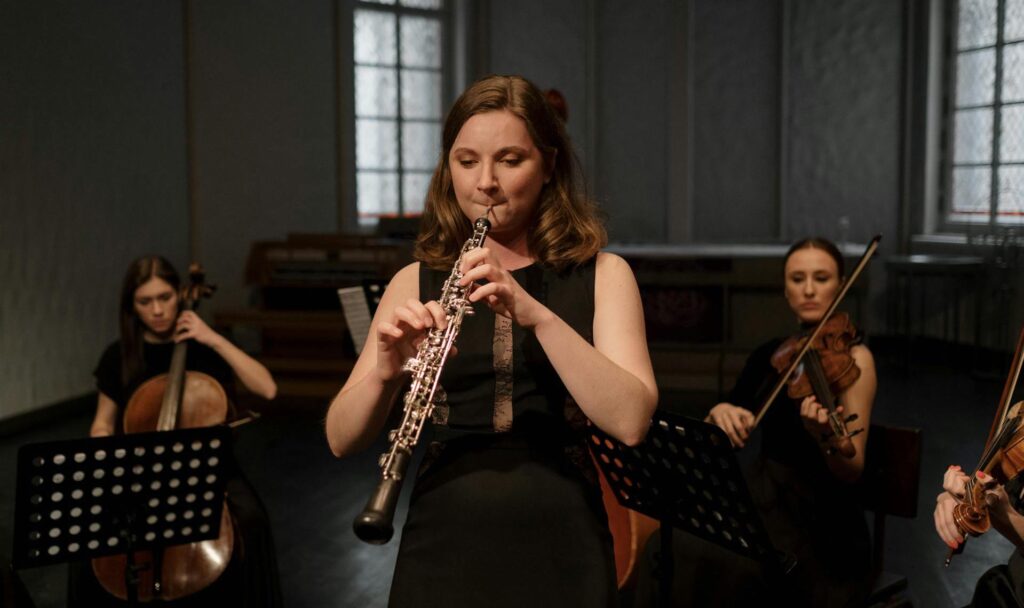
Symphony is one of the most sophisticated, profound, and enduring forms of instrumental music ever created. Emerging in the twilight of the Baroque era, it has evolved over centuries into the ultimate showcase of orchestral capability and a vessel for deep human emotion.
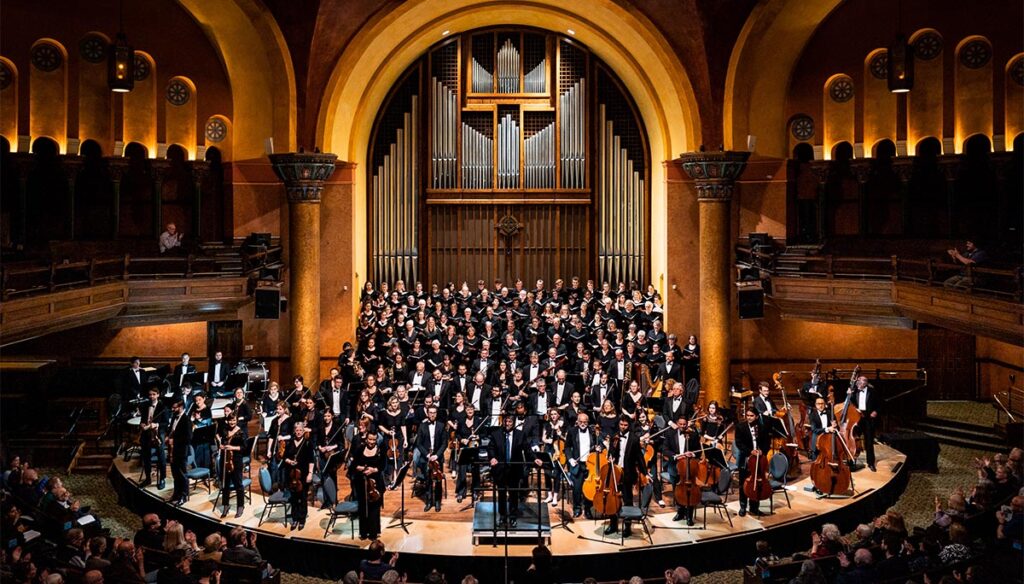
But what exactly is a symphony? To the casual listener, the word might conjure up images of a grand concert hall, a sea of string and wind instruments, and a conductor dramatically waving a baton. While those visual associations are accurate, the musical framework behind a classical symphony is rich, structured, and endlessly fascinating.
Defining the Classical Symphony
At its core, a classical symphony is an extended, multi-movement musical composition written for a full orchestra. Derived from the Greek word symfonia, which beautifully translates to “sounding together” or “harmonious combination of voices”, the symphony acts as a grand conversation where dozens of distinct instruments merge into a unified sonic experience.
While contemporary and romantic iterations of the form vary wildly, the archetypal Classical-era symphony is defined by a strict four-movement structure. Each movement possesses its own distinct tempo, mood, and internal form, typically arranged as follows:
- The Opening Movement (Allegro): Usually fast, energetic, and intellectually rigorous. It is almost always written in sonata form (consisting of an exposition of themes, a dramatic development, and a final recapitulation).
- The Slow Movement (Adagio or Andante): Lyrical, expressive, and deeply emotional. This movement offers a serene contrast to the energy of the first.
- The Dance Movement (Minuet and Trio / Scherzo): Originally a stately triple-meter courtly dance (the minuet) in the 18th century, it later evolved into the brisk, playful, or even frantic “scherzo” (literally meaning “joke”).
- The Finale (Allegro or Presto): A high-octane, triumphant conclusion. It is frequently structured as a fast rondo or another sonata, designed to leave the audience exhilarated.
From Operatic Roots to Independent Majesty
The symphony did not materialize out of thin air. Its lineage can be traced back to the Baroque era, specifically to the Italian opera house.
In 17th-century Italy, the instrumental introduction or prologue to an opera was called a Sinfonia. These operatic overtures were typically brief, three-part instrumental pieces structured in a Fast–Slow–Fast tempo format. As audiences began to appreciate the instrumental music for its own sake, composers realized these overtures could be detached from the theater and performed independently in concert settings.
Simultaneously, the development of the Concerto played a pivotal role. While most concertos featured a dramatic duel between a solo virtuoso and a backing orchestra, a specific sub-genre known as the Concerto Ripieno emerged. In a Concerto Ripieno, there was no designated soloist; instead, the entire orchestral ensemble played together as a cohesive unit.
As the mid-18th century approached, composers merged the structural layout of the Italian Sinfonia with the rich textures of the Concerto Ripieno. They added a fourth movement—the minuet—and thus, the Classical Symphony was officially born.
The Pioneers of the Classical Era
The transformation of the symphony from a lightweight concert opener into a monumental art form is credited to a handful of visionary masters.
Joseph Haydn: The Father of the Symphony
Though he did not single-handedly invent the form, Franz Joseph Haydn (1732–1809) earned the moniker “Father of the Symphony” because he elevated it to its highest level of structural perfection and artistic sophistication. Over his lifetime, Haydn composed an astounding 104 symphonies—a record that still stands today for the most symphonies written by a major composer. Haydn infused his works with wit, unexpected pauses, and rhythmic vitality, establishing the four-movement layout as the gold standard across Europe.
Wolfgang Amadeus Mozart: The Prodigious Genius
While Haydn built the architecture, Wolfgang Amadeus Mozart (1756–1791) filled it with unmatched melodic grace and psychological depth. Raised by his father Leopold Mozart—an accomplished symphonist and pedagogue in his own right—Wolfgang wrote his first symphony at just eight years old. Of his 41 official symphonies, his final works (such as Symphony No. 40 in G minor and Symphony No. 41 “Jupiter”) stand as monoliths of the classical repertoire, demonstrating breathtaking contrapuntal complexity.
The Romantic Revolution: Beethoven and Self-Expression
The trajectory of Western music changed forever with the arrival of Ludwig van Beethoven (1770–1827). In many history textbooks, Beethoven is categorized alongside Haydn and Mozart as a classical composer. However, his artistic output defies simple categorization. While his early symphonies honor Classical constraints, his mid-to-late works, specifically from Symphony No. 3 (“Eroica”) to his monumental Symphony No. 9, cracked open the gates of the Romantic Era.
Before Beethoven, symphonies were largely written to entertain noble patrons or aristocratic audiences. Beethoven transformed the genre into the ultimate vehicle for raw, uncompromising self-expression, philosophical inquiry, and political defiance. Under his pen, a symphony was no longer just a collection of pleasant melodies; it carried the narrative weight, depth, and epic scope of a literary novel.
Following Beethoven’s radical reimagining, the symphony alongside Opera became the supreme musical forms of the 19th century. Yet, a shift occurred: because the stakes were now so staggeringly high, romantic composers approached the symphony with intense trepidation. No one would ever write 104 symphonies again; instead, each new symphony was treated as a monumental, life-altering artistic statement.
The Dark Legend: The Curse of the Ninth Symphony
As the 19th century progressed, a chilling superstition took hold of the classical music world: The Curse of the Ninth Symphony.
Beethoven passed away after completing his monumental Ninth Symphony (the “Choral” symphony), leaving his Tenth as nothing more than fragmented sketches. Because the Ninth had broken the mold by introducing human voices and a massive message of universal brotherhood, it was viewed as the pinnacle of human achievement.
Subsequent romantic composers began to internalize a terrifying psychological barrier: they believed that writing a ninth symphony was a cosmic boundary, and that any composer who attempted it would die shortly after its completion.
The historical coincidences are uncanny:
- Franz Schubert died having (not) completed nine symphonies.
- Anton Bruckner died while still trying to finish the final movement of his Ninth.
- Antonín Dvořák and Louis Spohr likewise hit a ceiling at nine completed symphonies.
The superstition reached its peak with Gustav Mahler. Terrified of the curse, Mahler attempted to cheat fate. After finishing his Eighth Symphony, he refused to number his next symphonic work, naming it Das Lied von der Erde (“The Song of the Earth”) instead. He then went on to write his official Ninth Symphony, believing he had successfully bypassed the supernatural trap. Confident that the curse was broken, Mahler began sketching his Tenth. Tragically, the superstition claimed him anyway; he fell fatally ill on his deathbed, leaving the Tenth forever unfinished.
It wasn’t until the 20th century that the Soviet titan Dmitri Shostakovich definitively shattered the curse, defiantly composing a total of 15 masterfully dark symphonies before his death.
Program Music vs. Absolute Music
As the symphony evolved, a fascinating ideological schism divided composers: Absolute Music versus Program Music. Absolute music refers to symphonies that are entirely abstract, existing purely as sound, form, and harmony (such as Johannes Brahms’ four symphonies).
Conversely, a Program Symphony is built directly upon a narrative, a story, a painting, or a literary concept. In this format, the composer steps into the shoes of a storyteller, translating theatrical drama into abstract instrumental textures.
While early precursors exist—such as Antonio Vivaldi’s Baroque violin concertos The Four Seasons—the first official, landmark program symphony was Beethoven’s Symphony No. 6 (the “Pastoral”). Breaking standard classical etiquette, it featured five movements rather than four, with explicit titles guiding the listener through scenes of countryside life, a raging thunderstorm, and a joyful shepherd’s song.
Shortly after, French radical Hector Berlioz revolutionized the medium with his hallucinatory Symphonie Fantastique (1830). Telling the autobiographical story of an artist’s desperate, opium-fueled obsession with a woman, Berlioz utilized a recurring musical theme (the idée fixe) to tie the narrative together. It shattered traditional structures and birthed a avant-garde orchestral color scheme that still sounds shockingly modern today.
Titan Symphonists You Need to Know
To understand the scope of the classical symphony, one must dive into the essential catalog of its historical giants:
- Joseph Haydn: The architectural mastermind of wit and balance.
- Wolfgang Amadeus Mozart: The pure embodiment of classical lyricism and formal perfection.
- Ludwig van Beethoven: The revolutionary bridge to the Romantic age who injected raw humanity into the orchestra.
- Franz Schubert: The master of songful melodies and lingering melancholy.
- Hector Berlioz: The daring dramatist who turned the orchestra into a theatrical stage.
- Johannes Brahms: The traditionalist who defended absolute music with dense, emotionally rich masterpieces.
- Anton Bruckner: The architect of massive, spiritual, cathedral-like sonic spaces.
- Pyotr Ilyich Tchaikovsky: The Russian icon of hyper-emotionalism, sweeping romanticism, and tragic beauty.
- Gustav Mahler: The existential philosopher who famously claimed, “A symphony must be like the world. It must contain everything.”
- Dmitri Shostakovich: The 20th-century visionary who channeled political terror, irony, and resilience into his art.

The Modern Symphony: Freedom and Beyond
What does the symphony look like in the modern and contemporary era? After the earth-shattering innovations of the late 19th and early 20th centuries, the strict boundaries of the four-movement structure have collapsed entirely.
Today’s composers are unbound by time, limits, or rigid templates. Modern symphonies can consist of a single, massive, uninterrupted movement, or split into dozens of micro-movements. The traditional instrumentation of strings, brass, woodwinds, and percussion has expanded exponentially to welcome electric guitars, synthesizers, field recordings, and unconventional global instruments to cultivate entirely new timbral worlds.
While you may not see new symphonies entering the mainstream pop charts, the form remains fiercely alive. Contemporary classical concert halls and independent music labels regularly premiere groundbreaking symphonic commissions that push the limits of modern harmony.
Ultimately, because the rules have been entirely rewritten, how do we define a contemporary piece as a symphony? Perhaps the most poetic answer is also the most practical: a symphony is simply whatever a composer chooses to call a symphony. It remains an open canvas, an invitation for dozens of voices to gather on a stage, look toward a conductor, and find harmony in playing together.
#symphony #classical_music #music #music_genre #symphonic_orchestra