Wolfgang Amadeus Mozart (27 January 1756 – 5 December 1791) stands as one of the most influential and prolific composers in Western classical music. Born in Salzburg, Austria, Mozart displayed extraordinary musical talent from an early age, composing and performing with remarkable skill. Despite his tragically short life, he died at just 35, his body of work spans over 600 compositions, encompassing symphonies, operas, chamber music, piano works, and choral pieces, many of which continue to captivate audiences today.
Early Life, Education, and First Musical Influences
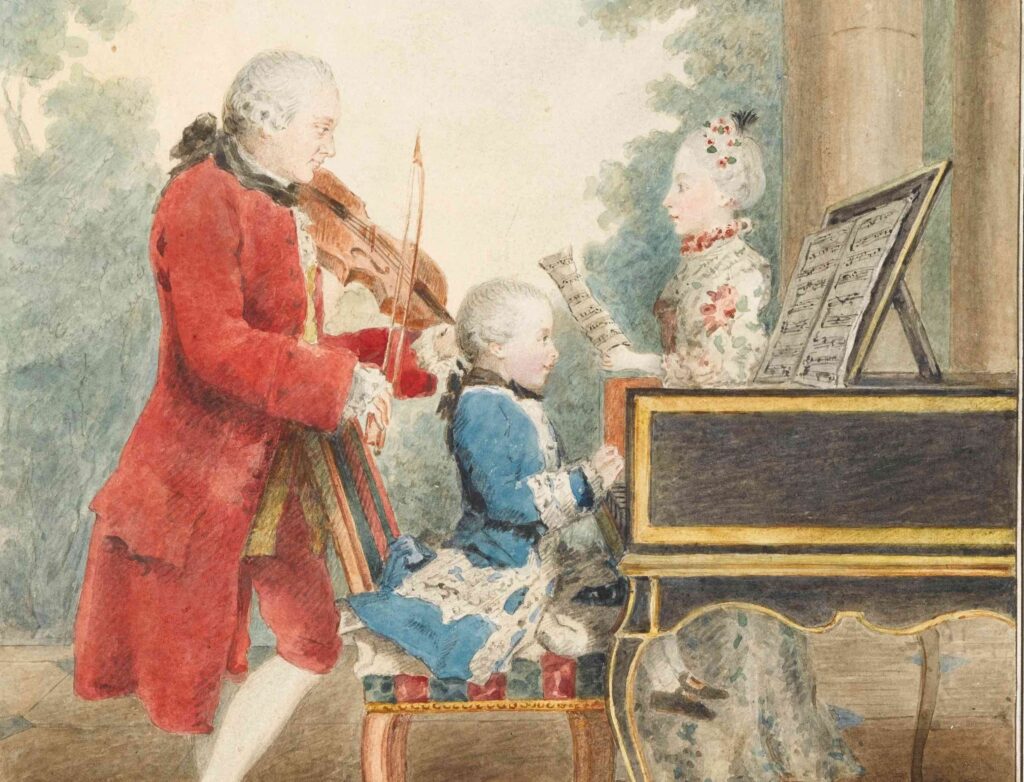
Mozart was born to Leopold Mozart, a respected composer, violinist, and pedagogue, and Anna Maria Pertl. Leopold recognized Wolfgang’s prodigious musical abilities almost immediately and took charge of his early education. By the age of five, Mozart was already composing simple pieces and performing for European royalty, accompanied by his sister Nannerl, who was also a talented musician.
His early influences were shaped by his father’s knowledge of Baroque composers such as Johann Sebastian Bach and George Frideric Handel, as well as by the emerging Classical style of Joseph Haydn. Mozart traveled extensively throughout Europe during his childhood, absorbing the musical styles of Italy, France, Germany, and England. These experiences provided him with exposure to operatic traditions, sacred music, and the courtly styles that would inform his later works.
Artistic Maturity, Importance, and Greatest Works
Mozart’s artistic maturity emerged in his late teens, marked by his ability to combine technical precision with profound emotional expression. By the 1770s and 1780s, he had moved to Vienna, where he achieved fame as a composer, performer, and teacher. His works from this period demonstrate an extraordinary balance between melody, harmony, and structural clarity.
Among his greatest works are the operas The Marriage of Figaro (1786), Don Giovanni (1787), and The Magic Flute (1791), which revolutionized the operatic form by blending drama, comedy, and musical sophistication. His symphonies, including Symphony No. 40 in G minor and Symphony No. 41 (“Jupiter”), are celebrated for their lyrical beauty and formal innovation. Additionally, piano concertos such as No. 20 in D minor and No. 21 in C major showcase his skill as a performer-composer, while chamber works like the Clarinet Quintet and string quartets reveal his mastery of intimate musical dialogue.
Composition Style and Influence on Others
Mozart’s compositional style is distinguished by its clarity, elegance, and balance, hallmarks of the Classical period. He excelled at melodic invention, using motifs that are memorable yet versatile, allowing them to develop naturally within a piece. His harmonic language is both sophisticated and accessible, capable of expressing joy, humor, grief, and profound spirituality.
Mozart’s influence extends far beyond his lifetime. He inspired contemporaries like Joseph Haydn and Ludwig van Beethoven, and his works became foundational for the development of Romantic music. Composers in the 19th and 20th centuries studied his techniques to understand counterpoint, orchestration, and formal structure.
Why Mozart Is Important in Music History
I could write a lot about the impact of Mozart’s music in the Classical era, about how it helped prepare the ground for the Romantic era, an evolution that Beethoven ultimately completed, about his symphonies, operas, and so much more.
But today I want to talk about something else: why is Mozart really famous? What made him this important?
The truth is that from an early age, Wolfgang Amadeus Mozart was used as a child prodigy by his father, Leopold Mozart. Leopold took his young son on long European tours and occasionally lied about his age to make him seem even younger, and therefore more impressive. Mozart performed for aristocrats across Europe, bringing fame and money to the family. In practice, he was a money-making machine.
This idea was later repeated by several musicians who attempted to turn their own young sons into prodigies, among them L. V. Beethoven and Franz Liszt.
Growing up, Mozart carried the legacy of those grand European tours and was widely known as the child prodigy. But this fame did not last in the same way into adulthood. In his adult life, Mozart was respected and known, but he was not significantly more famous than many other composers of his time. His reputation relied so heavily on his childhood image that when he died, many people had to be reminded who had died, by recalling the child prodigy rather than the adult composer.
After his death, the same pattern repeated itself. Burdened by debt and surrounded by myth, Mozart once again became a commercial product, this time as a young, tragic, dead composer. Numerous fake works were produced under his name and sold at higher prices. The number of false attributions became so overwhelming that someone had to catalogue his authentic works. The system still used today was created by Ludwig von Köchel, which is why Mozart’s pieces are numbered with K. rather than Op., like many other composers.
To this day, Mozart continues to be used as a source of profit. His “curse” has never been lifted. Vienna still relies heavily on Mozart as one of its most profitable cultural exports, turning him into merchandise as much as music.
While Mozart was undeniably a true musical genius, his enduring fame is, at least partially, the result of financial, commercial, and myth-making forces, not only artistic ones.
Wolfgang Amadeus Mozart and the Digital Music Era
Even centuries after his death, Mozart’s music has seamlessly entered the digital age, reaching audiences in ways his 18th-century self could never have imagined. Streaming platforms, online archives, and digital albums allow listeners around the world to experience his symphonies, operas, and chamber works instantly, often with high-quality recordings from historic performances. Digital albums dedicated to Mozart’s complete works, curated collections, and thematic compilations make it easier than ever for both enthusiasts and new listeners to explore his music in depth.
The digital music era has also enabled creative reinterpretations of Mozart. Electronic remixes, hybrid orchestral recordings, and interactive apps allow his compositions to intersect with modern genres and technology, bringing his melodies to younger audiences in immersive ways. This democratization of access ensures that Mozart’s influence continues to expand, proving that even in a landscape dominated by algorithms and streaming metrics, the emotional power and structural brilliance of his music remain timeless.
What is The Mozart Effect
The so-called “Mozart Effect” emerged in the late 20th century, suggesting that listening to Mozart’s music could temporarily enhance spatial reasoning and cognitive performance. While later research has nuanced these claims, the concept contributed to popularizing Mozart’s music as beneficial for learning and mental stimulation, particularly for children.
Final Thoughts
Wolfgang Amadeus Mozart’s genius transcends time. From his earliest compositions as a child prodigy to his mature works that redefined classical music, Mozart’s legacy endures as a benchmark of artistic perfection. His ability to combine technical mastery with profound emotional depth ensures that his music continues to inspire and move listeners centuries after his death.
Sources
- Britannica – Wolfgang Amadeus Mozart (general biography)
- Europeana – Mozart overview & early life details
- Wolfgang-Amadeus.at – life summary & profile
- Library of Congress – Mozart research guide
- Wikipedia
#Mozart #ClassicalMusic #WolfgangAmadeusMozart #MozartEffect #Opera #Symphony #PianoConcerto #MusicHistory #ClassicalComposer #MozartLegacy