In the history of Western music, a few figures mark turning points so profound that the art form itself seems divided into before and after. Ludwig van Beethoven stands among the most transformative of them.
He was not merely a brilliant composer. Beethoven fundamentally reshaped the role of the composer in society, expanded the emotional and philosophical scope of music, and pushed the Classical tradition toward the expressive intensity that would define the Romantic era.
When Beethoven began his career in the late eighteenth century, composers were still largely servants of aristocratic patrons or religious institutions. Music existed for courts, churches, and private salons. By the time Beethoven died in 1827, music had begun to belong to the public, and the composer had become something entirely new: an independent artist whose works expressed personal, philosophical, and even political ideas.
This transformation did not happen in isolation. Beethoven lived at the crossroads of enormous cultural change: the political upheaval of the French Revolution, the rise and fall of Napoleon Bonaparte, the expansion of scientific inquiry into humanity and nature, and the emergence of modern ideas about individuality and artistic genius.
Against this turbulent backdrop, and despite deafness, illness, and a deeply troubled personal life, Ludwig van Beethoven created music that continues to define the very meaning of artistic expression.
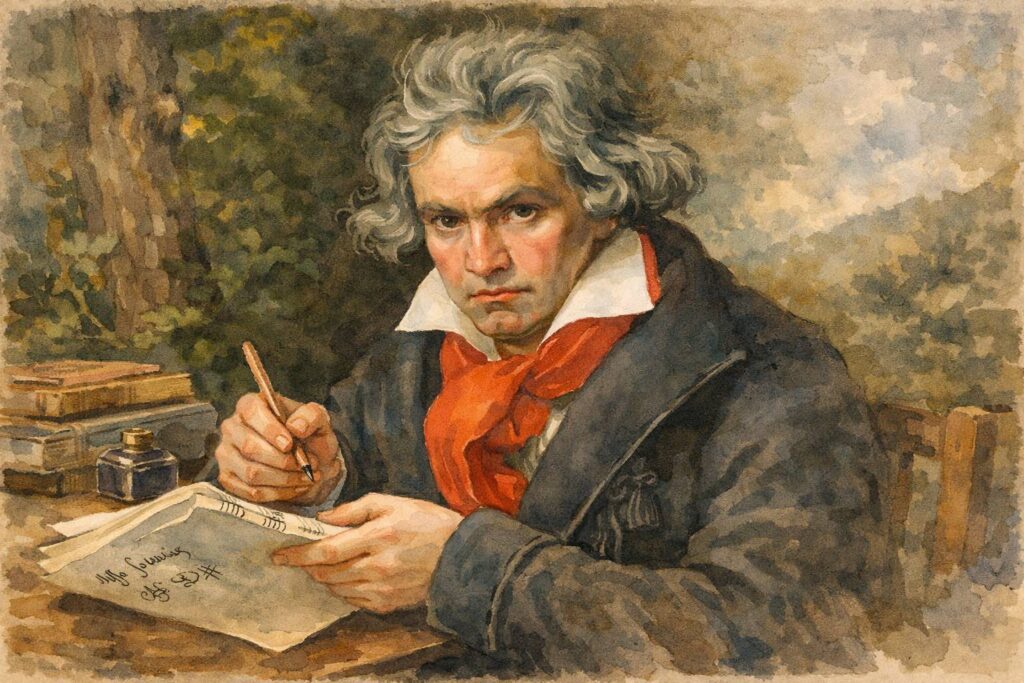
Early Life: Discipline, Hardship, and the Making of a Prodigy
Ludwig van Beethoven (17 December 1770 – 26 March 1827) was born in Bonn, a modest but culturally active city in the Electorate of Cologne. His family had long been associated with music. His grandfather had been a respected Kapellmeister, while his father Johann worked as a court singer.
Johann van Beethoven recognized his son’s musical talent early, but his methods were severe. Obsessed with replicating the success of Wolfgang Amadeus Mozart, he pushed Ludwig into relentless practice and attempted to market him as a child prodigy. Accounts from Beethoven’s youth suggest harsh discipline and episodes of emotional and physical abuse.
The family’s situation worsened as Johann’s alcoholism deepened. When Ludwig was still a teenager, he effectively became the head of the household, responsible for supporting his mother and younger brothers.
Despite these difficulties, Beethoven received crucial musical training. His most influential teacher in Bonn was Christian Gottlob Neefe, the court organist. Neefe introduced him to the works of Johann Sebastian Bach, especially The Well-Tempered Clavier. The contrapuntal mastery of Bach would remain a lifelong inspiration.
By age twelve Beethoven was already publishing music. By his late teens he was working professionally as an organist and performer.
In 1792, he moved to Vienna, the musical capital of Europe, where he studied with Joseph Haydn. The city was still shaped by the legacy of Mozart, and Beethoven quickly absorbed the Classical style that Haydn and Mozart had perfected.
Yet from the beginning, Beethoven showed signs of restlessness. The clarity and balance of Classical form were not enough for him. He wanted music that could contain drama, struggle, and the complexity of human emotion.
Vienna and the Age of Revolution
The Vienna Beethoven entered was a city in transition. Politically and intellectually, Europe was undergoing seismic change.
The French Revolution had shattered traditional political hierarchies, spreading radical ideas about liberty and equality across the continent. Enlightenment philosophy was challenging religious authority and aristocratic privilege. Scientific inquiry was expanding humanity’s understanding of nature and existence.
Though thinkers like Charles Darwin would emerge later in the nineteenth century, the intellectual atmosphere that would make such revolutionary ideas possible was already forming during Beethoven’s lifetime. The authority of tradition was increasingly questioned; new philosophies about human nature, psychology, and society were taking shape.
Obviously, the pace of technological change was slower than today. But the shift in worldview! I’m not so sure, it may have been just as dramatic as the transformations of the modern digital age, maybe even more!
Beethoven absorbed this environment deeply. His music increasingly reflected themes of heroism, struggle, and human dignity.
No work embodies this spirit more clearly than his Third Symphony.
Nine Symphonies of Ludwig van Beethoven
Beethoven wrote nine symphonies, but each feels like the beginning of a new world. These works collectively expanded the classical symphony from elegant entertainment into a monumental artistic statement. Some of his works are among the most influencial symphonies of all time.
Symphony No. 1 (1800)
Beethoven’s first symphony follows the structural model established by Haydn and Mozart, yet subtle disruptions appear immediately: unexpected harmonic shifts, dramatic openings, and bold orchestral gestures.
Even in this early work, Beethoven’s instinct to challenge tradition is evident.
Symphony No. 2 (1802)
Composed during the onset of his hearing loss, the Second Symphony is surprisingly energetic and optimistic. Its bold scale hints at the revolutionary music that would soon follow.
Symphony No. 3 “Eroica” (1803)
The Eroica Symphony marked a turning point in music history.
Initially, Beethoven dedicated the work to Napoleon, whom he admired as a champion of republican ideals. But when Napoleon crowned himself emperor, Beethoven reacted with fury and tore the dedication from the score.
The symphony’s unprecedented length, dramatic intensity, and heroic narrative shattered expectations of what a symphony could be.
Composer Hector Berlioz later wrote:
“With Beethoven’s Eroica, music entered a new era.”
Symphony No. 4 (1806)
Often overlooked between the monumental Third and Fifth, the Fourth Symphony is a work of elegance and wit.
Robert Schumann famously described it as:
“A slender Greek maiden between two Norse giants.”
Symphony No. 5 (1808)
Few musical gestures are more recognizable than the opening four notes of Beethoven’s Fifth Symphony.
The work embodies a dramatic narrative of struggle and triumph, culminating in a blazing C-major finale.
The opening motif is often associated with the remark:
“Fate knocking at the door.”
Although in some sources, they mention that “Fate knocking on the door” was later adopted by the publishers for a more dramatic promotion of the symphony, and in reality Beethoven has written the theme based on a bird’s singing on one of his long walks.
Symphony No. 6 “Pastoral” (1808)
The Pastoral Symphony stands among the earliest masterpieces of program music, in which musical structure follows a narrative or descriptive idea.
Beethoven described the work as:
“More the expression of feeling than painting.”
Each movement evokes scenes from rural life: arrival in the countryside, a flowing brook, a peasant dance, a violent storm, and a peaceful hymn of gratitude.
Unlike traditional symphonic form, the narrative drives the music’s structure, making it one of the earliest large-scale symphonic works where storytelling takes precedence over formal convention.
Symphony No. 7 (1812)
The Seventh Symphony is built on rhythmic energy. Its dance-like drive led Richard Wagner to call it:
“The apotheosis of the dance.”
It is said that in the premiere of Beethoven’s senventh symphony, audience have clapped so long after the second movement that the orchestra had to repeat the movement for the eaer audience before continueing with the third moevement.
Symphony No. 8 (1812)
The Eighth Symphony returns to a lighter tone, filled with humor and rhythmic playfulness.
Symphony No. 9 (1824)
The Ninth Symphony changed music forever by introducing a chorus and vocal soloists into the symphonic form.
The final movement sets Friedrich Schiller’s poem “Ode to Joy,” proclaiming universal brotherhood:
“Alle Menschen werden Brüder.”
Today its melody serves as the anthem of the European Union.
The Piano Sonatas: Reinventing the Instrument
Beethoven’s 32 piano sonatas form one of the greatest bodies of work in Western music.
They are often called the “New Testament” of piano repertoire, following Bach’s Well-Tempered Clavier.
But Ludwig van Beethoven approached the instrument differently from earlier composers.
Unlike Bach or Mozart, who were trained primarily on the harpsichord, Beethoven belonged to the first generation of composers raised on the piano itself. The instrument’s dynamic range, its ability to play both extremely soft and extremely loud, opened new expressive possibilities.
Beethoven exploited these capabilities to their fullest.
Early Sonatas
Works like the Pathétique Sonata (Op. 13) reveal dramatic contrasts and emotional intensity rarely heard in keyboard music before.
Middle Period
The Moonlight Sonata (Op. 27 No. 2) and Appassionata (Op. 57) push the piano toward orchestral power.
Late Sonatas
In the late works, especially the monumental Hammerklavier Sonata (Op. 106), Beethoven explores radical harmonic ideas and complex structures that would influence composers for generations.
These sonatas transformed the piano from a salon instrument into a vehicle for profound artistic expression.
String Quartets: The Laboratory of Beethoven’s Ideas
Beethoven’s 16 string quartets trace the entire evolution of his artistic life.
The early quartets build on the Classical traditions of Haydn and Mozart.
The middle quartets introduce greater emotional intensity and structural complexity.
But the late quartets, including Op. 130, Op. 131, and Op. 132, stand among the most visionary works in music history.
Their unconventional structures, spiritual depth, and experimental harmonies baffled early audiences.
Composer Igor Stravinsky later described them as:
“A miracle that seems to exist outside time.”
The Independent Composer: Ludwig van Beethoven and the Rise of the Modern Music Economy
One of Ludwig van Beethoven’s most radical achievements was not purely musical, it was economic and cultural.
Before his time, composers depended heavily on aristocratic patrons or church employment. Music existed largely in private courts or religious settings.
But by the early nineteenth century, new forces were transforming the musical landscape:
Printing and music publishing
Advances in printing technology made it possible to mass-produce sheet music, allowing composers to sell their works widely.
Public concerts
Concert halls were opening to paying audiences rather than exclusively aristocratic circles.
Middle-class audiences
An expanding urban middle class had both the interest and the money to support public performances.
Beethoven embraced this new system. He earned income through:
- selling compositions to publishers
- organizing ticketed concerts
- receiving commissions from multiple patrons
- teaching and performing
Unlike earlier composers tied to a single employer, Beethoven negotiated his own terms and maintained artistic independence.
This model would later become the norm for composers in the Romantic era.
Beethoven’s Philosophy: Darkness, Struggle, and Triumph
Beethoven’s music often begins in conflict.
His personal life contained immense suffering: childhood abuse, financial hardship, chronic illness, and eventually total deafness.
Yet his music rarely ends in despair.
Instead, Beethoven’s works often move toward resolution, illumination, and victory.
This pattern, from darkness toward triumph, appears repeatedly:
- the journey of Symphony No. 5
- the spiritual transcendence of the Ninth Symphony
- the introspective redemption of the late quartets
For Beethoven, struggle was not meaningless suffering. It was the path toward moral and spiritual strength.
In this sense, his music expresses a profoundly existential yet hopeful worldview.
Influence of Ludwig van Beethoven on Music History
The impact of Beethoven’s work is almost impossible to overstate.
Composers across the nineteenth and twentieth centuries built upon his legacy:
- Johannes Brahms struggled for years before writing his first symphony under Beethoven’s shadow.
- Gustav Mahler expanded the symphonic form into vast philosophical narratives.
- Dmitri Shostakovich echoed Beethoven’s dramatic struggle in his own symphonies.
Even composers who rejected Romanticism could not escape Beethoven’s influence.
Final Thoughts
Ludwig van Beethoven did not simply write masterpieces. He changed the meaning of music.
He transformed the symphony into a philosophical statement, the piano sonata into an arena of emotional exploration, and the string quartet into a laboratory of musical innovation.
Just as importantly, he redefined the composer as an independent thinker, someone whose music could express ideas about humanity, struggle, and hope.
Two centuries later, Beethoven’s works remain among the most performed and most powerful in the entire repertoire.
They continue to remind us that music is not merely sound.
It is a way of understanding the human condition.
Sources:
- The Music Book: Big Ideas Simply Explained, DK Publishing
- Lockwood, Lewis. Beethoven: The Music and the Life. Harvard University Press
- Solomon, Maynard. Late Beethoven, UCPress
- Wikipedia
- Classicfm
#Beethoven #ClassicalMusic #RomanticEra #Symphonies #PianoSonatas #StringQuartets #MusicHistory #ComposerLife #MusicPhilosophy #OrchestralMusic #WesternMusic #MusicCulture