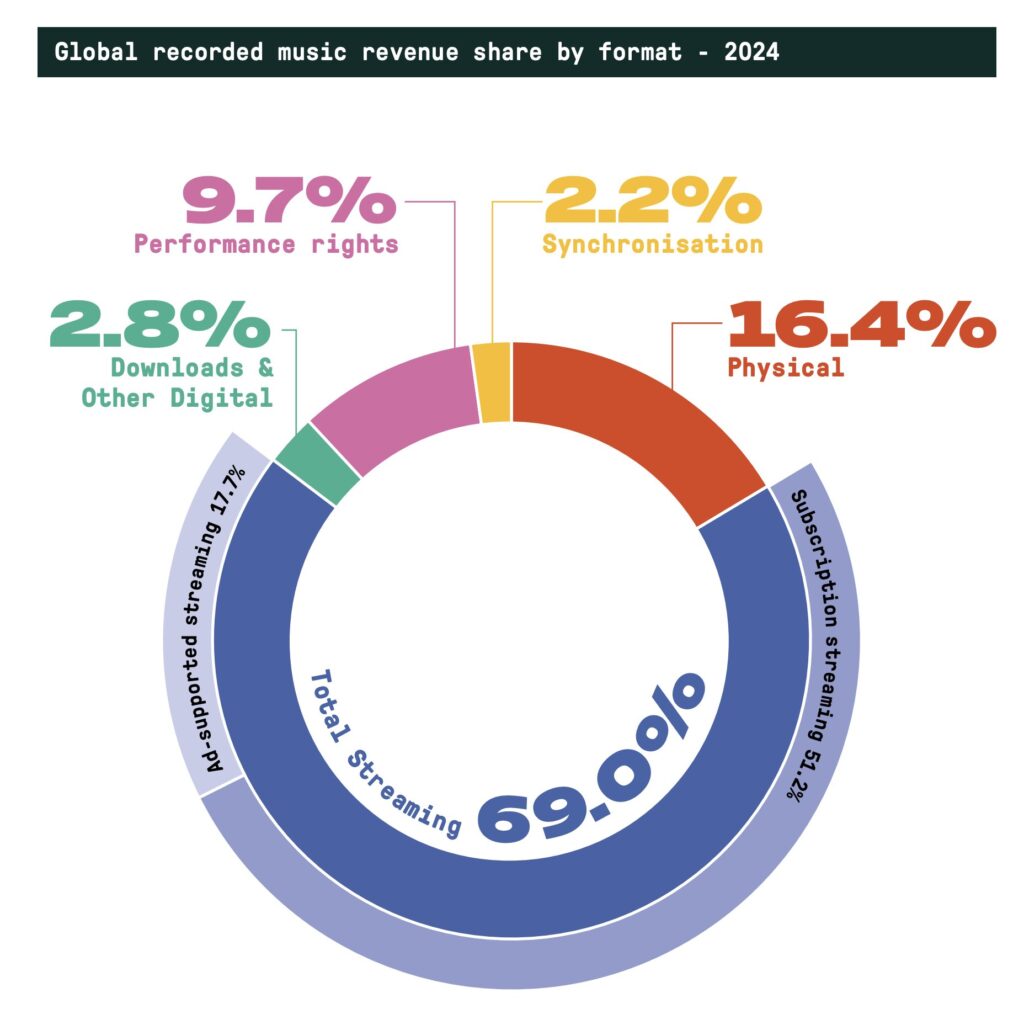
AI music is no longer a futuristic concept. It is already embedded in the infrastructure of the industry, from recommendation algorithms and mastering tools to systems capable of generating entire songs.
But the rapid development of generative AI, capable of producing music, lyrics, and even vocal performances, has triggered one of the most complex debates the music business has faced in decades.
The IFPI Global Music Report 2025 (State of the Industry) identifies artificial intelligence as one of the defining issues facing the recorded music sector today. While AI presents enormous creative and technological opportunities, it also raises urgent questions about copyright, artist consent, and the ownership of creative labor.
The industry now finds itself in a moment similar to the early days of file sharing in the late 1990s, a technological leap that forces the rules of music creation and distribution to be reconsidered.
The Explosion in Creation of AI Music
From Assistance to Generation
Artificial intelligence has long been part of music production tools.
For years, software has helped artists:
- Clean up audio recordings
- Suggest chord progressions
- Assist with mixing and mastering
- Improve vocal tuning
But generative AI represents a fundamentally different step.
Modern systems can now:
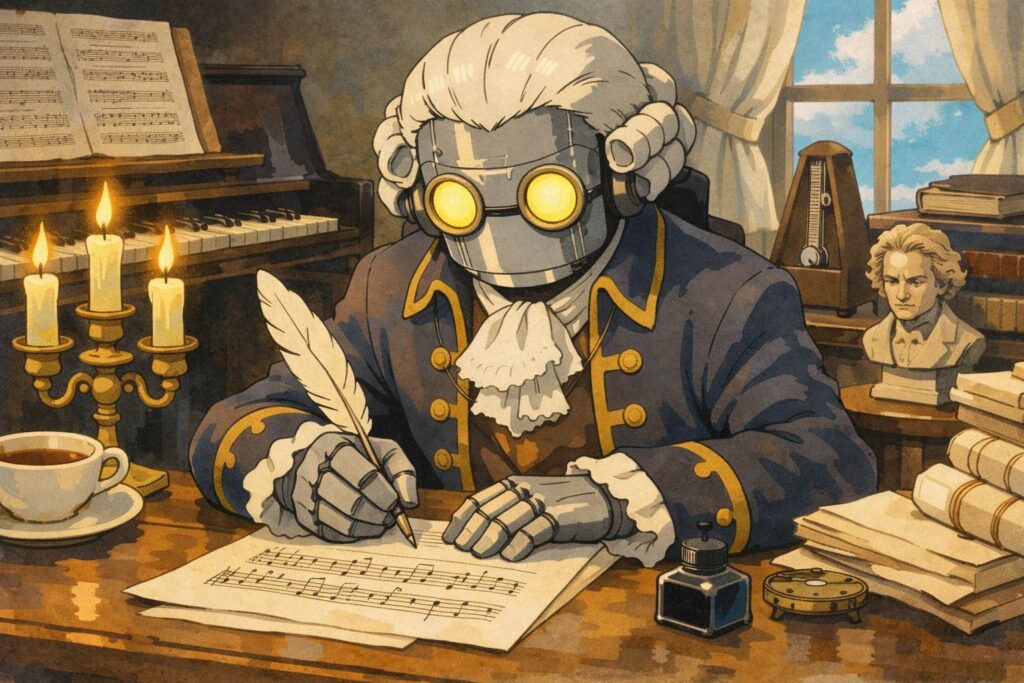
- Compose instrumental tracks, or even compose pieces instead of famous composers like Beethoven’s Symphony No. 10
- Generate lyrics
- Mimic vocal timbres
- Produce full arrangements
- Create music in the style of specific artists
Companies such as OpenAI, Google, and Stability AI have developed models capable of producing convincing musical outputs from simple text prompts.
In some cases, the results can resemble existing artists closely enough to create confusion about authorship.
This is where the legal and ethical tensions begin.
The Copyright Problem
Training Data Without Consent
Most generative AI systems rely on training datasets consisting of enormous amounts of existing creative material, music recordings, compositions, and audio samples.
The core controversy is simple:
Were those works used with permission?
Organizations representing the music industry argue that many AI developers have trained models on copyrighted music without obtaining licenses from rights holders.
The IFPI report states clearly that:
“Developers of generative AI systems must obtain authorization from rightsholders before using copyrighted works for training purposes.”
(IFPI Global Music Report 2025)
From the industry’s perspective, using recordings to train AI models without permission effectively amounts to unlicensed reproduction of copyrighted works.
This raises a fundamental question:
If an AI learns from human creativity, who owns the output?
The Voice Problem: When AI Imitates Artists
One of the most visible examples of AI disruption occurred in 2023 when an anonymously released song titled “Heart on My Sleeve” went viral online. The track used AI-generated voices mimicking Drake and The Weeknd, despite neither artist being involved in the recording.
The song spread across social platforms and streaming services before being removed following copyright complaints.
The incident illustrated a new legal frontier:
AI can imitate an artist’s voice, style, and identity without their participation.
This raises questions beyond copyright, touching on personality rights, likeness rights, and ethical consent.
Why the Music Industry Is Pushing Back
Copyright as Creative Infrastructure
Copyright is not simply a legal technicality. It is the economic foundation that allows artists, composers, and producers to earn income from their work.
Without copyright protection:
- Recording investments collapse
- Licensing markets weaken
- Professional music creation becomes unsustainable
The IFPI and other industry organizations argue that AI systems must operate within the same copyright framework that governs other creative industries.
In other words:
Innovation is welcome, but not at the expense of creators’ rights.
Governments Are Starting to Respond
Around the world, policymakers are beginning to address the intersection of AI and copyright.
The European Union’s AI Act, passed in 2024, includes transparency requirements for generative AI systems. Developers must disclose when copyrighted material has been used in training datasets (European Parliament, 2024).
Similarly, debates are ongoing in the United States, where the U.S. Copyright Office has issued guidance stating that purely AI-generated works cannot currently receive copyright protection because they lack human authorship (U.S. Copyright Office, 2023).
These developments suggest that the legal framework around AI-generated music is still evolving.
But the direction is clear: human creativity remains the core legal standard.
The Environmental Cost of the AI Music Boom
While the music industry grapples with the legal complexities of copyright and intellectual property, another crisis is quietly unfolding behind the screens. The rise of generative AI has ushered in an era of unprecedented creative accessibility, but this digital revolution comes with a massive physical toll on our already troubled planet. We are only a few years into the widespread adoption of these models, yet the energy grid strain and resulting political tensions are already very real.
To understand why generating a quick melody or an accompanying album cover is so taxing on the environment, we have to look at the infrastructure powering it. AI doesn’t exist in a vacuum; it operates out of massive, sprawling data centers packed with high-performance servers that require immense electricity to process computations and millions of gallons of water just to keep the hardware cool.
According to a comprehensive report by the International Energy Agency (IEA), a single query processed through an advanced generative AI model consumes roughly 2.9 watt-hours of electricity, nearly ten times the energy required for a conventional Google search. The IEA further notes that electricity consumption from data centers globally is on a trajectory to double by 2030, with power use specifically dedicated to AI poised to triple. The sheer scale of this energy demand is triggering fierce political debates. In the United States and Europe, policymakers are actively proposing moratoriums and strict caps on new data center construction simply because local power grids cannot keep up with the sudden surge in demand.
Of course, AI as a tool has immense benefits when applied intentionally. In fields like medicine, climate modeling, or even inside our own music industry, such as helping an independent artist master a track on a laptop rather than renting out a high-energy studio, it can be incredibly resourceful. The true danger lies in our rapid shift toward mindless overuse.
Because generative music platforms make creation effortless, a culture of casual, thoughtless generation has taken over. It is now a common pastime to spend half an hour typing random prompts, generating dozens of full-length songs, and pairing them with AI-generated artwork just to fill a bit of extra free time with no real artistic intention in mind.
What the average user fails to consider is that every single “re-prompt” triggers a massive surge of computation. Data published by researchers and highlighted by Climate Impact Partners reveals that training a single large-scale AI model can emit hundreds of metric tons of carbon dioxide, equivalent to driving a gas-powered car across the United States hundreds of times. While a single user’s casual music prompt represents a smaller fraction of that footprint, multiplying those millions of “just for fun” generations by millions of users worldwide creates a staggering cumulative demand on a global energy grid that still relies heavily on fossil fuels.
Furthermore, on a local level in Estonia, there have been virtually no efforts to curb the mindless overuse of these tools. For instance, organizations like Music Estonia are increasingly pushing to integrate AI into the industry, viewing its adoption as a symbol of forward-thinking progressivism while completely ignoring its ecological footprint. While some regulatory progress has been made regarding copyright and intellectual property, the catastrophic environmental impact of AI remains entirely absent from the conversation, as if the problem doesn’t even exist.
As we look toward the future of music, sustainability must become part of the conversation. If we continue to treat computational energy as a limitless, free resource for casual entertainment, we risk saving the future of music distribution at the direct cost of the planet that inspires it.
The Ethical Dimension of AI Music
Even if legal frameworks adapt, ethical questions remain.
If AI systems are trained on millions of songs created by human musicians, is it fair for companies to profit from that knowledge without compensation?
Some industry groups have proposed licensing frameworks that would allow AI companies to legally access music catalogs while paying royalties to rights holders, similar to how streaming platforms license music today.
Such systems could potentially create a new revenue stream for artists, while allowing AI innovation to continue.
However, these frameworks are still theoretical.
What Independent Artists Should Pay Attention To
Independent musicians may feel distant from these debates, but AI will likely affect them in several ways.
Competition From Synthetic Music
As generative systems improve, the volume of AI-created music could increase dramatically.
This may flood digital platforms with content, making discovery even more competitive.
Rights and Consent
Independent artists must also ensure that their own work is protected.
Registering copyrights, maintaining proper metadata, and understanding licensing agreements will become even more important in an AI-driven ecosystem.
Creative Opportunity
AI is not only a threat. It can also be a tool.
Many artists already use AI-assisted tools for:
- sound design
- composition experiments
- mastering assistance
- workflow acceleration
The key distinction is control.
When artists use AI to expand their creative possibilities, it becomes a collaborator.
When AI replaces human creators without consent, it becomes a disruption.
Why Human Narrative Still Matters
Despite rapid technological advances, music remains fundamentally human.
Listeners rarely connect with songs because of technical perfection alone. They connect with stories, personalities, emotions, and cultural context.
An AI-generated melody may sound convincing, but it does not carry the lived experience behind it.
History shows that music movements, from jazz to rock to hip-hop to electronic music, are shaped not only by sound, but by the communities and narratives around them.
Technology changes the tools.
But the cultural meaning of music still depends on people.
The Future: Conflict or Collaboration?
Artificial intelligence will almost certainly become a permanent part of the music ecosystem.
The question is not whether AI will exist in music, it already does.
The real question is how it will be governed.
If transparent licensing systems emerge, AI could become another technological layer in the long evolution of music production.
If not, the industry may face a new wave of legal battles similar to the early years of digital piracy.
The IFPI report frames the challenge clearly: innovation must coexist with respect for creators’ rights.
The coming decade will determine whether AI becomes a tool that supports musicians, or a force that undermines them.
References
- IFPI Global Music Report 2025 – State of the Industry
- European Parliament (2024) – Artificial Intelligence Act
- U.S. Copyright Office (2023) – Guidance on AI-generated works
- Music Business Worldwide – Coverage of AI music industry debates
#AIMusic #MusicIndustry #Copyright #FutureOfMusic #MusicTechnology #IndependentArtists #MusicBusiness #DigitalMusic #MusicRights #ArtificialIntelligence #Tunitemusic