Anton Rubinstein (28 November 1829 – 20 November 1894) was a titan of the 19th-century musical world, a figure whose influence stretched far beyond the confines of the concert hall to reshape the cultural landscape of Russia and Europe. As a virtuoso pianist, he was often compared to Franz Liszt and Johannes Brahms, yet his impact was perhaps even more profound in his capacity as an educator, administrator, and advocate for Russian national identity in music. Rubinstein was one of the founding fathers of the Russian musical tradition, establishing the first professional conservatory in Russia and creating a structured environment where the next generation of composers could flourish. His life was a testament to the power of art to bridge cultural divides, and his legacy remains a cornerstone of classical music education and performance.
Early Life and Musical Prodigy
Anton Grigorievich Rubinstein was born in Pyatigorsk, in the Caucasus region of the Russian Empire, into a family of Ukrainian Jewish descent that had converted to Russian Orthodoxy. His father, Grigory, was a physician and a talented amateur pianist who recognized Anton’s extraordinary musical aptitude at a very young age. By the age of nine, Anton was already performing in public, and his technical prowess on the piano was evident even to seasoned critics. The family moved to Berlin in 1843, where Anton studied composition with Carl Loewe and piano with Sigismund Neukomm. It was in Berlin that he began to develop his skills as a composer and performer, laying the groundwork for a career that would soon take him across Europe.
The Virtuoso Pianist
Rubinstein’s career as a pianist began in earnest in 1846 when he returned to Russia and embarked on a series of concerts that quickly established him as one of the greatest virtuosos of his time. His technique was flawless, his interpretation was deeply expressive, and his repertoire was vast. He was known for his ability to play complex works from memory, including entire concertos and sonatas, which was a remarkable feat in an era before widespread recording technology. Rubinstein’s concerts were not just displays of technical skill but also profound artistic experiences that moved audiences to tears.
His reputation grew rapidly, and he toured extensively throughout Europe, performing in major cities such as Paris, London, and Vienna. He was highly regarded by his contemporaries, including Frédéric Chopin, who reportedly said that Rubinstein was the greatest pianist he had ever heard. Rubinstein’s performances were characterized by their emotional depth and intellectual rigor, and he was able to connect with audiences on a profound level. His ability to interpret the works of Beethoven, Mozart, and Schubert was particularly praised, and he was seen as a guardian of the classical tradition.
The Conflict with the “Mighty Five”
Despite his immense success, Rubinstein’s relationship with the emerging nationalist movement in Russian music was complex and often contentious. In the 1850s and 1860s, a group of Russian composers known as “The Mighty Five” or “The Mighty Handful” emerged, consisting of Mily Balakirev, César Cui, Modest Mussorgsky, Nikolai Rimsky-Korsakov, and Alexander Borodin. This group, led by Balakirev, sought to create a distinctively Russian style of classical music, rejecting what they saw as the overly Germanic influence of Western European conservatories.
Rubinstein, who had been trained in the German tradition, was viewed with suspicion by the nationalists. They criticized his music for being too Western-oriented and lacking in genuine Russian character. The conflict came to a head in 1859 when Rubinstein founded the Russian Musical Society (RMS) and the St. Petersburg Conservatory in 1862. The nationalists, particularly Balakirev and later Mussorgsky, saw the Conservatory as a threat to the development of a truly Russian musical identity. They argued that the Conservatory’s emphasis on Western European techniques would stifle the natural creativity of Russian composers.
Rubinstein, however, believed that a strong foundation in Western European music theory and technique was essential for the development of any national school of music. He argued that Russian composers needed to master the tools of the trade before they could effectively express their national identity. This debate between the “Westernizers” and the “Nationalists” was a defining feature of 19th-century Russian music history, and Rubinstein’s role as a leader of the Westernizing faction was crucial.
The Founder of Russian Musical Education
The establishment of the St. Petersburg Conservatory in 1862 was Rubinstein’s most significant contribution to Russian music. At a time when Russia had no formal institutions for higher musical education, Rubinstein created a comprehensive system that included rigorous training in theory, composition, and performance. He recruited top-tier faculty from across Europe, including the renowned pianist Carl Klieber and the composer Anton Rubinstein himself, who taught piano and composition.
The Conservatory quickly became a center of excellence, attracting talented students from all over Russia. Among its early graduates were future stars such as Pyotr Ilyich Tchaikovsky, who studied composition under Rubinstein’s colleague Nikolai Zaremba and later under Rubinstein himself. Tchaikovsky’s relationship with Rubinstein was complex; he respected Rubinstein’s technical mastery but often found his teaching style too rigid. Nevertheless, Tchaikovsky’s success was in many ways a testament to the quality of education provided by the Conservatory.
Rubinstein’s vision for the Conservatory was not just about training performers but also about creating a sustainable ecosystem for Russian music. He believed that a professional class of musicians was necessary to elevate the status of music in Russian society. This vision was realized through the establishment of the RMS, which organized public concerts, published sheet music, and promoted musical literacy among the general public.
Compositional Output
As a composer, Rubinstein was incredibly prolific, writing over 70 operas, numerous symphonies, concertos, chamber works, and piano pieces. His output was vast, but his quality was often inconsistent. He was a master of form and technique, but his music sometimes lacked the emotional depth and originality of his contemporaries. His most famous work is arguably the Romance in F minor for piano and orchestra, which remains a staple of the piano repertoire. His Piano Concerto No. 4 in E-flat major is also well-regarded, showcasing his virtuoso skills and melodic gift.
Rubinstein’s operas were particularly popular in his time, with works such as Dmitry Donskoy and The Demon receiving widespread acclaim. However, many of his operas have fallen out of the repertoire, largely due to their perceived lack of dramatic innovation. His symphonic works, including his Ocean Symphony (Symphony No. 4), are more enduring, with the Ocean Symphony being a programmatic work that depicts the power and mystery of the sea.
Despite the criticism he received from the nationalists, Rubinstein’s music was widely performed and appreciated. He was a skilled melodist and a master of orchestration, and his works were admired for their craftsmanship and emotional expressiveness. His Piano Quintet in G minor is one of his most enduring chamber works, and it remains a favorite among chamber music enthusiasts.
The Conductor and Advocate
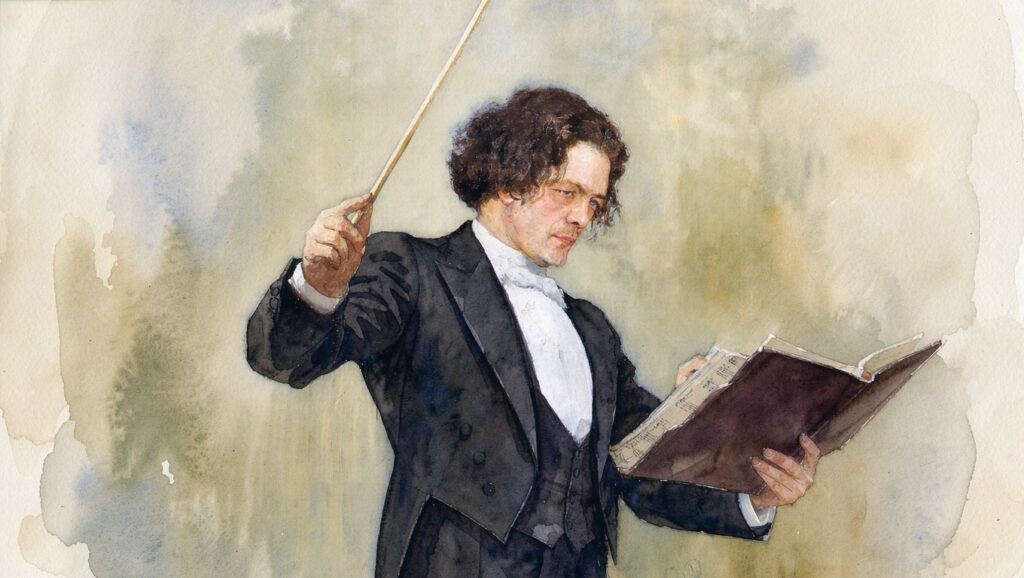
In addition to his work as a pianist and composer, Rubinstein was a pioneering conductor. He was one of the first conductors to use a baton, a practice that was then controversial. He believed that a conductor should be a clear and precise leader, and his baton technique allowed him to communicate his vision to the orchestra with greater accuracy. He conducted many premieres of Russian works, including Tchaikovsky’s Eugene Onegin and The Queen of Spades, and he was instrumental in promoting the music of his contemporaries.
Rubinstein was also a fierce advocate for the rights of composers. He fought for the establishment of copyright laws in Russia, ensuring that composers could earn a living from their work. He believed that music was a serious profession and that composers deserved to be treated with respect and financial security. His efforts helped to professionalize the status of composers in Russia, paving the way for future generations.
Legacy and Influence
Anton Rubinstein’s legacy is multifaceted. As a pianist, he set a new standard for virtuosity and interpretation, influencing generations of performers. As an educator, he created the infrastructure for professional musical training in Russia, producing a generation of talented musicians who would go on to shape the course of Russian music. As a composer, he contributed significantly to the repertoire, even if his works are not as frequently performed today as those of Tchaikovsky or Rimsky-Korsakov.
His role in the debate between Westernization and nationalism was crucial. While the nationalists ultimately won the cultural battle, Rubinstein’s insistence on the importance of technical mastery and universal musical values was not without merit. His work laid the foundation for the golden age of Russian music that followed, and his influence can be seen in the works of Tchaikovsky, Rachmaninoff, and Scriabin.
Today, Anton Rubinstein is remembered as a pivotal figure in music history. His contributions to the development of Russian musical culture were immense, and his impact on the world of classical music is still felt today. He was one of the most important music composers of the 19th century, and his works continue to be performed and studied by musicians around the world. As one of the most influential Russian Composers, his legacy is a testament to the power of art to transcend cultural and political boundaries.
Conclusion
Anton Rubinstein was a complex and multifaceted figure whose life and work had a profound impact on the world of classical music. He was a virtuoso pianist, a prolific composer, a visionary educator, and a passionate advocate for Russian music. Despite the controversies and criticisms he faced during his lifetime, his contributions to the musical world are undeniable. He helped to establish Russia as a major center of musical activity, and his influence can be seen in the works of many of the greatest composers of the late 19th and early 20th centuries. His life was a testament to the power of dedication, hard work, and artistic vision, and his legacy continues to inspire musicians and music lovers around the world.
#AntonRubinstein #RussianMusic #ClassicalMusic #Pianist #Composer #MusicHistory #Conservatory #StPetersburg #Virtuoso #MusicEducation #19thCenturyMusic #Tchaikovsky #RomanceInFMinor #MusicLegacy #RussianComposers