The project of Erik Satie’s Gnossiennes began more than a year ago, when pianist Matteo Ramon Arevalos and I decided to release an album through Tunitemusic featuring his interpretation of all seven Gnossiennes.
Satie’s music, particularly his Gnossiennes and Gymnopédies, possesses a distinctive melancholic atmosphere. Yet, for me, this melancholy has always carried a strong visual dimension. While listening to the music, I could not help imagining a slow, melancholic dance unfolding alongside it. The idea of a ballet performance featuring the complete collection of Gnossiennes was born from that image.
For this, I approached the wonderful ballerina Triinu Upkin. Fortunately, she was as fascinated by the project and Satie’s music as Matteo and I were.
From Satie to the Labyrinth of Ariadne
To develop the concept, I began looking into the possible origins and associations of the word Gnossienne. Although Satie never provided a definitive explanation of the title or its inspiration, one interesting theory connects it to ancient Crete and the ritual labyrinth dance.
The etymology of the word Gnossienne remains contentious. However, the word existed in French literature before Satie’s use of it and appeared in nineteenth-century dictionaries in connection with the labyrinth dance associated with Theseus and his victory over the Minotaur. The dance itself is described in an ancient hymn by Callimachus.
This possible connection gave me the starting point for our project.
I took Ariadne, the Cretan princess and daughter of King Minos, and placed her inside the labyrinth. But I wanted this labyrinth to be more than a physical structure. It would also be a mental one: a place where Ariadne struggles with the world around her, questions the established order, and gradually discovers new horizons.
Ariadne begins to question the state of things. Her curiosity leads to discovery, but every new discovery makes the labyrinth more complex. The more she learns, the more complicated life becomes. Understanding does not necessarily make the world easier to navigate; sometimes, it only reveals how much more there is to understand.
And so, rather than finding an exit, Ariadne continues to question, discover, struggle, and follow the path ahead.
The Red Thread
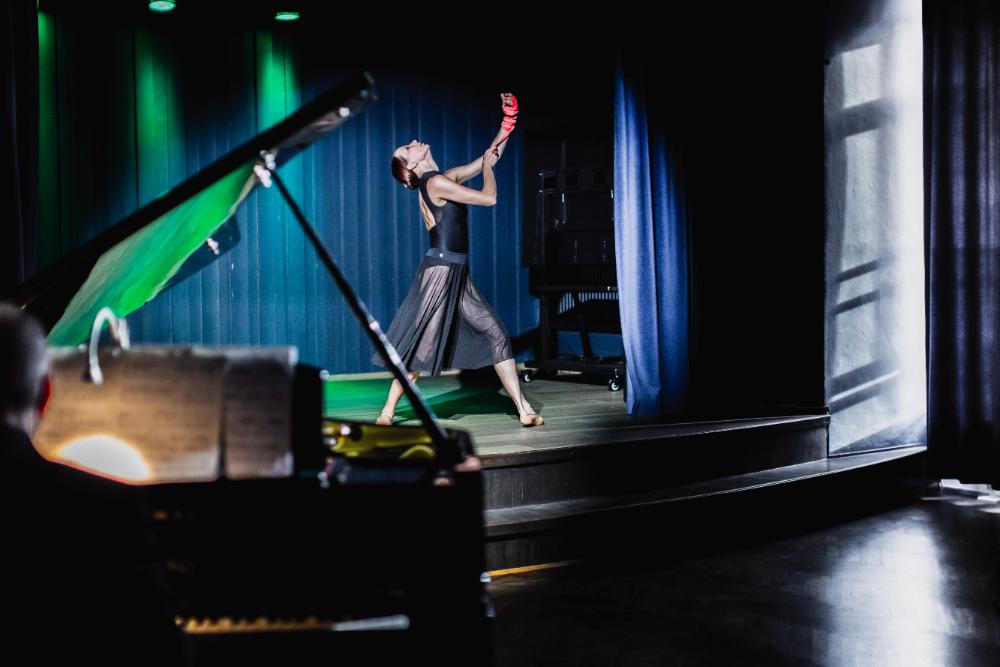
Triinu’s extraordinary choreography brought another dimension to the concept. Her use of a red ribbon as a representation of Ariadne’s inner and outer struggles became one of the central elements of the performance.
The thread is initially something to be found and followed. It offers direction, a sense of purpose, and perhaps even the promise of an exit. Ariadne follows it, learns from it, and gradually makes it part of her existence.
But the same thread that once showed her the way eventually becomes an obstacle. In the first act, it eventually ties her up, turning from a guide into a source of struggle. What once offered freedom now becomes a constraint. In the second act, the thread becomes part of Ariadne’s existance, part of her body.
And then, in the third act, the thread returns.
Is it the same thread, appearing once again? Or is it an entirely new one? Perhaps both interpretations are equally valid. The thread leads the way, and Ariadne follows. But whether she is following it towards freedom or simply deeper into the labyrinth remains an open question.
The Music and the Performance
To give the performance a broader dramatic structure, and to create moments of transition in which the audience could absorb the unfolding story, we decided to incorporate Matteo’s original composition La Folia into the programme, alongside Satie’s music.
The live performance therefore combined all seven Gnossiennes with La Folia interwind inside them, creating a larger musical and choreographic narrative.
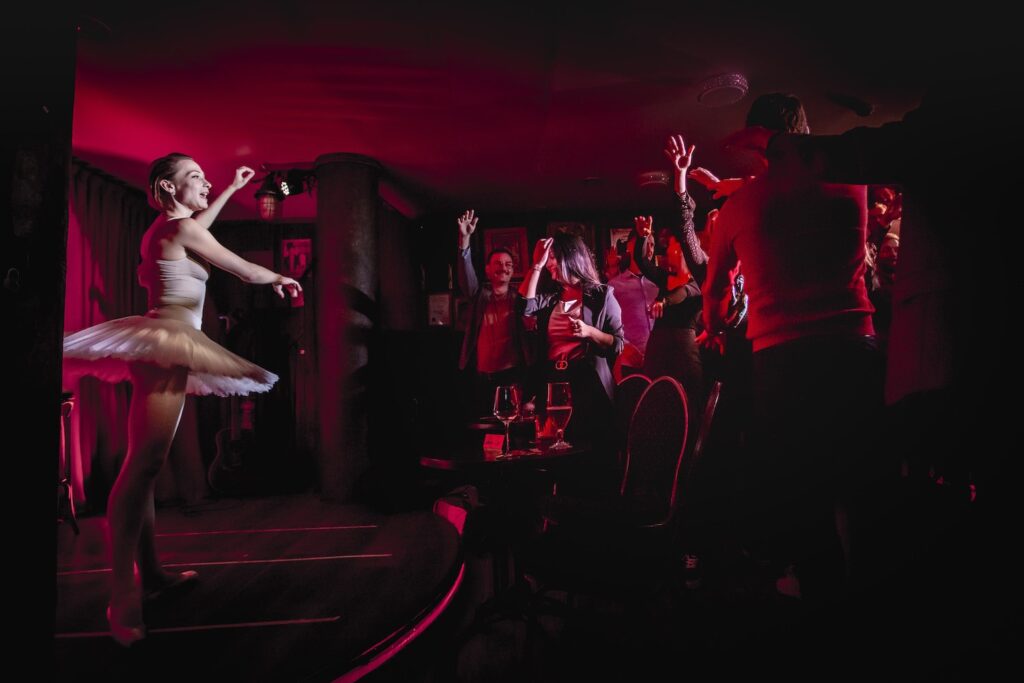
The video presented here, however, features only Satie’s seven Gnossiennes, accompanied by Triinu’s choreography. We decided to focus on this part of the performance to create a more concise video centred entirely on Satie’s music.
For those watching the video, the following outline may help in following the narrative and understanding the three acts.
- Act I: Gnossiennes Nos. 1, 2 and 3
- Act II: Gnossiennes Nos. 4 and 5
- Act III: Gnossiennes Nos. 6 and 7
“The Labyrinth of Ariadne” ballet
Act I
In the beginning, there was order.
A world of ritual, repetition, silence held in balance.
But beneath order, something begins to breathe.
A curiosity gives birth to a question, one that unsettles the foundations of what is known.
And in that question… a path appears.
The first question leads to more.
All unanswered. All unwelcome.
To question is to challenge.
And the mind enters its labyrinth.
Once inside, one realises that this is not a deviation from the path.
It is the path that was hidden.
Step after step, deeper into it.
Not forward… but inward.
Act II
The labyrinth slowly consumes meaning, patiently and relentlessly.
he self begins to scatter into fragments of desire and longing.
And then… stillness. Silence.
Not peace, but surrender without awareness.
Time no longer moves forward.
It folds inward.
Act III
And what remains after understanding…
is not resolution.
Only clarity, without comfort.
The labyrinth does not end.
The questions are not answered.
And questioning itself becomes the consequence.