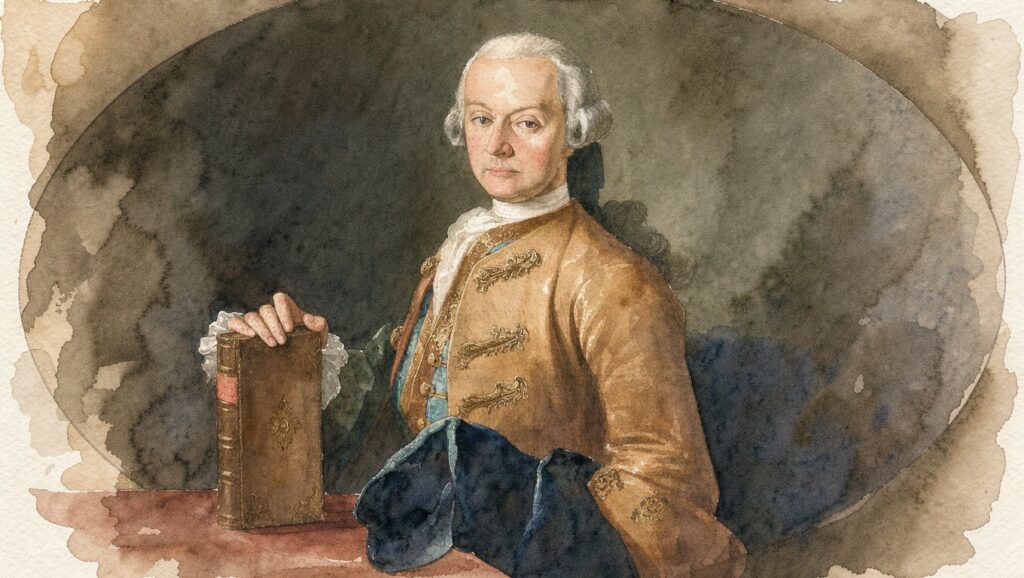
Leopold Mozart (14 November 1719 – 28 May 1787) was a German composer, conductor, teacher, and violinist, whose influence on the development of classical music extends far beyond his own compositions. While history often remembers him primarily as the father of Wolfgang Amadeus Mozart, Leopold was a highly accomplished and respected musician in his own right during the eighteenth century. He served as deputy kapellmeister to the archbishop of Salzburg and was a prolific writer on musical performance. His treatise, Versuch einer gründlichen Violinschule (A Treatise on the Fundamental Principles of Violin Playing), published in 1756, was one of the most important and influential method books of the era, shaping violin pedagogy across Europe. Leopold’s contributions to music history are substantial, not only through his own works but also through his role in shaping one of the greatest musical talents the world has ever known.
Early Life and Musical Foundations
Born in Augsburg, Germany, Leopold came from a family with deep roots in the printing and publishing trade. His father, Johann Georg Mozart, was a bookbinder, and Leopold initially studied philosophy and law at the Jesuit University of Ingolstadt. However, his true passion lay in music. He quickly demonstrated exceptional talent on the violin and composed his first works while still a young man. By his early twenties, he had established himself as a respected musician in Augsburg, serving as an assistant to the deputy kapellmeister of the city. His dedication to his craft and his intellectual approach to music set him apart from many of his contemporaries.
Leopold’s career progressed steadily, and in 1743, he was appointed to the court of the Prince-Archbishop of Salzburg. Over the years, he rose through the ranks, eventually becoming deputy kapellmeister in 1763. His responsibilities included composing music for court functions, teaching instrumental music, and overseeing the training of the choirboys. Leopold was known for his meticulous attention to detail and his high standards for performance. He believed that music should be both beautiful and instructive, a philosophy that guided his compositions and his teaching.
Leopold Mozart as a Composer
As one of the notable German Composers of the Baroque and Classical transition period, Leopold’s own compositional output was diverse. He wrote sacred music, including masses and vespers, as well as secular cantatas, symphonies, concertos, and chamber music. His Symphony in D major and his Concerto for Four Trumpets are among his more frequently performed works today. Leopold’s style reflected the transitional nature of the eighteenth century, blending the complex polyphony of the late Baroque with the clearer, more structured forms of the Classical era. His music was well-regarded by his peers, and he was a respected figure in the European musical community.
Leopold’s own compositions, while less well-known today, were appreciated by his contemporaries. His sacred music, in particular, was highly regarded for its emotional depth and technical skill. He wrote numerous masses, requiems, and vespers, many of which were performed in Salzburg and other German cities. His secular works, including symphonies and concertos, were also popular, and he was commissioned to write music for various court functions and public events. Leopold’s music reflected the tastes and styles of his time, and it was well-suited to the performance practices of the eighteenth century.
The Violin School
Leopold’s importance in music history extends beyond his compositions. His Violin School (Versuch einer gründlichen Violinschule) was translated into multiple languages and remained a standard reference for violinists for decades. It covered everything from basic technique to advanced bowing and fingering, and it emphasized the importance of expression and phrasing. Leopold’s approach was practical and accessible, making it suitable for students at all levels. The book was widely read and highly regarded, and it helped to standardize violin technique across Europe.
The Violin School was not merely a technical manual; it was a comprehensive guide to musical performance that reflected Leopold’s deep understanding of the art form. He emphasized the importance of phrasing, dynamics, and emotional expression, arguing that technical skill alone was insufficient for true musical mastery. His teachings influenced generations of violinists and helped to shape the aesthetic ideals of the Classical era. The book was so influential that it remained a standard text for over a century, and its principles can still be heard in modern violin pedagogy.
Leopold Mozart and the Grand Tours
The Mozart family’s famous Grand Tour of Europe, which began in 1763, was largely orchestrated by Leopold. He traveled with his wife, Anna Maria, his son Wolfgang, and his daughter Maria Anna, visiting Munich, Vienna, Paris, London, The Hague, and many other cities. These travels were designed to showcase Wolfgang’s prodigious abilities and to secure patronage and opportunities for his career. Leopold managed every aspect of the tours, from arranging performances to negotiating contracts and correspondence with potential employers. He was a shrewd businessman and a determined advocate for his son’s success.
During these years, Leopold and Wolfgang maintained an extensive correspondence, much of which has survived. These letters provide invaluable insight into their relationship and into the musical life of the eighteenth century. Leopold’s letters are often detailed and practical, offering advice on performance, composition, and travel. He was deeply concerned with Wolfgang’s well-being and often expressed his pride in his son’s achievements. However, he could also be critical and demanding, pushing Wolfgang to meet his high standards.
The Complex Father-Son Relationship
As Wolfgang grew older and more independent, tensions between father and son increased. Leopold struggled to accept that his son no longer needed his guidance and was capable of making his own decisions. He was particularly concerned about Wolfgang’s financial management and his choice of employers. When Wolfgang decided to leave Salzburg and settle in Vienna as a freelance musician, Leopold was deeply troubled. He viewed the arrangement as unstable and risky, and he feared that Wolfgang was making a mistake. Their correspondence became more strained, and their relationship grew more distant.
Despite these difficulties, Leopold and Wolfgang remained deeply connected. When Leopold traveled to Vienna in 1781 to visit his son, their relationship experienced both conflict and reconciliation. Leopold was present during the early performances of Wolfgang’s Idomeneo and witnessed his son’s growing success. Although they disagreed on many matters, their mutual love and respect for each other never fully disappeared. Leopold’s death in 1787, just a few years before Wolfgang’s own passing, was a profound loss for the younger Mozart.
Leopold’s Influence on Wolfgang
Leopold’s influence on his son cannot be overstated. Wolfgang’s technical mastery of composition, his understanding of instrumental technique, and his deep knowledge of music theory were all shaped by his father’s teaching. Leopold’s Violin School was a key text in Wolfgang’s education, and many of Leopold’s compositional techniques can be found in Wolfgang’s early works. The younger Mozart’s ability to write for the violin and his understanding of orchestration were directly influenced by his father’s expertise.
Wolfgang himself acknowledged his father’s role in his musical development. In letters to his father, he expressed gratitude for the rigorous training and discipline that Leopold had instilled in him. Many of Wolfgang’s early compositions show the clear influence of Leopold’s teaching, particularly in their formal structure and their attention to detail. As Wolfgang matured as a composer, he developed his own unique style, but the foundation laid by his father remained evident throughout his career.
Maria Anna Mozart: The Forgotten Prodigy
Leopold’s daughter, Maria Anna Mozart (1751–1829), affectionately known as “Nannerl,” was a child prodigy in her own right, often overshadowed by the towering legacy of her younger brother, Wolfgang Amadeus. Born in 1751, Maria Anna began her musical training under her father’s exacting guidance just two years before Wolfgang, and she quickly proved to be an exceptional keyboard player. She accompanied Leopold, Wolfgang, and their mother on the famous Grand Tours of Europe, performing in the royal courts of Munich, Vienna, Paris, London, and The Hague. In these public performances, Maria Anna was not merely a supporting player; she was a celebrated soloist in her own right, earning praise from critics and nobility alike for her virtuosity and musicality. However, as she reached marriageable age, the expectations for women in the eighteenth century curtailed her professional career. While Wolfgang was encouraged to pursue a public life as a composer and performer, Maria Anna was expected to settle into a more domestic role, eventually marrying Johann Baptist von Berchtold zu Sonnenburg in 1784. Despite the end of her public career, Maria Anna remained a vital support to her brother, helping to manage his household and caring for him during his final illness in Vienna. Her own compositions, including keyboard sonatas and songs, were published during her lifetime, yet they have largely been forgotten in the historical narrative. Maria Anna’s story is a poignant reminder of the many talented women whose contributions to music history were suppressed by the gender norms of their time, and recent scholarship has begun to restore her place as a significant musician and a crucial figure in the Mozart family’s artistic life.
Leopold’s Role as an Educator
Beyond his role as a father and teacher, Leopold was a significant figure among music composers of his time. He was a key figure in the development of the Classical style, bridging the gap between the Baroque and Classical eras. His music reflects the transition from the complex, polyphonic textures of the Baroque to the clearer, more balanced forms of the Classical period. Leopold’s emphasis on clarity, structure, and expression helped to shape the aesthetic ideals of the Classical era, and his influence can be heard in the works of many of his contemporaries and successors.
Leopold’s legacy also includes his role as a mentor and educator. He trained not only his own children but also many other young musicians in Salzburg. His teaching methods were rigorous and comprehensive, and he expected a high level of discipline and dedication from his students. Many of his former students went on to successful careers as performers and composers, and they carried his teachings with them. Leopold’s influence as an educator helped to spread his ideas about music and performance throughout Europe.
Personal Life and Later Years
In addition to his musical activities, Leopold was a keen observer of the cultural and social life of his time. His letters and writings provide valuable information about the musical world of the eighteenth century, including the practices of performance, the organization of courts and churches, and the relationships between musicians and their patrons. These documents are essential resources for historians and musicologists seeking to understand the context in which Leopold and his son worked.
Leopold’s life was marked by both professional success and personal challenges. He experienced the loss of several children in infancy, and his wife Anna Maria died in 1778, a tragedy that deeply affected him. Despite these personal losses, Leopold continued to work diligently and remained committed to his musical career. He was a dedicated professional who took his responsibilities seriously and who believed in the importance of music as an art form and a profession.
Death and Historical Recognition
Leopold Mozart died in Salzburg on 28 May 1787, at the age of sixty-seven. He was buried in an unmarked grave, as was common for musicians of his rank at the time. His death went largely unnoticed by the wider public, and his contributions to music were largely overshadowed by those of his son. However, in recent decades, there has been a growing appreciation for Leopold’s own achievements and his importance in the musical landscape of the eighteenth century. Scholars and musicians have begun to recognize him not just as the father of Mozart, but as a significant composer, teacher, and writer in his own right.
Today, Leopold Mozart is remembered as a key figure in the development of Western classical music. His Violin School remains a valuable resource for students and performers, and his compositions are increasingly being performed and recorded. His letters and writings provide invaluable insights into the musical life of his time, and his role in shaping the career of Wolfgang Amadeus Mozart ensures his place in the annals of music history. Leopold Mozart was more than just a father; he was a talented musician, a dedicated teacher, and a significant contributor to the cultural heritage of Europe. His legacy endures, not only in the music of his son but in his own substantial contributions to the art of music.
#LeopoldMozart #Mozart #ClassicalMusic #MusicHistory #Violin #Baroque #ClassicalEra #GermanComposers #MusicEducation #Composer #WolfgangAmadeusMozart #Musicology #Classical #ViolinSchool #MusicLife #Salzburg #18thCentury #MusicLegacy #BaroqueMusic #ClassicalComposition