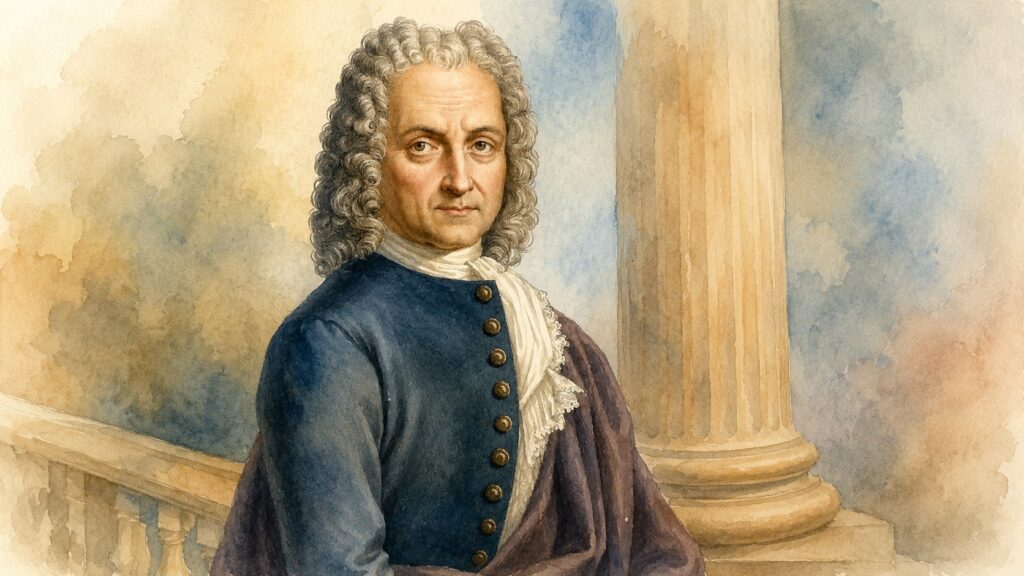
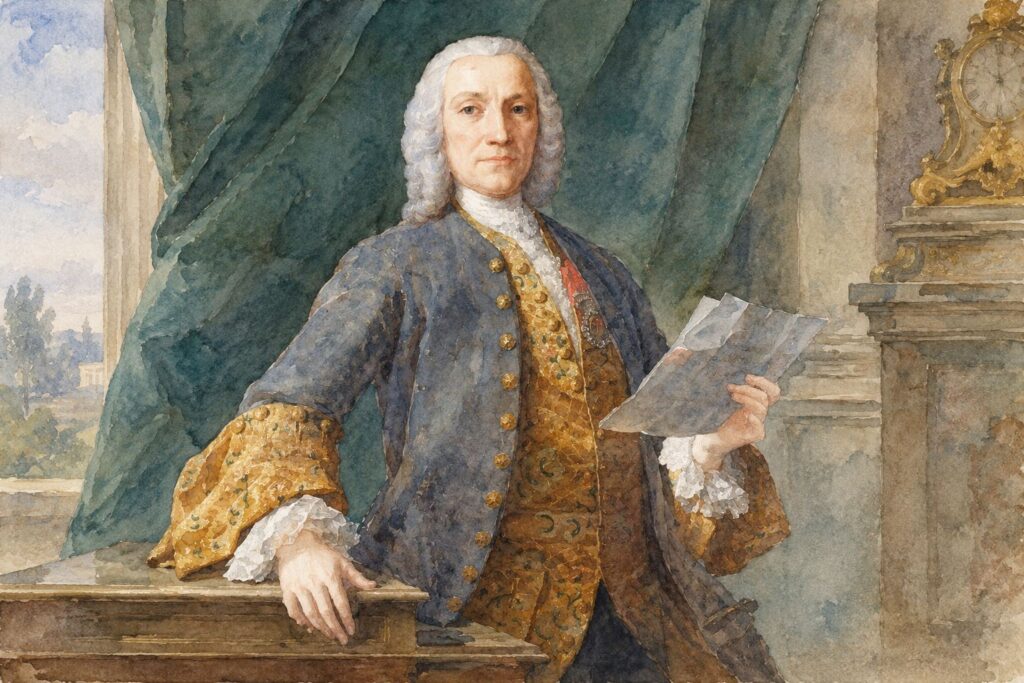
Domenico Scarlatti (26 October 1685 – 23 July 1757) stands as one of the most original and visionary figures in music history. While many of his contemporaries built their reputations upon vast grand operas, intricate sacred choral works, or multi-movement orchestral concertos, Scarlatti carved out an immortal legacy through a unique format: the single-movement keyboard sonata. Writing over 550 of these remarkable compositions, he transformed the technical and expressive possibilities of keyboard instruments, bridging the dramatic counterpoint of the High Baroque era with the emerging clarity and gallantry of the Classical period. His life journey, stretching from the bustling musical centers of Naples and Rome to the sun-drenched, Iberian court life of Lisbon and Madrid, infused his art with a rhythmic vitality and harmonic daring unmatched by almost any other composer of the eighteenth century.
Early Life and Artistic Background in Italy
Giuseppe Domenico Scarlatti was born in Naples, Italy, in 1685, a year that occupies a legendary place among music composers. That same year saw the births of two other Baroque titans: Johann Sebastian Bach and George Frideric Handel. Domenico was born into an extraordinarily musical lineage. His father, Alessandro Scarlatti, was one of the grand masters of Neapolitan opera and a central figure in Italian Baroque music. Growing up in a household saturated with musical instruction and performance, young Domenico displayed remarkable talent at an early age.
Recognizing his son’s extraordinary gifts, Alessandro provided him with rigorous musical training. Domenico studied under prominent teachers in Naples and likely received instruction from master musicians such as Gaetano Greco, Francesco Durante, and Bernardo Pasquini. By the age of sixteen, Domenico was appointed organist and composer at the Royal Chapel of Naples. His early works consisted largely of operas, cantatas, and sacred compositions, produced under the heavy influence and direct supervision of his dominant father.
In 1705, Alessandro sent Domenico to Venice, hoping to broaden his son’s career prospects and separate him from the Neapolitan sphere. Though documentation regarding Domenico’s years in Venice remains scarce, it was a pivotal period of artistic transformation. Venice was an international hub for opera and instrumental music, where Scarlatti encountered foreign musical traditions and met key figures of the European music scene. It was during this time that he crossed paths with George Frideric Handel. Legend holds that in Rome shortly thereafter, the two young virtuosos engaged in a friendly keyboard competition organized by Cardinal Ottoboni. While Handel was judged slightly superior on the organ, Scarlatti was universally acclaimed as the unrivaled master of the harpsichord.
Scarlatti subsequently held prestigious positions in Rome. From 1709 to 1719, he served as Maestro di Cappella to the exiled Queen Marie Casimire of Poland, composing several operas for her private theater. Later, he took on the role of chapel master at the Capella Giulia in Saint Peter’s Basilica, creating sacred church music for the Vatican. Despite these notable appointments, Scarlatti had not yet discovered his true, unique voice. His production up to his late thirties was respectable but largely conformed to the established Italian vocal and sacred idioms of his father’s generation.
The Iberian Turning Point: Lisbon and Madrid
The dramatic turning point in Scarlatti’s life and career arrived in 1719 when he resigned his post in Rome and moved to Portugal. He entered the service of King John V in Lisbon as the Master of the Royal Chapel and music tutor to the King’s younger brother, Don Antonio, as well as the royal princess, Maria Barbara of Braganza. This appointment marked the beginning of a lifelong relationship with Maria Barbara, a highly gifted harpsichordist who became Scarlatti’s ultimate musical patron and muse.
When Princess Maria Barbara married the heir to the Spanish throne, Ferdinand (later King Ferdinand VI), in 1729, Scarlatti accompanied her to Spain. For the remaining twenty-eight years of his life, Scarlatti lived and worked in Spain, residing predominantly at the royal palaces around Madrid, including Aranjuez, El Escorial, and La Granja de San Ildefonso.
Liberated from the overwhelming pressure of writing grand Italian operas and sacred music for demanding church patrons, Scarlatti devoted himself almost entirely to the harpsichord and the instruction of the royal court. The isolation of the Iberian court provided him with an incredible degree of creative freedom. Away from the conservative centers of European musical fashion, he absorbed the rich, vibrant folk traditions of Spain and Portugal.
In Madrid, Scarlatti lived a comfortable yet quiet life. He married twice; first to Maria Caterina Gentili in 1728, with whom he had five children, and after her death, to Anastasia Maxarti Ximenes in 1742, who bore him four more children. Though he maintained occasional contact with visiting musicians, such as the famous castrato Farinelli, Scarlatti spent his final decades in relative detachment from mainstream European musical politics. He died in Madrid on July 23, 1757, at the age of seventy-one, leaving behind a wealth of keyboard literature that would forever alter the course of instrumental performance.
The Keyboard Works: The 555 Sonatas
Domenico Scarlatti’s primary contribution to music rests upon his vast catalog of keyboard sonatas, numbered 555 in the definitive catalog compiled by American harpsichordist Ralph Kirkpatrick. While a small handful of these works were published during his lifetime—most notably the Essercizi per gravicembalo (Exercises for Harpsichord) in 1738—the vast majority were preserved in manuscript volumes prepared specifically for Queen Maria Barbara.
Structural Innovation
Scarlatti’s sonatas differ significantly from the multi-movement sonatas of later Classical composers like Joseph Haydn or Wolfgang Amadeus Mozart. With few exceptions, Scarlatti’s sonatas are brief, single-movement pieces written in binary form ($A-B$).
- First Section ($A$): Establishes the main home key, introduces primary thematic material, and modulates to a closely related key (usually the dominant or relative major).
- Second Section ($B$): Opens in the new key, explores daring harmonic departures and developmental transformations, and ultimately modulates back to resolve in the tonic key.
While binary form was standard in Baroque dance suites, Scarlatti revolutionized it. He frequently introduced contrasting second themes, dramatic pauses, and surprising key changes, laying the structural groundwork for what would eventually evolve into classical sonata-allegro form.
The Iberian Influence
What makes Scarlatti’s keyboard works unique among Baroque music composers is the unmistakable influence of Spanish and Portuguese folk music. Scarlatti assimilated the sights and sounds of the street, the tavern, and the royal court into his compositions:
- Flamenco Guitar Effects: Scarlatti imitated the strumming (rasgueado) and rapid picking (punteado) techniques of the Spanish guitar on the harpsichord keybed through repeated notes, fast arpeggios, and percussive chords.
- Dissonance and Cluster Chords: He frequently incorporated harsh, crushed notes (acciaccaturas) and internal dissonances that mimicked the vocal quarter-tones and raw emotional intensity of Andalusian cante jondo (deep song).
- Dance Rhythms: Many sonatas are built around traditional Iberian dance meters, including the jota, fandango, and seguidilla, utilizing syncopated rhythms, hemiolas, and sudden castanet-like rhythmic accents.
Technical Innovation and Performance Style
Scarlatti was a pioneer of modern keyboard technique. Before his era, harpsichord playing relied primarily on quiet finger independence, linear voice-leading, and refined ornamentations. Scarlatti transformed the keyboard into an athletic, dynamic, and theatrical medium.
His sonatas demand virtuosic physical execution, featuring:
- Hand-Crossing: Scarlatti frequently required the performer to cross their left hand over the right (and vice versa) across wide intervals, creating surprising registral contrasts and a dramatic visual spectacle during performance.
- Rapid Repeated Notes: Demanding incredible agility from the fingers and light action from the instrument, he used rapid repeated notes to convey energy and urgency.
- Wide Leaps: His music features sudden jumps across two or three octaves within fraction-of-a-second intervals, requiring precise spatial awareness from the player.
- Double Octaves and Scales: He incorporated fast runs in thirds, sixths, and double octaves that pushed harpsichord manufacturing and player dexterity to their absolute limits.
Scarlatti approached the harpsichord not merely as a polyphonic organ substitute, but as a full orchestral instrument capable of representing trumpets, drums, guitars, strings, and human voices.
Historical Importance and Legacy
In the broad sweep of music history, Domenico Scarlatti occupies a vital transitional position between the Baroque and Classical eras. While his contemporary J.S. Bach brought Baroque counterpoint and fugal composition to its absolute peak, Scarlatti was looking forward toward a new style centered on clear homophonic textures, dynamic contrast, and spontaneous emotional expression (galant style).
During his lifetime, his music was known to a relatively small circle outside Spain and Portugal, primarily because he rarely sought publication. However, the 1738 publication of his Essercizi in London gained him enthusiastic admirers throughout Europe, including Charles Avison and Thomas Roseingrave.
By the late eighteenth and nineteenth centuries, as the harpsichord gave way to the modern fortepiano and pianoforte, Scarlatti’s music remained remarkably resilient:
- 19th-Century Rediscovery: Prominent Romantic composers recognized his genius. Carl Czerny published an edition of his sonatas, and Frédéric Chopin regularly recommended Scarlatti’s works to his students to build finger independence, tone control, and crisp articulation. Johannes Brahms was an avid collector of Scarlatti manuscripts.
- 20th-Century Revival: The emergence of modern recording technology and modern musicology saw a revival of interest in Scarlatti. Harpsichordist Wanda Landowska brought his works back to life on historical instruments, while pianists like Vladimir Horowitz, Arturo Benedetti Michelangeli, and Martha Argerich demonstrated how brilliantly his sonatas translate to the modern concert grand piano.
- Scholarly Catalogs: Musicologists Alessandro Longo (who created the early ‘L.’ catalog numbers) and Ralph Kirkpatrick (who established the chronological ‘K.’ catalog numbers) provided systematic frameworks that enabled performers to study and perform his complete works.
Scarlatti proved that monumental musical art does not always require massive symphonic structures or grand operatic staging. Through brief, concentrated explosions of keyboard genius, he transformed five-minute sonatas into endless worlds of rhythm, color, and drama.
Conclusion
Domenico Scarlatti remains one of the most intriguing and inventive figures in the history of sound. By combining the rigorous contrapuntal heritage of Italian Baroque training with the fiery, rhythmic pulse of Iberian folk culture, he forged a distinct musical language that defied the conventions of his day. His 555 keyboard sonatas continue to serve as essential repertoire for harpsichordists and pianists worldwide, standing as timeless testaments to his technical daring, harmonic imagination, and boundless creative spirit.
Sources
- Boyd, Malcolm. Domenico Scarlatti: Master of Music. Overlook Press, 2001.
- Kirkpatrick, Ralph. Domenico Scarlatti. Princeton University Press, 1953.
- Pagano, Roberto. Scarlatti: Alessandro and Domenico: Two Lives in One. Pendragon Press, 2006.
- Pestelli, Giorgio. The Age of Mozart and Beethoven. Cambridge University Press, 1984.
- Schulenberg, David. Music of the Baroque. Oxford University Press, 2013.
#DomenicoScarlatti #BaroqueMusic #MusicHistory #ClassicalMusic #KeyboardMusic #Harpsichord #PianoMusic #ScarlattiSonatas #MusicComposers #Musicology #ClassicalComposers #EarlyMusic #ClassicalPiano #IberianMusic #Virtuoso Classical