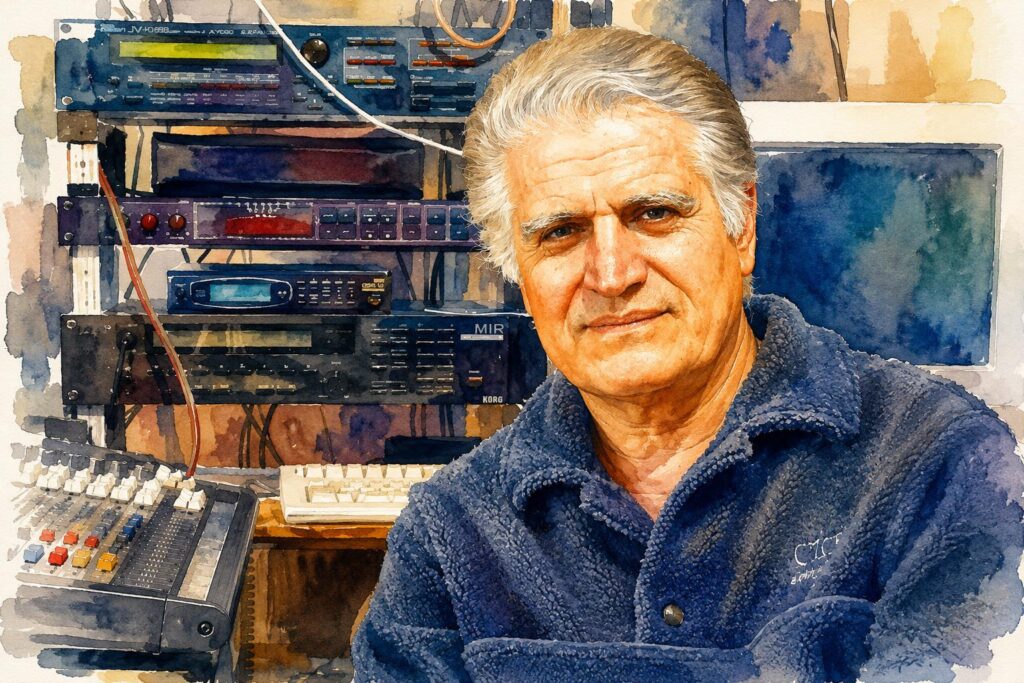
Veljo Tormis (7 August 1930 – 21 January 2017) stands as one of the most singular and monumental pillars in the landscape of twentieth-century choral creation. While global music history frequently shines its brightest spotlights on symphonists and avant-garde instrumental visionaries, Tormis chose a radically different path, dedicating almost his entire creative life to the human voice and the preservation of ancestral memory. Emerging from a small nation with an exceptionally deep vocal lineage, he transcended the traditional boundaries of Western classical music by anchoring his art in the ancient, pre-Christian oral traditions of the Baltic-Finnic peoples. His compositions are not mere arrangements of folklore; they are visceral, ritualistic transformations that channel the raw, elemental power of forgotten cultures into modern concert halls. Among the pantheon of celebrated music composers, Tormis occupies a unique position as an ethnomusicological conjurer, a creator who famously claimed that he did not use folk music, but rather that folk music used him.

Early Life and Musical Foundation
Born in the rural village of Kuusalu, Estonia, Tormis was immersed from infancy in an environment where sound and spirit were inextricably linked. His father served as a local sacristan and organist, meaning that Tormis’s earliest sonic memories were saturated with the deep resonances of church organs and congregational singing. This early exposure instilled in him an innate understanding of communal vocal structures.
His formal journey into the upper echelons of musical academia began at the Tallinn Conservatory, where he studied organ and composition under the tutelage of Edgar Arro. However, the shifting geopolitical landscapes of the mid-twentieth century soon redirected his path. In 1951, Tormis moved to the Moscow Conservatory, an institution that, despite the stifling ideological restrictions of the Soviet regime, boasted some of the most rigorous compositional training in the world. There, he studied under Vissarion Shebalin, a master traditionalist who emphasized clarity of form, contrapuntal mastery, and a profound respect for national melodic identities.
During his years in Moscow, Tormis found himself surrounded by a brilliant generation of peers, yet he increasingly felt a pull away from the grand romantic and early modernist orchestral styles that dominated Soviet institutional outputs. He returned to Estonia in 1956, working briefly as a teacher and music editor, but his true calling was crystallized a year later during an ethnomusicological expedition that would irrevocably alter his trajectory.
The Discovery of Regilaul
In 1957, Tormis visited the remote Estonian island of Kihnu. It was here that he encountered regilaul (runo-song) in its living, unadulterated state. Regilaul is an ancient form of oral poetry and song common to Baltic-Finnic peoples, dating back thousands of years. It features an eight-syllable, non-rhyming but heavily alliterative metric structure, usually performed by a lead singer and a responding choir in a narrow melodic range, often utilizing a simple, repetitive compass of just four or five notes.
To a musical world obsessed with serialism, complex chromaticism, and sprawling post-romantic orchestrations, regilaul might have seemed primitive. To Tormis, it was an epiphany. He recognized that this music possessed an architectural and spiritual integrity that did not need to be “improved” by Western harmonic conventions. He saw regilaul not as historical artifacts to be collected, dusted off, and dressed up in romanticized orchestral garb, but as a living energy system capable of conveying profound existential truth. This marked the birth of his artistic philosophy:
“It is not I who makes use of folk music, it is folk music that makes use of me. To me, folk song is not a musical element that can be used for self-expression… For me, folk song is a message from our ancestors that contains a completely different view of the world.”
Major Works and Choral Cycles
Tormis’s output is staggering in its depth, comprising over 500 choral songs organized into monumental cycles that map the spiritual terrain, seasonal rituals, and tragic historical fates of the Baltic-Finnic nations. Rather than writing isolated miniatures, Tormis preferred expansive, interconnected structures that allowed listeners to submerge themselves entirely into an ancient worldview.
                  ┌────────────────────────────────────────┐
                  │      VELJO TORMIS'S CHORAL LEGACY      │
                  └───────────────────┬────────────────────┘
                                      │
         ┌────────────────────────────┼────────────────────────────┐
         ▼                            ▼                            ▼
┌──────────────────┐         ┌──────────────────┐         ┌──────────────────┐
│  REGILAUL ROOTS  │         │ MONUMENTAL CYCLES│         │ RITUALISTIC FURY │
├──────────────────┤         ├──────────────────┤         ├──────────────────┤
│ Ancient Estonian │         │Forgotten Peoples │         │Curse Upon Iron   │
│ oral traditions  │         │6 fading cultures │         │Shamanistic drum &│
│ & alliteration.  │         │written 1970-1989.│         │anti-war message. │
└──────────────────┘         └──────────────────┘         └──────────────────┘
Forgotten Peoples (Unustatud rahvad)
Undoubtedly his magnum opus, Forgotten Peoples is a massive, six-part choral cycle composed between 1970 and 1989. Each part is dedicated to a specific, endangered or culturally marginalized Baltic-Finnic ethnic group whose language and traditions were on the precipice of extinction under the homogenizing pressures of Soviet Russification and modernization.
| Cycle Part | Target Culture | Artistic Core & Focus |
| Livonian Heritage | Livonians | Captures the maritime melancholy of a dying coastal language. |
| Votic Wedding Songs | Votians | Reconstructs the complex, multi-day wedding rituals of a vanishing tribe. |
| Izhorian Epic | Izhorians | Explores tragic narratives and historical resilience through tight vocal clusters. |
| Ingrian Evenings | Ingrian Finns | Focuses on youth gatherings, playful dances, and communal courtship songs. |
| Vepsian Paths | Vepsians | Utilizes shouting choruses and rhythmically jagged patterns reflecting forest life. |
| Karelian Destiny | Karelians | A powerful, dramatic finale drawing on the mythic weight of the Kalevala landscape. |
Through these works, Tormis acted as a musical archivist and savior. He took the precise linguistic rhythms, micro-melodic contours, and thematic concerns of these peoples and amplified them through the medium of the modern chamber choir, creating a living monument to human diversity.
Curse Upon Iron (Raua needmine)
If Forgotten Peoples is Tormis’s most expansive work, Curse Upon Iron (1972) is undeniably his most explosive and famous. Scored for full mixed choir, soloists, and an authentic shaman drum, the piece is a harrowing, claustrophobic incantation based on the Finnish epic Kalevala. It tells the mythological story of the creation of iron, tracing how a substance initially meant for harmless tools was corrupted by humanity into weapons of mass destruction.
Musically, Curse Upon Iron is a tour de force of choral orchestration. Tormis pushes the human voice to its absolute physical extremes, demanding whispered speech, guttural glissandi, ecstatic shouting, and primal, percussive chants. The driving, asymmetric pulse of the shaman drum serves as the terrifying heartbeat of the piece, building to an overwhelming acoustic frenzy. Written during the height of the Cold War, the piece was a thinly veiled, devastating critique of the military-industrial complex and the nuclear arms race, carrying an environmentalist and anti-war warning that remains deeply relevant today.
Musical Style and Choral Orchestration
Tormis’s style is instantly recognizable, yet it defies easy categorization within the continuum of twentieth-century classical music. While he was a contemporary of Western minimalists like Steve Reich and Philip Glass, Tormis’s repetitive structures did not stem from urban industrialized hypnotic states or mathematical patterns. Instead, his minimalism was ancient and organic, derived directly from the repetitive, trance-inducing nature of the regilaul refrain.
Key stylistic innovations that defined his craft include:
- Choral Orchestration: Tormis treated the choir not merely as a vehicle for four-part harmony, but as an avant-garde orchestra. He split voice parts into dozens of microscopic layers, creating dense polyphonic clusters, shimmering fields of sound, and percussive, percussive vocalizations that mimicked natural phenomena like wind, thunder, and water.
- Speech-Rhythms over Metrical Tyranny: The text always dictated the musical form. Tormis discarded the traditional tyranny of the bar line if it interfered with the natural, spoken alliterations and accents of the Finnic languages. His meters are fluid, often shifting rapidly between irregular time signatures to preserve the speech patterns of the ancestors.
- Modal Purity: Unlike many of his contemporaries who sought to modernize folk music by applying complex jazz chords or avant-garde atonality, Tormis preserved the stark, modal, and often pentatonic purity of the original songs. The tension in his music does not come from complex harmonic modulations, but from drone textures, extreme dynamic contrasts, and rhythmic accumulation.
Political Context and the Singing Revolution
To truly understand the importance of Veljo Tormis, one must examine his work through the lens of Soviet-occupied Estonia. Following World War II, the Soviet Union enacted strict policies of cultural censorship, forcing music composers to adhere to Socialist Realism—an aesthetic style requiring art to be optimistic, easily understood by the masses, and overtly loyal to the communist state.
Tormis brilliantly navigated this minefield. Because folk music was ostensibly viewed by Soviet authorities as the art of the working-class proletariat, Tormis was able to bypass rigid political censorship by framing his works as ethnomusicological preservation. However, beneath the surface of these ancient texts lay an explosive subtext of national survival and passive resistance.
When Tormis wrote about a vanishing forest tribe or sang a spell to ward off evil wolves, the Estonian public understood the implicit meaning: the forest tribe was Estonia, and the wolves were the Soviet oppressors. His compositions became an underground sanctuary for national identity. This cultural preservation laid the foundational psychological groundwork for the Singing Revolution of the late 1980s and early 1990s, where hundreds of thousands of Estonians gathered in mass choirs to sing their way to independence without shedding a single drop of blood. Tormis’s music proved that a song could be a shield, a sword, and a declaration of sovereign existence.
       ┌─────────────────────────────────────────────────────┐
       │     THE COMPOSER AS AN UNDERGROUND SANCTUARY       │
       └──────────────────────────┬──────────────────────────┘
                                  │
         ┌────────────────────────┴────────────────────────┐
         ▼                                                 ▼
┌──────────────────────────────┐                  ┌──────────────────────────────┐
│       SOVIET OUTSIDE         │                  │      ESTONIAN INSIDE         │
├──────────────────────────────┤                  ├──────────────────────────────┤
│ Appears as safe, historical  │                  │ Coded messages of survival,  │
│ ethnomusicology for masses.  │                  │ resistance, and sovereignty. │
└──────────────────────────────┘                  └──────────────────────────────┘
Legacy and Global Importance
Veljo Tormis retired from active composition in 2000, stepping away from the manuscript paper when he felt he had fulfilled his mission of returning the ancient songs to the collective consciousness of the modern world. He passed away in January 2017, leaving behind a nation in deep mourning but a global choral community permanently enriched by his vision.
Today, his legacy is preserved not only through frequent international performances but also through the work of the Veljo Tormis Virtual Centre, which catalogs his immense manuscript archive and promotes the study of regilaul. His influence on subsequent generations of estonian composers and international creators is immeasurable. While his contemporary Arvo Pärt achieved global fame through his serene, spiritual tintinnabuli style, Tormis provided the necessary, grounded counterweight: an earthly, primal, and thunderous celebration of human roots.
Conductors worldwide, from Tõnu Kaljuste and the Estonian Philharmonic Chamber Choir to avant-garde vocal ensembles across Europe, the Americas, and Asia, view Tormis’s scores as the ultimate test of a choir’s dramatic and technical capabilities. He transformed choral singing from a polite, polite drawing-room art form into an visceral theater of the human soul.
Conclusion
Veljo Tormis fundamentally shifted the axis of contemporary vocal art. By looking backward into the deep well of pre-Christian antiquity, he discovered a path forward that bypassed the sterile academic dead-ends of late twentieth-century modernism. His works remain a urgent reminder of what it means to be human in an increasingly fragmented, digitized world. He gave a permanent, resonant voice to peoples who were written out of the history books, proving that as long as their songs are sung, their spirits can never truly be forgotten.
Sources
- Daitz, Mimi S. (2004). Ancient Song Recovered: The Life and Music of Veljo Tormis. Hillsdale, NY: Pendragon Press.
- Tormis, Veljo (1997). Lauldud sõna (The Sung Word). Tartu: Tartu University Press.
- Estonian Music Information Centre (EMIC). (2021). Veljo Tormis: Biography and Work List. Tallinn: EMIC.
- Lippus, Urve (Ed.). (2000). Veljo Tormis’s Choral Music and Its Baltic-Finnic Context. Tallinn: Estonian Academy of Music.
- The Veljo Tormis Virtual Centre (tormis.ee). Digital Archive and Biographical Documentation.
#VeljoTormis #EstonianMusic #ChoralMusic #Regilaul #BalticComposers #ClassicalMusic #MusicHistory #ChoralCompositions #CurseUponIron #ForgottenPeoples #EstonianCulture #SingingRevolution #VocalMusic #Ethnomusicology #Folklore