In the landscape of twentieth-century classical music, few composers managed to marry the rigorous architecture of the European symphonic tradition with the intoxicating, visceral energy of Eastern folk music quite like Aram Khachaturian. Alongside his contemporary peers Dmitri Shostakovich and Sergei Prokofiev, Khachaturian formed the unofficial “triumvirate” of Soviet music, a trio of compositional titans whose works defined the acoustic identity of an era. Yet, while Shostakovich channeled psychological irony and Prokofiev championed a brittle, kinetic modernism, Khachaturian brought a fundamentally different sensory palate to the concert hall. His music is a kaleidoscope of vibrant orchestral color, dense post-romantic harmonies, and, above all, an uncompromising, driving rhythmic vitality rooted deeply in the soil of the Caucasus.
As a proud son of the Armenian diaspora, Khachaturian did not merely quote folk tunes; he transformed them into an expansive classical syntax. He effectively elevated Armenian folk idioms, modal improvisations, and traditional dances into grand-scale ballets, symphonies, and concertos that captivated audiences globally. To understand Khachaturian is to understand a complex intersection of cultural heritage, artistic brilliance, and the volatile political landscape of the Soviet Union.
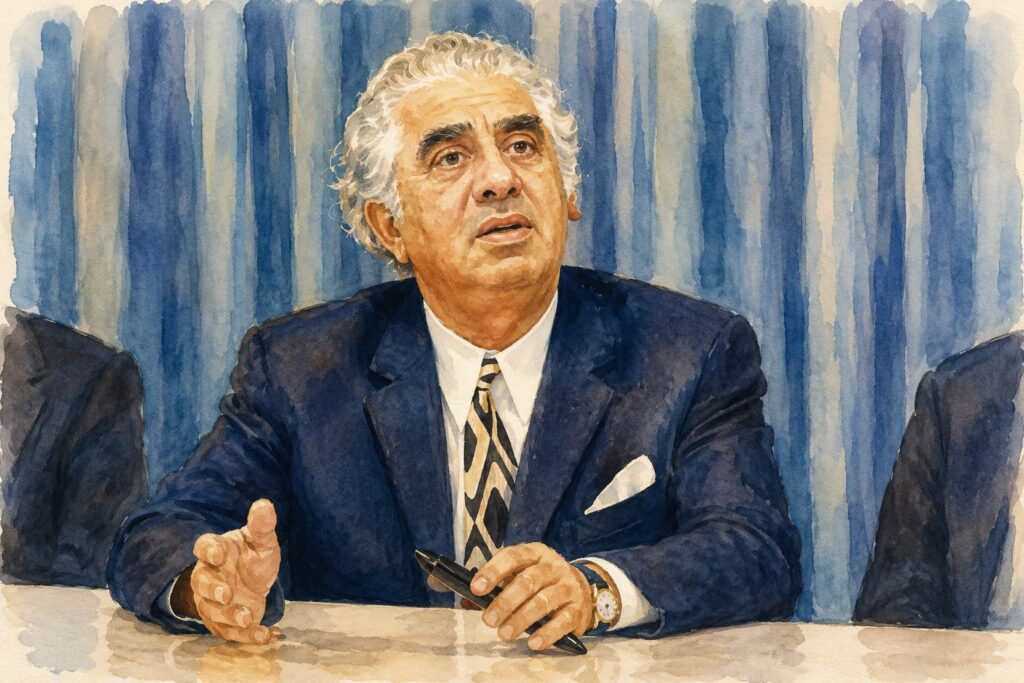
Early Life and Late Awakenings: From Tbilisi to Moscow
Aram Il’yich Khachaturian was born on June 6, 1903, in Tiflis (now Tbilisi), the historic and cosmopolitan capital of Georgia. At the time, Tiflis was a vibrant melting pot of cultures, home to large populations of Georgians, Armenians, Azerbaijanis, and Russians. Khachaturian’s parents were poor Armenian artisans originally from the region of Nakhichevan; his father was a bookbinder, and his mother raised the family in an atmosphere steeped in traditional music.
Surprisingly, given his later virtuosic command of the orchestra, Khachaturian was not a child prodigy. His early exposure to music was completely vernacular. He grew up listening to the songs of the ashughs. transcaucasian folk poets and troubadours, and the bustling street music of Tiflis, playing the tenor horn by ear in a local school brass band but receiving no formal lessons in music theory or notation.
It was not until 1921, at the relatively late age of eighteen, that Khachaturian made the pivotal decision to travel to Moscow with his brother, a theatrical director. Initially enrolling as a biology student at Moscow State University, his undeniable raw musical instinct led him within a year to the Gnessin State Musical College. There, despite his lack of formal training, the perceptive pedagogue Mikhail Gnessin recognized his genius and admitted him into the cello and composition classes.
In 1929, Khachaturian transferred to the prestigious Moscow Conservatory, studying composition under the eminent symphonist Nikolai Myaskovsky. It was during this intensive conservatory period that Khachaturian rapidly synthesized his innate Caucasian musical memories with the sophisticated traditions of Russian orchestration pioneered by Rimsky-Korsakov and Tchaikovsky. By the time he graduated in 1934 with his Symphony No. 1, Khachaturian had evolved from an untrained enthusiast into a master technician, ready to take the Soviet musical world by storm.
The Masterworks: Ballets, Concertos, and Global Acclaim
The decade following his graduation established Khachaturian as an international household name. His style was characterized by an instantly recognizable synthesis of sweeping lyricism, chromatic sensuality, and explosive percussive energy.
The Great Concertos
Khachaturian first achieved widespread fame through a trilogy of concertos dedicated to individual instruments. The Piano Concerto in D-flat major (1936) introduced his signature driving rhythms and famously utilized the flexatone (a musical instrument with a small flexible metal sheet) to create an eerie, expressive gliding sound in its slow movement. This was followed swiftly by the Violin Concerto in D minor (1940), composed for the legendary virtuoso David Oistrakh. The Violin Concerto remains a masterclass in perpetual-motion writing, demanding breathtaking technical acrobatics while maintaining a deeply expressive, song-like core. The trilogy was completed by his Cello Concerto (1946).
The Monumental Ballets
While his concertos solidified his reputation among concertgoers, it was through the medium of ballet that Khachaturian achieved immortality in popular culture.
- Gayane (1942): Composed during the bleakest years of World War II while the composer was evacuated to Perm, Gayane is a story of life on a collective farm near the Armenian border. It features what is undisputedly Khachaturian’s most famous piece of music: the frantic, percussive, and brilliantly orchestrated “Sabre Dance.” Though the piece became a global pop-culture phenomenon—frequently adapted for jazz, rock, and film—Khachaturian occasionally lamented that its monolithic popularity overshadowed the rest of his output.
- Spartacus (1954): Tracking the historic slave revolt against the Roman Republic, Spartacus represents the absolute peak of Khachaturian’s dramatic writing. The ballet’s central love theme, the “Adagio of Spartacus and Phrygia,” is one of the most soaring, intensely passionate melodies ever written for the classical stage, characterized by massive, surging orchestral crescendos.
| Work | Year of Composition | Key Characteristics |
| Piano Concerto in D-flat major | 1936 | Highly rhythmic; features a flexatone; marked by neo-romantic bravura. |
| Violin Concerto in D minor | 1940 | Written for David Oistrakh; dance-like, virtuosic, and deeply lyrical. |
| Symphony No. 2 (“The Bell”) | 1943 | A dramatic, tragic wartime symphony utilizing bell motifs to signify warning and mourning. |
| Gayane (Ballet) | 1942 | Features the famous “Sabre Dance”; heavily infused with authentic Armenian folk dances. |
| Spartacus (Ballet) | 1954 | Heroic epic style; home to the globally recognized “Adagio of Spartacus and Phrygia.” |
The Pillar of Armenian Classical Music
While Khachaturian worked within the institutional infrastructure of the Soviet Union, his historical importance to the development of Armenian classical music cannot be overstated. Before the twentieth century, Armenian classical music was in its infancy, primarily championed by the pioneering ethnomusicologist and priest Komitas Vardapet, who meticulously preserved and transcribed rural folk songs. Khachaturian took this foundational nationalist impulse and successfully translated it into the grand, multi-movement forms of Western European classical music.
To achieve this, he ingeniously simulated the timbres and tunings of traditional Armenian instruments using a standard Western orchestra:
- Imitating the Tar and Saz: Khachaturian frequently wrote rapidly repeating, staccato, or pizzicato figures in the violins and woodwinds to evoke the bright, plucked sounds of long-necked lutes.
- Recreating the Duduk: He utilized the lower registers of the oboe, the English horn, or the clarinet to capture the mournful, reedy, and highly expressive vibrato of the duduk, Armenia’s signature double-reed woodwind instrument.
- The Dhol Pulse: The driving percussion sections in his allegros mimic the syncopated, complex additive rhythms of the traditional Armenian hand drum.
Furthermore, Khachaturian’s melodic construction leaned heavily on the modal scales of the Near East rather than traditional Western major and minor scales. He relied on intervals like the augmented second, creating a distinctively bittersweet, exotic, and emotionally raw tonal landscape. Through his achievements, Armenia gained a monumental symphonic identity on the world stage, paving the way for future generations of Armenian composers, including Arno Babajanian, Alexander Arutiunian, and Avet Terterian.
Political Navigations: The Soviet System and the 1948 Decree
Like all Soviet artists of his generation, Khachaturian’s career was subject to the changing tides of ideological control. For much of the 1930s and early 1940s, his vibrant, optimistic, and populist style aligned perfectly with the tenets of Socialist Realism, the state-mandated artistic doctrine requiring art to be realistic, accessible to the working class, and supportive of socialist progress. He was showered with accolades, including multiple Stalin Prizes.
However, the political climate hardened severely after World War II. In February 1948, Andrei Zhdanov, Stalin’s cultural enforcer, launched a sweeping denunciation of the Soviet Union’s leading composers. Khachaturian, Shostakovich, and Prokofiev were officially condemned for “formalism”—a vague ideological charge meaning their music was deemed too complex, experimental, discordant, and “divorced from the Soviet people.”
“Those years were terribly difficult for me,” Khachaturian later recalled. “I was accused of things I did not understand, and my music was temporarily banned from performance. It felt as though my creative spine had been broken.”
Khachaturian was forced to issue a public, bureaucratically scripted apology, and he temporarily turned away from large symphonic works to write film scores and patriotic cantatas. Fortunately, the dark period was relatively short-lived. Following Stalin’s death in 1953, the cultural grip loosened significantly. Khachaturian was fully rehabilitated, restored to his leadership positions within the Union of Soviet Composers, and eventually awarded the prestigious title of Hero of Socialist Labor in 1973.
Legacy and Enduring Influence
In his later years, Khachaturian dedicated himself heavily to pedagogy and conducting. He joined the faculty of the Moscow Conservatory and the Gnessin Institute, mentoring scores of students from across the globe. He travelled extensively worldwide, conducting his own works with top-tier international orchestras from London to Washington.
Aram Khachaturian passed away on May 1, 1978, in Moscow, just weeks shy of his seventy-fifth birthday. He was buried with full state honors in the Komitas Pantheon in Yerevan, the capital of Armenia, alongside the nation’s most revered cultural figures.
Today, Khachaturian’s legacy is preserved not just in the active repertoires of major concert halls, but as an irreplaceable component of Armenian national pride. His home in Yerevan is now a thriving museum and archive dedicated to his memory, and his likeness has graced Armenian currency. By taking the vibrant, ancient rhythms of his ancestral home and breathing them into the timeless vessel of the classical orchestra, Khachaturian created an art form that remains universally accessible, enduringly thrilling, and profoundly human.
References
- Hakobian, Levon. Music of the Soviet Era: 1917–1991. London: Routledge, 2017.
- Khachaturian, Aram. Aram Khachaturian: Autobiography. Moscow: Soviet Composer, 1980.
- Robinson, Harlow. The Last Impresario: The Life and Times of Sol Hurok. New York: Viking, 1994. (Detailing Khachaturian’s American tours).
- Schwarz, Boris. Music and Musical Life in Soviet Russia: 1917–1981. Bloomington: Indiana University Press, 1983.
- Stephanian, Anahit. Aram Khachaturian and Armenian National Culture. Yerevan: Gitutyun, 2005.
#ClassicMusic #AramKhachaturian #ArmenianMusic #SovietComposer #SabreDance #Spartacus #Gayane #OrchestralMusic #MusicHistory #ViolinConcerto #TwentiethCenturyMusic #CaucasusCulture #NationalistMusic #ComposerProfile #SymphonicMasterpieces