For nearly two centuries following the death of Henry Purcell in 1695, mainland European critics frequently referred to Britain as Das Land ohne Musik—the land without music. While the nation excelled in commerce, literature, and imperial expansion, its classical music scene relied heavily on imported talent like Georg Friedrich Handel and Felix Mendelssohn.
This centuries-long drought ended abruptly at the close of the nineteenth century, courtesy of a self-taught, provincial outsider: Sir Edward Elgar.
Elgar did not merely compose music; he captured the psychological landscape of an empire at its zenith and during its subsequent fracture. Though often caricatured as the ultimate musical embodiment of Edwardian imperial swagger, thanks largely to his ubiquitous Pomp and Circumstance marches, Edward Elgar was a deeply complex, sensitive, and frequently melancholic artist. His music synthesized the grand romanticism of Johannes Brahms and Richard Wagner with a distinctly English lyricism, characterized by sweeping, nostalgic melodies and a brilliant mastery of the modern orchestra. As the foundational figure of the English Musical Renaissance, Elgar elevated British music back to the global stage, forever altering the trajectory of his country’s cultural history.
Early Life and the Provincial Struggle (1857–1898)
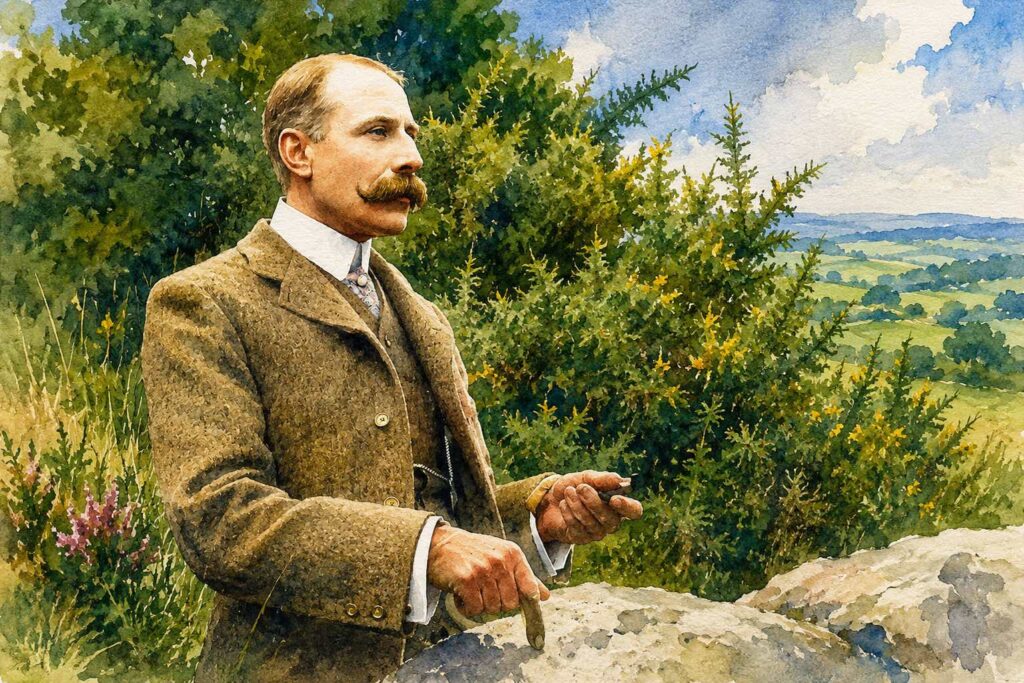
Edward William Elgar was born on June 2, 1857, in the small village of Broadheath, near Worcester. Unlike many of his contemporaries who studied at prestigious institutions like the Royal College of Music or European conservatories, Elgar was entirely an outsider to the musical establishment. His father, William Elgar, was a piano tuner and violinist who ran a music shop in Worcester; his mother, Ann Greening, was a well-read woman who instilled in her son a deep love for literature and the English countryside.
Growing up surrounded by sheet music and instruments in his father’s shop, Edward Elgar became a versatile, self-taught multi-instrumentalist. He mastered the violin, piano, organ, and bassoon, and eagerly devoured manuals on musical theory and orchestration. By his teenage years, he was deeply embedded in the local musical fabric, playing violin in regional orchestras, serving as the organist at St. George’s Roman Catholic Church, and even conducting the attendant band at the Worcester County Lunatic Asylum.
Despite his undeniable talent, Elgar’s early adulthood was marked by professional obscurity and intense financial insecurity. His provincial location, combined with his working-class background and Roman Catholic faith—in an era when the British musical elite was overwhelmingly Anglican, wealthy, and London-centric—acted as a severe barrier to advancement. He frequently despaired of ever achieving national recognition, writing bitterly about the systemic biases stacked against him.
The crucial turning point in Elgar’s life occurred in 1889 when he married Caroline Alice Roberts, a major’s daughter and one of his piano pupils. Alice was eight years his senior and hailed from a significantly higher social stratum. Her family strongly disapproved of the match, cutting her off financially. Yet, Alice possessed an unshakeable belief in Elgar’s genius. She became his manager, amanuensis, and emotional anchor, providing the stability and confidence he desperately needed to transition from a provincial teacher into a full-time composer.
The Zenith of Achievement: Masterworks and Breakthroughs
Elgar’s breakthrough came relatively late in life. In 1899, at the age of forty-two, he achieved overnight international fame with his Variations on an Original Theme, Op. 36, universally known as the Enigma Variations. The piece is a structural marvel: a haunting, melancholic original theme followed by fourteen variations, each sketching a cryptic psychological portrait of Alice, himself, or one of their close friends.
The “Enigma” itself refers to a hidden, unplayed musical theme that Edward Elgar claimed runs through and over the entire work but is never explicitly heard, a puzzle that musicologists debate to this day. The centerpiece of the work, the moving Nimrod variation, stands as a monument to deep friendship and artistic encouragement. When the legendary conductor Hans Richter championed the piece in London, Elgar was instantly catapulted to the forefront of European music.
[Theme] ──> [Var. I: C.A.E. (Alice)] ──> [Var. IX: Nimrod (Jaeger)] ──> [Var. XIV: E.D.U. (Elgar)]
If the Enigma Variations proved his orchestral genius, his 1900 choral masterpiece, The Dream of Gerontius, solidified his philosophical and dramatic depth. Based on Cardinal John Henry Newman’s poem about a soul’s journey through death to judgment, the work initially suffered a catastrophic, under-rehearsed premiere in Birmingham. However, its subsequent performance in Germany drew glowing praise from Richard Strauss, who openly declared Elgar the leader of the modern English school.
Over the next decade, Elgar produced an astonishing string of masterpieces that defined the Edwardian era:
- Pomp and Circumstance Marches (1901–1930): March No. 1 featured a melody so stirring that King Edward VII suggested words be set to it. With lyrics by A.C. Benson, it became “Land of Hope and Glory,” Britain’s unofficial second national anthem.
- Symphony No. 1 in A-flat major (1908): Premiered under Richter, it was an unprecedented success, achieving a staggering one hundred performances worldwide within its first year. Richter famously declared it “the greatest symphony of modern times.”
- Violin Concerto in B minor (1910): Written for the virtuoso Fritz Kreisler, this intensely intimate and structurally massive work features a unique, accompanied cadenza where the orchestral strings cushion the solo violin with a delicate, strummed effect.
- Symphony No. 2 in E-flat major (1911): A far more ambiguous, complex work than its predecessor, dedicated to the memory of Edward VII. Rather than blind optimism, it opens with an undercurrent of anxiety and quotes a poem by Percy Bysshe Shelley concerning the fleeting nature of joy.
| Composition | Premiere Year | Key Characteristic | Historical Significance |
| Enigma Variations | 1899 | Cryptic, episodic psychological portraits | Established Elgar’s international reputation |
| The Dream of Gerontius | 1900 | Deeply spiritual, late-Romantic choral canvas | Hailed by Richard Strauss as a masterpiece |
| Symphony No. 1 | 1908 | Noble, motto-driven structural unity | Broke the English “symphonic drought” |
| Cello Concerto | 1919 | Elegiac, sparse, post-war introspection | The definitive valedictory work of his career |
Crucial Role in the English Musical Renaissance of Edward Elgar
To understand Elgar’s profound importance to English classical music, one must contextualize the state of British composition in the late nineteenth century. For generations, British conservatories preached a conservative adherence to German models, producing well-crafted but largely uninspired imitations of Mendelssohn and Brahms.
Elgar shattered this paradigm. Ironically, he did so not by rejecting Continental developments, but by mastering them more thoroughly than any home-grown contemporary. His music absorbed the chromatic harmonic language of Wagner and the vivid, virtuosic orchestration techniques of Richard Strauss and Hector Berlioz. Yet, he filtered these influences through a deeply idiosyncratic English sensibility.
“English music is white, and should be white… out of doors, in the open air, brought up locally.” — Edward Elgar
Elgar’s “Englishness” was not rooted in the literal transcription of folk songs—a path later championed by Ralph Vaughan Williams and Cecil Sharp—but rather in a atmospheric translation of landscape and character. His music evokes the rolling hills of the Malverns, the solemnity of British statehood, and a characteristically British emotional reserve that suddenly gives way to overwhelming, passionate nobility (often marked in his scores with his signature directive, Nobilmente).
By demonstrating that an English composer could write large-scale symphonic and choral music capable of standing alongside the masterworks of Germany, France, and Russia, Elgar single-handedly restored Britain’s international musical credibility. He effectively paved the way for subsequent generations of British composers, including Vaughan Williams, Gustav Holst, William Walton, and Benjamin Britten.
The Later Years, WWI, and an Autumnal Farewell
The outbreak of World War I in 1914 shattered Elgar’s world. The Edwardian society he had soundtracked was systematically dismantled in the mud of Flanders. Elgar, too old to enlist, served in the Local Volunteer Force and wrote patriotic pieces, but the immense slaughter deeply traumatized him. His artistic worldview, anchored in the late-Romantic tradition, suddenly felt antiquated in a world hurtling toward modernism.
Out of this profound disillusionment came his final undisputed masterpiece: the Cello Concerto in E minor, Op. 85 (1919). Stripped of the dense orchestral opulence of his pre-war symphonies, the Cello Concerto is sparse, raw, and devastatingly elegiac. It begins with a weary, declamatory recitative from the solo cello, unfolding into a haunting lament for a lost generation and a dying era.
[Pre-War Opulence: Symphony No. 1]  ──(WWI Disruptor)──>  [Post-War Austerity: Cello Concerto]
   - Massive orchestration                                    - Sparse textures
   - Triumphant nobility                                      - Elegiac heartbreak
   - Optimistic vistas                                        - Intimate isolation
The premiere of the concerto was a notorious disaster due to inadequate rehearsal time allocated by the conductor Albert Coates, which deeply humiliated Elgar. Shortly thereafter, in 1920, Lady Elgar died of lung cancer. The loss of Alice shattered Elgar’s creative drive. For the remaining fourteen years of his life, he produced almost no major new compositions, choosing instead to live a quiet life in the countryside focused on his hobbies, which included chemistry, horse racing, and his beloved dogs.
Technological Pioneer and Lasting Legacy of Edward Elgar
Though his composing career effectively ended in 1920, Elgar’s final decade was marked by a fascinating engagement with a brand-new medium: the gramophone. Unlike many traditionalist musicians who viewed early recording technology with profound skepticism, Elgar was a passionate early adopter.
Recognizing the educational and archival value of the medium, he signed an exclusive contract with the Gramophone Company (later HMV). Between 1914 and 1933, he conducted extensive, historically invaluable acoustic and electrical recordings of almost all his major orchestral works. These recordings provide modern musicians with an indispensable, firsthand blueprint of his intended tempos, rubato, and emotional inflections, revealing a style that was far more fluid, urgent, and less sentimental than modern interpretations often suggest.
Sir Edward Elgar died on February 23, 1934, at the age of seventy-six, leaving his projected Third Symphony unfinished. He was buried beside his beloved Alice at St. Wulstan’s Church in Little Malvern.
Today, Elgar’s legacy extends far beyond the concert halls of Great Britain. While he remains a central fixture of British national identity—his Pomp and Circumstance accompanies millions of graduates across the globe every spring, and his music remains the emotional spine of the annual BBC Proms—he is increasingly recognized globally as a towering figure of late-Romanticism. His ability to balance public grandeur with intensely private vulnerability gives his music a timeless, universal resonance.
References
- Kennedy, M. (2004). The Life of Elgar. Cambridge University Press.
- Moore, J. N. (1984). Edward Elgar: A Creative Life. Oxford University Press.
- Rushton, J. (1999). Elgar: ‘Enigma’ Variations. Cambridge University Press.
- McVeagh, D. (2007). Elgar the Music Maker. Boydell Press.
- Grimley, D. M. (Ed.). (2004). The Cambridge Companion to Elgar. Cambridge University Press.
#EdwardElgar #ClassicalMusic #EnglishMusic #EnigmaVariations #Nimrod #CelloConcerto #BritishHistory #EdwardianEra #OrchestralMusic #MusicHistory #ComposerBiographies #Gerontius #SymphonicMasterpieces #PompAndCircumstance #EnglishRenaissance