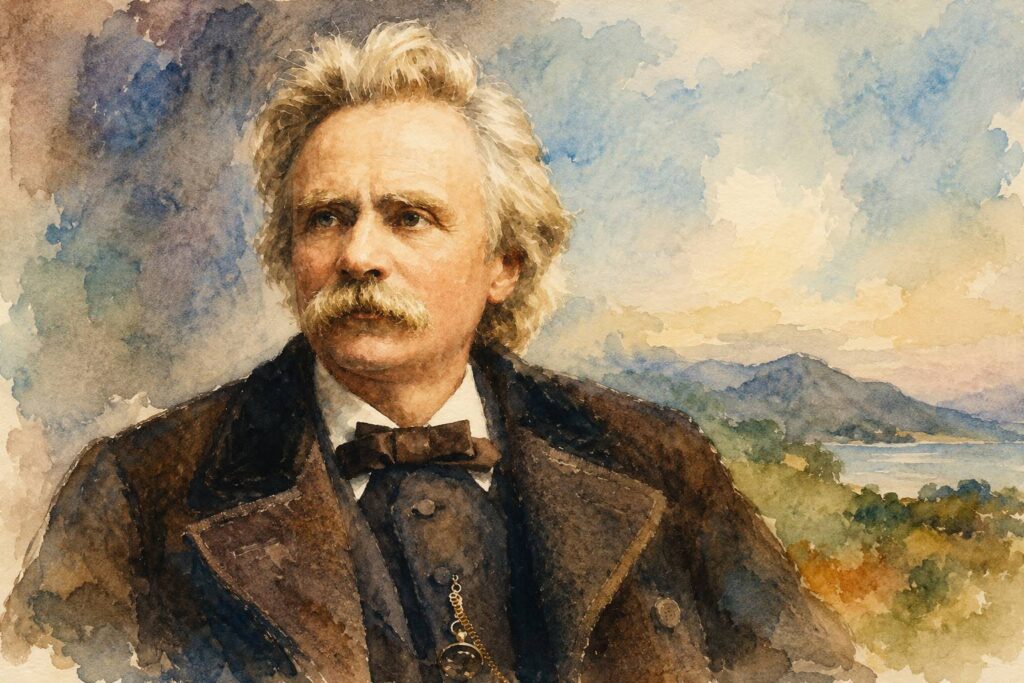
Few figures in the history of Western civilization provoke as much intense fascination, artistic reverence, and moral repulsion as Wilhelm Richard Wagner (22 May 1813 – 13 February 1883). A colossus of the nineteenth century, Wagner was not merely a composer of opera; he was a cultural revolutionary, a polemicist, a conductor, and a theater architect who fundamentally transformed the trajectory of Western music and dramatic art. His conceptualization of the Gesamtkunstwerk, the “total work of art” that unified music, poetry, visual spectacle, and drama into a single cohesive vehicle, shattered the existing paradigms of Italian and French opera (Millington, 2001).
While his musical innovations, particularly his advanced use of chromaticism and the leitmotif system, laid the foundational stepping stones for modernism and twentieth-century film scoring, his personal life and political ideologies remain deeply fraught. Wagner’s virulent antisemitism, aggressive German nationalism, and subsequent posthumous appropriation by the Nazi regime have rendered him a perennially controversial figure (Deathridge, 2008). To explore Wagner is to confront the terrifying paradox of cultural history: that art of the most sublime, transcendent beauty can emanate from a mind poisoned by bigotry and megalomania.
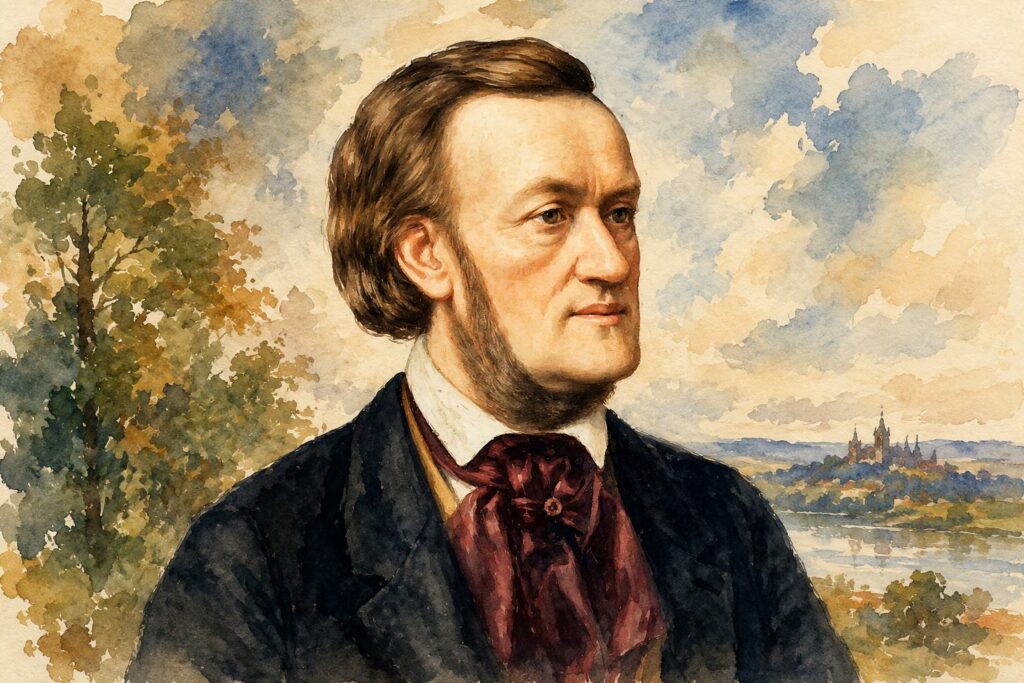
Biography: A Turbulent Life of Exile and Triumph
Richard Wagner was born on May 22, 1813, in Leipzig, Germany, into a modest bureaucratic family. His early exposure to the theater came via his stepfather, Ludwig Geyer, an actor and playwright, who cultivated the young boy’s voracious appetite for literature and drama (Gutman, 1990). Unlike many of his contemporaries, such as Wolfgang Amadeus Mozart or Felix Mendelssohn, Wagner was not a childhood musical prodigy. His formal composition training did not begin in earnest until his enrollment at the University of Leipzig in 1831, where he studied under Theodor Weinlig (Millington, 2001).
[Early Years & Struggles] ──> [1849 Dresden Revolution] ──> [Exile in Switzerland] ──> [Ludwig II Patronage] ──> [Bayreuth Era]Wagner’s early career was defined by financial instability, artistic frustration, and a relentless flight from creditors. He held minor conducting posts in provincial towns like Würzburg, Magdeburg, and Riga. It was during his time in Riga that he married his first wife, the actress Minna Planer, a tumultuous union characterized by mutual infidelity and financial ruin (Westernhagen, 1981). Desperate for international success, Wagner fled Riga in 1839 to escape his mounting debts, embarking on a perilous sea voyage to London, an experience of tempestuous waves and sailor folklore that directly inspired his first masterwork, Der fliegende Holländer (The Flying Dutchman).
A subsequent miserable sojourn in Paris from 1839 to 1842 yielded little operatic success but forced Wagner to survive by churning out musical journalism and arranging sheet music for popular operas. His fortunes shifted dramatically in 1842 when his grand historical opera Rienzi was accepted and triumphantly premiered in Dresden. This success secured him the prestigious position of Royal Saxon Court Conductor (Kapellmeister) in Dresden, providing temporary financial solvency and an elite platform to debut Tannhäuser (1845) and complete Lohengrin (1848).
“I cannot replicate the life of an ordinary craftsman; I require light, beauty, and brilliance. The world owes me what I need.”
Richard Wagner, in a letter detailing his lifestyle demands.
Richard Wagner’s tenure in Dresden was cut short by his radical political entanglements. Swept up in the pan-European revolutionary fervor of 1848–1849, Wagner aligned himself with left-wing anarchists like Mikhail Bakunin, participating in the aborted May Uprising of 1849 in Dresden (Deathridge, 2008). When Prussian troops crushed the insurrection, an arrest warrant was issued for Wagner. Forced into political exile, he fled to Switzerland with the financial assistance of his friend Franz Liszt.
                  ┌─────────────────────────────────────┐
                  │   Wagner's Swiss Exile (1849-1862)  │
                  └──────────────────┬──────────────────┘
                                     │
         ┌───────────────────────────┴───────────────────────────┐
         ▼                                                       ▼
[Theoretical Manifestos]                               [Creative Implosion]
- Art and Revolution                                   - Begins 'Der Ring des Nibelungen'
- Opera and Drama                                      - Composes 'Tristan und Isolde'
- Das Judenthum in der Musik                           - Immerses in Schopenhauer's philosophy
The years of Swiss exile were a periods of immense intellectual incubation. For nearly a decade, Wagner composed little music, focusing instead on writing expansive theoretical essays, including Art and Revolution (1849), The Artwork of the Future (1849), and Opera and Drama (1851), alongside his infamous antisemitic tract Das Judenthum in der Musik (Jewishness in Music, 1850). It was also during this exile that he discovered the pessimistic philosophy of Arthur Schopenhauer, whose assertion that music is the highest, most direct expression of the metaphysical “Will” profoundly reshaped Wagner’s approach to composition (Magee, 2000).
By 1864, Wagner’s financial resources were entirely depleted, and he faced total ruin. He was rescued by an extraordinary stroke of political fortune: the ascension of the eighteen-year-old King Ludwig II to the throne of Bavaria. An ardent admirer of Wagner’s librettos, Ludwig summoned the composer to Munich, cleared his astronomical debts, and provided him with an open-ended annual stipend (Newman, 1976). This royal patronage insulated Wagner from market pressures, allowing him to focus exclusively on his most ambitious artistic visions.
During this Bavarian period, Wagner’s personal life underwent a seismic shift. He began a scandalous affair with Cosima von Bülow, the daughter of Franz Liszt and the wife of the prominent conductor Hans von Bülow (who, remarkably, continued to conduct Wagner’s premieres out of artistic devotion). After Minna’s death and Cosima’s divorce, the two married in 1870. Cosima would become Wagner’s fierce protector, muse, and the archivist whose meticulous diaries offer an unparalleled, albeit hagiographic, look into his daily thoughts. Wagner spent his final decade supervising the construction of his custom opera house in Bayreuth, culminating in the first complete performance of his monumental four-opera cycle in 1876. He died of a heart attack on February 13, 1883, in Venice, Italy, and was buried in the garden of his villa, Wahnfried, in Bayreuth.
Major Musical and Dramatic Works
Wagner’s output is almost unique in classical music because he wrote both the music and the libretti (the text) for all his mature operas, a practice he deemed essential for achieving true artistic unity. His canon is traditionally divided into his early romantic operas and his later music dramas.
The Romantic Operas
The transition from conventional opera to the Wagnerian music drama is signaled by three transitional works:
- Der fliegende Holländer (1843): Introduces the core Wagnerian theme of redemption through self-sacrificing love (Erlösung), utilizing recurring musical themes to depict the curse of the ghost captain.
- Tannhäuser (1845): Explores the psychological torment of a man torn between sacred, spiritual love (represented by Saint Elisabeth) and profane, sensual eroticism (represented by the pagan goddess Venus).
- Lohengrin (1850): A mythic Arthurian tale of a holy knight whose divine origin must remain a secret. It represents the apex of Romantic German opera, featuring the world-famous “Bridal Chorus.”
The Transcendent Music Dramas
Abandoning traditional operatic structures, such as distinct recitatives, arias, and choruses, Richard Wagner developed what he called “infinite melody” (unendliche Melodie), a continuous stream of orchestral and vocal sound that avoided predictable cadences and structural pauses (Thorau, 2018).
| Work / Cycle | Composition Era | Premise & Cultural Significance |
| Tristan und Isolde | 1857–1859 | An intoxicating exploration of forbidden love, metaphysical desire, and death (Liebestod). Its opening chord revolutionized Western harmony by delaying resolution for over four hours. |
| Die Meistersinger von Nürnberg | 1862–1867 | Wagner’s sole mature comedy. It celebrates German art, craftsmanship, and the evolution of tradition through youthful innovation, set in Renaissance Nuremberg. |
| Der Ring des Nibelungen (The Ring Cycle) | 1848–1874 | An epic tetralogy spanning fifteen hours across four operas: Das Rheingold, Die Walküre, Siegfried, and Götterdämmerung. It traces the rise and apocalyptic fall of gods, giants, and humans corrupted by a ring of absolute power. |
| Parsifal | 1877–1882 | Wagner’s final “Festival Play for the Consecration of the Stage” (Bühnenweihfestspiel). A deeply solemn work drawing on Christian mysticism, Buddhism, and Holy Grail lore, dealing with compassion, suffering, and redemption. |
Musical Innovations and Importance of Richard Wagner
Wagner’s impact on the technical evolution of music is immeasurable. His most significant structural innovation was the systematization of the leitmotif (leading motif), a short, recurring musical phrase associated with a specific character, object, place, or abstract psychological state (Thorau, 2018). While earlier composers had used reminiscent themes, Richard Wagner wove hundreds of these motifs into a complex, contrapuntal orchestral tapestry. The orchestra ceased to be a mere accompaniment to the singers; it became an omniscient narrator, akin to the chorus in ancient Greek tragedy, revealing the subconscious motivations and hidden secrets of the characters onstage.
[Character/Object/Idea] ──> Assigned to a Short Musical Phrase (Leitmotif) ──> Orchestral Contrapuntal Development ──> Subconscious Narrative RevealedHarmonically, Wagner pushed the boundaries of traditional tonality to the absolute brink. The very first measure of Tristan und Isolde introduces the famous “Tristan Chord” (F – B – D-sharp – G-sharp), a dissonant sonority that refuses to resolve to a conventional home key.
Standard Classical Harmony:   [Dissonance] ───> [Immediate Resolution to Home Key]
Wagnerian Tristan Harmony:    [Dissonance] ───> [Chromatically Shifts to Another Dissonance] ... (4 Hours) ... ───> [Final Resolution at Death]
By delaying harmonic resolution across entire acts via chromaticism (moving by half-steps rather than diatonic scales), Wagner generated an unprecedented sense of yearning and psychological tension. This breakdown of functional tonality directly inspired the radical musical developments of the early twentieth century, serving as the immediate catalyst for the musical expressionism of Arnold Schoenberg, Gustav Mahler, and Richard Strauss (Taraskin, 2005).
Furthermore, Richard Wagner’s demands for expanded sonic power forced changes in instrument design, leading to the creation of the “Wagner tuba” a brass instrument designed to bridge the sonic gap between the French horn and the trombone.
Architectural Revolution: The Bayreuth Festspielhaus
To realize his Gesamtkunstwerk, Wagner recognized that the architectural realities of nineteenth-century European opera houses were fundamentally inadequate. Existing theaters, designed with horseshoe seating tiers and illuminated auditoriums, were social hubs where the aristocracy gathered to socialize, gossip, and display wealth, treating the stage performance as a secondary consideration (Spotts, 1994).
With the financial backing of King Ludwig II and public donations, Wagner designed and built the Bayreuth Festspielhaus in northern Bavaria, a theater dedicated exclusively to the performance of his own works.
The Festspielhaus introduced revolutionary democratic and acoustic design principles that redefined the modern theater-going experience:
- The Mystical Abyss (Mystischer Abgrund): Richard Wagner completely hid the orchestra pit beneath the stage under a curved wooden hood. This prevented the audience from being distracted by the physical movements of the musicians and the conductor. Acoustically, it blended the vocal lines with a diffused, rich orchestral sound before reaching the auditorium.
- Democratic Seating Layout: Eliminating private luxury boxes, Wagner arranged the seats in a steep, un-tiered amphitheater wedge, ensuring every single audience member had an uninterrupted view of the stage.
- Darkening the House: Wagner was the first to completely extinguish the auditorium lights during performances, forcing the audience to plunge into darkness and redirect their total psychological focus to the illuminated world of the stage drama.
Ideology, Politics, and Posthumous Controversy
It is impossible to separate the artistic legacy of Richard Wagner from the toxic political ideology he championed. Wagner was an outspoken ethno-nationalist who viewed the emerging German state not merely as a geo-political entity, but as a spiritual and racial collective (Rose, 1992). This worldview was anchored by a deep-seated, systemic antisemitism. In his essay Das Judenthum in der Musik (1850), published initially under a pseudonym and later republished under his own name, Wagner attacked Jewish composers like Felix Mendelssohn and Giacomo Meyerbeer. He claimed that because Jews were historically displaced outsiders, they were inherently incapable of genuine artistic expression, creative originality, or connection to the organic spirit of the German people (Rose, 1992).
Wagnerian Ethno-Nationalism ──> Cultural Antisemitism ──> Posthumous Radicalization (Bayreuth Circle) ──> Nazi Appropriation (Hitler)Following Wagner’s death, his widow Cosima transformed their Bayreuth home into a shrine for proto-fascist, pan-German nationalist thought. The “Bayreuth Circle” attracted racial theorists like Houston Stewart Chamberlain, whose white-supremacist ideologies laid the intellectual framework for the National Socialist movement (Spotts, 1994).
In the twentieth century, Adolf Hitler became an obsessive devotee of Wagner’s music, stating that “whoever wants to understand National Socialist Germany must know Wagner.” During the Third Reich, the Bayreuth Festival was transformed into a state-sponsored propaganda tool, and Wagner’s music was regularly deployed at Nazi party rallies and played over loudspeakers within concentration camps (Weiner, 1997).
This historical reality created a profound cultural trauma, resulting in an informal, yet fiercely maintained, public ban on performing Wagner’s music in the State of Israel. When conductors like Zubin Mehta or Daniel Barenboim attempted to perform excerpts of Wagner in Israel, they were met with public protests, political denunciation, and walkouts by Holocaust survivors for whom the music remains a symbol of genocide.
The ongoing debate centers on a fundamental philosophical dilemma: Can an artwork be decoupled from the moral character and intent of its creator? Scholars like Bryan Magee argue that Wagner’s operas themselves do not contain explicit antisemitism and instead deal with universal, humanist myths. Conversely, critics like Marc Weiner argue that contemporary audiences cannot ignore the subtextual racial coding embedded within caricatured villains like Alberich and Mime in the Ring or Beckmesser in Die Meistersinger (Weiner, 1997).
Personally, I believe we should think about this matter logically, not just in the case of Richard Wagner, but regarding all artists and their art. The first thing to consider is the art itself. If a work of art does not contain hate speech or promote violence, racism, or anything similar, then it is not inherently bad. In Wagner’s case, his music and operas do not promote hatred; they are purely mythological. And with the genius of their composer behind them, they are undeniably great works of art.
Those who believe Wagner’s music contains some hidden antisemitic message almost sound like conspiracy theorists who claim that if you play Led Zeppelin music backwards, it says “Lucifer is your lord,” and so on.
I understand that the creator of these works was himself a racist and narcissistic person, but fortunately none of those qualities found their way into his music. What makes Wagner antisemitic are his writings, memoirs, and letters, not his compositions. And let’s not forget that the direct connection between Wagner and Nazism is still debated; many believe that his antisemitic ideas were never as brutal as the Nazis later made them appear. But of course, believing Wagner was a good person is not something I could support in any way.
Which brings me to my final point: if the artwork itself is not hate speech, and the artist has been dead for a long time, I believe there is no harm in separating the art from the artist and appreciating a great work of art. However, if Wagner were alive today, listening to and promoting his music would also mean promoting him as a person. If Wagner were alive today, I would not listen to his music or attend his concerts, no matter how good they were, and I definitely would not recommend his music to anyone either.
It could be interesting to imagine what Richard Wagner would do if he were alive in our contemporary world. The initial idea might be that he would use his opportunity to write operas and articles against Israel as a nation, because he was anti-semite. However, deeper reflection can change that view. Wagner, at his core, was a racist, selfish, apartheid‑seeking individual, and those characteristics overlap with the essence of Zionism. If he had lived long enough to be with us today, I’m pretty sure he would side with most Western politicians and wealthy people, standing with Israel, denying the existence of millions of people, and labeling any war crime as self‑defence or a pre‑emptive attack.
Legacy and Conclusion
Despite the dark shadow cast by his politics, Wagner’s artistic legacy remains an undeniable pillar of modernity. Beyond classical music, his emphasis on internal psychology, mythic archetypes, and stream-of-consciousness narratives deeply impacted modernist literature, directly shaping the structures of Thomas Mann’s Buddenbrooks, James Joyce’s Ulysses, and T.S. Eliot’s The Waste Land (Large & Weber, 1984).
In the visual realm, the structural principles of the Gesamtkunstwerk found expression in the architecture of the Bauhaus movement, while his leitmotif technique effectively created the blueprint for modern cinematic music. Film composers from Max Steiner to John Williams have utilized explicitly Wagnerian structural methodology to score narrative cinema.
Ultimately, Richard Wagner remains a monumental enigma. He was an artistic visionary who expanded the emotional and technical horizons of Western music to dizzying new heights, yet he harnessed those achievements to an intolerant, exclusionary social philosophy. To engage with Wagner is to engage with the absolute limits of art, a reminder that creative genius can simultaneously elevate human expression to its peak while mirroring the deepest darkness of the human condition.
References
- Deathridge, J. (2008). Wagner Beyond Good and Evil. Berkeley: University of California Press.
- Gutman, R. W. (1990). Richard Wagner: The Man, His Mind, and His Music. New York: Harcourt Brace Jovanovich.
- Large, D. C., & Weber, W. (Eds.). (1984). Wagnerism in European Culture and Politics. Ithaca: Cornell University Press.
- Magee, B. (2000). The Tristan Chord: Wagner and Philosophy. London: Allen Lane.
- Millington, B. (Ed.). (2001). The Wagner Compendium: A Guide to Wagner’s Life and Music. London: Thames & Hudson.
- Newman, E. (1976). The Life of Richard Wagner (Vols. 1-4). Cambridge: Cambridge University Press.
- Rose, P. L. (1992). Wagner: Race and Revolution. New Haven: Yale University Press.
- Spotts, F. (1994). Bayreuth: A History of the Wagner Festival. New Haven: Yale University Press.
- Taruskin, R. (2005). The Oxford History of Western Music: The Nineteenth Century. Oxford: Oxford University Press.
- Thorau, C. (2018). The Leitmotif: History and Theory of a Musical Concept. Cambridge: Cambridge University Press.
- von Westernhagen, C. (1981). Wagner: A Biography. Cambridge: Cambridge University Press.
- Weiner, M. A. (1997). Richard Wagner and the Anti-Semitic Imagination. Lincoln: University of Nebraska Press.
#ClassicalMusic #RichardWagner #OperaHistory #Musicology #Gesamtkunstwerk #TheRingCycle #Bayreuth #TristanUndIsolde #Leitmotif #NineteenthCentury #MusicTheory #GermanRomanticism #OperaLovers #ArtHistory #MusicalRevolution