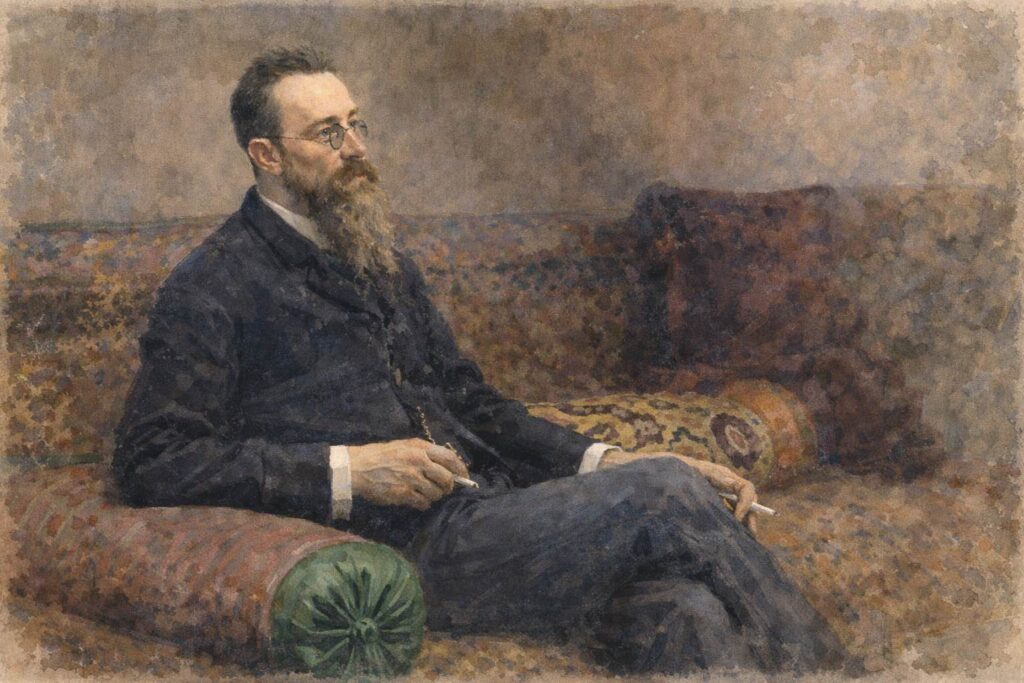
Nikolai Rimsky‑Korsakov (18 March 1844 – 21 June 1908) is one of the most celebrated figures in 19th‑century Russian music. Though he is perhaps best known today for the dazzling orchestral virtuosity of pieces like “The Flight of the Bumblebee” and the exotic‑sounding “Scheherazade,”his legacy stretches far beyond a handful of popular songs. Rimsky‑Korsakov was a composer, teacher, and, most importantly, an orchestration genius whose techniques reshaped how the orchestra is used in the Western canon. This article explores his early life, artistic maturation, key works, compositional style, and the lasting influence he has on musicians worldwide.
Rimsky‑Korsakov’s life spanned the late Romantic era, a period of great change in Russian society and music. Born into a wealthy Russian merchant family, he grew up surrounded by music, a passion that eventually led him to study at the Saint Petersburg Conservatory and join the legendary “Mighty Handful” (or “The Five”) who were a group of nationalist composers who sought to create a distinct Russian musical voice. Over his career, Rimsky‑Korsakov composed operas, symphonic poems, ballets, songs, and music for the stage, but he is most celebrated for his skillful orchestration, a craft that earned him the nickname “The Russian Bruckner.”
Early Life, Education, and First Musical Influences
Nikolai Alexeyevich Rimsky‑Korsakov was born in the provincial town of Kostroma into a wealthy merchant family. From a very early age he was immersed in a culturally rich environment; the family’s salon was frequented by visiting performers, giving the young Rimsky‑Korsakov exposure to a wide range of music. He began piano lessons at the age of five and took up the violin at ten, developing a solid instrumental foundation that would later inform his orchestral writing.
In 1861, the outbreak of the Crimean War saw Rimsky‑Korsakov conscripted into the Russian Army as a sub‑lieutenant in the 3rd Cossack Regiment. Though his military service imposed a rigid schedule, he found time to play chamber music with fellow officers and cultivated the discipline that would become a hallmark of his compositional career.
His formal musical education began in earnest in 1863 when he entered the Saint Petersburg Conservatory. There he studied counterpoint, harmony, and composition under Alexander Zatayevich, a disciple of Mikhail Glinka. He also took piano lessons from Mikhail Baklanov and violin lessons with Semyon Tchernikov. The conservatory years produced a series of early works, including piano pieces, songs, and his 1868 “Symphonic Overture The Night of the Rape.” It was during this period that Rimsky‑Korsakov first encountered the music of his future mentor, Mily Balakirev, who would profoundly shape his artistic outlook. Balakirev’s emphasis on Russian folk tunes, Orthodox chant, and Eastern musical idioms, particularly those of Turkish and Greek origin, found its way into Rimsky‑Korsakov’s developing style. At the same time, Rimsky‑Korsakov absorbed the broader German Romantic tradition, studying the works of Wagner, Schumann, and Liszt.
Artistic Maturity
1. Joining “The Five
In the early 1870s, Rimsky‑Korsakov became a member of the informal group known as The Five (Russian: Могучая кучка, lit. ‘Mighty Bunch’), also known as the Mighty Handful or The Mighty Five. This circle, comprising Balakirev, Modest Mussorgsky, César Cui, Alexander Borodin, and Rimsky‑Korsakov himself, sought to create music that was unmistakably Russian, drawing on folk songs, Orthodox chants, and folk dance rhythms.
- Key Projects:
- 1874–1876: Participated in the joint orchestration of Balakirev’s “The Tale of Tsar Saltan”.
- 1878: Collaborated with Mussorgsky on “Pictures at an Exhibition” (transcribed for piano).
- 1885–1886: Assisted in the orchestration of “The Night of the Rape” and other works for the Saint Petersburg Conservatory.
2. Academic Career
Rimsky‑Korsakov joined the Saint Petersburg Conservatory faculty in 1881 as a professor of composition. He taught notable students such as Sergei Rachmaninoff (although their relationship was strained) and Igor Stravinsky (who admired Rimsky‑Korsakov’s orchestration).
- Impact: His pedagogy stressed structural clarity, orchestration, and the use of folk material, influencing a whole generation of Russian composers.
3. Stylistic Development
Throughout the 1880s–1900s, Rimsky‑Korsakov’s compositional voice matured into a distinctive blend of:
- Programmatic storytelling (e.g., Scheherazade, Sadko).
- Masterful orchestration (coloristic detail, unique instrumental combinations).
- Use of folk motifs (integrated rather than quoted).
- Harmonic innovation (modal scales, chromaticism).
He was also known for his meticulous revisions—his scores underwent multiple edits to achieve perfection.
Nikolai Rimsky‑Korsakov Importance
The significance of Nikolai Rimsky‑Korsakov in Russian music can be seen in three interrelated dimensions. First, as a member of the “Mighty Handful” (also known as “The Five”), he helped forge a distinctly Russian national music, drawing upon folk melodies, Orthodox chants, and Slavic dance rhythms while rejecting the dominant Western orchestral conventions of his time. His compositions, particularly the symphonic poems Scheherazade and Capriccio Espagnol, became the flagship examples of this nationalist movement, both domestically and abroad.
Second, Rimsky‑Korsakov’s work as a composer and teacher at the Saint Petersburg Conservatory positioned him as a key transmitter of Russian musical values to the next generation. He taught students who would go on to become towering figures in Western music, such as Sergei Rachmaninoff, Igor Stravinsky, and Dmitri Shostakovich. His insistence on structural clarity, masterful orchestration, and the integration of folk material provided a pedagogical framework that shaped the evolution of Russian composition in the early 20th century.
Finally, Rimsky‑Korsakov’s legacy lies in his unprecedented command of orchestration. He pioneered a set of techniques, unique instrumental combinations, vivid timbral color, and advanced harmonic idioms, that set the standard for orchestral writing in the 20th century. His 1908 treatise, Principles of Orchestration, remains a staple reference for conductors and composers worldwide, cementing his influence beyond the confines of Russian music.
Greatest Works
| Genre | Work | Year | Significance |
|---|---|---|---|
| Symphonic Poem | Scheherazade | 1888 | The first Russian symphonic poem to be internationally renowned. Combines storytelling with lush orchestration. |
| Opera | The Maid of Pskov | 1890 | A lyrical opera that demonstrates his mastery of vocal writing. |
| Ballet | Sadko | 1906 | A Russian folk‑based ballet with dazzling orchestration. |
| Concertante | Flight of the Bumblebee (c. 1889) | 1894 | A virtuosic orchestral interlude often performed as a showcase for soloists. |
| Orchestral Suite | Capriccio Espagnol | 1887 | A colorful, rhythmic tour-de-force, reflecting his fascination with Spanish folk music. |
| Incidental Music | The Tale of Tsar Saltan(Orchestration) | 1880s | A monumental work that combines drama with symphonic color. |
| Symphonic | The Flight of the Bumblebee(orchestrated) | 1900 | Demonstrates his skill in making a small solo passage into a full orchestral masterpiece. |
These works showcase his programmatic flair and his unparalleled ability to paint musical pictures.
Composition Style & Techniques of Nikolai Rimsky‑Korsakov
1. Orchestration Mastery
- Instrumental Color: Rimsky‑Korsakov explored combinations such as clarinet in bassoonregisters or violins and flutes in parallel thirds for shimmering effects.
- Use of Non‑Traditional Instruments: He incorporated balalaikas, domra, and even piano as orchestral colors, giving his music an authentic folk timbre.
- Dynamic Range: His scores employ subtle dynamic nuances, from whispering pianissimos to thunderous fortissimos, often with extreme contrasts.
“Rimsky‑Korsakov’s orchestration is like a painter with an endless palette; his colors are defined not by instruments alone, but by their timbral relationships.” – John Williams (composer and conductor)
2. Harmonic Language
- Modal Influences: He frequently used Dorian, Phrygian, and Lydian modes derived from Russian folk tunes.
- Chromaticism: Though grounded in tonality, his harmonic progressions often include chromatic mediants and secondary dominants.
- Parallel Motion: He employed parallel fourths and fifths, reminiscent of Orthodox chant, giving his music a sacred, timeless quality.
3. Programmatic Narrative
- Rimsky‑Korsakov was an early advocate of program music, pieces designed to depict a story or image.
- He wrote program notes for many works, clarifying his intentions and guiding listeners through the musical narrative.
Influence on Other Composers
Rimsky‑Korsakov’s orchestration mastery and programmatic sensibilities resonated across a broad spectrum of composers, both within Russia and internationally. Igor Stravinsky, who studied Rimsky‑Korsakov’s techniques, adopted many of his coloristic methods in works such as The Firebird (original 1910 version). Sergei Rachmaninoff, in turn, drew from Rimsky‑Korsakov’s orchestral language when arranging his own piano works for the orchestra, as seen in the Rhapsody on a Theme of Paganini. Boris Stravinsky, a student of Rimsky‑Korsakov’s treatise, employed its principles in The Great Gate of Kiev, while Dmitri Shostakovich’s approach to thematic development and orchestral color in The Gadfly shows clear echoes of Rimsky‑Korsakov’s influence.
Outside Russia, composers such as Carl Orff and Claude Debussy found inspiration in Rimsky‑Korsakov’s vivid palette, and his techniques have become standard practice in film scoring. Even contemporary composers continue to consult Principles of Orchestration for guidance on achieving lush, dynamic soundscapes. In short, Rimsky‑Korsakov’s impact extends far beyond his own compositions; he helped lay the groundwork for modern orchestral practice and inspired countless musicians to explore the full expressive potential of the orchestra.
Nikolai Rimsky‑Korsakov in a Nutshell
- Standard‑Setting Orchestration
Rimsky‑Korsakov set the groundwork for 20th‑century orchestral writing. His concepts of instrument timbre, balance, and color continue to inform orchestral scores across genres, from classical to film music. - Cultural Bridge
He brought Russian folk elements to an international audience, making Russian national music a staple in the concert hall worldwide. - Pedagogical Legacy
His teaching and writings shaped an entire generation of composers who would go on to revolutionize Western music. - Enduring Popularity
Pieces such as Scheherazade and Flight of the Bumblebee remain in the repertoire of orchestras and soloists, continuing to captivate audiences.
Final Thoughts
Nikolai Rimsky‑Korsakov remains an emblematic figure of Russian Romanticism, yet his influence extends far beyond the confines of his homeland. He succeeded in fusing nationalist spirit with universal musical ideas, creating works that are at once deeply rooted in Russian folklore and universally resonant. His mastery of orchestration, his visionary programmatic storytelling, and his mentorship of a new generation of composers have secured his place as a pivotal figure in the transition from Romanticism to Modernism.
Whether you are a seasoned conductor, a music student, or simply a lover of symphonic beauty, Rimsky‑Korsakov’s music offers an inexhaustible source of wonder. As you explore his scores, pay attention to how he paints with sound, each instrument becomes a brushstroke, each chord a hue, each rhythm a gesture that together tell stories that endure centuries after the composer’s final note.
Sources:
- Britannica
- The Music Book: Big Ideas Simply Explained, DK Publishing
- Wikipedia – The Five
- Wikipedia – Nikolai Rimsky-Korsakov
#NikolaiRimskyKorsakov #RussianMusic #Orchestration #Scheherazade #TheFlightOfTheBumblebee #MightyHandful #MusicHistory #SymphonicPoems #ProgramMusic #ClassicalMusic #MusicEducation #FilmMusic #MusicLovers