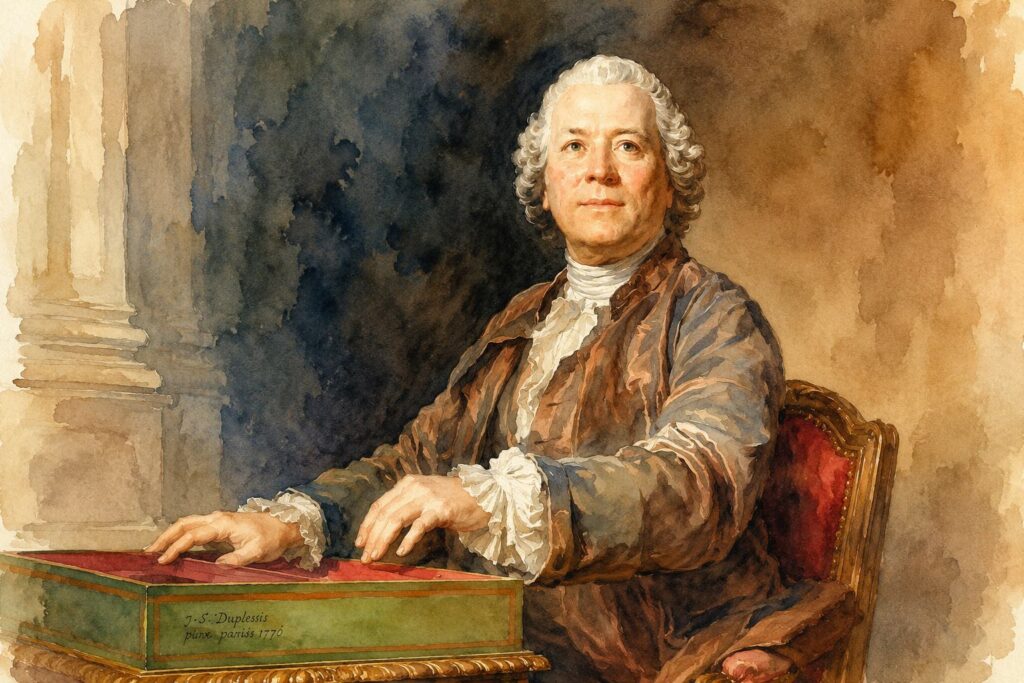
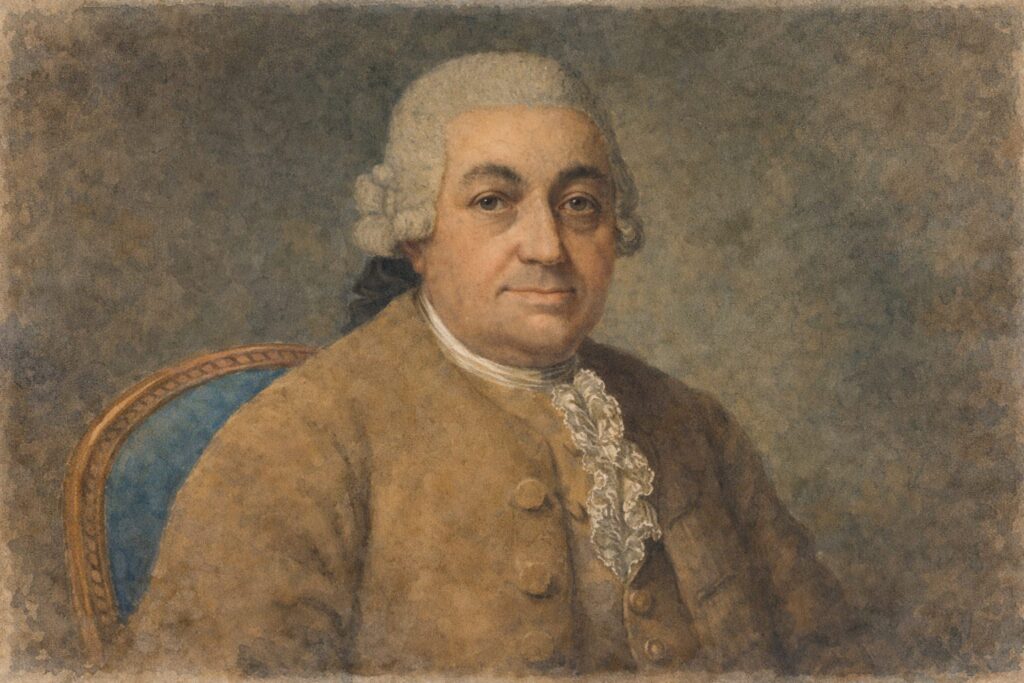
Carl Philipp Emanuel Bach One of the most forward‑looking composers of the 18th century, he bridged the elaborate world of Baroque music with the expressive clarity of the Classical era. His innovative “Empfindsamer Stil” (sensitive style) set the stage for the musical revolution that would culminate in the works of Mozart, Beethoven, and beyond.
Carl Philipp Emanuel Bach (8 March 1714 – 14 December 1788), the third son of the towering Johann Sebastian Bach, is often remembered as a “forgotten” sibling of the Baroque master. Yet a closer look reveals a composer who was, in many ways, the architect of the Classical style. His prolific output, over 300 symphonies, numerous keyboard works, chamber music, cantatas, and operas, demonstrates a keen sense of melodic expression, harmonic daring, and formal experimentation that made him a pivotal figure in the history of Western art music.
Early Life, Education, and First Musical Influences
Carl Philipp Emanuel Bach was born in the small town of Eisenach, nestled in the Thuringian Forest. He entered a household steeped in music; his father, Johann Sebastian Bach, was one of the most prolific composers of the Baroque era, and his elder brothers were also musicians. From the moment he could grasp a key, C.P.E. began studying keyboard technique and the elementary principles of counterpoint under his father’s guidance. By the age of six, he was already proficient on the organ, and his earliest compositions reflected the disciplined structure that defined the Bach tradition.
Between 1720 and 1730, while his older brother Johann Christian was studying at Leipzig’s Thomasschule, C.P.E. stayed in Eisenach. There, he received lessons from Johann Michael Bach, a cousin of his father who served as a court musician in Weimar. This period provided him with a grounding in the practical aspects of court music, organ performance, improvisation, and the demands of a princely musical household. The Weimar court was a vibrant musical center, attracting the likes of Dietrich Buxtehude and later Johann Sebastian Bach himself. Exposure to Buxtehude’s expressive organ works left an indelible mark on the young composer’s sense of harmonic color and melodic invention.
In 1730, at the age of 16, C.P.E. entered the court of the Duke of Saxe‑Weimar, where he took on the roles of court composer and organist. This appointment allowed him to engage directly with the late Baroque style that permeated court life and to experiment with the evolving forms of the time. It was during these years that he began to develop a personal voice that blended the disciplined counterpoint of his father with a freer, more expressive approach.
He returned briefly to Leipzig in the early 1730s, re‑immersing himself in his father’s rigorous compositional techniques. Yet his experience in Weimar, combined with his continued study of the works of Georg Philipp Telemann, who was celebrated for his concise, melodic writing, and Johann Adolph Hasse, whose operatic style was marked by dramatic vocal lines, broadened his musical horizons. Telemann’s influence is evident in C.P.E.’s early keyboard suites, while Hasse’s dramatic sensibilities would later inform his vocal and operatic output.
These formative years, rich in both rigorous instruction and exposure to diverse musical traditions, forged a composer who would later become the linchpin between the intricate Baroque idiom and the emerging Classical style. C.P.E. Bach’s early life was a crucible of technical mastery, inventive experimentation, and an insatiable curiosity about the evolving language of music.
Key Influences:
- Johann Sebastian Bach – Counterpoint, modal harmony.
- Georg Philipp Telemann – Concise forms, melodic elegance.
- Johann Adolph Hasse – Operatic and vocal styles.
- Johann Michael Bach – The practice of keyboard and organ improvisation.
Artistic Maturity
Hamburg Years (1740‑1749)
After a short tenure as Kantor at St. Mary’s in Hamburg (1739–1742), C.P.E. Bach moved to the city of Hamburg, a major hub of music publishing and performance. Here, he composed prolifically for the public concert scene, pioneering the public concert model that prefigured the later symphony concerts.
- Public Concert Series: He organized weekly concerts featuring his own compositions, attracting a broader audience than the courtly sphere.
- Symphonies: His first six symphonies (Op. 1, 1739–1740) were groundbreaking in their use of dynamic contrast and expressive minor keys.
Berlin Years (1750‑1788)
In 1750, the court of the Kingdom of Prussia offered C.P.E. Bach the post of Kantor at St. Mary’s Church in Berlin and a position in the Musical Society (Musikalisches Hoftheater). Over the next 38 years, he became a central figure in Berlin’s musical life.
- Court Composer: He wrote music for royal ceremonies, operas, and chamber concerts.
- Influence on Students: Notably, Johann Gottlieb Naumann and Johann Gottfried Schichtstudied under him.
- Empfindsamer Stil: His mature style, characterized by sudden dynamic changes, expressive harmonic shifts, and frequent use of “lament bass” patterns, became his trademark.
Importance in Music History
- Transitionary Role: C.P.E. Bach’s music is often described as the bridge between Baroque complexity and Classical clarity.
- Empfindsamer Stil: He codified this “sensitive style,” influencing later composers such as Haydn, W.A. Mozart, and early Beethoven.
- Public Concert Model: His initiative in organizing public concerts expanded the music audience beyond courtly elites, paving the way for the Vienna Philharmonic and the modern symphonic tradition.
- Keyboard Literature: His Piano Sonatas and Keyboard Concertos expanded the repertoire and helped establish the piano as a solo instrument.
- Harmonic Innovation: He experimented with distant key relationships, chromaticism, and the use of enharmonic modulation, techniques that foreshadow Romantic harmonic exploration.
Greatest Works
| Genre | Work | Year | Significance |
|---|---|---|---|
| Symphonies | Symphony No. 3 in F major, Op. 2 (1756) | 1756 | One of the first symphonies to explore dramatic dynamic contrast. |
| Symphony No. 11 in E major, Op. 3 (1758) | 1758 | Early example of a “Clever” or “Sturm und Drang” symphony. | |
| Keyboard | Piano Sonata No. 1 in F minor, Op. 2 (1749) | 1749 | Exemplifies the empfindsamer Stil on the keyboard. |
| Essay on the Composition of Music (1762) | 1762 | Theoretical treatise that codified his style and influenced pedagogy. | |
| Cantatas | Kantate „Ich möchte dich anbeten“, BWV 181 | 1750 | A masterful blend of Baroque vocal forms and Classical harmonic clarity. |
| Operas | Sofonisba (1760) | 1760 | One of his few operas, showcasing the blend of dramatic narrative and musical innovation. |
| Concertos | Keyboard Concerto No. 1 in B♭ major, Op. 5 (1771) | 1771 | Influential in the development of the piano concerto. |
Highlighted Works
- Symphony No. 7 in C minor, Op. 4: The “Sturm und Drang” symphony that prefigured Beethoven’s early dramatic symphonies.
- Piano Sonata No. 5 in G major: A model of lyrical clarity and balanced form.
- Cantata “Einen Jüngling hat der Götterwald gerufen” (1756): An example of his mature vocal style.
Composition Style and Influence on Others
Composition Style
| Feature | Description |
|---|---|
| Melody | Free, expressive lines, often with large leaps and ornamentation reminiscent of Bach but with a more lyrical touch. |
| Harmony | Frequent use of minor keys, chromatic chords, and abrupt modulations; often employs harmonic “paradoxes” (e.g., unexpected tonic changes). |
| Form | Blends Baroque forms (e.g., suite, fugue) with emerging Classical structures (e.g., sonata form, binary form). |
| Dynamics | Early use of sudden dynamic contrast (forte‑piano) and messa di voce—features that later became standard in the Classical period. |
| Texture | More transparent textures compared to Baroque dense counterpoint; often features homophonic passages with expressive accompaniment. |
Influence on Others
- Ludwig van Beethoven: Beethoven cited C.P.E. Bach’s Piano Sonata No. 7 as a model for early “Sturm und Drang” influences.
- Wolfgang Amadeus Mozart: Mozart admired C.P.E. Bach’s Keyboard Concertos; his own concertos display similar harmonic daring.
- Johann Nepomuk Hummel: His early keyboard works show traces of C.P.E. Bach’s empfindsamer Stil.
- Early Romanticists: The path from C.P.E. Bach’s chromaticism to Schubert’s harmonic language is evident.
Carl Philipp Emanuel Bach in a Nutshell
- Stylistic Evolution: C.P.E. Bach is a living document of musical transition, illustrating how Baroque complexity gave way to Classical clarity.
- Educational Legacy: His treatise Essay on the Composition of Music remains a valuable pedagogical resource for understanding 18th‑century composition techniques.
- Cultural Impact: His public concerts democratized music consumption, influencing the social and cultural role of music.
- Innovation: By embracing expressive harmonic shifts and dynamic contrast, he set a new standard for emotional depth in instrumental music.
Final Thoughts
Carl Philipp Emanuel Bach may not command the same household name as his father or his famed contemporaries, but his fingerprints are indelibly etched in the music of the Classical and Romantic eras. His willingness to explore new harmonic terrains, his commitment to the public concert, and his clear articulation of the empfindsamer Stil make him a crucial link in music’s evolutionary chain. For anyone looking to understand how the piano, symphony, and expressive style evolved during the 18th century, C.P.E. Bach’s oeuvre is a must‑listen and a must‑study.
Sources:
- Bach Digital
- Classicfm
- Wikipedia
- The Cambridge Companion to the Keyboard Music of C.P.E. Bach – (Cambridge University Press)
#CarlPhilippEmanuelBach #CPEBach #EmpfindsamerStil #BaroqueToClassical #MusicHistory #BachFamily #ClassicalMusic #PianoSonatas #Symphonies #KeyboardConcertos #PublicConcerts #MusicTheory #BeethovenInfluence #MozartInfluence #MusicEducation #18thCenturyMusic #ViennaClassic #PrussianMusic