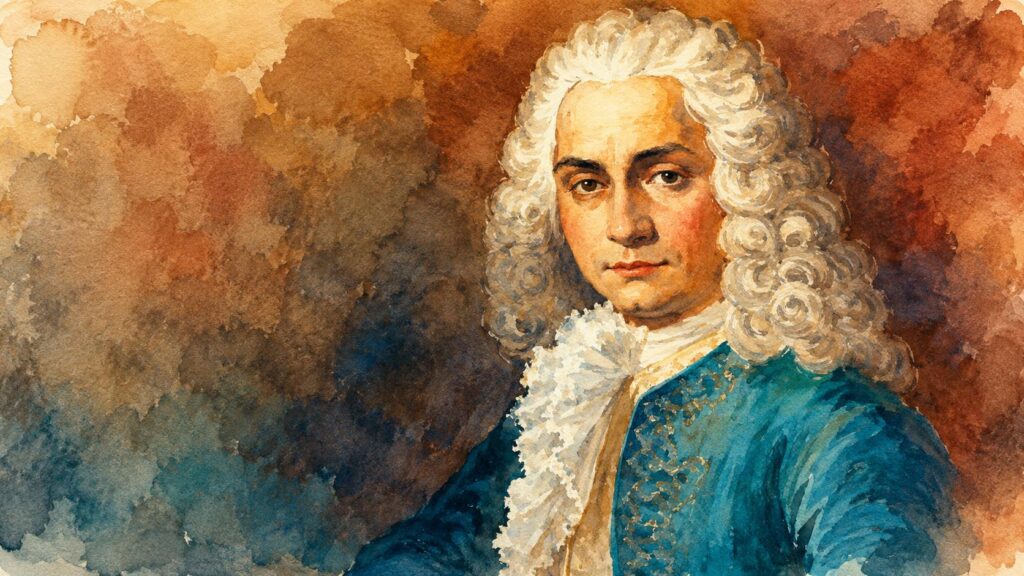
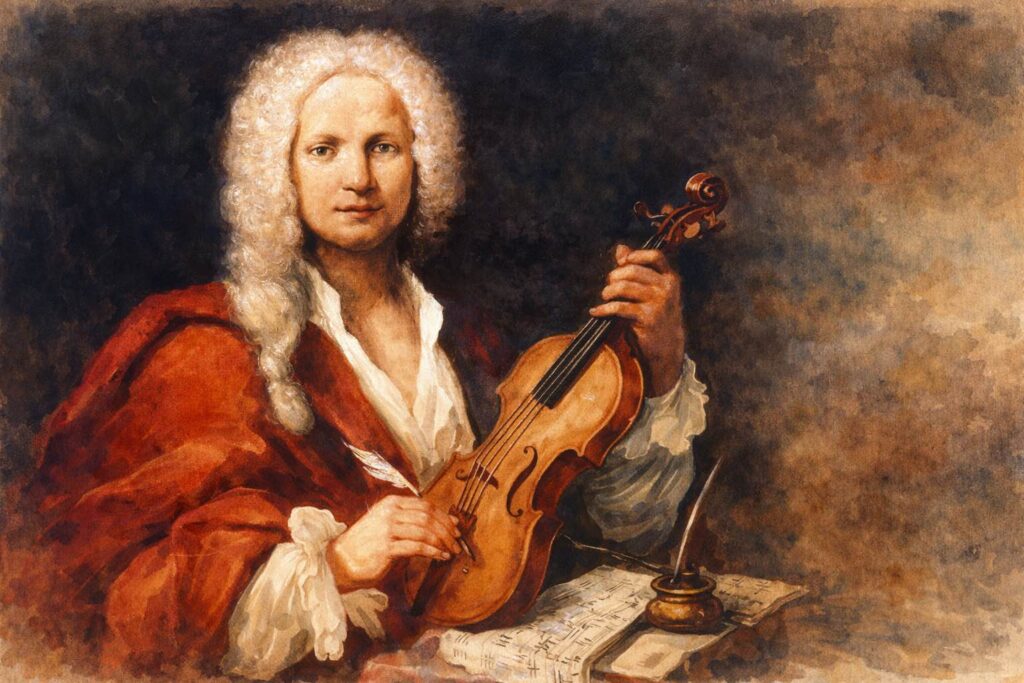
Antonio Lucio Vivaldi (4 March 1678 – 28 July 1741), one of the most celebrated composers of the Baroque era, is the eldest son of Giovanni Battista Vivaldi, a professional violinist who played in the orchestra of St. Mark’s Basilica. From an early age Antonio was immersed in a musical household, receiving his first training from his father and developing into a skilled violinist. Venice at the time was a vibrant musical center, a place where opera, sacred music, and instrumental innovation intersected.
At fifteen he began studying for the Catholic priesthood, and in 1703 he was ordained. Vivaldi’s distinctive reddish hair earned him the nickname Il Prete Rosso “the Red Priest” a playful yet enduring label that stuck throughout his life. Despite his priestly status, chronic health issues, likely asthma, prevented him from regular mass duties and instead steered him toward a life spent largely in music.
Artistic Maturity: Career and Innovations
Almost immediately after ordination, Vivaldi was appointed maestro di violino at the Ospedale della Pietà; a prestigious Venetian institution for orphaned and abandoned girls that also functioned as a celebrated music school and choir. It was here that he spent the majority of his career: teaching, training young musicians, and composing an extraordinary volume of music specifically for their performances.
Driven by institutional demand, in one year he was expected to produce two new concertos per month, Vivaldi became famous for speed and prolific output. He boasted that he could compose a concerto with all its parts faster than a copyist could transcribe it, a claim supported by his massive corpus of over 500 surviving concertos.
Beyond the Pietà, Vivaldi worked in Mantua and Rome, produced dozens of operas, and traveled widely, bringing his music, and his ideas, to courts and theatres across Europe.
Contemporaries and Musical Relationships
Vivaldi’s world was populated by some of the greatest minds of early 18th-century music. These relationships, direct or indirect, shaped his artistic development and helped spread his influence.
- Arcangelo Corelli – Though a generation older, Corelli’s violin style and concerto grosso format deeply influenced Vivaldi’s early work.
- Tomaso Albinoni and Alessandro Marcello – Italian contemporaries who shared the Venetian Baroque milieu; Vivaldi’s style both paralleled and pushed beyond their instrumental traditions.
- Johann Georg Pisendel – A German violinist/composer who studied with Vivaldi in Venice; Vivaldi dedicated several works to him.
- Johann Sebastian Bach – Although they never met, Bach’s exposure to Vivaldi’s published concertos revolutionized his own approach: he transcribed several Vivaldi concertos for keyboard and organ and adopted key elements of Vivaldi’s ritornello form. Vivaldi’s influence was fundamental to Bach’s instrumental writing.
Importantly, Vivaldi’s music circulated widely in printed editions throughout Europe — long before many of his peers’ works — allowing his style to influence composers far beyond Italy.
Vivaldi as Violinist and “The Red Priest”
Though primarily remembered today as a composer, Vivaldi was a remarkable violinist. Contemporary accounts praise his technical brilliance and improvisatory flair. As a teacher at the Pietà, he shaped a generation of performers, and it is his works for violin, often demanding and virtuosic, that most clearly reflect his intimate understanding of the instrument.
His clerical identity was in many ways symbolic rather than vocational: he remained a priest throughout his life but focused on composing, teaching, and performing rather than liturgical duties. The nickname Il Prete Rosso captures both his appearance and his unique fusion of sacred titles with secular musical innovation.
Greatest Works and Compositional Style
The Four Seasons
Undoubtedly Vivaldi’s most iconic achievement is The Four Seasons (Le Quattro Stagioni), a set of four violin concertos that offer early examples of programm music: vivid, almost cinematic soundscapes depicting birdsong, storms, harvest dances, and winter’s chill. Published in 1725 as part of Il cimento dell’armonia e dell’inventione, these concertos remain among the most performed works in all of classical repertoire.
L’Estro Armonico and Concertos
His Opus 3, L’estro armonico (1711), 12 concertos for various ensembles, was enormously influential across Europe. Bach and other composers drew on this collection as models for their own instrumental works.
Operas and Sacred Music
Alongside concertos, Vivaldi wrote nearly 50 operas (many lost) and significant sacred vocal works such as Gloria and Juditha triumphans. These pieces showcase his versatility, from dramatic vocal writing to liturgical splendor, and remind us that his genius extended far beyond the violin concerto.
Compositional Style and Influence
Vivaldi’s music is characterized by energetic ritornello structures, bold contrasts of solo and ensemble, rhythmic vitality, and clear melodic lines. He helped formalize the three-movement concerto (fast–slow–fast) and pioneered a style that brought the soloist and orchestra into dynamic dialogue.
His influence extended into the Classical era and beyond; composers like Bach absorbed his ideas, and the revival of Baroque music in the 20th century, sparked in part by scholars like Marc Pincherle, restored Vivaldi to his rightful place in the canon.
Why Antonio Vivaldi Matters
Antonio Vivaldi is important not simply for what he wrote, but for how he expanded the possibilities of instrumental music. He transformed the concerto from a courtly diversion into a platform for emotional storytelling and virtuosic expression. His works bridged sacred and secular, teacher and performer, tradition and innovation. Today, Vivaldi’s music remains a vibrant living repertory, a testament to the enduring power of melody, rhythm, and imagination.
Vivaldi the Great Melodist
Few composers in history have possessed a melodic instinct as immediately recognizable and enduring as Antonio Vivaldi. At the heart of his genius lies his masterful use of the ritornello form, especially in his concertos, where a recurring orchestral refrain frames and energizes the solo passages. The success of this structure depends on the strength of its returning theme, it must be bold, memorable, and emotionally vivid enough to reward repetition, and Vivaldi understood this better than anyone of his time.
His gift for crafting radiant, rhythmically alive melodies allowed the ritornello to function not merely as structural glue, but as a dramatic protagonist. Nowhere is this clearer than in the opening movement of the “Spring” concerto from The Four Seasons, whose jubilant principal theme has become one of the most famous musical ideas ever written. That sparkling motif from Spring (La primavera) is so universally known that it is often used as shorthand for “classical music” itself, a rare achievement that confirms Vivaldi not only as a great craftsman of form, but as one of the supreme melodists in the entire history of music.
Final Thoughts
Vivaldi’s life, from Venetian priest to internationally influential composer, exemplifies the universal potential of music to transcend roles, borders, and centuries. His prodigious output, charismatic style, and technical innovation have inspired listeners and composers alike. In an era increasingly interested in storytelling through sound, Vivaldi’s music feels as immediate and compelling today as it did three centuries ago.
Sources:
- Wikipedia – Antonio Vivaldi biography
- Encyclopedia.com – Notes on Vivaldi’s compositional speed and concertos
- Wikipedia – The Four Seasons
- Wikipedia – L’Estro Armonico
- Britannica – Vivaldi biography and musical context
#AntonioVivaldi #BaroqueMusic #IlPreteRosso #FourSeasons #ViolinConcerto #ClassicalMusic #MusicHistory #BaroqueInnovation