For more than a decade, the global music industry lived under a cloud of pessimism. Declining physical sales, collapsing CD markets, piracy, and the long hangover from the digital shock of the early 2000s left many wondering whether recorded music could ever truly recover.
Yet the latest data from the IFPI Global Music Report 2025 paints a very different picture, one that deserves nuance, honesty, and perspective.
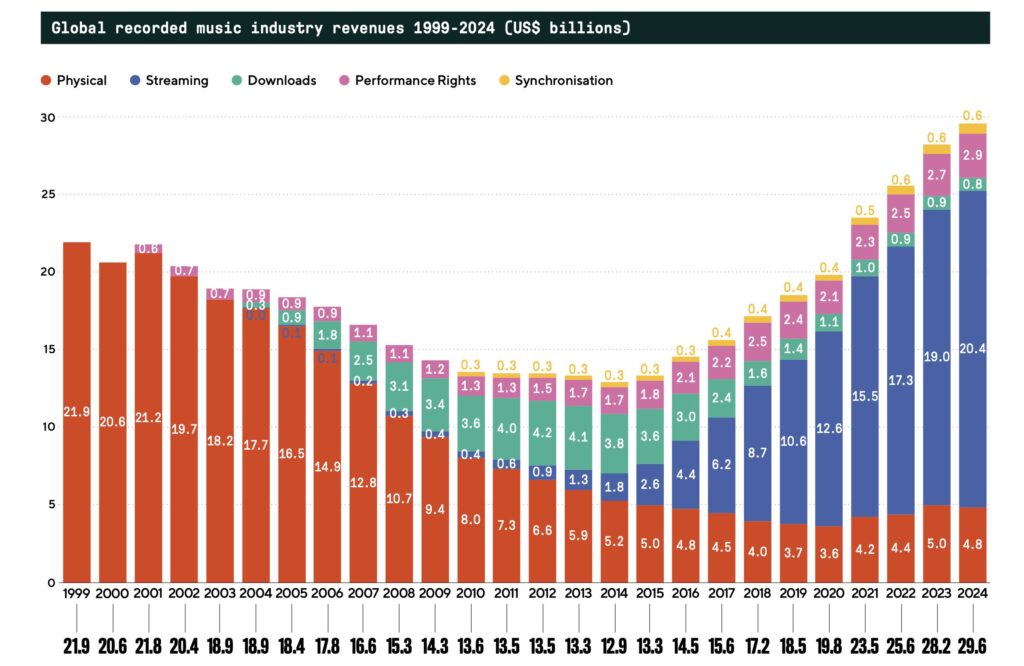
In 2024, global recorded music revenues grew by 4.8%, marking the tenth consecutive year of growth. This is not a fragile rebound. It is a sustained structural recovery, and at the center of it stands streaming.
Streaming: From Disruption to Stabiliser
Streaming is no longer an experiment or a trend. It is the foundation of today’s recorded music economy.
According to IFPI data, streaming now accounts for 69.0% of total global recorded music revenues, with subscription streaming alone representing over half (51.2%) of global revenues. In 2024, subscription streaming revenues grew by 9.5%, while ad-supported streaming grew more modestly.
As the report states clearly:
“Streaming continued to be the engine of growth for recorded music revenues, growing at the fastest rate and adding more revenue than any other format.”
This matters because growth is not coming from a single hit market or a temporary trend. Streaming has brought predictability and continuity back to an industry once dominated by boom-and-bust cycles.
A Year-by-Year Perspective: Why This Growth Is Different
What makes the current phase of music industry growth significant is not just the numbers, but their consistency.
- 2015–2019: Early recovery driven almost entirely by streaming adoption
- 2020–2021: Pandemic years, with streaming acting as a stabilising force
- 2022–2024: Expansion phase, with growth across nearly all regions
In 2024 alone, recorded music revenues grew in every global region for the fourth consecutive year. Markets such as the Middle East & North Africa and Sub-Saharan Africa showed particularly strong momentum, reflecting how streaming has lowered entry barriers for emerging scenes and independent artists worldwide.
What About Physical, Radio, and Performance Rights?
While streaming dominates headlines, it does not exist in isolation.
Physical formats declined by 3.1% globally in 2024, following a strong vinyl-driven year in 2023. Downloads and other digital formats continued their long decline, now accounting for just 2.8% of global revenues, effectively signalling the end of the download era.
At the same time, performance rights revenues grew by 5.9%, reaching US$2.9 billion, now representing 9.7% of global recorded music revenues. These revenues are closely linked to radio plays, public performances, broadcasting, and licensing, reminding us that traditional channels still matter, especially for long-term artist income and catalogue value.
Radio may no longer drive discovery the way it once did, but it remains a crucial legitimising and monetising layer, particularly in local markets and for genres that benefit from repeated exposure rather than viral spikes.
Digital Albums: A Strategic Choice for Independent Artists
For independent artists, these shifts carry an important lesson. Releasing a digital album, especially as a first or early release, is no longer a compromise. It is often the smartest strategic move.
Digital albums allow artists to:
- Enter the streaming ecosystem immediately
- Avoid manufacturing, storage, and distribution costs
- Test audience response without financial risk
- Build long-term visibility through playlists and algorithms
In a streaming-led market, albums no longer disappear after release week. They live, grow, and accumulate value over time. For independent artists, this means that a digital album is not a lesser version of a “real” release, it is the primary format of the modern music industry.
Physical editions can (and should) come later, once demand exists and identity is established.
Global Music Markets that the Independent Artists Should Watch
Streaming Isn’t Perfect, But It Isn’t the Villain Either (Almost)
Yes, there are serious issues:
- Unequal revenue distribution
- Algorithmic opacity
- Low per-stream payouts
- High marketing fees and low income
- And maybe most important of all: streaming services have control over the data, livelihood, and music of almost all the artists in the world. That’s a lot of power going to one place and can easily be used against artists and record labels.
The complaints are valid. They must be addressed. But perspective matters. Before streaming, the industry was shrinking. Before streaming, access was limited, gatekeepers were absolute, and global reach was a privilege. Streaming did not solve everything, but it re-opened the future.
Even critics of streaming must acknowledge one crucial fact: it helped bring the industry back from the edge.
Don’t get me wrong, I’m not happy with many aspects of streaming services, specially Spotify, but we should not be unjust. The fact is that music industry was crippling and almost dying before the streaming format came to the rescue. Yes, there’s much to be discussed and much to be improved, yet there’s much that have been achieved thanks to new formats including online radio and streaming platforms.
I Switched from Spotify to Apple Music and Experienced Digital Album Again
As the IFPI report emphasises, streaming has enabled long-term artist development, sustained investment, and global participation at a scale previously impossible.
The music industry is not “saved.”
But it is alive, growing, and structurally healthier than it was a decade ago.
And for independent artists willing to think digitally first, especially through well-planned digital album releases, the opportunities have never been broader.
In the Digital Album Era, Cassettes Quietly Return to Estonia
Source: IFPI Global Music Report 2025
#MusicIndustry #GlobalMusicIndustry #MusicIndustryGrowth #StreamingEconomy #MusicStreaming #DigitalAlbum #DigitalAlbums #IndependentArtists #IndieMusic #MusicBusiness #RecordedMusic #MusicTrends #FutureOfMusic #MusicStreamingPlatforms #RadioAirplay #PerformanceRights #MusicLicensing #AlbumRelease #ArtistStrategy #Tunitemusic