Giovanni Pierluigi da Palestrina (c. 1525 – February 2, 1594) stands as one of the towering figures in Renaissance music and arguably the most influential composer of sacred polyphony in Western history. Revered historically as the “Prince of Music,” his work represents a culmination of Renaissance ideals, balance, clarity, and spiritual depth, while simultaneously shaping the theoretical foundation of counterpoint for centuries to come.
Early Life, Education, and First Musical Influences
Palestrina was born around 1525 in Palestrina, near Rome, into a milieu rich in musical tradition though modest in status. As a child he was brought to Rome, where he served as a choirboy at the basilica of Santa Maria Maggiore, a formative experience that immersed him in the liturgical traditions and vocal techniques that would define his career.
His earliest formal musical education was shaped by the Roman Church’s choral practices. Here Palestrina absorbed the contrapuntal methods of earlier Franco-Flemish masters, innovators of polyphony, while also learning organ and vocal performance. This grounding instilled a lifelong commitment to text clarity and balanced harmonies, qualities essential to his mature style.
Artistic Maturity
Palestrina’s artistic maturation unfolded in the heart of ecclesiastical Rome. By the early 1550s he had secured influential positions, including musical director of the Cappella Giulia at St. Peter’s Basilica and singer (and later composer) in the Pontifical Choir. These posts placed him at the nexus of Church music, where he composed prolifically and collaborated with ecclesiastical patrons.
Though he wrote secular madrigals early in his career, his main focus shifted decisively toward sacred music, masses, motets, Magnificats, offertories, and liturgical settings, which became his enduring legacy.
Importance and Influence
Palestrina’s significance cannot be overstated: he distilled the complex polyphonic language of the Renaissance into a refined, clear, and spiritually expressive style. His music met the demands of the Counter-Reformation Church, particularly the need for intelligible sacred text within elaborate polyphony, showing that intricate musical craft need not obscure spiritual meaning.
By emphasizing smooth voice leading, careful dissonance control, and transparent harmonic motion, Palestrina created a sound world that became the definitive model of Renaissance polyphony. In the centuries after his death, this idealized “Palestrina style” became codified in treatises on counterpoint, such as Fux’s Gradus ad Parnassum, and taught as the foundation of compositional technique.
Greatest Works
While Palestrina’s output was vast, over 100 masses and 250 motets, certain works are cornerstones of the choral repertoire:
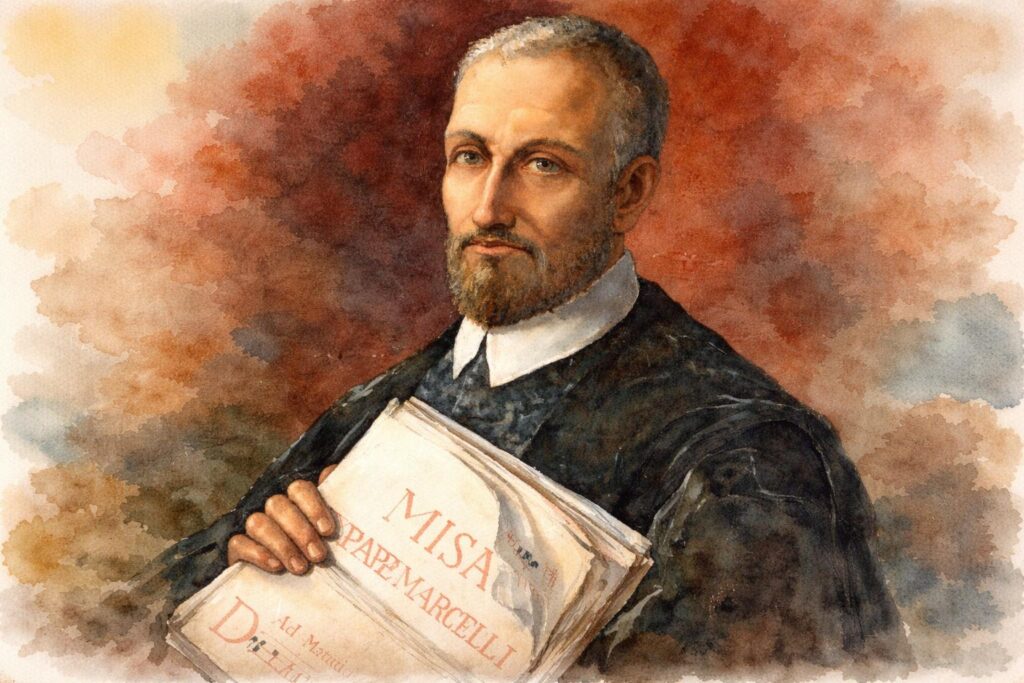
- Missa Papae Marcelli (Pope Marcellus Mass) – perhaps his most famous mass, lauded for its sublime six-voice polyphony and historical reputation as “saving” polyphonic church music.
- Sicut cervus – a motet expressing deep spiritual yearning, celebrated as a model of Renaissance choral writing.
- O magnum mysterium – a profound Christmas motet evoking awe and devotional wonder.
- Canticum Canticorum – a large cycle of 29 motets setting texts from the Song of Solomon, notable for its expressive depth.
- Other masses like Missa brevis showcase his mastery of form and textural balance.
Composition Style and Influence on Others
Palestrina’s music is often described as the epitome of balanced polyphony: interweaving independent vocal lines that uphold both harmonic coherence and textual clarity. He employed techniques such as:
- Smooth voice leading with minimal leaps, ensuring seamless harmonic continuity.
- Controlled dissonance treatment, aligning with liturgical intelligibility.
- Cantus firmus integration embedding chant melodies structurally within polyphonic contexts.
The result was music that felt both devotional and meticulously crafted. Palestrina’s compositional language shaped the Roman School and guided later masters, from Bach’s theoretical studies to classical training deep into the 19th century.
Why Is Palestrina Important?
Palestrina isn’t just a historic figure; he represents a turning point in Western music. He synthesized the polyphonic achievements of his predecessors into a style that was both spiritually profound and technically impeccable, thereby laying a foundation for future music theory and composition. His works remain benchmarks for understanding how music can serve both text and transcendence.
Final Thoughts
Palestrina’s legacy is not confined to the archives of Renaissance music, it lives in every composition that seeks to harmonize structure with soul. In an age where music constantly seeks novel expression, his work reminds us that innovation need not forsake clarity, and that discipline in craft can elevate meaning. He didn’t merely refine polyphony; he humanized it.
Sources:
- Giovanni Pierluigi da Palestrina | Biography & Facts – Britannica
- Giovanni Pierluigi da Palestrina summary – Britannica
- Missa Papae Marcelli – Wikipedia
- Sicut cervus (Palestrina) – Wikipedia
- O magnum mysterium (Palestrina) – Wikipedia
- Canticum Canticorum (Palestrina) – Wikipedia
#GiovanniPierluigiDaPalestrina #RenaissancePolyphony #SacredMusic #MissaPapaeMarcelli #Counterpoint #MusicHistory #ChoralWorks #PalestrinaStyle