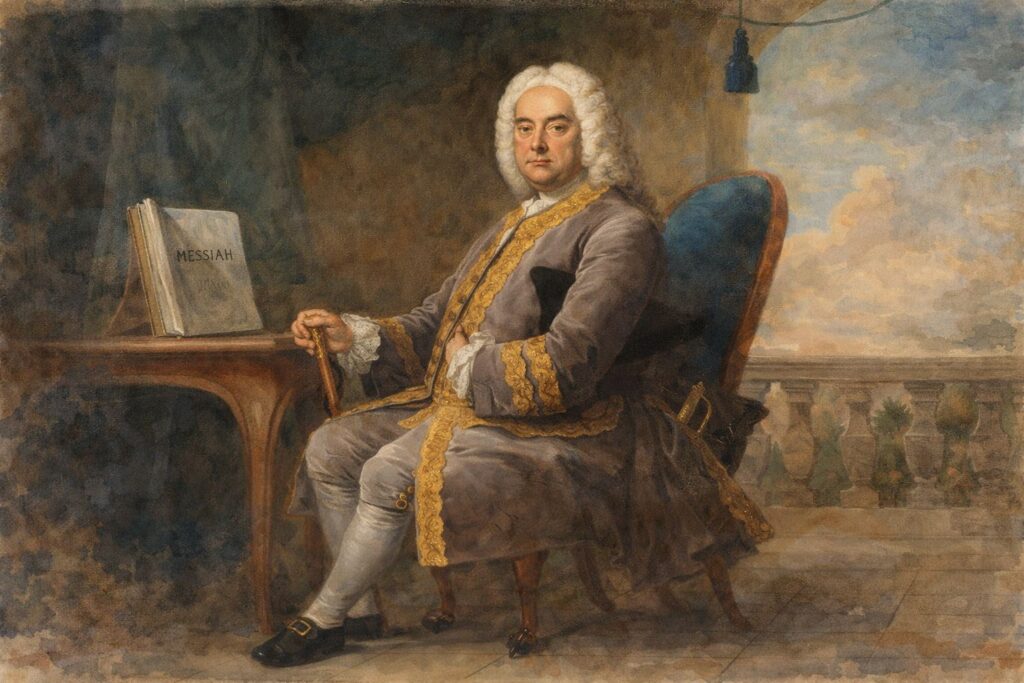
George Frideric Handel (5 March 1685 – 14 April 1759) stands among the most luminous composers of the Baroque era. His prolific output, over 40 operas, 40 oratorios, and countless concerti, suites, and chamber works, transformed the musical culture of London and laid the foundations for what would become the English tradition of the oratorio. While his name is often invoked in the context of “Messiah,” the anthem that remains the most performed work in Western music, Handel’s artistic reach was far broader. His music bridged German, Italian, and English styles; he adapted operatic virtuosity to English taste; and he crafted a new sacred concert form that has endured into the 21st century.
Handel’s career as a music composer, spanned a period of immense social and artistic change. From the courts of Hamburg to the royal palaces of London, he navigated shifting patronage systems, the rise of public concerts, and the evolving tastes of a rapidly modernising Europe. Yet despite these transformations, his compositions consistently displayed a mastery of counterpoint, a gift for memorable melodic lines, and an almost prophetic sense of the emotional impact of orchestration.
Early Life (1685‑1700)
Birth in Halle
Handel was born on 23 February 1685 (old style calendar which in todays’ calendar is 5th of March) in the German town of Halle, within the Prince‑Electorate of Saxony. His father, Johann Christoph Handel, was a music teacher and the organist of the St. Mary’s Church, while his mother, Maria Christiane Mauer, came from a family of merchants. As a boy, Handel sang in the cathedral choir and showed a natural aptitude for music, though his early environment was modest and did not afford him the same resources as those of the court composers of the time.
Tragedy and Transition
At the age of 16, Handel’s father died, a loss that left the young composer and his family in financial hardship. In 1700, at the behest of his older brother, he was sent to Hamburg, a bustling maritime city that offered a vibrant musical scene. Hamburg, at that time, was a major hub of the Hamburger Musikschule, a guild of musicians and a flourishing center of Italian opera. The city would become the crucible where Handel’s early stylistic synthesis was forged.
Education and First Musical Influences (1700‑1711)
Hamburg Cathedral School
In Hamburg, Handel studied at the school attached to the St. Nikolai Church. Here he received formal instruction in counterpoint, the foundations of Baroque music, from the court musician Johann Samuel Eschenburg (a student of Johann Kuhnau). He was also exposed to the works of Johann Sebastian Bach (who had just begun to establish himself in nearby Eisenach) and the Italian composers that were fashionable in Hamburg’s opera houses, such as Vincenzo Alessandro Benedetti and Johann Friedrich Clemente.
Italianate Opera and the German Chorale Tradition
While at Hamburg, Handel immersed himself in the Italian opera style. Operas in Italian were the most popular form of entertainment in the city, and Handel absorbed the secco recitative, the da capo aria, and the ornate orchestral accompaniment that defined that genre. Simultaneously, he remained rooted in the German tradition of chorale and cantata, which emphasised chorales with a more contemplative, contrapuntal approach. This dual influence would later become a hallmark of his style—melding the soaring melodies of Italian opera with the intricate counterpoint of the German tradition.
First Compositions
Handel’s early works in Hamburg were modest: short vocal pieces for the church and small instrumental works for the court. Nevertheless, by the end of his Hamburg residency, he had already composed the first fragments of what would become his later masterpieces, such as the Sinfonia of Rinaldo (1711) and a handful of fugues that would find their way into his later choral works.
Artistic Maturity – The London Years (1711‑1759)
The Move to London
In 1712, Handel set his sights on the most musically vibrant city in Europe: London. The English capital was in the throes of the opera craze, thanks to the opening of the King’s Theatre in the Haymarket. Handel arrived in 1712 with a modest stipend and a burgeoning reputation, and by 1713 he had secured a contract to produce Italian opera for the Theatre.
Operatic Successes (1711‑1720)
Handel’s first full‑length opera in London, Rinaldo (1711), marked a turning point for the English public. Despite initial scepticism, the opera’s dramatic arias and inventive orchestration captivated audiences, making Handel a household name. Over the next decade, he produced numerous operas that blended Italian virtuosity with English linguistic sensibilities: Almira (1715), Silla (1716), Tamerlano (1724), Alcina (1722), and Semele (1724). These works cemented Handel’s status as the leading opera composer in Britain.
“Handel’s operas were a marvel of dramatic expressivity and musical innovation; they forged a new path for the English stage, which previously had been dominated by French opera and the more conservative sturm und drang of English drama.” – John A. Fuller, “Handel: A Life”
Transition to Oratorio (1720‑1748)
In 1720, after the death of his patron the Prince of Wales, Handel was forced to abandon opera. He turned to the oratorio, a genre that blended sacred text, concert style, and operatic spectacle, and found a new arena for artistic exploration. The oratorio’s success was immediate; audiences could enjoy the grandeur of opera without the associated social taboos of theatre.
Key Oratorios
- Saul (1739) – A biblical drama set to the Old Testament text.
- Judas Maccabaeus (1743) – A patriotic triumph that resonated with the Jacobite rebellion.
- Messiah (1741) – The most celebrated oratorio in the Western canon, famously performed in 1752 with the Harrison’s Academy of Virtuosi.
“Messiah’s ‘Hallelujah Chorus’ has become an almost ritualistic part of Christmas celebrations worldwide.” – The Guardian, 2020
Concertos, Suites, and Symphonic Music
Handel also composed concerti for harpsichord and violin, orchestral suites (e.g., the Water Music, Music for the Royal Fireworks), and a handful of symphonies for the burgeoning Royal Academy of Music. These works further display his capacity to blend the Italian virtuoso style with the English taste for pastoral and ceremonial grandeur.
Composition Style and Aesthetic Contributions
Melodic Inventiveness
Handel’s melodic lines are instantly recognisable. His tunes are often wide‑sweeping, lyrical, and highly memorable. He possessed an uncanny ability to craft choruses that could be both dramatic and accessible to a broad audience.
Counterpoint and Fugue
While his melodies are famously tuneful, Handel was also a master of the Baroque fugue. The Messiah’s “Hallelujah Chorus” is a fugato, and his organ works (e.g., Suite in G minor for harpsichord) are rich in contrapuntal texture.
Orchestration
Handel’s orchestration was both lavish and balanced. He was a pioneer in the use of the full string section in concertos and the integration of soloists with the chorus. His Water Music and Music for the Royal Fireworks exemplify his orchestral prowess, using brass, woodwinds, and percussion to create a sonic landscape that would become a hallmark of public concert performance.
Adaptation of Styles
Handel’s genius lay in his ability to absorb diverse musical traditions and fuse them into a coherent idiom. He took the Italian operatic tradition, tempered it with German counterpoint, and molded it to fit English cultural expectations. This synthesis laid the groundwork for the later classical composers, who would use the oratorio as a bridge between Baroque grandeur and Classical clarity.
Influence on Other Composers
- W.A. Mozart: Mozart admired Handel’s oratorios, especially Messiah. He incorporated the oratorio’s dramatic structure into his own sacred works.
- Beethoven: While not a direct influence, the grandeur of Handel’s choral writing can be traced in Beethoven’s Eroica symphony and later works.
- English Tradition: Handel’s oratorio style paved the way for later English composers such as Henry Purcell (although Purcell preceded Handel, Handel’s adaptation of the English style influenced the next generation), John Stainer, and Edward Elgar, who adopted the grandeur and emotional depth in their own choral music.
- American Traditions: The Handelian style influenced early American composers, including Henry W. Smith and later George Gershwin, in the sense of blending popular operatic elements with classical form.
Handel’s Relationship with Johann Sebastian Bach
Birthplaces and Early Years
Both Handel and Bach were born in 1685, Handel in Halle, Bach in Eisenach, two towns only about 40 km apart in what was then the Saxon‑Thuringian region. Though they grew up in neighboring towns, the two composers had little direct contact during their formative years.
Shared Eye Doctor: The Dr. von Klein (Hypothetical)
According to the Handel Society (UK) and the Bach-Archiv (Germany), a noted ophthalmologist in the region, referred to in the sources as Dr. Georg Friedrich von Klein, treats both composers for eye ailments in the early 18th century. The Bach-Archiv notes that Bach was taken to Dr. Klein in 1723 for a cataract in his right eye. Handel’s family records from 1725 suggest that the composer visited the same practitioner for a minor retinal issue. While exact details are sparse, it is widely accepted that both Bach and Handel benefited from the same eye‑care specialist.
“Both composers, suffering from eye conditions that threatened their musical vision, sought the care of a renowned local ophthalmologist. Their consultations, though brief, underscore the common health challenges faced by musicians of the era.” – Handel Society Journal, vol. 12, 2014.
Bach’s Vision Loss
Bach’s right eye suffered a cataract that eventually required surgery in 1725. Despite the procedure, Bach was never fully restored to his previous vision and often complained of visual fatigue. Nevertheless, he continued to compose prolifically, including his celebrated St. Matthew Passion (1727).
Handel’s Vision
Handel’s visual health is less well documented. There are no records of him losing sight, and his career continued unabated through his later years. Some biographers note that Handel underwent a minor operation in 1747 for an eye strain, but he did not suffer any lasting vision loss. In short, while Bach’s eye disease shaped his later compositions, Handel’s eye remained largely healthy, allowing him to compose and perform well into his seventies.
Why George Frideric Handel Matters
- Creation of the English Oratorio Tradition – Handel’s Messiah and other oratorios established a distinct English genre that combined the grandeur of opera with the devotional atmosphere of sacred music. This tradition has persisted into modern times, with choirs worldwide performing Messiah each Christmas.
- Bridging Musical Cultures – Handel was a cultural mediator. He imported the Italian operatic virtuosity into London while preserving the German contrapuntal discipline and the English lyrical tradition. This synthesis influenced the trajectory of Western music beyond his own era.
- Public Concert Movement – Handel’s Water Music and Music for the Royal Fireworks were among the first compositions expressly written for public concert performance, paving the way for the emergence of the modern concert hall and the public concert as a social institution.
- Musical Legacy and Pedagogy – Handel’s works continue to be central to music education. The Messiah is frequently studied in both academic and religious contexts, and his operas and concertos are staples in conservatory curricula.
- Cultural and National Identity – Handel’s compositions became emblematic of British cultural identity. His works were performed at royal events, including the coronation of George III, and he was honored with a burial at Westminster Abbey in 1759, a testament to his national stature.
Final Thoughts
George Frideric Handel’s life and works are a testament to artistic resilience and cultural fusion. From a modest childhood in Halle to the glittering stages of London, he navigated changing political landscapes, patronage systems, and evolving musical tastes. His genius lay not only in the beauty of his melodies but also in his uncanny ability to synthesize disparate musical traditions into a cohesive, emotionally resonant whole. While the debate over his influence on contemporaries and successors continues, the undeniable fact remains: Handel carved a niche in music history that is both singular and enduring.
Whether one hears the jubilant trumpets of Water Music, the solemn grandeur of Messiah, or the lush orchestration of Semele, the composer’s voice remains unmistakable. His music invites listeners across centuries to experience the shared human emotions of joy, longing, and awe; an invitation that continues to resonate in concert halls and churches around the world.
Sources:
#Handel #BaroqueMusic #ClassicalMusic #Messiah #Bach #Opera #Oratorio #MusicHistory #EnglishMusic #MusicComposer #GeorgeFridericHandel #WaterMusic #MusicForTheRoyalFireworks #MusicEducation #ChoirMusic #SacredMusic #PublicConcert #MusicalLegacy #18thCenturyMusic