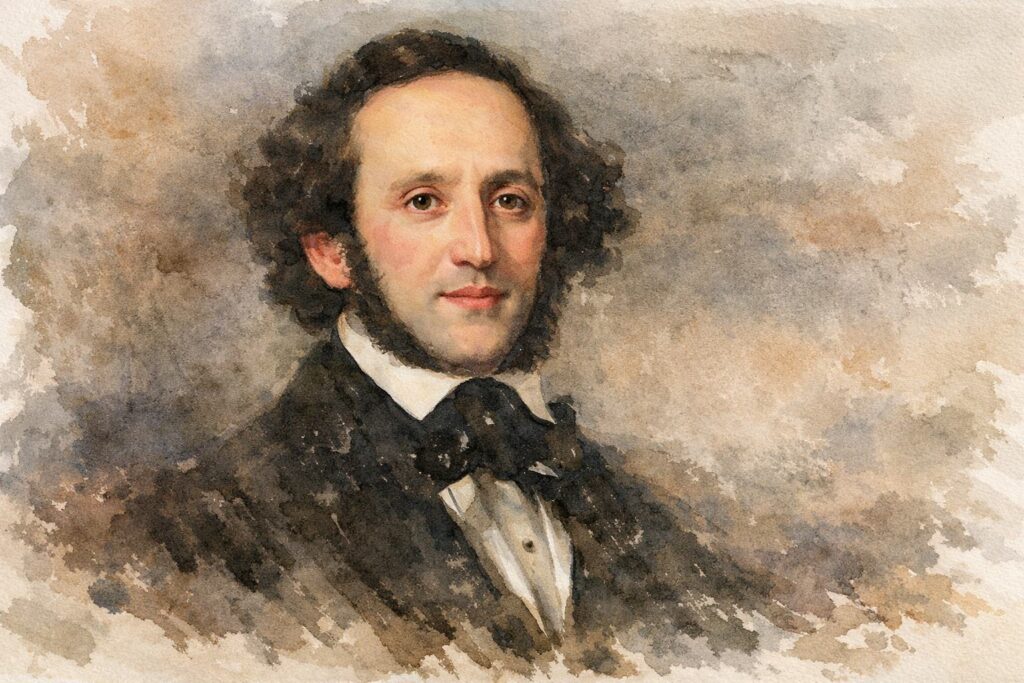
Jakob Ludwig Felix Mendelssohn-Bartholdy (February 3, 1809 – November 4, 1847) was a German composer, conductor, pianist, and educator whose prodigious gifts and refined aesthetic made him one of the most celebrated figures of early Romanticism. Blessed with astonishing technical mastery and a preternatural melodic gift, Mendelssohn synthesized classical clarity with emerging Romantic expressiveness, crafting music of elegance, emotional resonance, and enduring appeal.
Early Life, Education, and First Musical Influences
Born into a wealthy and intellectually vibrant Jewish family in Hamburg, Mendelssohn was the grandson of the philosopher Moses Mendelssohn. His parents ensured he and his siblings received broad artistic and literary education from early childhood.
Mendelssohn’s piano studies began with his father’s support, but his shaping musical influence came from Carl Friedrich Zelter, his composition teacher in Berlin, who cultivated his mastery of counterpoint and structure. Travels with his sister Fanny exposed him to European musical currents and the works of W.A. Mozart, experiences that widened his stylistic palette.
A child prodigy, Mendelssohn wrote his first compositions while still a boy: operas, string symphonies, concertos, chamber works, and fugues. By age nine he was performing publicly. The influence of J.S. Bach, Beethoven, and Mozart is palpable in these early works, reflecting deep roots in tradition even as his imagination pushed forward.
Artistic Maturity
Mendelssohn’s first masterpiece emerged at just 16 years old, the String Octet in E-flat major, Op. 20, a dazzling and virtuosic chamber work that expanded genre boundaries with its lightness, brilliance, and clever double-quartet scoring.
In 1826 he composed the Overture to A Midsummer Night’s Dream, a work rife with shimmering orchestral colors and unforgettable themes. This piece, and later the full incidental music (including the iconic Wedding March), would become one of the most enduring in the repertoire.
His tours of England and Scotland were pivotal. While there he conducted his early symphonies and championed the music of J.S. Bach, notably giving the first performance of Bach’s St. Matthew Passion since the composer’s death, a watershed event in the 19th-century Bach revival.
In adulthood, Mendelssohn served as music director in Düsseldorf and later led Leipzig’s Gewandhaus Orchestra, elevating orchestral performance standards and fostering a thriving musical culture.
Felix Mendelssohn and His Style
Mendelssohn’s music is characterized by:
Clarity and balance — a transparent approach rooted in classical form and structure.
Lyrical brilliance — memorable melodies that feel both effortless and profound.
Textural color — vivid orchestration that evokes atmosphere and narrative nuance.
Counterpoint and dialogue — an inherited mastery from Bach tempered with Romantic expression.
Though sometimes considered less “intense” than the works of later Romantic giants, his music possesses an unmistakable elegance and emotional depth. His Songs Without Words (Lieder ohne Worte) for piano, for example, created a new idiom of intimate lyricism, poetic, miniature landscapes of feeling.
Greatest Works
Mendelssohn produced an astonishing ~750 compositions across genres. Highlights include:
Orchestral & Symphonic
- Overture & Incidental Music to A Midsummer Night’s Dream — (incl. Wedding March)
- The Hebrides (Fingal’s Cave) — evocative tone-poem-like orchestral piece
- Symphony No. 4 “Italian” — vibrant and joyful
- Symphony No. 3 “Scottish” — atmospheric and introspective
- Symphony No. 5 “Reformation” — rooted in Lutheran heritage
Concertos
- Violin Concerto in E minor, Op. 64 — a cornerstone of the violin repertoire whose melodic flow and structural cohesion were groundbreaking.
- Piano Concertos — elegant and virtuosic, displaying his intimate keyboard command.
Choral & Sacred
- Oratorio Elijah — a dramatic, deeply expressive epic in oratorio form.
- St. Paul (Paulus) — another major sacred telling with rich choral writing.
- Lobgesang (Hymn of Praise) — a hybrid symphony-cantata blending voices and orchestra.
Chamber & Piano
- Octet in E-flat — a youthful masterpiece of chamber brilliance.
- Songs Without Words — defining pieces for piano lyricism.
- String Quartets, Piano Trios — deep wells of expressive nuance.
Influence on Others & Lasting Importance
Mendelssohn’s impact ripples through music history in several key ways:
Revival of Bach — his celebrated 1829 St. Matthew Passion performance reignited global interest in J.S. Bach’s sacred music.
Symphonic & Concerto Craft — his Violin Concerto set new structural precedents and remains central to the repertoire.
Pedagogy & Leadership — founder of the Leipzig Conservatory, mentor to a generation of composers, and influencer in standardizing modern conducting.
Cross-genre reach — oratorios like Elijah kept large-scale sacred music alive for Romantic audiences.
Despite occasional criticism for perceived lightness, Mendelssohn’s music continues to enchant audiences with its sincerity, refinement, and communicative clarity.
Why Mendelssohn Matters
Mendelssohn’s importance cannot be overstated: he bridged classicism and Romanticism with grace, expanded expressive possibilities while retaining architectural integrity, and helped shape the cultural musical landscape of Europe in the 19th century. His melodies, harmonic warmth, and orchestral colors still resonate with listeners, performers, and composers alike, proving that depth and beauty can walk hand-in-hand.
Final Thoughts
Felix Mendelssohn’s life was too short, dying at 38, but the reach of his music is enduring. Whether through the enchanting world of Midsummer Night’s Dream, the storm-tossed beauty of his symphonies, or the intimate poetry of his piano works, his voice remains a vital chapter in the story of Western art music.
Sources
- Britannica: Felix Mendelssohn biography & facts
- Library of Congress: Composer overview
- Mendelssohn Gesellschaft: life & legacy
- Wikipedia — Violin Concerto
#FelixMendelssohn #Romanticism #ClassicalMusic #MidsummerNightsDream #ViolinConcerto #SongsWithoutWords #MusicHistory #Symphony #Oratorio #Leipzig #BachRevival