There are operas that tell stories, and there are operas that reshape the way we experience history itself. Akhnaten by Philip Glass, the third part of his portrait trilogy following Einstein on the Beach and Satyagraha, belongs unmistakably to the second category. It is not simply a historical opera about an Egyptian pharaoh. It is a meditation on how civilizations remember and erase their prophets.
For me personally, it is also one of the most powerful operas of the late twentieth century. And within it, the scene titled Attack and Fall stands among the most devastating pages of contemporary classical music I know: a moment when ritual collapses into violence, and time itself seems to fracture.
Premiered in 1984 in Stuttgart, Akhnaten completes Glass’s trilogy portraying three figures who reshaped human thought: Albert Einstein, Mahatma Gandhi, and the Egyptian pharaoh Akhenaten (Akhenaten). Science, politics, religion, three forces that redefine the human world. In Glass’s hands, they become three different musical ways of thinking about transformation.
A pharaoh erased from history, and restored through opera
Unlike Einstein and Gandhi, Akhnaten left almost no stable historical narrative behind him. His reign lasted roughly seventeen years in the 14th century BCE. During that time, he attempted one of the most radical religious reforms in recorded history: replacing Egypt’s vast pantheon with devotion to a single solar deity, the Aten.
Akhenaten is often considered one of the earliest historical figures to promote the idea of devotion to a single deity. There is ongoing debate among historians about whether this represents true monotheism or a form of exclusive worship within a broader religious context. Some scholars note that Zarathustra may have articulated a comparable religious vision, though the exact dating of his life remains uncertain. The transition of Judaism from earlier polytheistic or henotheistic practices toward exclusive worship of Yahweh is also difficult to date precisely, but most evidence suggests that this development occurred centuries after Akhenaten’s reign. Regardless of these chronological debates, Akhenaten remains one of the earliest known rulers to attempt a radical transformation of religious life around the worship of a single divine principle.
After his death, the backlash was swift and systematic. His successors dismantled his capital city Akhetaten, erased references to him from monuments, and restored the traditional priesthood of Amun. Even his name nearly vanished from history.
Glass did something remarkable with this absence. Rather than reconstructing a conventional biography, he embraced the fragmentary nature of the archaeological record. The opera’s libretto draws directly from ancient materials: the Book of the Dead, the Amarna Letters, boundary inscriptions from Akhetaten, and even Psalm 104. Later, unexpectedly, modern travel-guide language appears in the Professor’s closing narration, reminding us that archaeology itself shapes what we think history is.
The structure: ritual instead of drama
The opera unfolds in three acts that correspond not simply to events but to stages of transformation.
Act I begins with the funeral of Akhnaten’s father, Amenhotep III, whose mummification ritual is staged with extraordinary stillness. The weighing of the heart, borrowed directly from Egyptian funerary tradition, sets the tone: death is not an ending but a passage.
The coronation follows. Amenhotep IV becomes Akhnaten, “Spirit of Aten.” A new vision begins.
Act II presents the flowering of that vision. The new religion replaces traditional temple practice. The royal couple sing their intimate duet. A new capital city, Akhetaten, “Horizon of Aten”, rises in the desert.
Act III shows the inevitable consequence of revolution. Resistance grows. Priests return. The palace is attacked. The family falls.
Then comes silence, and archaeology.
Minimalism as historical time
Glass’s musical language is often described simply as “minimalist,” but in Akhnaten minimalism becomes something else entirely: a temporal environment.
Repetition here is not decorative. It is structural. It mirrors ritual, architecture, inscription, and sunlight itself.
Glass’s encounter with Ravi Shankar in the 1960s profoundly shaped his approach to cyclic musical thinking, and in Akhnaten that cyclicity becomes historical perspective. Events unfold not as narrative acceleration but as ceremonial inevitability.
Listening to the opera feels less like watching a story and more like entering a temple.
The voice of Akhnaten: between worlds
Philip Glass’s decision to cast the title role as a countertenor is one of the opera’s most striking choices.
Historically, portraits of Akhnaten often depict him with ambiguous or androgynous physical features. Whether symbolic or literal, this ambiguity resonated with Glass’s musical imagination. The countertenor voice, balanced between registers traditionally coded as masculine and feminine, creates a sonic identity that mirrors the pharaoh’s theological revolution: a ruler seeking unity beyond duality.
It also gives the opera its unmistakable sound world. Akhnaten’s voice does not dominate through force. It transforms through presence.
Akhetaten: the city as an idea
One of the opera’s most visionary sequences is the founding of Akhetaten itself.
Historically, the city was constructed on an empty stretch of desert aligned with the rising sun. In the opera, its creation becomes an architectural metaphor for belief: a civilization redesigned around a single image of light.
Yet Glass avoids triumphalism. The city is not presented as destiny fulfilled. It is presented as fragile hope.
That fragility becomes essential in the opera’s final act.
Attack and Fall: when ritual breaks
The final collapse of Akhnaten’s reign is one of the most overwhelming scenes in contemporary opera.
Priests of the old religion lead a crowd against the palace. Doors are broken. The royal family is dragged away. The pharaoh is killed.
Musically, this is where Glass’s language transforms most radically. The ritual stability of earlier acts fractures. Rhythmic insistence turns into pressure. The chorus becomes mass rather than ceremony.
For me, Attack and Fall is not simply a dramatic climax. It is a contemplation on how societies react to visionary change. It captures something terrifying and timeless: the moment when a collective imagination rejects transformation and restores familiarity at any cost. I see it today first hand in real life with the political changes around the world.
Few passages in modern opera communicate historical tragedy with such clarity and inevitability.
Archaeology as epilogue
The opera’s final scene shifts unexpectedly to the present.
A professor lectures students about the ruins of Akhetaten. The ancient world returns not as memory but as excavation.
This ending changes everything. It reminds us that Akhnaten’s revolution failed politically, but survived culturally, artistically, and imaginatively. His story exists not in monuments but in fragments assembled by later generations.
The opera itself becomes part of that reconstruction.
While this closing act, in a way dimishes the epic and dramatic “attack and fall” ending, it gives the piece a deeper value and a fresh perspective.
A modern myth rather than a historical biography
Director Phelim McDermott’s now-famous staging emphasizes this idea explicitly. Instead of attempting archaeological realism, it evokes the dreamlike Egypt imagined in the early twentieth century after the discovery of Tutankhamun’s tomb.
The result is not historical reenactment but historical imagination layered across time: ancient Egypt, modern archaeology, and contemporary theatre coexisting in one visual language.
This is exactly where Akhnaten becomes timeless.
The opera’s place in Glass’s portrait trilogy
Within Glass’s trilogy, Akhnaten represents the figure of religion.
Einstein transforms space and time. Gandhi transforms political ethics. Akhnaten transforms divine perception.
Unlike the other two figures, however, Akhnaten fails in his lifetime. That failure gives the opera its emotional depth. It is not a portrait of success—it is a portrait of vision misunderstood.
And that makes it the most tragic work of the three.
Performance of Akhnaten by Philip Glass
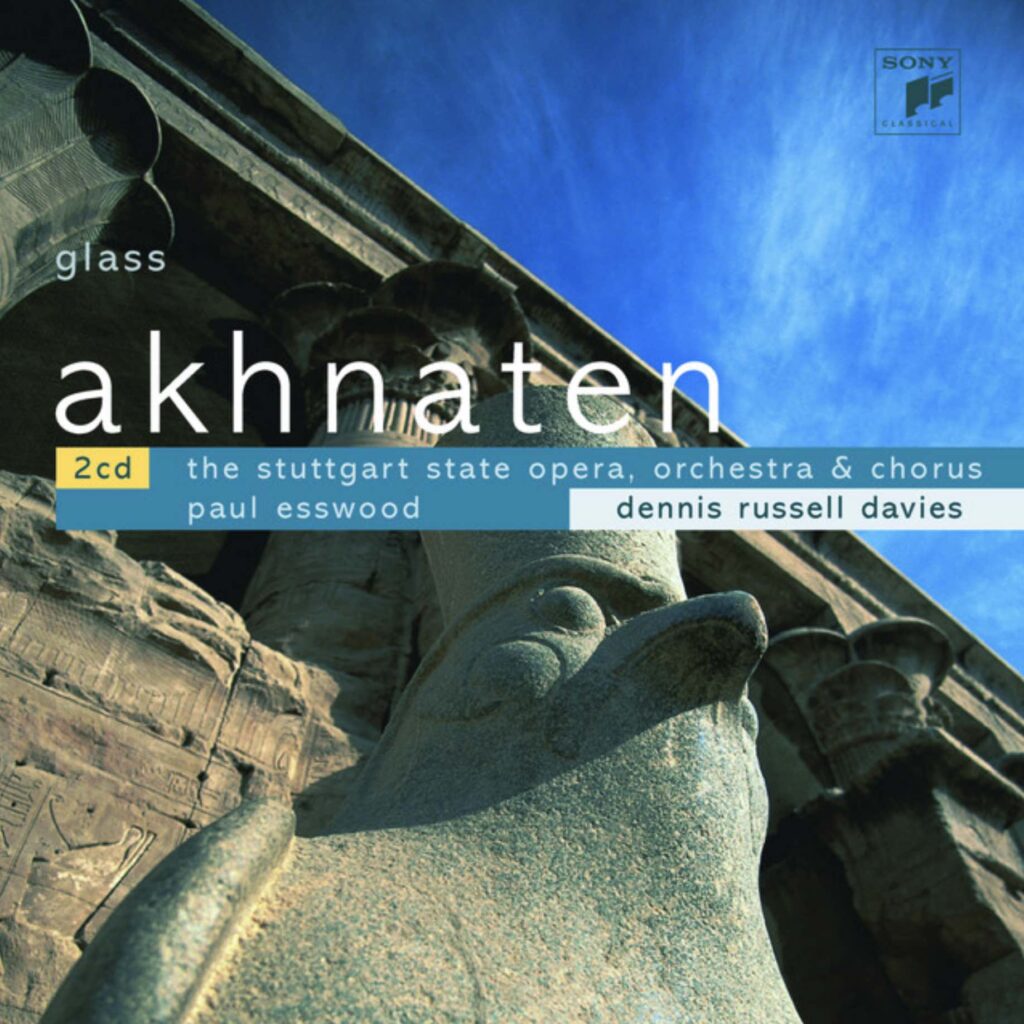
There are several new performances of this work taking place in 2026, but among the well-known earlier recordings, while the Metropolitan Opera production has a broader international appeal, I find myself slightly preferring the version from the Stuttgart State Opera. The Stuttgart performance feels more expressive and dynamically stronger than the Met version, which, in my view, makes it more closely aligned with both the character of the composition and the dramatic trajectory of the story.
For the first time I heard Philip Glass’s Attack and Fall in Estonia Concert Hall (Kontserdisaal), and despite the smaller orchestra performing the piece, the dramatic effects have not been reduced thanks to the brilliant arrangement and incredible compsition.
The return of Akhnaten in 2026
In recent years, Akhnaten has quietly entered the modern operatic canon. Its revival cycle across Europe and the United States confirms what many listeners already sensed decades ago: this is no longer a specialist minimalist experiment. It is repertory.
In 2026, major performances include the revival of Los Angeles Opera’s staging of the McDermott production at the Dorothy Chandler Pavilion, as well as a major European concert performance at the Concertgebouw conducted by Karen Kamensek with Anthony Roth Costanzo in the title role.
These revivals confirm something remarkable: four decades after its premiere, Akhnaten continues to speak with urgency. Its themes, religious reform, political resistance, historical erasure, and the fragility of visionary leadership, feel not ancient but immediate.
And perhaps that is why this opera still feels so personal to me. It is not only a story about a pharaoh who tried to change the world. It is a story about what happens when imagination confronts power, and about how art preserves what history tries to forget.
#PhilipGlass #Akhnaten #Minimalism #ContemporaryOpera #ModernOpera #OperaReview #ClassicalMusic #ContemporaryClassical #MusicHistory #AncientEgypt #Akhenaten #AnthonyRothCostanzo #KarenKamensek #LosAngelesOpera #Concertgebouw #OperaRevival #EinsteinOnTheBeach #Satyagraha #MinimalistMusic #20thCenturyMusic #21stCenturyOpera #OperaProduction #MusicCriticism #Tunitemusic #ClassicalMusicMagazine #OperaLovers #MusicAndHistory #RitualInMusic #ModernClassics #AttackAndFall
Cover album: ℗ 1987 SONY BMG MUSIC ENTERTAINMENT