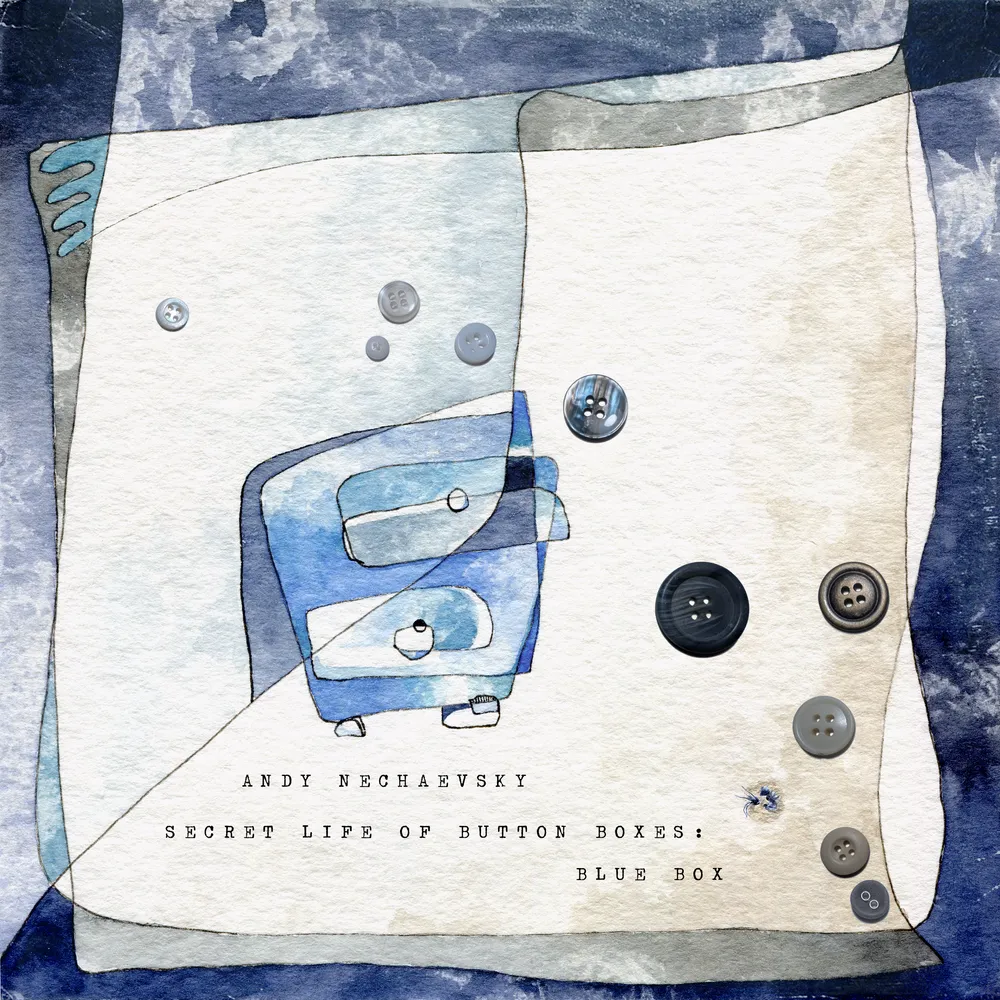
Blue Box, the second release in Andy Nechaevsky’s Secret Life of Button Boxes series, enters a colder and darker territory than its predecessor, Red Box. Across ten pieces, Nechaevsky continues his exploration of acoustic sound, improvisation and unusual instrumental relationships, but here the music feels less like an exploration of memory and more like a descent into it.
The main instruments are kalimbas and cello, but this is far from a conventional musical dialogue between the two. At times, the instruments do not seem to support each other at all. Instead, they stand in opposition, harmonically and melodically, creating a tension that becomes one of the defining characteristics of the album.
Blue Box and the Collision of Two Musical Worlds
The cello, which might normally be expected to occupy a supporting role, gives the music much of its depth. Its pizzicatos, long sustained notes and pitches that do not always seem to belong to the same harmonic world as the kalimbas create an unusual sense of space.
At certain points, it feels as if the two instruments are playing two completely different pieces at the same time. And yet, somehow, they belong together.
There is a coherent system beneath the apparent disagreement. The music does not simply become random or chaotic. Instead, the collision of different melodic layers creates its own kind of order. What might initially sound like wrong notes gradually begin to feel less like mistakes and more like two realities existing simultaneously. The result is deeply melancholic.
An Experimental Album Without a Conventional Rhythm
One of the most striking elements of Secret Life of Button Boxes: Blue Box is its refusal to rely on strong rhythmic patterns. Much of the album moves through a free rhythmic space, without the reassuring pulse that usually tells the listener where to place themselves.
There are no obvious beats to follow and very little of the conventional melodic structure that might make the music immediately accessible. Instead, Nechaevsky allows sounds to exist beside one another.
The kalimbas, in particular, create an almost continuous clicking and shimmering. At times, their sound resembles falling rain: small drops appearing one after another, never quite forming a predictable pattern. Against this, the cello stretches, interrupts and deepens the sonic space.
This is what gives the music such a visual and dramatic quality. Rather than simply following melodies, I found myself imagining spaces, rooms and landscapes.
The album seems to exist somewhere between composition and spontaneous creation. There is enough structure to prevent the pieces from becoming arbitrary, but enough freedom to make each sound feel as though it has arrived at precisely that moment.
The Physical Sound of Andy Nechaevsky
Another important aspect of Blue Box is its physicality. You can hear the instruments as objects. The clicks, resonances, friction and imperfections are not hidden behind an overly polished production. They become part of the music itself.
The result feels tactile, almost as though you are sitting in the room with the instruments rather than listening to a recording that has been completely separated from its physical origins.
This approach fits naturally into Nechaevsky’s wider work as an experimental sound artist. His music is not simply about producing pleasant combinations of sounds; it is about discovering what those sounds can become when traditional expectations are removed.
That makes Blue Box particularly interesting as a listening experience. The instruments are not merely performing notes. Their physical characteristics become part of the composition.
From Del Sur to Red Box and Blue Box
There is also a clear thread connecting Blue Box to Nechaevsky’s earlier work, particularly Del Sur and the first Secret Life of Button Boxes release, Red Box. Across these works, his approach to sound seems to become increasingly focused on the physical character of instruments, unusual harmonic relationships and the space between composition and spontaneous creation. If Del Sur introduced some of these ideas in a more open and exploratory form, Red Box turned them into a more defined musical world, and Blue Box now pushes that language further into darker and more fragmented territory. It feels less like a change of direction than the next stage of the same ongoing experiment.
Secret Life of Button Boxes: Blue Box Is Not Background Music
But I would give you a warning. If you are tired at the end of the day and want to sit back, relax and put something on in the background, Blue Box is probably not the album to choose. This is not background music, it demands attention.
Despite the lack of conventional melodies, beats and strong rhythmic structures, Blue Box does not allow the mind to wander easily. The constant movement of the kalimbas, the unexpected entrances of the cello and the harmonic friction between the instruments keep pulling the listener back into the music. There is always something slightly unsettled happening beneath the surface. And that is precisely its strength.
Where Secret Life of Button Boxes: Red Box opened the door to Nechaevsky’s musical world, Blue Box takes us further inside. The colours are darker, the spaces feel colder, and the relationship between the sounds is more confrontational. It is not necessarily music that asks to be understood. It asks to be experienced.
For me, Blue Box works best when you give it your full attention. Sit down, put on your headphones, and let the instruments exist on their own terms. Listen to the kalimbas as rain, the cello as a distant voice, and the apparent harmonic conflicts as different memories trying to occupy the same space. It is melancholic, strange and at times unsettling. But it is also remarkably dramatic.
And above all, Secret Life of Button Boxes: Blue Box by Andy Nechaevsky is an experimental album that refuses to become wallpaper; which, in an age of endless background listening, is something worth appreciating.
#AndyNechaevsky #BlueBox #SecretLifeOfButtonBoxes #ExperimentalMusic #AvantGardeMusic #ContemporaryMusic #ExperimentalSound #Kalimba #CelloMusic #ImprovisedMusic #SoundArt #AcousticMusic #MusicalExploration #NewMusic #MusicReview