Maria Anna Mozart (30 July 1751 – 29 October 1829), affectionately known to her family as “Nannerl,” remains one of the most intriguing and poignant figures in music history. For centuries, her legacy was swallowed whole by the towering shadow of her younger brother, Wolfgang Amadeus Mozart. Yet, in the mid-18th century, European audiences did not just talk about one musical miracle from Salzburg; they talked about two. As a child prodigy, Maria Anna toured the cultural capitals of Europe, dazzling emperors, kings, and critics with her breathtaking virtuosity on the harpsichord and fortepiano. She was not merely a passive witness to the dawn of the Viennese Classical style; she was an active participant whose raw talent equaled, and occasionally eclipsed, that of her famous sibling during their youth. To understand her life is to pull back the curtain on the rigid gender politics of the Enlightenment, revealing how societal expectations systematically stifled one of the most promising female composers and performers of her generation.
The Dawn of the Miracle Children: The Prodigy Years
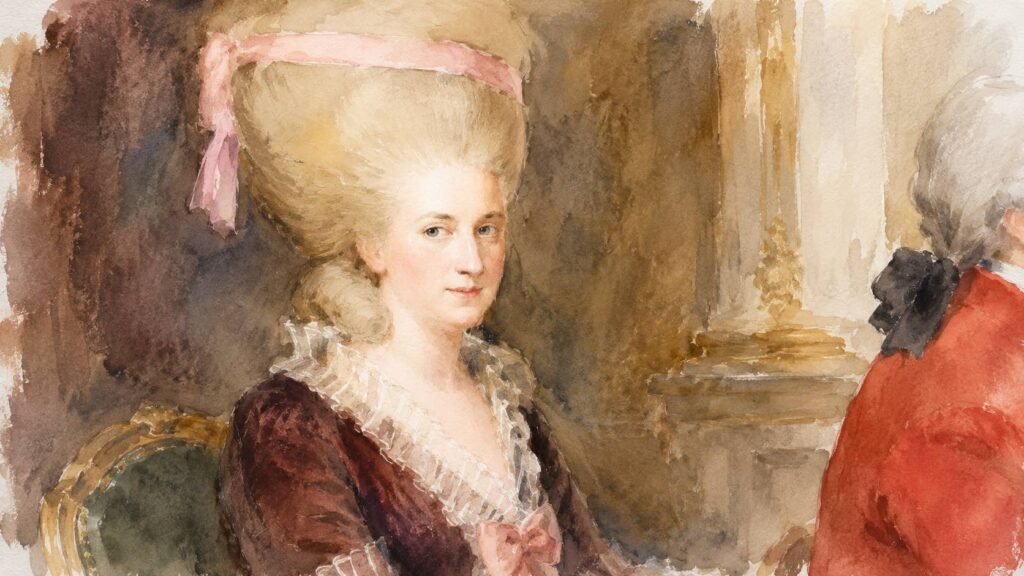
Maria Anna Mozart was born in Salzburg, Austria, to Leopold Mozart and Anna Maria Pertl. Leopold, an accomplished violinist, composer, and author of a definitive violin treatise, recognized his daughter’s extraordinary cognitive and musical faculties early on. In 1759, when Nannerl was seven years old, Leopold compiled a musical notebook for her—the Nannerl Notenbuch. This manuscript served as her primary instructional guide, containing short pieces, minuets, and structural exercises designed to build technical brilliance and an understanding of harmony.
Intrigued by his older sister’s lessons, a three-year-old Wolfgang Amadeus would sit by the keyboard, mimicking her finger placements and absorbing the music. In many ways, Maria Anna was Wolfgang’s first musical inspiration and role model.
By 1762, Leopold realized the immense financial and reputational potential of his extraordinary children. He arranged a series of performances that would evolve into an epic, multi-year grand tour of Europe. The “Miracle Children” traveled to Munich, Vienna, Paris, London, Brussels, and the Netherlands. They performed before the elite of Western civilization, including:
- Empress Maria Theresa of Austria at Schönbrunn Palace
- King Louis XV at the Palace of Versailles
- King George III in London
Contemporary reviews from this period consistently indicate that Maria Anna was considered a peerless virtuoso. In London, critics noted that the eleven-year-old sister executed the most complex counterpoint and rapid passage-work with a precision and emotional maturity that surpassed her younger brother. They were billed together as equal wonders of nature, navigating the highly demanding textures of early classical music side by side.
The Iron Cage of 18th-Century Convention
The trajectory of Maria Anna’s life changed dramatically when she crossed the threshold into adulthood. In the 18th-century European upper-middle class, a woman’s identity was strictly bound to domesticity, marriage, and the preservation of family honor. Public performance for monetary gain was viewed as unseemly for a woman of marriageable age; it carried connotations of lower-class theatricality and compromised a woman’s social standing.
Consequently, when Nannerl turned eighteen in 1769, her touring days came to an abrupt, mandatory end. While Leopold packed his bags to take the young Wolfgang to Italy—the epicenter of opera and composition—to further his artistic education, Maria Anna was left behind in the provincial confines of Salzburg.
“When Wolfgang traveled to Italy with his father, Nannerl remained with her mother in Salzburg, her brilliant performing career effectively terminated by the calendar of her gender.”
The psychological toll of this enforced retirement must have been immense. She transitioned from an internationally celebrated virtuoso, toasted by royalty, to a dutiful daughter confined to a quiet household, handling domestic chores and copying musical manuscripts for her brother. While Wolfgang was encouraged to innovate, experiment, and claim his place among the immortal music composers of Europe, Maria Anna’s musical expressions were limited to private spaces and the instruction of local piano students.
Maria Anna Mozart: The Invisible Composer
The historical narrative long dismissed Maria Anna as merely a talented interpreter of other people’s music. However, surviving correspondence within the Mozart family fundamentally challenges this assumption, proving that she was also an active composer.
The most damning piece of evidence regarding her erased catalog comes from a letter written by Wolfgang himself in 1770. Writing from Rome to his sister in Salzburg, Wolfgang expressed genuine admiration for a composition she had sent him:
“I am amazed! I had no idea you could compose so well. In a word, your song is beautiful. I beg you, try to do these things more often.”
Despite this explicit praise from one of history’s greatest musical minds, not a single surviving musical composition bears the name of Maria Anna Mozart today. The total absence of her manuscripts highlights a dark reality of historical musicology. In the 18th century, works by women were rarely preserved, published, or taken seriously by archival institutions.
Musicologists have put forward several compelling theories regarding what happened to her creative output:
1. Intentional and Unintentional Loss
Because her music was viewed as an amateur pastime rather than a professional contribution, her manuscript papers were likely discarded after her death, viewed as sentimental family ephemera rather than historical treasure.
2. Misattribution and Absorption
It was common practice within musical families for works to be shared or grouped together. Some researchers hypothesize that some of Wolfgang’s earliest childhood compositions—pieces written down before he had mastered musical notation—may actually have been composed by Maria Anna or created as collaborative exercises between the two siblings. Without definitive handwriting analysis or signed drafts, her voice remains subsumed within the broader “Mozart” brand.
3. Deliberate Suppression
Leopold Mozart, while an extraordinary educator, was a pragmatist controlled by the social codes of his time. He did not foster or promote his daughter’s compositional ambitions because there was no viable economic or social path for a female composer in the aristocratic court system of Salzburg.
Milestones of a Divergent Life of Maria Anna Mozart
To understand how thoroughly her path diverged from Wolfgang’s, it is useful to look at the structural milestones of her life after her performing career was halted.
| Year | Life Event / Milestone | Context and Historical Impact |
| 1759 | Gift of the Nannerl Notenbuch | Marks the beginning of her formal, rigorous musical education under Leopold. |
| 1762–1766 | The Grand European Tour | Dazzled European nobility; established her reputation as a top-tier keyboard virtuoso. |
| 1769 | Forced Retirement from Touring | Reached adulthood; societal norms restricted her from public performance. |
| 1784 | Marriage to Johann Baptist von Berchtold | Married a wealthy, twice-widowed magistrate; relocated to the remote village of St. Gilgen. |
| 1801 | Return to Salzburg | Following her husband’s death, she returned to Salzburg to teach music and regain independence. |
| 1829 | Death in Salzburg | Passed away at age 78, having outlived her brother by nearly four decades. |
Her marriage in 1784 further isolated her from the artistic mainstream. She wed Johann Baptist von Berchtold zu Sonnenburg, a man fifteen years her senior who already had five children from two previous marriages. She moved with him to St. Gilgen, a remote village far from the cultural energy of Vienna or even Salzburg. There, she took on the exhausting role of a stepmother while giving birth to three children of her own.
In a bizarre echo of her own upbringing, her father Leopold insisted on raising her firstborn son, Leopold Alois Pantaleon, in Salzburg during the child’s infancy, attempting to control and mold a third generation of the Mozart family.
Guardian of the Legacy
While Maria Anna Mozart was denied the opportunity to immortalize herself through her own compositions, her importance to the survival of her brother’s legacy cannot be overstated. Wolfgang died tragically young in 1791, leaving behind a chaotic archive of masterpieces, unfinished drafts, and personal letters.
Following the death of her husband in 1801, Maria Anna moved back to Salzburg. Though her eyesight was failing—eventually leaving her completely blind—her mind and memory remained sharp. She became an invaluable resource for the earliest generation of Mozart biographers, including Georg Nikolaus von Nissen (the second husband of Wolfgang’s widow, Constanze).
Maria Anna provided:
- Vivid childhood diaries detailing their European tours.
- Dozens of intimate family letters that shed light on Wolfgang’s personality, humor, and creative process.
- Crucial authentications of early musical manuscripts.
Without her meticulous preservation of these family artifacts and her willingness to share her memories, our contemporary understanding of Wolfgang Amadeus Mozart’s life and creative evolution would be fundamentally incomplete. She guarded the flame of his genius, even though that same flame had effectively scorched her own career prospects.
Importance and Modern Legacy of Maria Anna Mozart
In contemporary musicology, Maria Anna Mozart has evolved from a tragic footnote into a foundational symbol. She stands as the ultimate case study for feminist music historians seeking to understand how structural gender discrimination operates within institutional art. Her life proves that the historical scarcity of classical works by women was not due to a biological lack of talent or creative spark, but was rather the result of systemic erasure and forced domestic confinement.
Today, her story is being re-examined with deep nuance. She has inspired numerous contemporary biographies, academic papers, plays, and films, such as the French feature film Mozart’s Sister (2010). Modern pianists occasionally dedicate concert programs to her memory, performing works from her childhood notebook to honor the technical standard she set for the era.
Maria Anna Mozart was a brilliant light turned down by the social conventions of her century. By reclaiming her place in our cultural memory, we enrich our understanding of the Classical era and honor a woman who was, in every sense of the word, a true master of her craft.
Maria Anna Mozart in the digital age
As proof of her tragic erasure from history, it should suffice to note that while I always aim to embed an artist’s profile from Spotify or another digital streaming platform in these articles, Maria Anna Mozart effectively has none. All I could find is a bare profile with no picture, virtually no monthly listeners, and almost no tracks under her name. Even the feature film Mozart’s Sister, whose soundtrack is listed under her profile, mostly uses Wolfgang Amadeus Mozart’s music rather than her own. While this digital absence is ultimately due to the tragic scarcity of her surviving manuscripts, it is by no means a reflection of a lack of genius.
Sources
- Deutscher, Alma. The Silent Virtuoso: Structural Barriers for Women in Eighteenth-Century Music. Oxford University Press, 2018.
- Eisen, Cliff, and Keefe, Simon P. The Cambridge Mozart Encyclopedia. Cambridge University Press, 2006.
- Glover, Jane. Mozart’s Women: His Family, His Friends, His Music. Harper Perennial, 2006.
- Halliwell, Ruth. The Mozart Family: Four Lives in a Social Context. Clarendon Press, 1998.
- Solomon, Maynard. Mozart: A Life. HarperCollins, 1995.
#MariaAnnaMozart #NannerlMozart #WomenInMusic #MusicHistory #ClassicalMusic #FemaleComposers #MozartFamily #EighteenthCentury #UntoldStories #MusicComposers #FeministMusicology #SalzburgHistory #MusicalProdigy #KeyboardVirtuoso #LostMasterpieces